
Nociceptive pain vs neuropathic pain - why cannabinoids work differently for each type
Nociceptive pain vs neuropathic pain: comparison and what studies really show. Table from u Bucha.
Pain is not a single mechanism - it encompasses at least several completely different biological processes, and the difference between nociceptive and neuropathic pain directly affects how and whether CBD can help. A meta-analysis of 11 randomized controlled trials showed that cannabinoid therapy reduces neuropathic pain by an average of 30%, but results for nociceptive pain are less clear (Aviram & Samuels, Journal of Pain Research, 2017). This article explains why that is.
KEY INFORMATION
• Nociceptive pain is a warning signal following tissue damage; neuropathic pain arises from damage to the nervous system itself.
• CBD acts on both types of pain, but through different mechanisms - in neuropathic pain, CB1/CB2 in the CNS are key, while in nociceptive pain, TRPV1 and COX-2 are crucial.
• A meta-analysis of 11 RCTs showed a ~30% reduction in neuropathic pain with cannabinoid therapy (Aviram & Samuels, 2017).
• CBD+THC (nabiximols) has stronger clinical evidence than isolated CBD.
• In nociceptive pain, CBD acts more as an anti-inflammatory agent, while in neuropathic pain - as a neuromodulator.
What is nociceptive pain - mechanism and characteristics
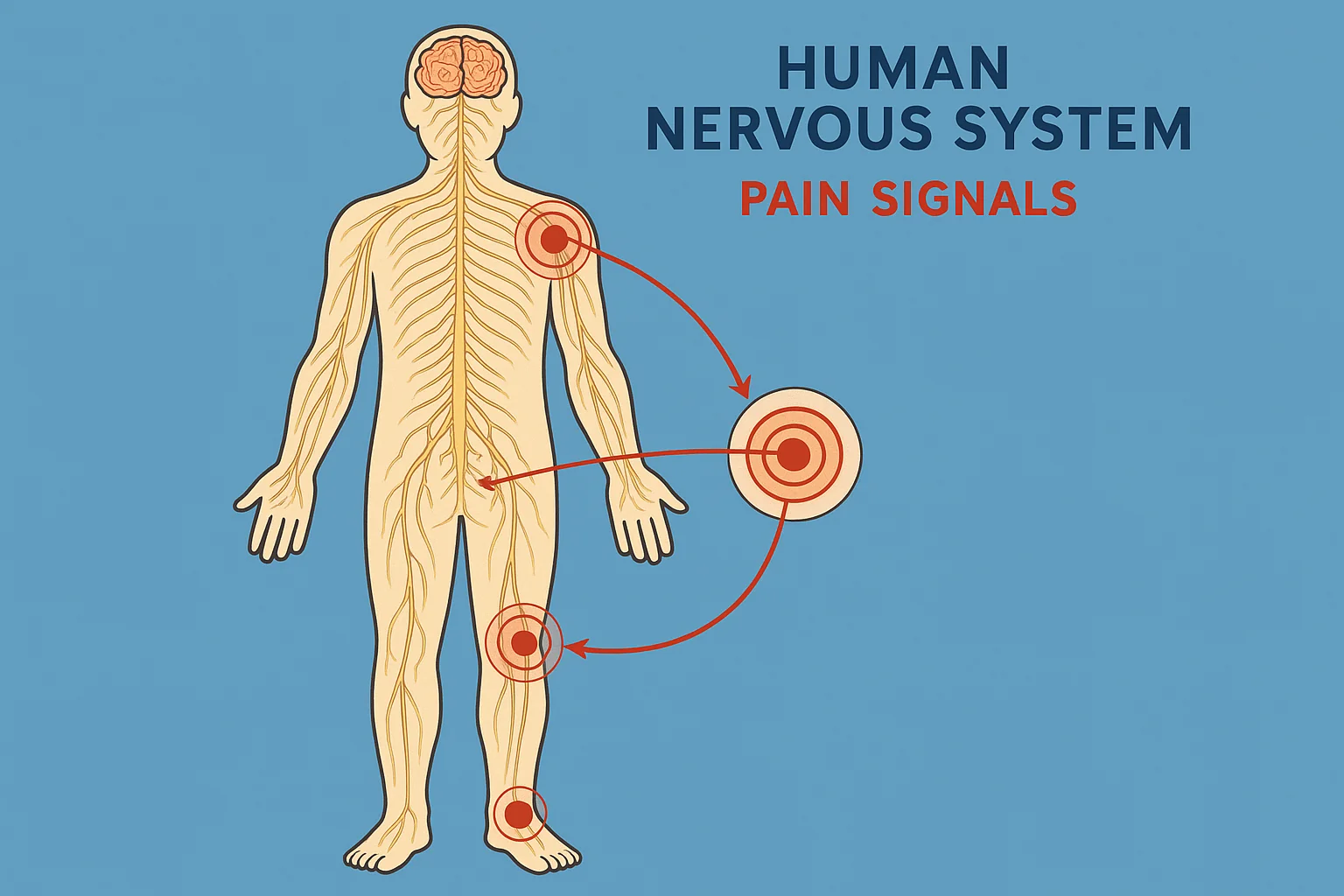
Nociceptive pain is the evolutionarily oldest form of pain perception and serves as an alarm system. Nociceptors - specialized pain receptors in the skin, muscles, joints, and internal organs - respond to mechanical, thermal, and chemical stimuli. When tissues are damaged, inflammatory mediators are released: prostaglandins, bradykinin, substance P, and pro-inflammatory cytokines. They activate nociceptors, and the pain signal travels through A-delta (fast, sharp) and C (slow, burning) fibers to the spinal cord, and from there to the cerebral cortex.
Characteristic features of nociceptive pain: it has a clear location, worsens with touch or movement at the injury site, and usually subsides as the tissue heals. Examples: pain after a fracture, sprain, surgery, pain in inflammatory joint conditions (rheumatoid arthritis, degenerative disease), pain after a burn. Classic medications - non-steroidal anti-inflammatory drugs (NSAIDs), paracetamol - work well because they directly target inflammatory mediators.
An important clinical observation: nociceptive pain in inflammatory conditions has a component that CBD can effectively act on - inhibition of COX-2 and modulation of pro-inflammatory cytokines. In contrast, post-traumatic nociceptive pain without an inflammatory component (e.g., acute pain after surgery) is more resistant to CBD than to classic analgesics.
What is neuropathic pain - damage to the system, not the tissue
Neuropathic pain arises when the nervous system itself - peripheral or central - is damaged or dysfunctional. This is a fundamental difference: in neuropathic pain, there is no active tissue injury signaling nociceptors. Instead, damaged neurons send spontaneous, abnormal pain signals. Mechanisms include: hyperexcitability of neurons, central sensitization, demyelination of nerve fibers, pathological activity of ion channels.
Characteristic features of neuropathic pain: burning, tingling, electric shock-like sensations, allodynia (pain from touch that normally does not cause pain), hyperalgesia (increased pain response to normal stimuli). Pain persists without active injury and is often chronic. Examples: diabetic neuropathy, postherpetic neuralgia, phantom pain, peripheral neuropathy after chemotherapy, multiple sclerosis with neuropathic pain.
Classic pain medications (NSAIDs, opioids) are less effective for neuropathic pain than for nociceptive pain because they do not address pathological neuronal activity. More effective are medications that stabilize neurons: gabapentin, pregabalin, duloxetine, tricyclic antidepressants.
Nociceptive pain vs neuropathic pain - a comparative table from a cannabinoid perspective
The table below compares both types of pain in terms of mechanism, typical symptoms, and cannabinoid activity in clinical and preclinical studies. This is a simplified model - actual chronic pain often has components of both types (mixed pain).
| Feature | Nociceptive pain | Neuropathic pain |
|---|---|---|
| Source | Tissue damage, inflammation | Damage or dysfunction of the nervous system |
| Nature of pain | Acute, localized, pulsating | Burning, radiating, electric, allodynia |
| Shelf life | Subsides after injury healing | Often chronic despite the absence of an active injury |
| Main CBD receptors | TRPV1, COX-2 (indirectly), TRP | CB1, CB2 (CNS and PNS), GPR55 |
| CBD mechanism | Inhibition of inflammation, blockade of TRPV1 | Neuromodulation, inhibition of glia, reduction of central sensitization |
| Clinical evidence for CBD | Limited (mainly preclinical models) | Meta-analysis of 11 RCTs: about 30% pain reduction |
| Evidence for CBD+THC | Moderate (arthritis, inflammation) | Strong (nabiximols: MS, neuropathy) |
| Response to NSAIDs | Good | Weak |
| Examples of conditions | Arthritis, postoperative pain, burns | Diabetic neuropathy, neuralgia, MS, phantom pain |
How CBD works on nociceptive pain - inflammatory mechanism
In nociceptive pain with an inflammatory component, CBD targets several points in the inflammatory cascade simultaneously. First, it inhibits the activity of the COX-2 enzyme, responsible for the production of prostaglandins - key mediators of pain and fever. Second, it activates the TRPV1 receptor (vanilloid receptor) and then desensitizes it - initially, a brief channel opening may cause discomfort, but prolonged activation leads to reduced receptor sensitivity to pain stimuli (desensitization). Third, CBD modulates the secretion of pro-inflammatory cytokines by macrophages and glial cells.
A study by Hammell and colleagues on an arthritis model showed that topical application of CBD significantly reduced inflammation and joint-related pain (European Journal of Pain, 2016). Interestingly, topical application achieved a local effect without significant systemic absorption - suggesting that for nociceptive pain, topical CBD ointments and patches may be more effective than oral oils.
In nociceptive pain without a strong inflammatory component - for example, acute post-traumatic pain - CBD shows distinctly weaker analgesic effects than in inflammatory pain. This is an important distinction: CBD is not a general analgesic like ibuprofen. It acts selectively on pains with a strong inflammatory background.
How CBD works on neuropathic pain - neuromodulation and gliosis
Neuropathic pain has a completely different cannabinoid pharmacology. CB1 receptors in the peripheral and central nervous systems and CB2 on immune and glial cells play a key role here. In neuropathic pain, there is pathological activation of microglia (brain immune cells) and astrocytes within the spinal cord and CNS - a phenomenon referred to as neuroinflammation. CBD inhibits microglial activation and reduces the secretion of pro-inflammatory cytokines in the CNS, which reduces central pain hypersensitivity (Frontiers in Pharmacology, 2018).
The CB2 receptor is particularly interesting in the context of neuropathic pain. Normally, CB2 has low expression in the CNS, but under neuroinflammatory conditions - such as neuropathic pain - its expression dramatically increases in microglia and astrocytes. CBD and other cannabinoids activate CB2, leading to a reduction in neuroinflammation without the psychoactive effects associated with CB1. Xiong and colleagues demonstrated that activation of the CB2 pathway by cannabinoids is one of the key mechanisms of neuropathic analgesia (Nature Chemical Biology, 2012).
An additional mechanism specific to neuropathic pain: CBD inhibits the reuptake of adenosine, an endogenous pain modulator. Adenosine acts as a natural analgesic through A1 and A2A receptors - an increase in its levels reduces neuronal excitability and pain conduction. This is a distinct pathway from classical cannabinoid mechanisms and explains part of CBD's activity in neuropathic pain.
Clinical evidence - what do studies on humans say
A meta-analysis by Aviram and Samuelson from 2017 summarized 11 randomized controlled trials with a total of over 1000 patients suffering from neuropathic pain. Result: cannabinoid therapy reduced neuropathic pain by about 30% on the NRS (Numeric Rating Scale) compared to placebo (Journal of Pain Research, 2017). Most studies used nabiximols (CBD+THC) or inhalation of medical cannabis, rather than isolated CBD - indicating the entourage effect as a factor enhancing efficacy.
In neuropathic pain associated with multiple sclerosis, nabiximols (Sativex) has the status of an approved drug in several dozen countries specifically for spastic and neuropathic pain. In diabetic neuropathy, several small RCTs have shown pain reduction with oral CBD, although larger phase 3 studies are still needed.
For nociceptive pain, the results are less clear-cut. A review by Whiting and colleagues published in JAMA (JAMA, 2015) showed moderate evidence of efficacy for chronic pain with an inflammatory component (arthritis, musculoskeletal pain), but insufficient evidence for acute nociceptive pain. This means that CBD is effective in chronic inflammatory pain, but not as a substitute for analgesics in acute injuries.
Mixed pain - when both mechanisms act simultaneously
In clinical practice, pure forms of nociceptive or neuropathic pain are rarer than mixed pain. For example, diabetic neuropathy has both neuropathic (nerve damage) and nociceptive (inflammatory) components. Rheumatoid arthritis combines inflammatory pain (nociceptive) with secondary central sensitization (neuropathic component).
In mixed pain, CBD may act on both components simultaneously, making it potentially beneficial in such complex conditions. However, it does not replace specialized treatment - especially in advanced neuropathy, where doctors have access to medications precisely targeting ion channels that CBD only indirectly modulates.
Practical tips: how to use CBD for chronic pain
Understanding the mechanisms is one thing - practical application is another. In chronic pain with a neuropathic or inflammatory component, several principles can increase the chances of effect with CBD. First: time. The effect of CBD on chronic pain does not appear after a single dose. Clinical studies observe participants for 2-4 weeks of regular use before assessing efficacy. In neuropathic pain, it is particularly important to maintain regular CBD levels, as the mechanism of action (inhibiting neuroinflammation, modulating microglia) requires time to reveal its effect.
Second: form. For localized pain with an inflammatory component (arthritis, muscle pain, joint pain), topical creams and preparations may work more effectively than oral oils. A study by Hammell and colleagues demonstrated local efficacy of CBD in arthritis after transdermal application (European Journal of Pain, 2016). In neuropathic pain requiring CNS modulation - oral or sublingual oils are the appropriate form.
Third: dosage and titration. The recommended starting protocol is 5-10 mg of CBD once daily, increased by 5 mg every 5-7 days. In neuropathic pain, studies use doses of 20-40 mg per day as a target. Increasing the dose too quickly makes it difficult to assess at what dose the effect actually appears. Keeping a short pain diary (NRS scale 0-10) during titration is a simple tool that allows for an objective assessment of progress and identification of the individual sweet spot.
Frequently Asked Questions
What is the difference between nociceptive and neuropathic pain?
Nociceptive pain is a warning signal in the case of actual tissue damage - it subsides after the injury heals. Neuropathic pain results from damage or dysfunction of the nervous system itself and persists chronically, characterized by a burning or electric nature. Different mechanisms require different therapeutic strategies - which is why medications effective for one type may be ineffective for the other.
Why does CBD work differently for nociceptive and neuropathic pain?
In nociceptive pain, CBD primarily works by inhibiting inflammatory mediators (COX-2, cytokines) and desensitizing TRPV1. In neuropathic pain, the key players are CB1 and CB2 receptors in the nervous system, microglial modulation, and inhibition of neuroinflammation. Xiong and colleagues demonstrated that cannabinoid receptors CB2 are particularly important in neuropathic pain (Nature Chemical Biology, 2012).
Does CBD help with neuropathic pain?
A meta-analysis of 11 RCTs indicates about a 30% reduction in neuropathic pain with cannabinoid therapy (Aviram & Samuels, Journal of Pain Research, 2017). Stronger evidence pertains to CBD+THC (nabiximols) than to CBD alone. Isolated CBD shows activity in preclinical models and small clinical studies. It does not replace neurological medications but can be a complementary element in chronic pain management.
What doses of CBD are used for pain?
Clinical studies use doses of 15-600 mg per day, but for chronic pain, effective doses in reviews are usually 20-40 mg orally. In nociceptive pain with an inflammatory component, lower doses may be effective than in neuropathic pain. Always start with 5-10 mg and gradually increase, observing the effect for at least 2 weeks.
Can cannabinoids be combined with pain medications?
CBD inhibits the CYP3A4 and CYP2D6 enzymes that metabolize many drugs - including opioids. Combining CBD with opioids may enhance their effects (opioid-sparing effect), which can be beneficial but requires medical supervision (Brunt et al., Pharmaceuticals, 2018). Before combining CBD with prescription medications - especially for chronic pain - consult your doctor.
In summary: nociceptive and neuropathic pain are two distinct biological phenomena requiring different strategies. CBD affects both, but through different mechanisms and with varying strength of evidence. The best effects are observed in chronic pain with an inflammatory (nociceptive) or neuropathic component - in both cases, systematic use for at least several weeks is key, rather than a one-time attempt. Proper understanding of the mechanism allows for a realistic approach to supplementation and avoids disappointment stemming from misplaced expectations.
This article is for informational and educational purposes and does not replace consultation with a doctor. If you are pregnant, breastfeeding, taking medications, or have chronic conditions, consult the use of supplements or herbs with a specialist.
Author: Michał Waluk · Published: 2026-05-04 · Updated: 2026-05-04