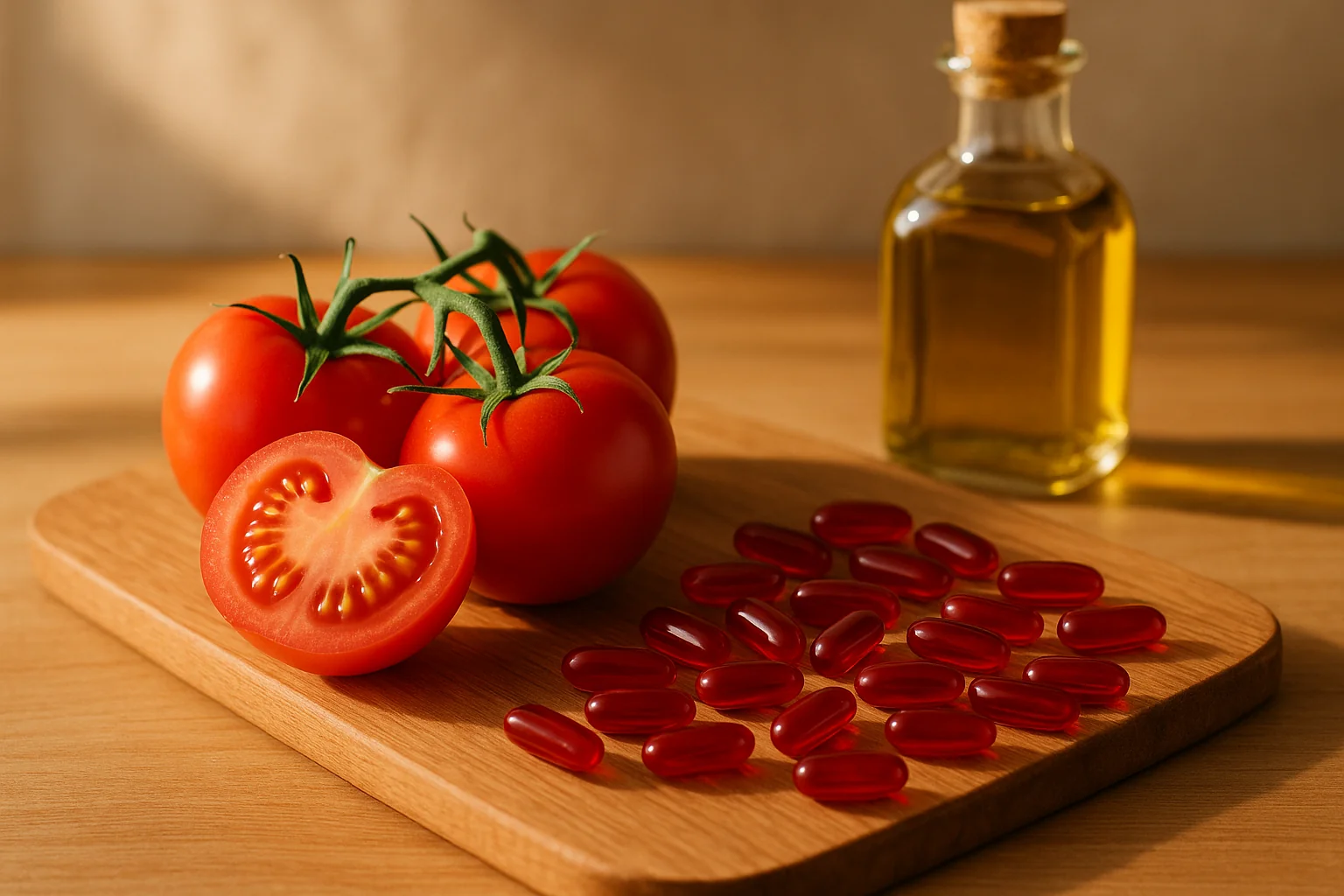

Lycopene - for prostate and heart: dosage and sources (table)
Likopen: tabela, ile, kiedy i jak. Przewodnik u Bucha.
Lycopene is a red carotenoid that gives color to tomatoes, watermelon, and grapefruit. Unlike beta-carotene, it is not a precursor of vitamin A, but it exhibits one of the strongest antioxidant potentials among carotenoids - its ability to quench singlet oxygen is twice as high as that of beta-carotene (Di Mascio et al., Archives of Biochemistry and Biophysics, 1989). Interest in lycopene increased after a large epidemiological study published in 1995 showed an inverse correlation between tomato consumption and prostate cancer risk. This article presents current data: a dosage table, an overview of dietary sources, and a discussion of what research really says about lycopene.
KEY INFORMATION
• Lycopene is best absorbed from tomato products cooked with fat - bioavailability is 2-4 times higher than from raw tomatoes.
• Clinical studies on prostate used 15-30 mg of lycopene daily for 3-6 months.
• A meta-analysis of 26 observational studies links high lycopene intake with an 11% lower risk of prostate cancer - however, evidence from RCTs is mixed.
• Lycopene has documented cardioprotective effects: it inhibits LDL oxidation and lowers blood pressure in clinical studies.
• Doses above 75 mg daily may cause lycopenodermia - orange skin discoloration (reversible).
How is lycopene absorbed and why are cooked tomatoes better than raw ones?
Lycopene is a lipophilic carotenoid - it dissolves in fats, not in water. In nature, most lycopene in tomatoes exists in the trans form, which is less bioavailable than the cis form. Heat treatment causes isomerization of trans-lycopene to cis-isomers, which are better absorbed by the intestine. At the same time, cooking breaks down cell walls and chromoplasts, releasing lycopene from the cellular matrix and making it more available to digestive enzymes.
A pharmacokinetic study showed that the bioavailability of lycopene from tomato juice cooked with oil was 2.5 times higher than from raw tomato juice (Gartner et al., American Journal of Clinical Nutrition, 1997). Tomato concentrate and passata contain more lycopene per 100 g and in a more absorbable form than fresh tomatoes. This paradox surprises many: in terms of lycopene, a serving of pasta sauce is more valuable than a salad of tomatoes.
For those preferring supplementation: lycopene in capsules suspended in vegetable oil has bioavailability comparable to tomato products. Supplements containing lycopene in the "beadlet" form (microcapsules) without oil are significantly less absorbable - choose products with a carrier fat or take them with a meal containing fat.
Table of lycopene sources and content in food
Before deciding on a supplement, it is worth assessing how much lycopene you are getting from your diet. The table below shows the lycopene content in the most important dietary sources.
| Product | Lycopene content (mg/100 g) | Typical serving | Lycopene from serving (mg) | Bioavailability |
|---|---|---|---|---|
| Tomato concentrate (30%) | 29-42 | 2 tablespoons (30 g) | 9-13 | High (processed) |
| Tomato passata | 14-17 | 150 ml | 21-26 | High |
| Tomato sauce (cooked) | 10-15 | 200 g | 20-30 | Very high (with oil) |
| Raw tomatoes | 2-4 | 1 tomato (120 g) | 2-5 | Niska |
| Watermelon | 4-7 | 200 g | 8-14 | Moderate |
| Pink grapefruit | 0,5-2 | 100 g | 0,5-2 | Moderate |
| Supplement (oil capsule) | According to the label | 1 capsule | 10-30 | High (with oil) |
Lycopene and prostate - what do we really know?
The history of interest in lycopene and the prostate began with a study published in Journal of the National Cancer Institute In 1995 - the prospective analysis of the Health Professionals Follow-Up Study showed that men consuming tomatoes or tomato sauce 2 or more times a week had a 21-34% lower risk of prostate cancer (Giovannucci et al., JNCI, 1995). These are epidemiological results, not clinical - correlation, not causation.
Subsequent meta-analyses of observational studies confirmed this trend. A review of 26 studies published in Cancer Epidemiology, Biomarkers & Prevention showed that high lycopene intake is associated with an 11% lower risk of prostate cancer (RR 0.89, 95% CI 0.80-0.98) (Chen et al., 2013). However, randomized clinical trials yielded mixed results - some showed a reduction in PSA and slowed tumor growth, while others did not show significant effects. This means that lycopene as primary prevention for prostate cancer is a promising hypothesis, but not a proven clinical fact.
Results regarding benign prostatic hyperplasia (BPH) are more consistent. Several clinical studies have shown that 15 mg of lycopene daily for 6 months slowed the progression of BPH and reduced PSA in men with early-stage gland enlargement.
Lycopene and the cardiovascular system
Clinical studies on the cardioprotective effects of lycopene are more robust than those on prostate. A randomized placebo-controlled study showed that 15 mg of lycopene daily for 8 weeks reduced oxidized LDL levels by 13% - a key factor in the pathogenesis of atherosclerosis (Agarwal and Rao, Journal of the American College of Nutrition, 1998). A study from British Journal of Nutrition also showed that 7 mg of lycopene daily for 1 year lowered systolic blood pressure by 9 mmHg in patients with hypertension.
Lycopene acts cardioprotectively on several levels: it inhibits LDL oxidation (a key step in plaque formation), reduces the expression of adhesion molecules in the vascular endothelium (reducing inflammation in the vessels), and may inhibit cholesterol synthesis by modulating the enzyme HMG-CoA reductase - a mechanism similar to statins, but expressed much weaker.
Frequently Asked Questions
How much lycopene should I take daily?
Clinical studies used 15-30 mg daily for 3-6 months as a therapeutic dose. For prevention, 10-15 mg is sufficient. A typical Mediterranean diet provides 5-7 mg daily - supplementation allows to reach levels studied clinically. Do not exceed 75 mg daily - above this dose, with prolonged use, lycopenodermia (orange skin discoloration) may occur.
Where is the best source of lycopene - from tomatoes or supplements?
Both sources are valuable. Processed tomato products cooked with fat (sauce, passata, concentrate) have 2-4 times higher bioavailability than raw tomatoes. A lycopene supplement suspended in oil has comparable bioavailability to tomato sauce. A diet rich in tomato products is optimal - a supplement is useful with irregular eating habits.
Does lycopene protect against prostate cancer?
Epidemiological data suggest an 11% lower risk with high lycopene intake. However, randomized clinical trials have not yielded consistent results - lycopene is not a proven preventive agent against prostate cancer. As part of a Mediterranean diet and support for prostate health (BPH) - yes, but not as a standalone oncological prevention.
Is lycopene safe?
Yes - a very good safety profile. The only side effect at very high doses (above 75 mg/day) is lycopenodermia - orange skin discoloration, completely reversible. No organ toxicity and known interactions with medications. Safe from food without restrictions.
When is the best time to take a lycopene supplement?
With a meal containing fats - the bioavailability of lycopene without fat is several times lower. The time of day is not significantly important. Most conveniently with lunch or dinner. On an empty stomach - definitely avoid.
Lycopene and skin - protection against UV radiation
Less known, but well-documented property of lycopene is skin photoprotection. The carotenoid accumulates in the skin and absorbs UVA and UVB radiation, reducing oxidative damage to DNA and skin proteins caused by the sun. A randomized clinical trial showed that consuming 40 g of tomato concentrate (containing about 16 mg of lycopene) daily for 10 weeks reduced skin redness after UV exposure by 40% compared to the control group (Stahl et al., Journal of Nutrition, 2001).
Lycopene does not replace sunscreen - protection is internal and complementary, not external. However, for those spending a lot of time in the sun, regular users of tanning beds, or individuals with fair skin prone to photo-damage, a diet rich in processed tomato products or lycopene supplementation can provide a valuable layer of additional protection. The mechanism is multi-level: absorption of radiation, scavenging of singlet oxygen and reactive nitrogen species generated by UV, as well as modulation of the expression of DNA repair enzyme genes.
Likopen i inne karotenoidy - czy synergizm ma znaczenie?
Carotenoids in nature never occur in isolation. Tomatoes contain not only lycopene but also beta-carotene, phytoene, phytofluene, and lutein. Studies suggest that the natural mixture of carotenoids from food may act synergistically - each carotenoid absorbs radiation in slightly different spectra and neutralizes different reactive oxygen species. Supplements containing isolated lycopene are cheaper and standardized, but may lose some of the synergy typical of whole foods.
An important interaction: lycopene and beta-carotene compete for the same absorption transporters in the intestine. Very high supplementation of beta-carotene may reduce the absorption of lycopene and vice versa. In practice, this means it is better to obtain carotenoids from food (where their proportions are natural) or choose supplements containing a mixture of carotenoids rather than megadoses of one.
Resveratrol and lycopene are a popular combination in cardioprotective supplementation - resveratrol mainly affects platelet aggregation and SIRT1 activation, while lycopene targets LDL oxidation and the endothelium. There are no known negative interactions; both should be taken with a fatty meal for optimal bioavailability.
Lycopene and bone health and osteoporosis
A lesser-known area of research on lycopene is its impact on bone metabolism. Oxidative stress is one of the factors that intensify osteoclast activity - the cells responsible for the resorption (breakdown) of bone tissue. Lycopene, as a strong antioxidant, may reduce this oxidative stress in bone tissue, potentially slowing down bone mass loss.
An observational study conducted on a group of 1027 postmenopausal women showed that low serum lycopene levels correlated with higher markers of bone resorption (N-telopeptides, alkaline phosphatase) independent of other risk factors (Rao et al., Experimental Biology and Medicine, 2003). A randomized clinical trial with supplementation of 30 mg of lycopene daily for 4 months in postmenopausal women showed a significant reduction in markers of oxidative stress and a trend towards lowering markers of bone resorption, although the results did not reach statistical significance. Research in this area is preliminary - lycopene is not an established treatment for osteoporosis - but for postmenopausal women at risk of osteoporosis, a high intake of lycopene from the diet is a rational element of multifactorial prevention.
Practical guide: how to maximize lycopene intake from diet
The most effective strategy for increasing lycopene intake is not supplementation, but a daily diet rich in processed tomato products. Here are some practical data: 200 g of tomato sauce (ready-made pasta sauce) provides about 20-30 mg of lycopene - that’s a full daily supplemental dose. Two tablespoons of tomato paste (30 g) provide about 15-18 mg of lycopene. A glass of tomato juice (200 ml) - about 20 mg of lycopene. One large fresh tomato - only 3-5 mg, but cooking it with oil increases bioavailability several times.
Key principles for maximizing the bioavailability of lycopene from food: (1) always cook or heat tomato products - the isomerization of trans-lycopene to cis form increases bioavailability; (2) always add fat - olive oil, canola oil, or avocado increase lycopene absorption 2-4 times; (3) prefer processed forms (sauce, passata, concentrate, ketchup) over fresh tomatoes for supplementation purposes; (4) watermelons and pink grapefruits are alternative sources of lycopene for those who do not like tomatoes. Lycopene supplements make sense for individuals with irregular eating habits or specific health indications (high PSA, cardiovascular disease) - choose a capsule preparation with oil, not in dry powder, for optimal bioavailability.
This article is for informational and educational purposes and does not replace consultation with a doctor. If you are pregnant, breastfeeding, taking medications, or have chronic conditions, consult the use of supplements or herbs with a specialist.
Author: Michał Waluk · Published: 2026-05-04 · Updated: 2026-05-04