
CBD and hypertension and the heart: what do studies say and is it safe?
One study in humans, nine volunteers, and 600 mg of CBD. What was actually measured, which medications interact, and what is still unknown.
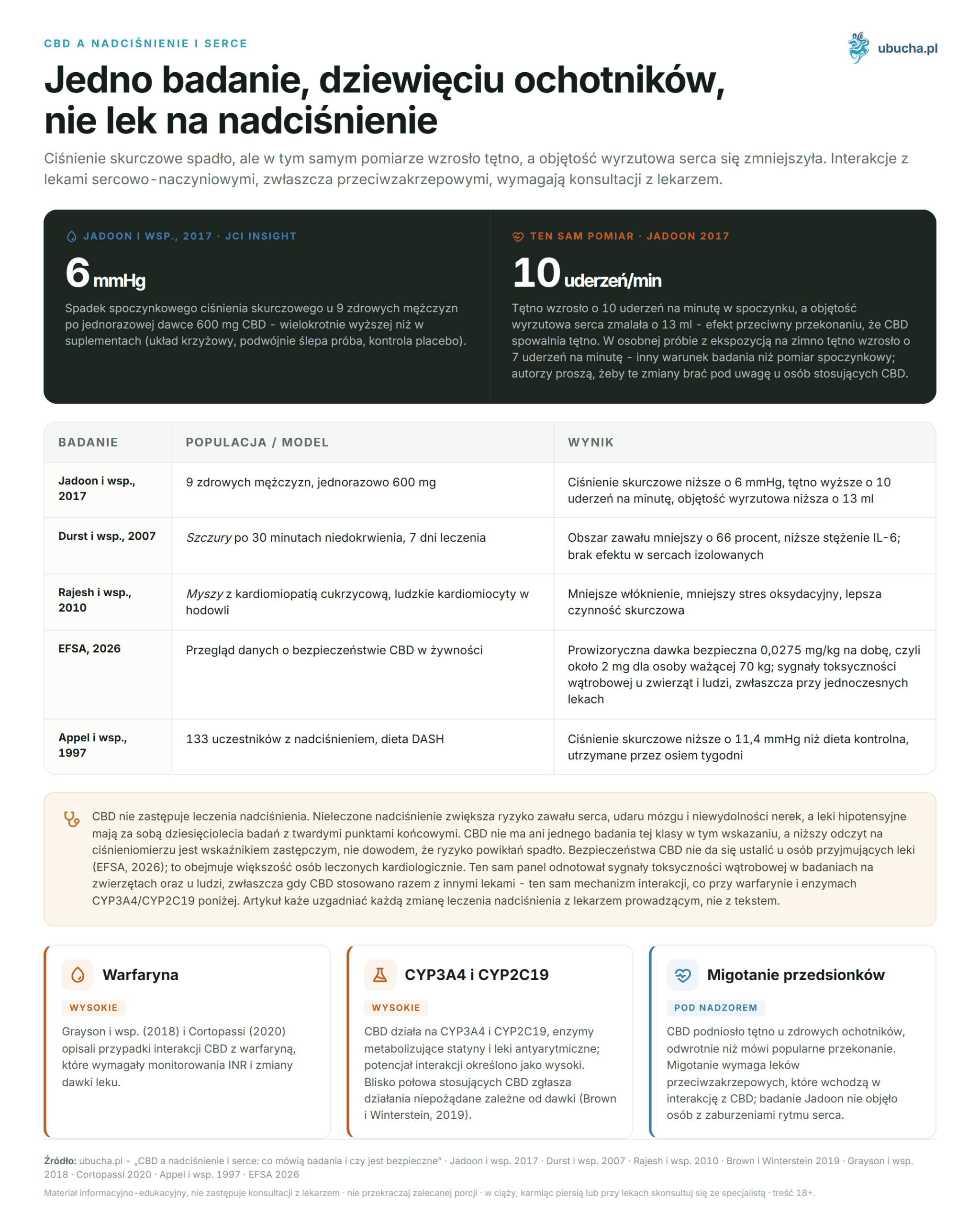
CBD is sometimes described as a natural way to lower blood pressure. The basis for this opinion is narrower than it seems: the study by Jadoon et al. from 2017 involved nine healthy men who received either 600 mg of CBD or a placebo in a crossover design with a double-blind trial. Systolic blood pressure dropped, but in the same measurement, heart rate increased, and stroke volume decreased (Jadoon et al., JCI Insight, 2017). This latter part of the result disappears from most summaries and concerns exactly those readers who are looking for answers here: individuals with diagnosed heart disease and a list of medications they take. Below we show what exactly was measured in this one human trial, what results come from animal studies, which cardiovascular drugs interact with CBD, and where the limits of what can be said honestly today lie.
KEY INFORMATION
• In nine healthy men, 600 mg of CBD lowered resting systolic blood pressure by 6 mmHg and simultaneously raised heart rate by 10 beats per minute (Jadoon et al., JCI Insight, 2017).
• Nearly half of those using CBD experience dose-dependent adverse effects (Brown and Winterstein, 2019).
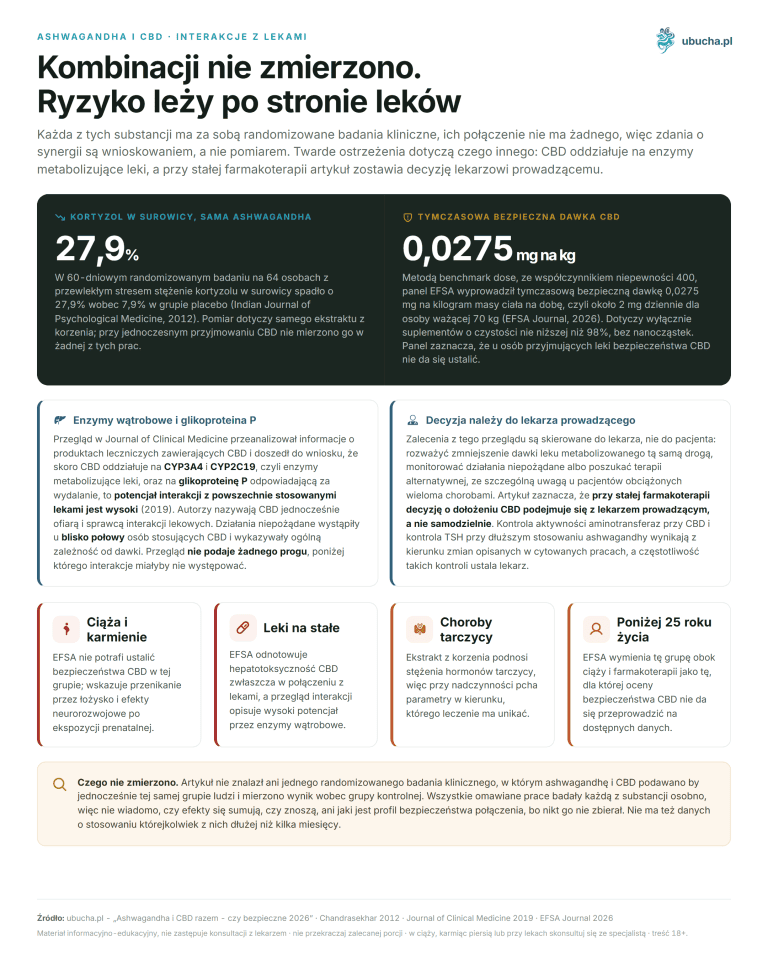
• EFSA states that the safety of CBD cannot be established in individuals taking medications.
• Cases of CBD interactions with warfarin have been described, requiring INR monitoring.
What did the study by Jadoon et al. from 2017 really show?
That a single dose of CBD lowers blood pressure and raises heart rate. Nine healthy men received a single dose of 600 mg of CBD or placebo in a crossover design with a double-blind trial. Resting systolic blood pressure dropped by 6 mmHg, heart rate increased by 10 beats per minute, and stroke volume decreased by 13 ml.
The full set of results is richer than most summaries indicate. After CBD, blood pressure was lower by 5 mmHg, especially before and after stress; stroke volume decreased while maintaining minute output; skin flow in the forearm reacted less to isometric effort. In the cold exposure trial, blood pressure was lower by 6 mmHg, heart rate higher by 7 beats per minute, and total peripheral resistance lower (Jadoon et al., JCI Insight, 2017).
The authors' conclusion is also more cautious than it is often quoted. They write that a single dose of CBD lowers resting blood pressure and the increase in blood pressure in response to stress, and that this is accompanied by an increase in heart rate. They add two sentences that are often omitted in popular descriptions: such hemodynamic changes must be considered in individuals using CBD, and the role of CBD in treating cardiovascular diseases requires further research.
The limitations are significant. Nine individuals, all healthy men, one dose, one day of observation, and a dose many times higher than those found in supplements. We do not know what happens with long-term use or in individuals who actually have hypertension. The statement 'CBD treats hypertension' has no basis in this study.
How does CBD affect blood vessels and the heart in studies?
In humans, a decrease in total peripheral resistance was measured, which is consistent with vasodilation, along with a simultaneous increase in heart rate. The rest of the picture comes from animal studies, where CBD limited myocardial damage. Translating these results to humans remains a hypothesis.
Durst and colleagues ligated the anterior interventricular branch in rats for 30 minutes, and then administered CBD at a dose of 5 mg/kg intraperitoneally or a carrier for seven days. The area of infarction decreased by 66 percent with an almost identical area at risk, and the concentration of IL-6 dropped from 2812 to 254 pg/ml. In isolated hearts, there was no difference, so the authors describe the effect as occurring exclusively in a living organism (Durst i wsp., American Journal of Physiology, 2007).
Rajesh and colleagues examined a mouse model of type 1 diabetic cardiomyopathy and primary human cardiomyocytes in high glucose concentration. CBD alleviated cardiac dysfunction, fibrosis, oxidative and nitrosative stress, and cell death; in cardiomyocytes, it reduced the production of reactive oxygen species and the activation of NF-kB (Rajesh i wsp., Journal of the American College of Cardiology, 2010). This is an animal model and cell culture, not a clinical study.
| Work | Who or what was studied | Outcome |
|---|---|---|
| Jadoon i wsp., 2017 | 9 healthy men, a single dose of 600 mg | Systolic blood pressure lower by 6 mmHg, heart rate higher by 10 beats per minute, stroke volume lower by 13 ml |
| Durst i wsp., 2007 | Szczury po 30 minutach niedokrwienia, 7 dni leczenia | Area of infarction smaller by 66 percent, lower IL-6 concentration; no effect in isolated hearts |
| Rajesh i wsp., 2010 | Mice with diabetic cardiomyopathy, human cardiomyocytes in culture | Less fibrosis, lower oxidative stress, better contractile function |
| EFSA, 2026 | Review of CBD safety data in food | Provisional safe dose 0.0275 mg/kg per day, or about 2 mg for a person weighing 70 kg |
Which cardiovascular drugs interact with CBD?
Primarily those metabolized by cytochrome P450. Brown and Winterstein reviewed the characteristics of registered CBD products and describe them as substances acting on targets relevant to drug metabolism, including CYP3A4 and CYP2C19, as well as for their excretion, including P-glycoprotein. They define the potential for interactions with commonly used drugs as high.
The same review provides a number that rarely appears in marketing materials: adverse effects occurred in nearly half of the individuals using CBD and were dose-dependent. The most common included increased aminotransferase activity, drowsiness, sleep disturbances, infections, and anemia. The authors recommend considering reducing the doses of substrate drugs, monitoring adverse effects, or changing therapy, especially in patients with multiple diseases at once (Brown i Winterstein, Journal of Clinical Medicine, 2019).
Statins such as atorvastatin or simvastatin are substrates of CYP3A4, so they belong to the group directly affected by this mechanism. The same applies to some antiarrhythmic drugs. We did not find a study that measured the strength of such an interaction in humans at doses found in supplements, so we do not set any safe dose limit here.
The best-documented case is warfarin. Grayson and colleagues described a case of warfarin interaction with CBD and recommended monitoring INR when introducing cannabinoids (Grayson i wsp., Epilepsy and Behavior Case Reports, 2018). A second description, Cortopassi from 2020, concerns the need to change the dose of warfarin after starting and increasing the dose of CBD (Cortopassi, American Journal of Health-System Pharmacy, 2020). These are individual cases, not a population study, but the direction is the same.
Is CBD safe in arrhythmia and atrial fibrillation?
It is unknown, and two reasons suggest caution. The first is the increase in heart rate measured in healthy volunteers after CBD. The second is the fact that atrial fibrillation itself is an indication for anticoagulant treatment, which is a therapy that has been described to interact with CBD.
The study by Jadoon and colleagues did not include individuals with rhythm disorders, so it says nothing about how the heart will behave when already arrhythmic. However, it states that in healthy men, CBD raised the heart rate by 10 beats per minute at rest and by 7 during cold exposure, and the authors explicitly ask to consider these hemodynamic changes in individuals using CBD. The frequent claim that CBD slows the heart rate is a reversal of what was measured in this study.
Antiarrhythmic drugs have a narrow therapeutic window, and some of them are substrates of CYP3A4, which is the enzyme that CBD affects (SSRIs, SNRIs, and other psychotropic medications). There is no protocol that would allow combining them with CBD without the supervision of a cardiologist, as there is no study on which such a protocol could be based. More about drug interactions is discussed in the text about CBD oil for seniors.
How much can blood pressure be lowered just by changing lifestyle?
More than was found in the CBD study. In the first DASH trial, 459 adults participated. Among the 133 participants with hypertension, a diet combining vegetables, fruits, and low-fat dairy reduced systolic blood pressure by 11.4 mmHg more than the control diet.
The details are worth mentioning because they show the scale of comparison. Participants were fed a control diet for three weeks, and then randomly assigned to one of three diets for eight weeks. The diet under investigation was rich in vegetables and fruits and low-fat dairy products, with restrictions on saturated and total fats; sodium intake and body weight were kept constant, so the effect did not result from salt reduction or weight loss. In individuals without hypertension, the decrease was smaller, by 3.5 mmHg, and diastolic pressure decreased by 5.5 and 2.1 mmHg respectively (Appel i wsp., New England Journal of Medicine, 1997).
The comparison of these two numbers clarifies the proportions. A single dose of 600 mg of CBD resulted in a 6 mmHg decrease in healthy volunteers, while the diet in individuals with hypertension resulted in an 11.4 mmHg decrease maintained over eight weeks. This is not an argument against CBD, but a reminder of where stronger evidence lies. We noticed that in texts about CBD and blood pressure, comparisons with diet are rare, even though it best illustrates the order of magnitude.
What is known about the long-term use of CBD in heart diseases?
Not much, and that is an honest answer. There are no long-term studies with random assignment in people with hypertension or after a heart attack. The only human study cited in this article lasted one day and involved nine healthy individuals.
The safety assessment comes from a different angle. The EFSA panel reviewed data on CBD as a novel food and derived a provisional safe dose: 0.0275 mg per kilogram of body weight per day, which is about 2 mg for a person weighing 70 kg. This value applies only to supplements with at least 98 percent purity of CBD, without nanoparticles. The panel also noted signals of liver toxicity in animal studies and in humans, especially when CBD was used together with other medications (EFSA, EFSA Journal, 2026).
The statement that should accompany every number in this article is this: the safety of CBD cannot be established in individuals under 25 years of age, in pregnant and breastfeeding women, and in those taking medications. The latter includes most people undergoing cardiological treatment. This is not a prohibition, but a statement that data is lacking.
Can CBD replace antihypertensive medications?
No. Untreated hypertension increases the risk of heart attack, stroke, and kidney failure, and antihypertensive medications have decades of research with hard endpoints behind them. CBD has not a single study of this caliber in this indication.
The evidence for CBD consists of one one-day trial in nine healthy men and a set of animal studies. The evidence for medications consists of large, long-term clinical trials with hard endpoints. What matters here is not the size of the effect on a single blood pressure measurement, but whether anyone has checked what happens to the risk of heart attack and stroke over the following years. With CBD, no one has checked this, and a lower number on the blood pressure monitor is a surrogate marker, not proof that the risk of complications has decreased. The difference between the two determines what can be written.
If you are thinking about CBD in the context of managing stress rather than treating blood pressure, that is a different question and a different answer. We describe a practical approach to workplace stress separately: CBD for work stress. Any changes to the hypertension treatment plan should be discussed with your attending physician, not with an article.
For whom does CBD make sense in cases of heart problems, and for whom does it not?
There is the least sense where the risk of interactions is the highest. Individuals taking anticoagulants, antiarrhythmics, or statins have a documented mechanism through which CBD may alter the concentration of their medication, and there is no study measuring this effect in patients.
Healthy individuals without cardiovascular pharmacotherapy are in the opposite situation: the risk of interactions is low, but the benefit is also unproven, as the only human study involved a single dose and one day. Therefore, a cautious conclusion is as follows: CBD is neither a medication nor an obvious threat here, but a substance that has been studied too weakly to predict anything.
From our observations, the question usually asked in the store is "how much to take for hypertension." The unavoidable answer is: there is no such dose because there is no study that has determined it. A more practical approach is to talk to your attending physician, who knows your list of medications. If you are already using CBD, mention it at your next visit, even if the dose seems symbolic to you, because it is not the dose that determines whether the question of interaction makes sense.
Frequently Asked Questions
Does CBD lower blood pressure?
In one study in humans, yes. Nine healthy men after a single 600 mg dose of CBD had resting systolic blood pressure lower by 6 mmHg, and under stress lower by 5 mmHg (Jadoon et al., JCI Insight, 2017). There is no data on long-term use or on individuals with hypertension.
Does CBD affect heart rate?
Yes, and in the opposite direction than popular belief suggests. In the study by Jadoon et al., heart rate after CBD increased by 10 beats per minute at rest and by 7 during cold exposure, and the differences were statistically significant. The authors ask that these changes be taken into account for individuals using CBD.
Can CBD be taken with blood pressure medications?
Not without consultation. CBD acts on targets significant for drug metabolism, including CYP3A4 and CYP2C19 and P-glycoprotein, and the potential for interactions with commonly used medications is considered high (SSRIs, SNRIs, and other psychotropic medications). Make the decision with a cardiologist or internist.
How much CBD should be taken for hypertension?
There is no such dose. There is no clinical study that would determine the dosing of CBD in hypertension. The EFSA panel, however, provides a ceiling for supplements: the provisional safe dose is 0.0275 mg per kilogram of body weight per day, which is about 2 mg for a person weighing 70 kg (EFSA, 2026).
Is CBD safe for heart diseases?
The safety of CBD cannot be established in individuals taking medications, and this is almost always the case in cardiology (EFSA, 2026). Cases requiring dose adjustment and monitoring of INR have been described with warfarin. A cardiology consultation before using CBD is a requirement, not a formality.
This article is for informational and educational purposes only and does not constitute medical advice. Before starting to use hemp or CBD for therapeutic purposes, consult your doctor, especially if you are taking other medications, are pregnant, or breastfeeding.
Author: Michał Waluk · Opublikowano: 2026-05-22 · Aktualizacja: 2026-08-15