
The endocannabinoid system in the menstrual cycle - why anandamide rises to ovulation
The endocannabinoid system in the menstrual cycle — a mechanism explained simply, based on research. u Bucha.
The endocannabinoid system is not static - in women, its activity rhythmically changes with the menstrual cycle. Anandamide levels peak just before ovulation, and studies have shown that this is not a coincidence: anandamide directly modulates the release of luteinizing hormone (LH) and influences the release of the egg (Rapino et al., PNAS, 2008). Understanding these connections explains why estrogen, CBD, and the menstrual cycle are more deeply intertwined than one might think.
KEY INFORMATION
• Anandamide (AEA) peaks just before ovulation and influences the release of LH - a key signal triggering ovulation.
• Estrogen inhibits the FAAH enzyme that breaks down anandamide - the higher the estrogen, the slower the degradation of AEA and the higher its level.
• The luteal phase (after ovulation) is characterized by low anandamide and increased pain during menstruation - a biological connection, not a coincidence.
• CBD inhibits FAAH and may raise anandamide levels, especially in phases when it is low.
• Women planning a pregnancy should exercise caution with cannabinoids - the ECS regulates embryo implantation.
What is the endocannabinoid system and how does it work in women?
The endocannabinoid system (ECS) is a network of receptors, endogenous ligands, and metabolizing enzymes present in virtually every tissue in the body. Key components include: CB1 receptors (mainly in the CNS) and CB2 (mainly in immune and peripheral tissue), endogenous ligands - anandamide (AEA) and 2-arachidonoylglycerol (2-AG) - and synthesis and degradation enzymes: NAPE-PLD (synthesis of AEA), FAAH (degradation of AEA), DAGL (synthesis of 2-AG), and MAGL (degradation of 2-AG).
In women, the ECS is particularly active in reproductive system tissues. CB1 and CB2 receptors are present in the ovaries, uterus, fallopian tubes, endometrium, and placenta. This is not a peripheral, insignificant distribution - the ECS in these tissues regulates ovulation, egg transport, embryo implantation, and early stages of pregnancy (Paria et al., PNAS, 2001). Therefore, the ECS is an integral component of women's reproductive biology, not an external pharmacological system.
Interestingly, the endocannabinoid system and the hormonal system regulate each other - not only do hormones affect the ECS, but the ECS also modifies hormone action. This feedback makes the ECS an active participant in the cycle, rather than a passive receiver of hormonal signals.
How anandamide changes throughout the menstrual cycle - phase by phase
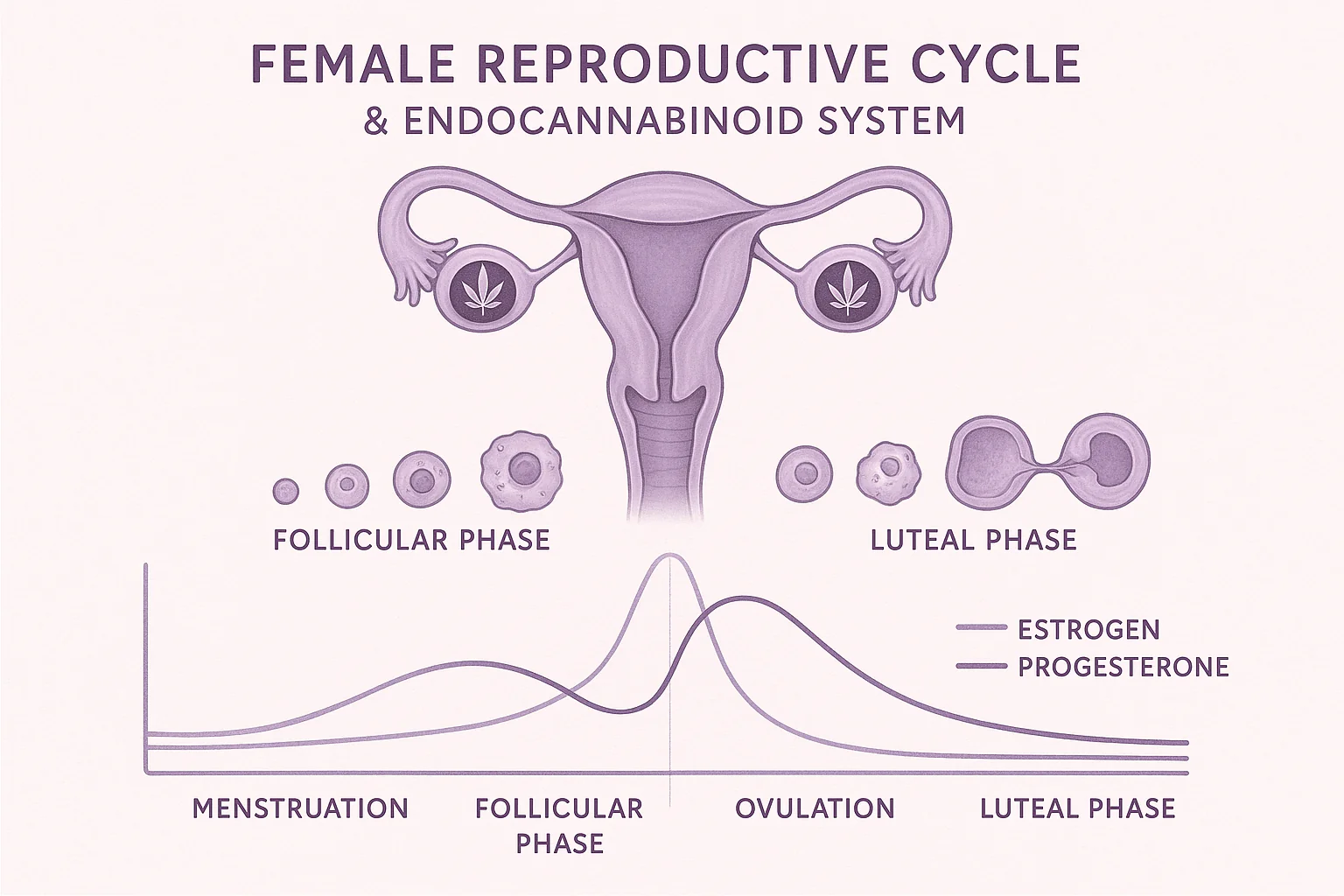
The menstrual cycle in women typically lasts 28 days and is divided into four phases: menstruation (days 1-5), follicular phase (days 6-13), ovulation (around day 14), and luteal phase (days 15-28). Anandamide levels and ECS activity differ significantly between these phases, which has specific physiological and subjective consequences.
In the follicular phase, the level of estrogen secreted by developing ovarian follicles increases. Estradiol directly inhibits the activity of the FAAH enzyme - as a result, anandamide degrades more slowly and its concentration rises. The study by Bradshaw and colleagues showed a clear inverse correlation between estradiol levels and FAAH activity in reproductive tissues of female rodents (Journal of Pharmacology and Experimental Therapeutics, 2006). Data in humans is limited but consistent with this mechanism.
The peak of anandamide occurs in the periovulatory phase (just before ovulation). Rapino and colleagues demonstrated that anandamide modulates the release of LH from the pituitary gland - the signal triggering ovulation (PNAS, 2008). The mechanism involves the activation of CB1 receptors in the hypothalamus, which modify the pulsatile release of GnRH (gonadotropin-releasing hormone) stimulating LH. Thus, anandamide is not only a marker of the phase - it is an active regulator of the timing of ovulation.
Table: ECS and the phases of the menstrual cycle
The table below summarizes key ECS parameters and their changes during the different phases of the cycle. The data is based on the review by Rapino et al. (2008), Bradshaw et al. (2006), and studies by Mazur and colleagues on ECS in gynecology.
| Cycle phase | Dominant hormone | FAAH activity | Anandamide level | ECS implications |
|---|---|---|---|---|
| Menstruacja (dni 1-5) | Low E2 and P4 | High | Niski | Reduced pain modulation by ECS; pro-inflammatory prostaglandins dominate |
| Folikularna (dni 6-13) | Increasing estradiol (E2) | Decreasing | Increasing | ECS gradually more active; improved mood, libido |
| Ovulation (around day 14) | Peak E2, surge LH | Niska | Peak | Anandamide modulates LH surge; supports egg release |
| Lutealna (dni 15-28) | Progesterone (P4) dominates | High (P4 activates FAAH) | Low, decreasing | Reduced anti-nociceptive effect of ECS; PMS, premenstrual pain |
Progesterone, FAAH, and the luteal phase - why PMS has a biological basis in the ECS
The luteal phase after ovulation is characterized by the dominance of progesterone secreted by the corpus luteum. Progesterone, unlike estradiol, does not inhibit FAAH - and according to some studies, it may activate it. The result: anandamide degrades faster, its level drops, and endocannabinoid modulation of pain and mood weakens. This coincides with the rising levels of F2α prostaglandins in the endometrium - mediators of pain and menstrual cramps.
This biological mechanism explains why many women experience increased sensitivity to pain, irritability, and mood changes in the week before menstruation - it is not just subjective sensitivity, but an objective change in ECS activity. Lower anandamide in the luteal phase means less endogenous pain modulation and weaker antinociceptive effects of the ECS just when pro-inflammatory prostaglandin levels are rising (Frontiers in Endocrinology, 2018).
CBD, by inhibiting the FAAH enzyme, may raise anandamide levels particularly in phases when it is low - that is, in the luteal phase and during menstruation. This is a pharmacological hypothesis explaining the popularity of hemp oils among women seeking support for menstrual pain. Direct large RCTs assessing CBD and menstrual pain in humans are still needed, but the biological mechanism is consistent.
ECS and fertility - caution when planning a pregnancy
Studies in animal models have shown that dysregulation of the ECS disrupts embryo implantation. Paria and colleagues demonstrated that CB1 receptors in the uterus regulate the implantation window - a narrow time frame during which the embryo can implant (PNAS, 2001). Both too low and too high CB1 activity in this window impairs implantation. Exogenous cannabinoids - including CBD - may disrupt this precise endocannabinoid signaling.
Clinical data on CBD and fertility in humans is limited, but health regulators - including WHO and EMA - recommend avoiding CBD during pregnancy and while planning a pregnancy due to the lack of safety studies in this context. The biological mechanism (CBD affects the system regulating implantation) justifies this caution, even if direct evidence of harm in humans is not available.
Endometriosis and the endocannabinoid system - current research
Endometriosis - a chronic condition characterized by the presence of endometrial tissue outside the uterus - is particularly interesting in the context of ECS. Studies have shown that women with endometriosis have altered expression of CB1 and CB2 receptors in endometrial lesions compared to healthy endometrium. Reduced CB1 expression in endometriotic tissue may contribute to increased pain sensitivity - as CB1 normally plays an antinociceptive role in this tissue (Frontiers in Endocrinology, 2018).
Additionally, women with endometriosis exhibit higher levels of the FAAH enzyme in serum - which means faster degradation of anandamide and lower systemic concentrations. This mechanism may explain why pain in endometriosis is so difficult to control and why cannabinoids are garnering interest as a potential complementary treatment tool. Clinical studies on CBD and endometriosis are still preliminary, but the biological mechanism is well established. Women with endometriosis considering CBD supplementation should consult a gynecologist, especially if they are undergoing hormonal treatment or planning a pregnancy.
Frequently Asked Questions
How does anandamide level change during the menstrual cycle?
Anandamide increases during the follicular phase (estrogen inhibits FAAH), peaks just before ovulation, and then decreases during the luteal phase (progesterone activates FAAH). The peak level of periovulatory anandamide modulates LH release and contributes to the release of the egg (Rapino et al., PNAS, 2008). This is one of the best-documented examples of the coupling between ECS and the reproductive system.
Why does estrogen raise anandamide levels?
Estradiol directly inhibits the FAAH enzyme responsible for the degradation of anandamide. The higher the level of estradiol (peak in the follicular phase), the slower the degradation of anandamide - and the higher its level. Bradshaw and colleagues demonstrated an inverse correlation between estradiol and FAAH in reproductive tissues (J Pharmacol Exp Ther, 2006). This is the biochemical link between sex hormones and the endocannabinoid system.
How does CBD affect the menstrual cycle?
CBD inhibits FAAH - the same enzyme that breaks down anandamide. Therefore, it may raise the level of endogenous anandamide, especially in phases with low AEA (luteal, menstruation). It may alleviate menstrual pain by modulating CB1/CB2 in the uterus and reducing inflammation. Direct large RCTs on CBD and menstrual pain in humans have not yet been conducted - the biological mechanism is consistent, but clinical confirmation is still needed.
Does ECS affect fertility?
Yes - CB1 receptors in the uterus regulate the implantation window. Disruptions in endocannabinoid signaling are associated with difficulties in implantation and early pregnancy loss (Paria et al., PNAS, 2001). Women planning a pregnancy should avoid CBD and other exogenous cannabinoids - they may interfere with the precise endocannabinoid signaling necessary for implantation.
Why can menstrual pain vary in different phases of the cycle?
In the luteal phase, anandamide is low (progesterone activates FAAH), and pro-inflammatory prostaglandins in the endometrium increase. Reduced endocannabinoid pain modulation coinciding with the rise of inflammatory mediators explains the intensification of pain and discomfort before and during menstruation. This is a biological mechanism, not subjective sensitivity (Frontiers in Endocrinology, 2018).
This article is for informational and educational purposes and does not replace consultation with a doctor. If you are pregnant, breastfeeding, taking medications, or have chronic conditions, consult the use of supplements or herbs with a specialist.
Author: Michał Waluk · Published: 2026-05-04 · Updated: 2026-05-04