
CBD gummies ranking of the top 5 and how to choose the right ones in 2026
Ranking of the top 5 CBD gummies from u Bucha: dose per piece, ingredients, and cost of 100 mg of phytonutrients. We check what studies confirm and what is just on the label.
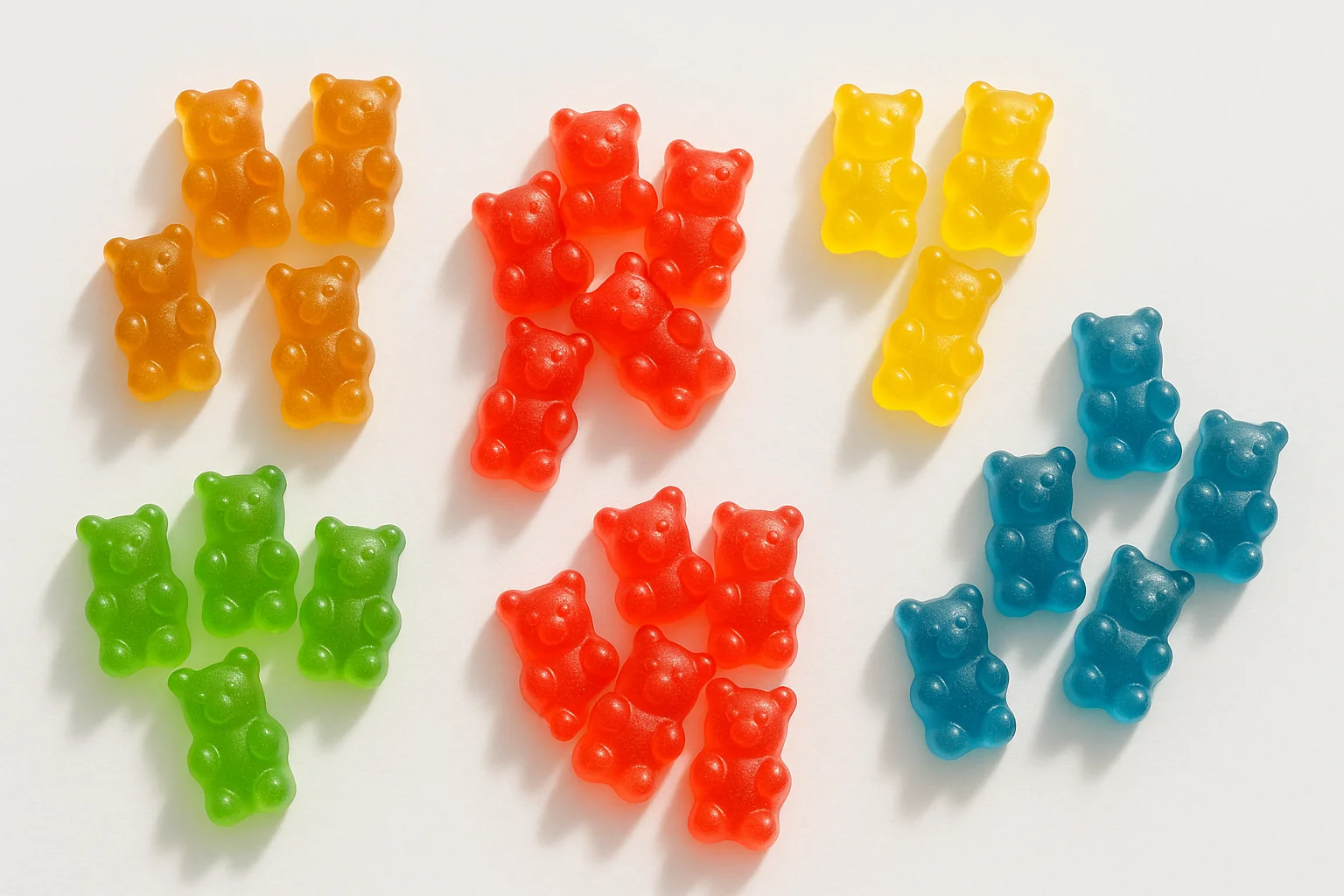
On the gummy shelf at u Bucha today, there are 40 items, but only 28 of them have cannabis raw material listed in the ingredients. The rest are herbal, mushroom, or those with just L-theanine, sometimes under a name that suggests cannabis. This ranking organizes the shelf: five gummies with cannabis, selected based on declared content per piece and cost of 100 mg of phytonutrients, not by flavor or jar design. Additionally, we clarify the numbers that circulate in descriptions of CBD gummies and have no basis in the studies they refer to. You will learn how much you are actually paying per milligram, what the differences are between gelatin and pectin bases, and what can be checked on the label before purchase.
KEY INFORMATION
• Of 84 CBD extracts purchased online, about 31% had label-compliant content (Bonn-Miller, JAMA 2017).
• Millar 2018 does not provide oral bioavailability of CBD in humans: it was only measured after smoking, where it was 31%.
• The cost of 100 mg of phytonutrients in our top five ranges from 5.93 PLN to 11.67 PLN.
• Ceny ze Store API, stan na 2026-08-08.
How did we select the five CBD gummies for this ranking?
Only those gummies that have cannabis raw material listed in the ingredients and a declared content in milligrams per piece were included in the comparison. Without this number, it is impossible to calculate the cost of 100 mg, and without this conversion, the ranking would compare packages, not products. 28 out of 40 items in the category met this condition, and the five selected were those with the lowest cost per milligram.
The declaration in milligrams is not a given. Some cannabis gummies describe the raw material solely by the percentage in the recipe, for example, hemp oil from seeds at 8%, and refer to the content of phytonutrients to the label on the packaging. Several variants of the same line state 8 or 10 mg in the daily serving, while several others do not. Such items cannot be fairly placed in the same line as a gummy where the manufacturer states directly: 25 mg of broad-spectrum phytonutrients from Cannabis sativa.
We noticed while organizing this shelf something that can mislead even a careful buyer. One of the products carries the designation of the line under which the brand usually sells cannabis gummies, but its ingredient list does not contain cannabis at all: the only active ingredient is 100 mg of L-theanine. The manufacturer states this clearly on the card, but the name does its work. The line name does not replace the ingredient list, so read the active ingredient table, not the label on the lid.
Which CBD gummies made it into the selection?
We arranged the five based on the cost of 100 mg of phytonutrients from cannabis, from lowest to highest. In case of a tie, the recipe with a simpler composition is ranked higher. The content per piece and the number of pieces in the package come from the manufacturers' cards, and the prices from the Store API of the shop, as of August 8, 2026.
| Place | Product | What distinguishes | Cannabis per piece | Packaging | Price | Koszt 100 mg |
|---|---|---|---|---|---|---|
| 1 | CANNOVA + motherwort, CBD gummies 25 mg | the lowest cost per milligram, 120 mg of motherwort extract | 25 mg | 60 szt. / 1500 mg | 89.00 PLN | 5.93 zł |
| 2 | CANNOVA + melatonin, CBD gummies 25 mg | the same conversion, 1 mg of melatonin in the evening | 25 mg | 60 szt. / 1500 mg | 89.00 PLN | 5.93 zł |
| 3 | Sugar-free hemp gummies, lemon, TOPICAL | 25 mg without added sugar, one active ingredient | 25 mg | 30 szt. / 750 mg | 45.00 zł | 6.00 PLN |
| 4 | CANNOVA + heather and mistletoe, CBG gummies 15 mg | jedyna pozycja z CBG zamiast CBD | 15 mg | 60 szt. / 900 mg | 89.00 PLN | 9.89 zł |
| 5 | Vegan CBD gummies 300 mg, orange | pectin base, without added sugar, lowest entry price | 10 mg | 30 szt. / 300 mg | 35.00 zł | 11.67 zł |
The two items in first place differ only by the herbal addition: motherwort in the daytime version, melatonin in the evening version. The price and conversion are identical, so the choice comes down to the time of day. The fifth place costs the most per milligram of all five, but has the lowest price for a single package and is the only one that does not contain gelatin. A full shelf awaits in the category jelly candy.
How much does 100 mg of phytonutrients from hemp really cost?
From 5.93 zł to 11.67 zł in gummies and from 9.50 zł to 13.00 zł in oils from the same offer. This reverses the common notion in texts about gummies: that you always pay extra for the convenience of a gummy compared to an oil. In this store, the cheapest gummy by conversion is over three złoty cheaper than the cheapest oil for every 100 mg.
The conversion only works when you compare the same. Oil allows you to go below the smallest gummy dose and approach it gradually, which a gummy does not allow: you get a portion measured by the manufacturer. A large package of gummies is cheaper per milligram, but requires paying the full amount at once and consuming sixty portions before you can calculate the savings. If you want to check your tolerance first, the same line sells a three-piece sample for 10 zł: in conversion, that's 13.33 zł for 100 mg, which is more expensive per milligram, but cheaper for the trial itself.
How many milligrams in a gummy should you choose to start?
Manufacturers of all five items recommend one or two gummies daily and set a ceiling at two. This means from 10 mg for the vegan version to 50 mg for two gummies of 25 mg each, and the label does not specify where in this range you should land. So start with the smallest portion recommended by the manufacturer and observe.
The reference point from the literature is more modest than the store descriptions suggest. Shannon and colleagues described in The Permanente Journal (2019) a retrospective series of 72 adult patients from a psychiatric clinic: anxiety scale results decreased in the first month for 79.2% of them, and sleep quality results for 66.7%. This is a review of documentation, not a study with randomization and a control group, so it speaks to the direction of observation, not to effectiveness confirmed by experiment. The authors themselves conclude that controlled clinical trials are needed.
The mere number of milligrams does not resolve everything either. A meta-analysis of observational data from drug-resistant epilepsy (Pamplona i wsp., Frontiers in Neurology, 2018) showed that patients taking CBD-rich extracts used an average of 6.0 mg/kg per day compared to 25.3 mg/kg with pure cannabidiol. Improvement was reported by 71% of those on extracts compared to 46% on isolate. However, after applying the clinical threshold for reducing seizures by half, the difference disappeared, so the advantage of broad-spectrum extract remains a hypothesis to be tested, not a fact.
In practice, it is worth separating two decisions: how many milligrams and at what time. The version with motherwort and the sugar-free lemon one are suitable for daytime use, as they do not contain a sedative ingredient. The version with melatonin is evening by definition, so two gummies a day would also mean 2 mg of melatonin. Mixing different formulations in the same day easily exceeds the total cannabis portion above the ceiling on the label.
What do studies say about the absorption of CBD from gummies?
Less than what product descriptions suggest. A systematic review Millar i wsp. (Frontiers in Pharmacology, 2018) searched 792 studies and found 24 with pharmacokinetic data in humans. Absolute bioavailability was measured only after smoking, where it was 31%. No study has done this for the oral and sublingual routes.
Popular figures like "6 to 15% orally" and "20 to 35% sublingually" do not come from this review, although they are often attributed to it. The review provides verifiable facts: a half-life of 1.4 to 10.9 hours after aerosol administration on the mucous membrane and from 2 to 5 days after chronic oral administration, maximum concentration reached between zero and four hours, and a clearly higher maximum concentration after a meal and in formulations with fat.
This gap in data has practical implications. Since no one has measured what portion of cannabidiol from an ingested gummy reaches the bloodstream, no product description can honestly promise a specific percentage. Statements like "the gummy absorbs twice as poorly as a drop under the tongue" are based on assumptions from animal studies, which the review itself cites as insufficient compared to human data.
For gummies, there are two conclusions. First, eat it with a meal containing fat, as this is the only simple way to increase blood concentration without changing the dose. Second, with daily oral use, the substance remains in the body for days, not hours, so the effect builds up over weeks, and after three days, there’s nothing to evaluate. We gathered more about the differences between routes of administration in our post about bioavailability of CBD.
How to check the composition and COA certificate before purchase?
The label can be inconsistent with the content, and this has been measured. Bonn-Miller and colleagues purchased 84 CBD extracts online from 31 companies and tested them in the laboratory (JAMA, 2017). About 26% contained less cannabidiol than the label claimed, about 43% more, and only about 31% of products fell within 10% of the declaration.
The Certificate of Analysis, or COA, is the answer to this problem, but its assignment to a batch matters. A report without a batch number or older than the packaging in your hand tells you nothing about what you are buying. The manufacturer of one of the items in our comparison publishes a cannabinoid profile and microbiological study assigned to specific batches, so the batch number from the lid can be compared with the list of documents instead of taking the description at face value.
Besides the report itself, it’s worth going through four things from the label. Check if the hemp raw material has a value listed in milligrams per piece, not just a percentage share in the formulation. Check the gelling agent, as gelatin excludes a plant-based diet. Check the sweetening base: sugar with glucose syrup in classic versions, polyols in sugar-free ones. Finally, check if the recommended daily portion has a set ceiling, as it’s easy to exceed it unnoticed with flavored gummies.
One thing does not replace another. The batch testing report tells you how much cannabidiol is actually in the product, while the ingredient list tells you what else you are consuming with it. A manufacturer can reliably publish a cannabinoid profile and simultaneously base the gummy on sugar with glucose syrup. Both pieces of information should be checked separately before the package goes into the cart.
When does a gummy lose to an oil?
When you need a dose outside the manufacturer’s grid. A gummy provides a dose measured once and for all: 10, 15, or 25 mg, without halves and without titration. Oil allows you to reach your dose drop by drop, go lower when drowsiness appears, and return higher after a week. In terms of adjustment, this is an advantage that the gummy's taste does not compensate for.
A gummy also loses in composition if you look at the entire matrix, not just one active ingredient. Classic versions are based on sugar and glucose syrup, while sugar-free versions use maltitol, sorbitol, or erythritol. Polyols in larger amounts can cause bloating, so two gummies a day for a month is also a dietary decision. Gelatin excludes a plant-based diet, and in one of the items, it specifically mentions pork gelatin, which the manufacturer states directly.
Finally, it loses with large daily portions. To reach 50 mg of phytonutrients, you need to eat two gummies of 25 mg each, thus hitting the ceiling set by the manufacturer, and take in all the sugar or polyol base with them. The same threshold in oil can be measured with a dropper, adding only carrier oil to your body, without sugar and without gelatin. With portions above one gummy a day, the difference in composition becomes noticeable faster than the difference in price.
However, it wins wherever convenience determines regularity. You don’t have to measure anything or drink anything, the portion is always the same, and the taste doesn’t remind you that you’re taking a supplement. If you weigh both formats, we have a separate comparison: CBD gummies or CBD oil. The full range of oils is available in the category oils.
Do CBD gummies have side effects?
The safety profile of cannabidiol itself is favorable, but not zero. The report WHO from 2018 states that in humans, CBD does not show effects indicating potential for abuse or addiction, and on this basis, the expert committee did not recommend subjecting pure CBD to international control.
Brown and Winterstein collected data from the characteristics of medicinal products containing CBD (Journal of Clinical Medicine, 2019). Undesirable effects occurred in nearly half of users and increased with dosage. The most common include:
- elevation of liver transaminase activity,
- drowsiness,
- sleep disorders,
- infekcje,
- anemia.
The authors also point to the influence of CBD on CYP3A4 and CYP2C19 and on P-glycoprotein, meaning the metabolic and excretion pathways of many drugs. This concerns doses used therapeutically, which are significantly higher than one gummy, but the direction of interactions remains the same.
A gummy adds its own risks that oil does not have. Sugar in classic versions is a problem for diabetes and low-carb diets. Polyols in sugar-free versions burden the intestines. Dyes and preservatives, such as potassium sorbate, can be problematic for allergy sufferers. If you are taking medication regularly, are pregnant, or breastfeeding, discuss the decision about hemp gummies with your doctor, not just the product description.
A separate issue is that a gummy looks and tastes like a candy. In a home with children, this is not a trivial matter: the manufacturer of the CANNOVA line notes that the product is not suitable for children, and the TOPICAL brand asks to keep the jar out of reach of small children. The fruity aroma and sweet base say nothing about who the formulation was written for.
Frequently Asked Questions
How many milligrams of cannabis is in one gummy from this ranking?
From 10 to 25 mg of declared broad-spectrum phytonutrients from Cannabis sativa. The highest are the CANNOVA gummies and the lemon TOPICAL gummies, each with 25 mg, while the vegan Reakiro gummies have the least at 10 mg. Manufacturers of all five products recommend one or two gummies daily and no more.
Are CBD gummies more expensive than oil?
Not in this offer. One hundred milligrams of phytonutrients from CANNOVA gummies costs 5.93 PLN, while the cheapest oil, CANNOVA 20%, costs about 9.50 PLN. Gummies are cheaper because they are sold in packages of sixty. Prices are from the Store API of the shop, as of August 8, 2026.
How long does it take for a cannabis gummy to take effect?
The Millar 2018 review states that the maximum concentration of cannabidiol in humans occurs between zero and four hours after administration, depending on the route and formulation. After a meal with fat, this concentration increases. Therefore, a gummy is not a form for quick response, but for a regular routine.
What is the difference between gelatin and pectin bases?
Gelatin comes from animals and excludes vegan and vegetarian diets, while pectin is plant-based. Pectin recipes in this selection can also be sugar-free, sweetened with maltitol and sorbitol. These polyols in larger amounts can cause bloating, so the sugar-free version is not always gentler on the stomach.
Does every item on the gummy shelf contain cannabis?
No. Out of 40 items in the gummy category, only 28 have cannabis raw material listed in the ingredients. The rest are herbal, mushroom, or just L-theanine recipes. One product carries the designation of a cannabis line in its name, but there is no cannabis in the ingredient list, which the manufacturer clearly states on the card.
Do you need to be cautious with medications when using CBD gummies?
Yes. Brown and Winterstein (Journal of Clinical Medicine, 2019) describe cannabidiol as a substance that acts on CYP3A4 and CYP2C19 and on P-glycoprotein, which are metabolic and excretion pathways for many medications. The authors recommend considering a lower medication dose, monitoring, and consulting with patients undergoing chronic treatment.
You can check current prices and the full composition of each described item in the category jelly candy, and we compared evening recipes with melatonin separately in the post CBD for sleep: oil or gummies with melatonin.
This article is for informational and educational purposes. It contains internal links to product categories available in the u Bucha store. Prices and specifications may change: check the current data on the product page before purchasing.
Author: Michał Waluk · Opublikowano: 2026-06-22 · Aktualizacja: 2026-08-08