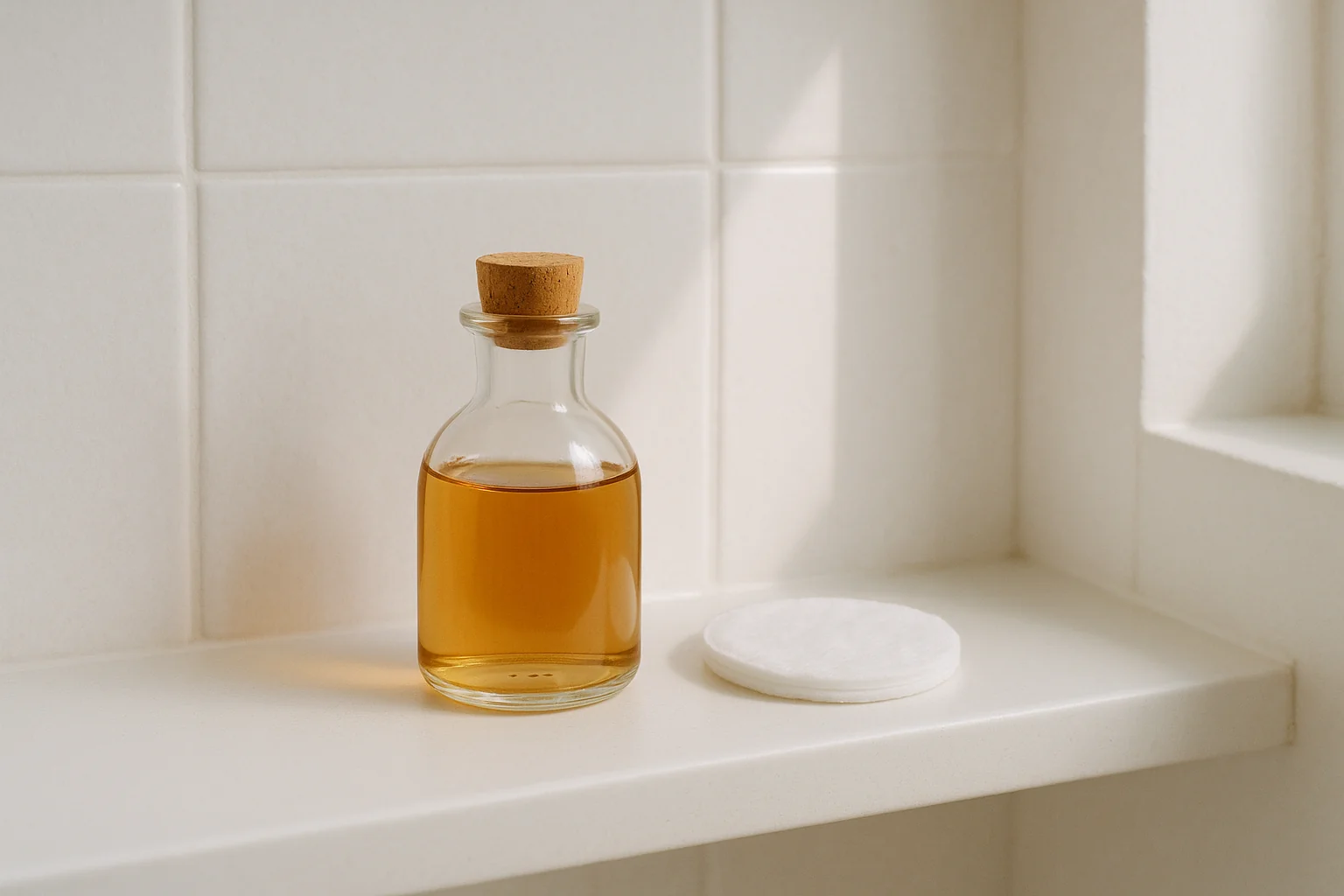

Apple cider vinegar for skin: does ACV really cleanse pores and brighten?
Apple cider vinegar for skin – diluted toner 1:10, pH about 3 vs skin pH 5.5. Does ACV clean pores and lighten? What do studies say, how to use it safely.
Apple cider vinegar (ACV) regularly appears on lists of "natural beauty hacks." Its popularity as a facial tonic stems from several convincing assumptions: lowered pH would balance the skin's acidity, acetic acid would have antibacterial effects on acne, and enzymes from the "mother of vinegar" would lighten discolorations. How much of this is true and how much is myth? Clinical evidence is much more modest than beauty content influencers suggest. This article explains what ACV can really do for the skin, how to use it safely - and why pure ACV on the face is a serious risk.
KEY INFORMATION
• The pH of apple cider vinegar is about 3 - healthy skin has a pH of 4.5-5.5; undiluted ACV can cause chemical burns (Lukasik et al., Pediatric Dermatology, 2019).
• A safe dilution for ACV toner is 1:10 (1 teaspoon of ACV to 10 teaspoons of water), resulting in a concentration of about 0.5% acetic acid.
• Direct clinical evidence confirming "pore cleansing" by ACV does not exist - antibacterial effects have been confirmed in vitro, not in RCTs on humans.
• Before first use on your face, always perform a skin test on your wrist for 24 hours.
What is apple cider vinegar and why has it made its way into skincare?
Apple cider vinegar is a product of apple fermentation: fruit sugars are converted by yeast into alcohol (cider), and then by acetic acid bacteria (Acetobacter aceti) into acetic acid. Raw, unfiltered ACV contains the so-called "mother of vinegar" - a suspension of yeast, bacteria, and proteins (mainly cellulose). The concentration of acetic acid in typical ACV is about 5%, which translates to a pH of about 2.5-3.5. In comparison: the natural pH of healthy skin is 4.5-5.5, and the pH of the eye mucosa is about 7.4 - which is why undiluted ACV stings like acid if it gets into the eyes.
Interest in ACV as a cosmetic arises from several true properties of acetic acid: it is antibacterial (its action against Staphylococcus aureus and Cutibacterium acnes has been confirmed in vitro), has a low pH (which theoretically "restores" the skin's acidity), and contains traces of alpha-hydroxy acids (AHAs) that exfoliate the epidermis. The problem is that none of these properties are strong enough at the concentration of a homemade toner (0.5%) to compete with dedicated cosmetics.
Does ACV regulate skin pH and close pores?
The "pH" argument is most often cited in the context of ACV on the skin, but it requires verification. Healthy skin has a natural acid-lipid mantle with a pH of 4.5-5.5. After alkaline washing with soap, the skin's pH may temporarily rise to 6-7, disrupting the barrier. The theory states that an acidic ACV tonic restores optimal pH. In practice, healthy skin naturally restores pH within 30-90 minutes - the tonic speeds up this process, but it is not essential for it.
When it comes to pores: the concept of "opening and closing pores" through temperature or pH is a dermatological myth. Pores are the entrance to the sebaceous gland - they do not have smooth muscles or the ability to mechanically close. The size of the pores depends on the amount and density of sebum and the inflammatory state around the hair follicle. ACV may indirectly reduce the visibility of pores by reducing sebaceous clogging (antibacterial effect) - but not by "closing" in the anatomical sense.
Our observations: People with combination or oily skin who report positive effects of ACV mainly describe reduced skin shine and slight cleansing after application. This is likely the result of mild exfoliation and antiseptic action. They rarely mention "cleansing pores" after a month - this effect does not last long-term, as ACV does not address the causes of excess sebum production.
The antibacterial action of ACV - what does science say?
Acetic acid has documented antibacterial activity in vitro. Laboratory studies have confirmed the effectiveness of ACV at concentrations of 1-5% against strains of Staphylococcus aureus (including MRSA), Escherichia coli, and Candida albicans. In the context of acne: Cutibacterium acnes (formerly Propionibacterium acnes), the main bacteria responsible for common acne, is sensitive to acetic acid under in vitro conditions.
However, the transition from in vitro studies to clinical effects is complicated. The concentration of ACV in a homemade toner (about 0.5%) is many times lower than those tested in laboratory conditions. Human skin is a much more complex environment than a Petri dish - it has a keratin layer that the acid penetrates very superficially. Lukasik et al. (Pediatric Dermatology, 2019) They published a series of cases of chemical burns on children's skin where parents applied undiluted ACV "for eczema" according to internet advice - which clearly illustrates the boundary between anecdotal use and clinical safety.
How to safely use ACV on your face?
If you decide to try ACV as a toner, the key is proper dilution. Never apply undiluted vinegar directly to the face - even brief contact of concentrated acid with delicate skin can cause redness, burning, and with prolonged exposure - chemical burns.
Safe usage protocol: dilute 1 part ACV in 10 parts boiled, cooled water (for sensitive skin - 1:15 or 1:20). Apply with a cotton pad to cleansed skin, avoiding the eye and mouth areas. Wait 30 seconds, then rinse or leave on (depending on skin tolerance). Always finish your skincare routine with a moisturizing cream, as ACV may temporarily dry out the skin. Use a maximum of 2-3 times a week, not daily.
Before the first application on the face, perform a skin test: apply the diluted toner to the inner side of your wrist and observe for 24 hours. Redness, itching, or burning is a signal to further dilute or discontinue use. People with active rosacea, eczema, or psoriasis should completely avoid ACV on the face - acids exacerbate these conditions.
ACV vs cosmetic acids - is it worth using instead of them?
Comparing ACV with cosmetic AHA and BHA acids shows the limitations of a homemade toner. Cosmetic glycolic acid (AHA) and salicylic acid (BHA) are available in concentrations of 5-10% in OTC products and even 20-30% in dermatological offices. They work deeper, more evenly, and have documented clinical efficacy in reducing wrinkles, pigmentation, and acne. ACV at a concentration of 0.5% provides a fraction of such action.
However, ACV has advantages in terms of availability and price: it is cheap, easy to buy, and gives many people gentle toning effects without the risk of peels that require skin acclimatization. Who is it suitable for? For those with combination or oily skin looking for a simple, inexpensive toner without preservatives and long INCI lists. It is not a "game changer" in skincare, but when used properly - it is safe. Detailed skincare tips can be found in the article. Zinc for acne and immunity.
Frequently Asked Questions
Does apple cider vinegar really clean pores?
Direct clinical evidence is limited. Acetic acid shows antibacterial action in vitro against C. acnes, which may indirectly reduce pore clogging. However, "cleansing pores" in the mechanical sense is a myth - pores do not open and close under the influence of pH.
How to dilute apple cider vinegar for skin use?
A safe dilution is 1:10 (1 teaspoon of ACV to 10 teaspoons of water). For sensitive skin - 1:15 or 1:20. Lukasik et al. (Pediatric Dermatology, 2019) described chemical burns on children's skin after applying undiluted ACV. Always perform a patch test before use.
Does apple cider vinegar lighten the skin?
There are no RCT studies confirming lightening effects. ACV at a concentration of 0.5% may gently exfoliate dead skin cells (AHA effect), which slightly improves skin tone uniformity. Cosmetic acids work more effectively and safely than homemade ACV toner.
Is ACV safe for daily facial use?
No - daily use can gradually damage the skin barrier and increase dryness. The maximum recommended frequency is 2-3 times a week. After each application, apply a moisturizing cream with ceramides or hyaluronic acid.
For whom is ACV unsuitable for skin?
ACV is definitely not recommended for rosacea, eczema, psoriasis, sensitive and reactive skin, and active skin lesions. In children, the use of ACV on the skin is contraindicated - the risk of chemical burns is real even with moderate dilution.
This article is for informational and educational purposes and does not replace consultation with a doctor. If you are pregnant, breastfeeding, taking medications, or have chronic conditions, consult the use of supplements or herbs with a specialist.
Author: Michał Waluk · Published: 2026-05-04 · Updated: 2026-05-04