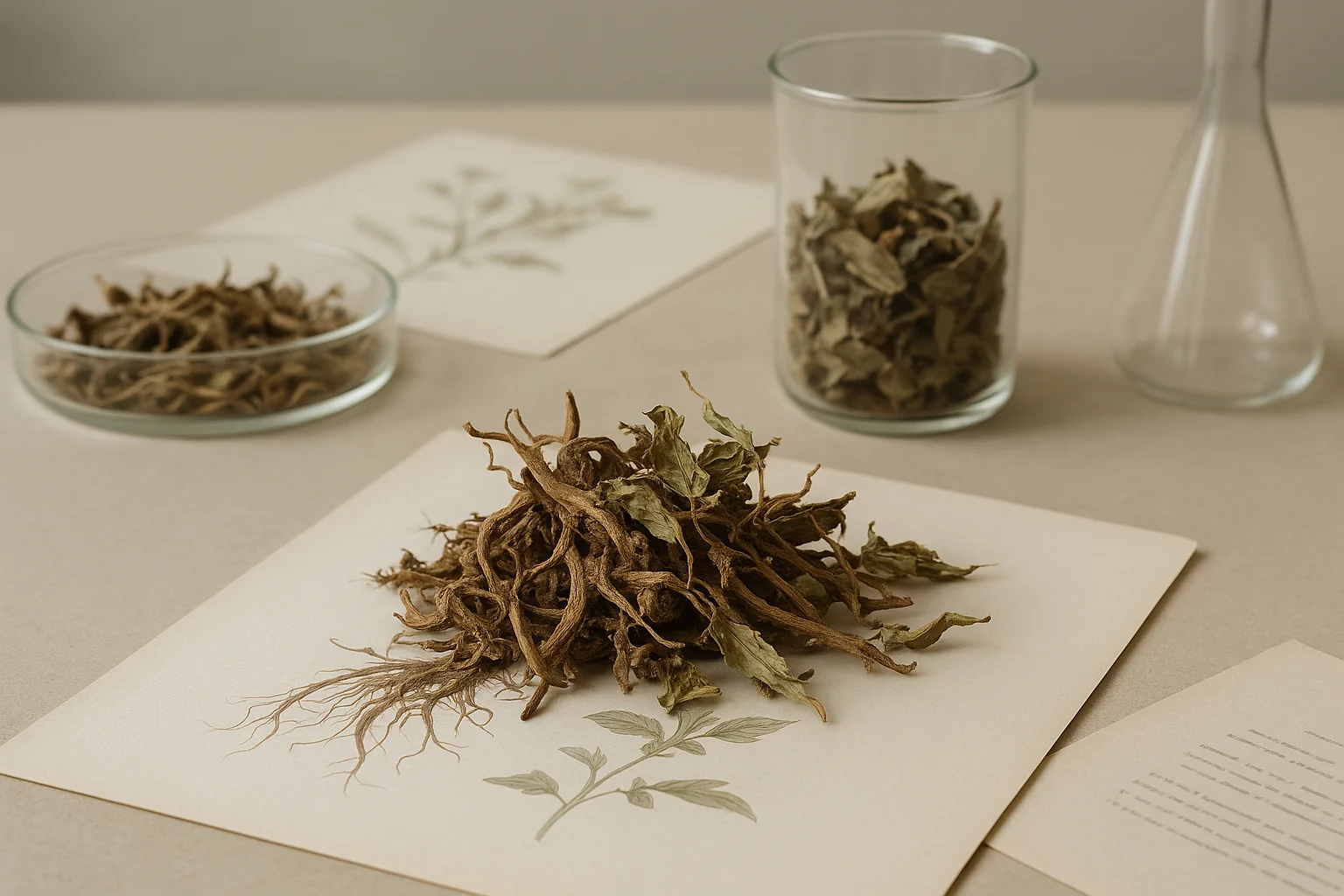

White Widow (Cannabis flos S-LAB): limonene at the forefront and the name of several independent lines
What Polish strain databases and the pedigree graph of this cluster say about the White Widow strain: a volatile composition described by one source, one pharmacy supplier, and a name under which more than one company maintains its own lines.
What is White Widow and where does this strain come from?
White Widow is a hybrid with a documented pedigree: the breeder Green House Seeds and the Leafly database indicate a cross between Brazilian sativa and Indian indica from the southern subcontinent. The pedigree is therefore known, but it leads to two regional categories rather than two named, individually identified plants.
Brazilian sativa and South Indian indica are descriptions of origin, not proper names of specific individuals. Under each of these terms lies a population of plants from that region, so two cultivars derived from 'the same' landrace may come from specimens that never grew next to each other. The pedigree of this strain counts as known in the cluster because the breeder revealed it and it can be cited, however, it ends at two geographical drawers instead of two addresses in the graph.
The name itself does not lead to a single plant either. The note in the pedigree graph of this cluster records that under the term White Widow, at least two independent companies maintain their own clonal line, listed there as Paradise Seeds and 7ACRES from the Canopy Growth group, and each considers its own to be original, with no definitive source available. The graph treats this term as a family label, not as one identifiable individual. For the patient, this results in a practical matter: the dried flower issued today under this name is defined by the manufacturer's documentation and batch number, not by the history of the name itself.
Which producers supply White Widow to Polish pharmacies?
One. In the register on which this cluster stands, the dried flower under this name is supplied exclusively by S-LAB, and there is only one pharmacy position, so there are no versions to compare. The database from which the profile originates marked this position at the time of registration as unavailable for sale.
| Producer | Registered name without a numerical component | Genetics according to the database | Recorded leading terpene | State at the time of registration |
|---|---|---|---|---|
| S-LAB | Cannabis flos S-LAB | hybrid | limonene | unavailable |
The full registered name carries a number: it includes the declared THC content along with a note about tolerance and the upper limit of CBD content. In the table, it was deliberately left out of this element, because the quoted bare returns exactly to where the rule of providing a range originated. The manufacturer's declaration allows for a deviation of one-tenth of the nominal value, so we provide the THC content for this entry as 16.2-19.8% and exclusively in that form. What this number indicates, and what it does not indicate about potency, is discussed in a separate text about lower potency dried flower.
One supplier is the state of the register, not the property of the strain. The registration of the raw material is valid for five years, can be withdrawn early, and the import contract can be terminated overnight; additionally, the wholesaler can deplete stock faster than the catalog can record it. The card for this position still stands in the catalog, even though it was described as unavailable at the time of registration, and this discrepancy between the catalog and the stock is the rule here, not the exception. We therefore maintain the current state of the assortment exclusively in the list of strains available in Polish pharmacies, and what else this manufacturer provides is described in the text about their catalog.
How does White Widow smell and taste?
The database describes this dried flower with three terms: spicy, fruity, and pungent. These are catalog labels, not the result of sensory evaluation conducted according to a protocol, so they rather indicate which scent category this position has been placed in, rather than what the patient will feel upon opening the package.
The scent originates from the volatile compounds, and for White Widow, it describes one source, one Polish profile database. It lists seven compounds: limonene, nerolidol, caryophyllene, pinene, myrcene, bisabolol, and humulene. The highest share belongs to limonene, followed closely by nerolidol, which is rare in this cluster, as nerolidol usually occupies lower positions. The citrus note of the former and the warmer, slightly floral note of the latter explain why the catalog description mixes fruit with root. We discuss more about the leading compound in the text dedicated to limonenowi, and about its neighbor from this card in the text about nerolidolu.
We do not provide percentage shares next to the names of the compounds, and this card shows the reason better than the general disclaimer: the seven values sum up to eighty-nine percent. Eleven points are missing to reach a full hundred, and it is unclear what they pertain to, as the source does not specify whether the denominator is the mass of the dried flower, the essential oil itself, or only those compounds that are marked. In the same database, twelve positions out of one hundred forty-five hit exactly one hundred, and six others exceed it, which would be impossible with a fixed denominator. The number without a denominator in the drug description appears to be a measurement, but it is not, so only the composition remains.
How long does it take for White Widow to take effect and how long does the effect last?
Not after the time appropriate for this strain, but after the time appropriate for the method of administration. No individual cultivar has had a separate pharmacokinetic study published, so the ranges below describe absorption from the lungs or the gastrointestinal tract and apply equally to every pharmacy position.
The route of administration determines the course more than the variety itself. After vaporization, the substance passes from the lungs to the blood almost immediately, so the first sensations appear after a few minutes, the intensity increases for another ten to thirty minutes, and the whole effect lasts for two to four hours. After ingestion, the raw material first passes through the intestine and liver, so the first sensations are awaited from half an hour to two hours, and the episode can last six, sometimes eight hours. Hence the most common mistake with oral administration: anyone who thinks nothing is happening after thirty minutes and takes another dose will receive both doses at once. The above ranges describe the route of administration, not this variety; pharmacokinetic studies for a single cultivar have not been published.
Nothing from the data collected for this entry changes that. Neither the volatile composition from one card nor the record of THC content indicates how quickly the substance will appear in the blood or when it will disappear from there.
What is known, and what is not known about the effects of White Widow?
Nothing is known regarding this strain as a whole. No clinical studies have been conducted on the dried flower of this name, and what can be quoted pertains to a single compound from its profile, studied separately and on animals. The rest of the descriptions come from catalog materials and patient reports.
The oldest of the two studies attributed to this compound was published in 2002 in the journal Phytomedicine, authored by Vale TG, Furtado EC, Santos JG, Viana GS (PMID:12587690). Limonene administered intraperitoneally in mice showed muscle relaxant effects (rota-rod test) from a dose of 50 mg/kg and prolonged sleep induced by pentobarbital at a dose of 200 mg/kg (about 2.6 times); in the elevated plus maze test, already at a dose of 5 mg/kg, it reduced the number of entries into the open arms, which the authors described as an anxiogenic effect, not anxiolytic.
The second study is recent: Fakhri S, Yarmohammadi M, Abbaszadeh F, Kiani A, Farzaei MH published it in 2025 in Behavioural Pharmacology (PMID:40622197). Limonene reduced paw swelling induced by carrageenan in rats and pain responses in the formalin test in mice; the effect was linked to the l-arginine/nitric oxide/cGMP/KATP channel pathway and the involvement of opioid and benzodiazepine receptors. Both studies describe animals and pure compounds in doses calculated per kilogram of body weight, not dried flower inhaled by humans.
It is worth stating the limit of this data directly. No anxiolytic effect of limonene has been demonstrated in humans. It has also not been shown that isolated limonene has anxiolytic effects in animals; the only available data from the elevated plus maze test showed the opposite effect in mice, reducing the number of entries into the open arms even at a low dose.
What side effects have been reported after using White Widow?
None specifically for this name. Public compilations do not separate reports by individual strains, and under this term, there is one entry from one manufacturer in pharmacies, so even a report that might come in would go into the pool described by the product's batch number, not the name of the plant listed on the label.
Silence in the registry is not evidence of the mildness of this dried flower, but rather a consequence of how this registry was constructed. Anyone comparing two strains based on the number of reports would compare the sales volume of individual batches, not the properties of the plant.
Reports of adverse effects are collected for medicinal products with a batch number, not for the strain name, so the following pertains to hemp dried flower as a group of raw materials. The most frequently reported symptoms are dry mouth, red eyes, and increased heart rate. Dizziness upon rapid standing, daytime drowsiness, and temporary worsening of short-term memory are less frequently described, as well as anxiety that increases with dosage. A separate issue is medications taken concurrently, especially sedatives and those affecting coagulation: their assessment requires knowledge of the entire list of preparations, not just the description of the plant. We do not provide the frequency of these symptoms numerically, as public compilations for hemp dried flower in Poland do not separate them by individual products.
At what temperature do the terpenes from the White Widow profile evaporate?
At very different temperatures, and that is the whole answer. The boiling points of the compounds listed on this card vary by more than one hundred degrees; for three out of seven, the public database does not provide comparable values, and the vaporizer setting is not the temperature of the dried flower itself.
| Compound from the card | Boiling point record | Measurement conditions |
|---|---|---|
| pinene | 156.2 °C | atmospheric pressure |
| myrcene | 166.8 °C | atmospheric pressure |
| limonene | 177.8 °C | atmospheric pressure |
| caryophyllene | 257.5 °C | atmospheric pressure |
| humulene | 99.5 °C | under reduced pressure, 3 mmHg |
| nerolidol | 275-277 °C | pressure not provided |
| bisabolol | no record | the database did not return a record |
Three out of seven entries fall out of comparison, and this is not a trivial matter. The record for humulene comes from a measurement conducted under reduced pressure, and then the substance boils at a lower temperature because the apparatus lowers the threshold, not because the compound turned out to be more volatile. For nerolidol, there is one value, but without the specified pressure, so the atmospheric value field remains empty in the data instead of accepting conditions that no one measured. For bisabolol, the public database did not return any record, and the lack of a record means a lack of knowledge, not zero.
This is where the discrepancy arises between the listings circulating on forums: the same name sometimes gets an atmospheric value, sometimes a value from distillation conducted in a vacuum, and no one notes the difference. We dedicate osobny tekst, and to what escapes from the heated raw material in what order, inny. The relationship between the number on the vaporizer display and what happens in the chamber with the material is different, and we dedicate text. The method of administration is determined by the attending physician, and the boiling point is not a guideline for this.
Which strains are related to White Widow?
None. In the pedigree graph of this cluster, three cultivars list White Widow on the parent side: Delahaze, Jack Haze, and White Widow X. These are offspring, not siblings, and the list of strains sharing a parent with it remains empty, which is indeed the correct result here, not a data gap.
The reason lies in its own pedigree. Both parents are regional categories, and the graph does not consciously derive kinship from landrace: two plants described as Brazilian sativa may have nothing in common except for the continent. Moreover, each of these two terms appears in the entire graph exactly once, on the side of that one strain, so even if the categories counted as named plants, there would be no one to share the parent with. The strains that have White Widow listed higher in the tree are described separately: Delahaze and Jack Haze.
The closest name does not resolve anything on its own. White Widow X has its parents recorded in the graph as White Widow and Cold Creek Kush, referencing the product page of the Canadian producer. The record thus states that some line with this name served as a parent, but it does not say whether it was the same plant that S-LAB sells today under this name, as the term encompasses several independently maintained lines. The Polish profile database adds its own trace: the position described in the title as White Widow X is held under the base term white-widow and at the address of the card without the letter X, causing the two names to merge into one record. The cluster maintains separate entries for them and separately describes the latter.
Frequently asked questions about the White Widow strain
Can White Widow be purchased without a prescription?
No. Dried flower is dispensed in pharmacies by prescription from a doctor, in the Rpw category, and the doctor specifies a specific raw material on the prescription or allows a variant with a similar profile. Outside of this route, a pharmaceutical product by this name is not available.
How many producers supply this strain to Polish pharmacies today?
One, S-LAB, and it is one registered item. At the time of compiling the list, the database described it as unavailable in circulation, which happens regularly given the five-year validity period of permits and variable supplies.
Why are there no percentage shares for the terpenes of this profile?
Because it is unclear what these shares refer to. Seven values from this strain's card sum up to eighty-nine percent, while in the same database, six other entries exceed one hundred, which would be impossible with one constant denominator.
Why is the THC content given as a range?
Because the manufacturer's declaration allows for a deviation of one-tenth of the nominal value. For this item, it gives 16.2-19.8%, and only such a record corresponds to what the producer guarantees in the series documentation.
Are White Widow and White Widow X the same strain?
In this cluster, they are two separate entries. The pedigree graph records White Widow on the parent side of White Widow X, but it does not determine whether it refers to the same clonal line, as more than one company maintains its own lines under that name.
Do studies on limonene indicate how this dried flower will act?
No. Both studies concern the pure compound administered to animals in doses calculated per kilogram of body weight, not the dried flower inhaled by humans, and predictions for the patient cannot be derived from them.
Dried flower is a pharmaceutical raw material dispensed by prescription from a doctor in the Rpw category. The material is informational in nature, describing the state of available data and does not replace the advice of a doctor or pharmacist. The editorial text was prepared by u Bucha editorial. We maintain a complete catalog of dried flower available in our store at the dried flower category.