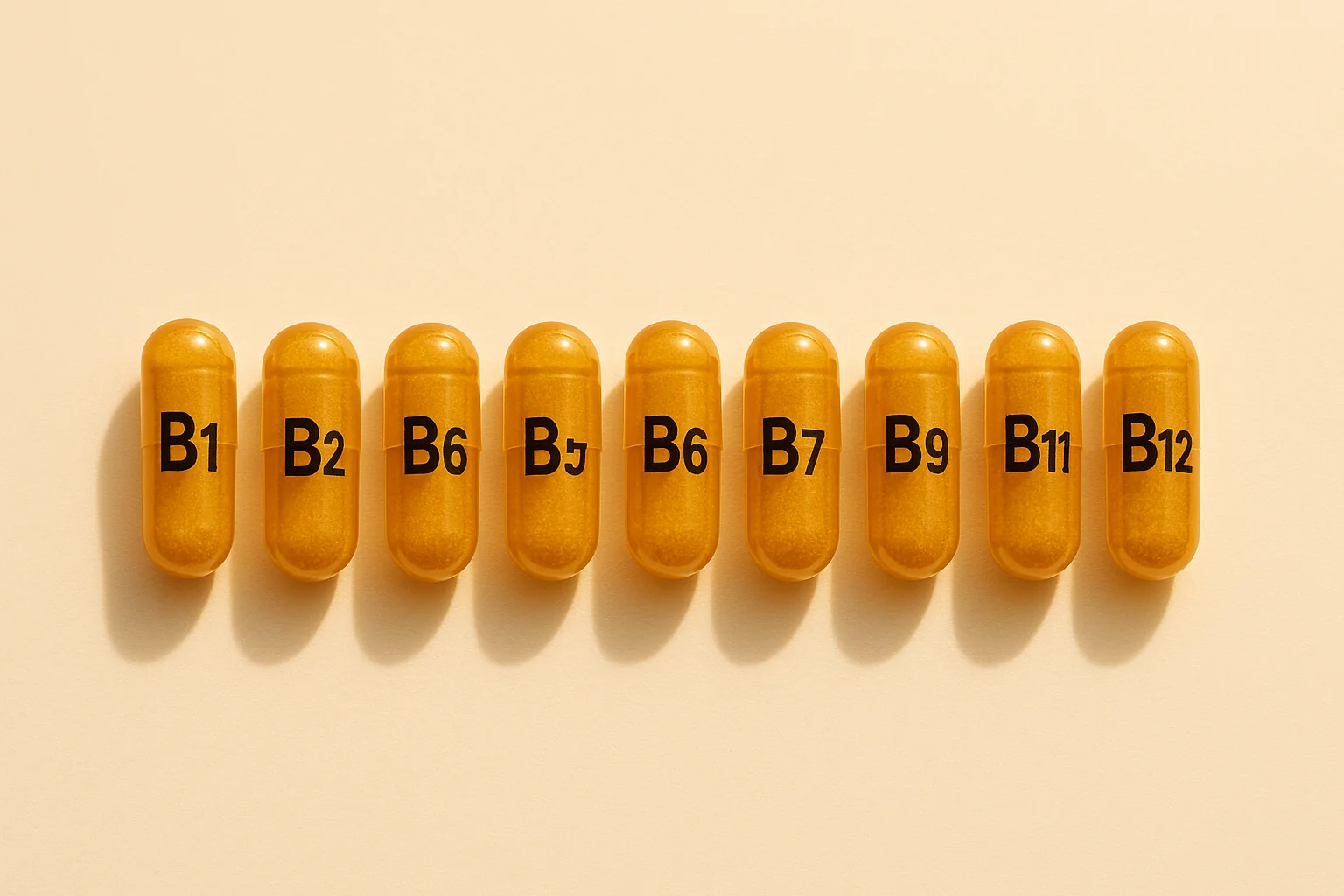

B vitamins (B complex) - what they do and who needs them
B vitamins — what they are, how they work, and what for. A guide from u Bucha.
Eight vitamins, one team - this is a brief way to describe the B group. Vitamins B1, B2, B3, B5, B6, B7, B9, and B12 work like an orchestra: each plays its part, but together they create a cohesive whole responsible for energy production, nervous system function, and DNA replication. According to EFSA data, deficiencies of vitamins from this group are among the most common in Europe - particularly B12 in older adults and vegans, and folic acid in women of childbearing age (EFSA Dietary Reference Values, 2015). This article explains what each of the eight does, who actually needs it, and how to supplement it sensibly.
KEY INFORMATION
• B vitamins are water-soluble - the body does not store them, requiring a constant supply through diet or supplementation.
• B12 and folic acid (B9) are crucial for red blood cell formation and DNA methylation - their deficiency leads to megaloblastic anemia.
• Methylcobalamin (active B12) is absorbed better than cyanocobalamin in individuals with MTHFR polymorphism.
• Long-term use of B6 above 100 mg/day can cause neuropathy - stick to physiological doses.
• Individuals taking metformin, proton pump inhibitors, or following a plant-based diet are at particular risk of B12 deficiency.
What each B vitamin does - function table
Each of the eight B vitamins performs unique functions, although their actions overlap and complement each other. A deficiency of one can mask or exacerbate the symptoms of another deficiency - which is why the B complex makes sense as a starting point for diagnostics.
| Vitamin | Main functions | Main dietary sources | Risk groups for deficiency |
|---|---|---|---|
| B1 (thiamine) | Carbohydrate metabolism, heart and nervous system function | Whole grains, legumes, pork | Alcoholics, individuals on a highly processed diet |
| B2 (riboflavin) | Mitochondrial respiratory chain, lipid and amino acid metabolism | Dairy, eggs, meat, green vegetables | Vegans, individuals with absorption disorders |
| B3 (niacin) | NAD+/NADH synthesis, DNA repair, energy metabolism | Meat, fish, nuts, seeds | Individuals on a diet low in tryptophan |
| B5 (pantothenic acid) | Coenzyme A synthesis, fatty acid metabolism, hormone production | Liver, mushrooms, eggs, avocado | Rare deficiency with a normal diet |
| B6 (pyridoxine) | Amino acid metabolism, neurotransmitter synthesis (serotonin, dopamine), heme production | Poultry, fish, potatoes, bananas | Individuals taking oral contraceptives, alcoholics |
| B7 (biotin) | Metabolism of fats, sugars, and proteins; skin, hair, and nail health | Eggs (yolk), nuts, soy, liver | Individuals consuming a lot of raw egg whites (avidin binds biotin) |
| B9 (folic acid / methylfolate) | DNA synthesis, red blood cell formation, development of the fetal neural tube | Leafy green vegetables, legumes, liver | Pregnant women, individuals with MTHFR, alcoholics |
| B12 (cobalamin) | DNA synthesis, methylation, myelin sheath of nerves, erythrocyte formation | Exclusively animal products: meat, fish, dairy, eggs | Vegans, seniors 50+, individuals on metformin or PPIs |
Why does B12 deserve special attention?
Vitamin B12 is the only B vitamin that is absolutely absent in any plant product - it is synthesized solely by bacteria and archaea, and enters animal organisms through the food chain. Therefore, vegans without supplementation will develop a B12 deficiency with mathematical certainty - it is just a matter of time, usually 3-5 years when liver stores are depleted (Watanabe et al., Nutrients, 2014).
Symptoms of B12 deficiency are insidious - they develop slowly and can be mistaken for depression, chronic fatigue, or normal aging. Tingling and numbness in the limbs, memory disturbances, megaloblastic anemia, elevated homocysteine (a cardiovascular risk marker) - these are classic symptoms. The problem is that neurological damage from B12 deficiency can be irreversible if not treated early enough.
A little-known fact: metformin - a drug used by millions of people with type 2 diabetes and insulin resistance - reduces B12 absorption by 10-30% with long-term use (Ting et al., Diabetes Care, 2006). Many people taking metformin for years have never heard this from their doctor. Regular B12 testing (every 1-2 years) should be standard for any patient undergoing long-term treatment with metformin.
In diagnosing B12 deficiency, the standard total B12 serum test has a significant limitation: it measures the sum of all forms of cobalamin, including biologically inactive fractions. A more accurate tool is holotranscobalamin (holoTC) - the active fraction of B12 bound to transcobalamin II, which actually reaches the cells. Studies indicate that holoTC detects functional deficiency earlier than total B12 measurement, especially in individuals with results in the so-called gray zone (150-300 pmol/l), where the result is formally within the norm, but tissue stores may already be insufficient (Nexo and Hoffmann-Lücke, Clinical Chemistry and Laboratory Medicine, 2011). An additional marker is the concentration of methylmalonic acid (MMA) - its elevation with normal serum B12 is almost certain evidence of functional deficiency at the cellular level.
Folic acid or methylfolate - which form is better?
This question becomes significant when we consider the polymorphism of the MTHFR gene. The MTHFR enzyme (methylenetetrahydrofolate reductase) converts folic acid into the active 5-methylfolate - the form that the body actually utilizes. The C677T variant of this gene, present in an estimated 10-15% of the European population, reduces enzyme activity by as much as 30-70% (Moll et al., Nutrients, 2015).
For these individuals, folic acid from supplements is poorly converted and may even accumulate in the form of unmethylated folic acid (UMFA), raising concerns among researchers about masking B12 deficiency. Methylfolate (5-MTHF) bypasses this enzymatic step and is available directly. For women planning pregnancy and individuals with a history of elevated homocysteine, methylfolate is a safer choice.
Most cheap supplements and multivitamins still contain folic acid in synthetic form. Active methylfolate can be found in premium preparations and supplements dedicated to pregnancy - the price is higher, but biologically justified.
In the context of pregnancy, EFSA confirms that the demand for folate increases to 600 mcg DFE (dietary folate equivalents) per day, and women planning pregnancy and those pregnant in the first trimester are recommended to supplement with folic acid or methylfolate at a dose of 400 mcg per day - precisely to protect against neural tube defects in the fetus (EFSA Panel on Dietetic Products, Nutrition and Allergies, 2014). In women with the MTHFR C677T polymorphism, using active methylfolate instead of folic acid may provide better bioavailability at the same nominal dose, although the final decision should be made in collaboration with the healthcare provider overseeing the pregnancy.
Who should supplement with a B-complex vitamin?
The answer to this question depends on lifestyle, diet, and health status. Not everyone needs a B-complex supplement - a well-balanced diet containing animal products, whole grains, and green vegetables should cover the demand for most vitamins in this group.
Supplementation with a B-complex is justified for: vegans and vegetarians (B12 and riboflavin are difficult to obtain from a plant-based diet), seniors over 50 (absorption of B12 from food decreases due to atrophic gastritis), women taking hormonal contraceptives (OC increases the need for B6 and B9), individuals under prolonged stress and with chronic fatigue (energy metabolism depends on B1, B2, B3, and B5), those on a low-calorie or restrictive diet, and patients taking metformin, proton pump inhibitors, or antiepileptic drugs.
Based on the questions that regularly reach our team, we see a characteristic pattern: individuals working in a state of continuous sleep deprivation and stress reach for B-complex hoping for a "boost of energy". The effect is indeed noticeable - but only when actual B vitamin deficiency is behind the fatigue. At normal levels, supplementation does not provide an "energy boost" beyond the biological capabilities of the body.
Frequently Asked Questions
Can B-complex vitamins be taken daily?
Yes - B vitamins are water-soluble, and excess is excreted in urine. The risk of accumulation is minimal at standard doses close to the RDA. The only exception is B6 (pyridoxine): doses above 100 mg per day for extended periods can cause peripheral neuropathy (EFSA, 2023).
Who particularly needs B12 supplementation?
Vegans and vegetarians (B12 is not found in plants), individuals over 50 years old (absorption from food decreases with age), those suffering from pernicious anemia (lack of Castle's factor), patients using metformin or proton pump inhibitors, and individuals with inflammatory bowel diseases (Crohn's, UC) that limit absorption.
What is the difference between cyanocobalamin and methylcobalamin?
Methylcobalamin is the active form ready for use by neurons and DNA methylation pathways. Cyanocobalamin requires enzymatic conversion - in individuals with MTHFR polymorphism, this conversion is limited. Methylcobalamin is more expensive but more effective in individuals with methylation disorders and better tolerated by the nervous system.
Do B vitamins help with stress and fatigue?
Yes - provided that fatigue is due to deficiency. B1, B2, B3, and B5 are cofactors of the mitochondrial respiratory chain. Without them, ATP production declines. B12 and folate are essential for red blood cell formation. If levels are normal, additional supplementation will not improve energy beyond physiological maximum.
When to take B-complex - in the morning or evening?
In the morning with a meal is the optimal choice. B vitamins participate in energy metabolism and naturally support activity during the day. B6 and B12 can slightly stimulate the nervous system - taken in the evening, they may hinder sleep in sensitive individuals. A meal improves the absorption of water-soluble vitamins.
How can I check if I have a deficiency of B vitamins?
The starting point is a complete blood count (CBC): enlarged red blood cells with an average volume (MCV) above 100 fl signal megaloblastic anemia, which may indicate a deficiency of B12 or folate. However, the serum concentration of B12 can be insufficient - a result at the lower limit of the laboratory norm (150-300 pmol/l) does not exclude functional deficiency. A more specific test is holotranscobalamin (holoTC): it measures the active fraction of B12 available to cells and shows deficiency before morphological changes appear; values below 35 pmol/l are definitive (Nexo and Hoffmann-Lücke, Clin Chem Lab Med, 2011). If the results are ambiguous, the doctor may order a measurement of methylmalonic acid (MMA) in urine or serum - its elevation with normal total B12 is strong evidence of tissue-level deficiency. The concentration of folate in red blood cells (not just in serum) better reflects long-term stores of this vitamin than a single serum measurement.
This article is for informational and educational purposes and does not replace consultation with a doctor. If you are pregnant, breastfeeding, taking medications, or have chronic conditions, consult the use of supplements or herbs with a specialist.
Author: Michał Waluk · Published: 2026-05-04 · Updated: 2026-05-04