
Ile CBD jest wykrywalne we krwi i moczu: czas detekcji (tabela)
Zmierzone okna detekcji CBD we krwi i w moczu, progi odcięcia stosowane w testach narkotykowych oraz to, czego badanie Spindle'a wcale nie sprawdzało.
Pytanie wraca zawsze w tym samym kontekście: badanie w medycynie pracy, kontrola drogowa, test antydopingowy. Odpowiedź zaczyna się od rozróżnienia, które gubi większość poradników. Standardowy test narkotykowy nie szuka kannabidiolu. Szuka metabolitu tetrahydrokannabinolu, czyli THC-COOH, przy określonym progu odcięcia. Bez podania tego progu i metody każde zdanie w rodzaju „wykrywalne przez X dni” jest bez znaczenia, bo ta sama próbka bywa dodatnia przy jednym progu i ujemna przy drugim. Druga rzecz, którą poradniki mieszają, to dwie różne cząsteczki: dane o czasie utrzymywania się THC bywają podawane jako dane o kannabidiolu, choć oba związki metabolizują się inaczej. Poniżej znajdziesz wartości zmierzone w badaniach z ludźmi, z podaniem, czego dokładnie dotyczą i przy jakim progu odcięcia, oraz to, czego cytowane w internecie prace w ogóle nie sprawdzały.
KLUCZOWE INFORMACJE
• Testy przesiewowe mierzą THC-COOH, zwykle przy progu 50 ng/ml, a test potwierdzający przy 15 ng/ml. Kannabidiol nie jest ich analitem.
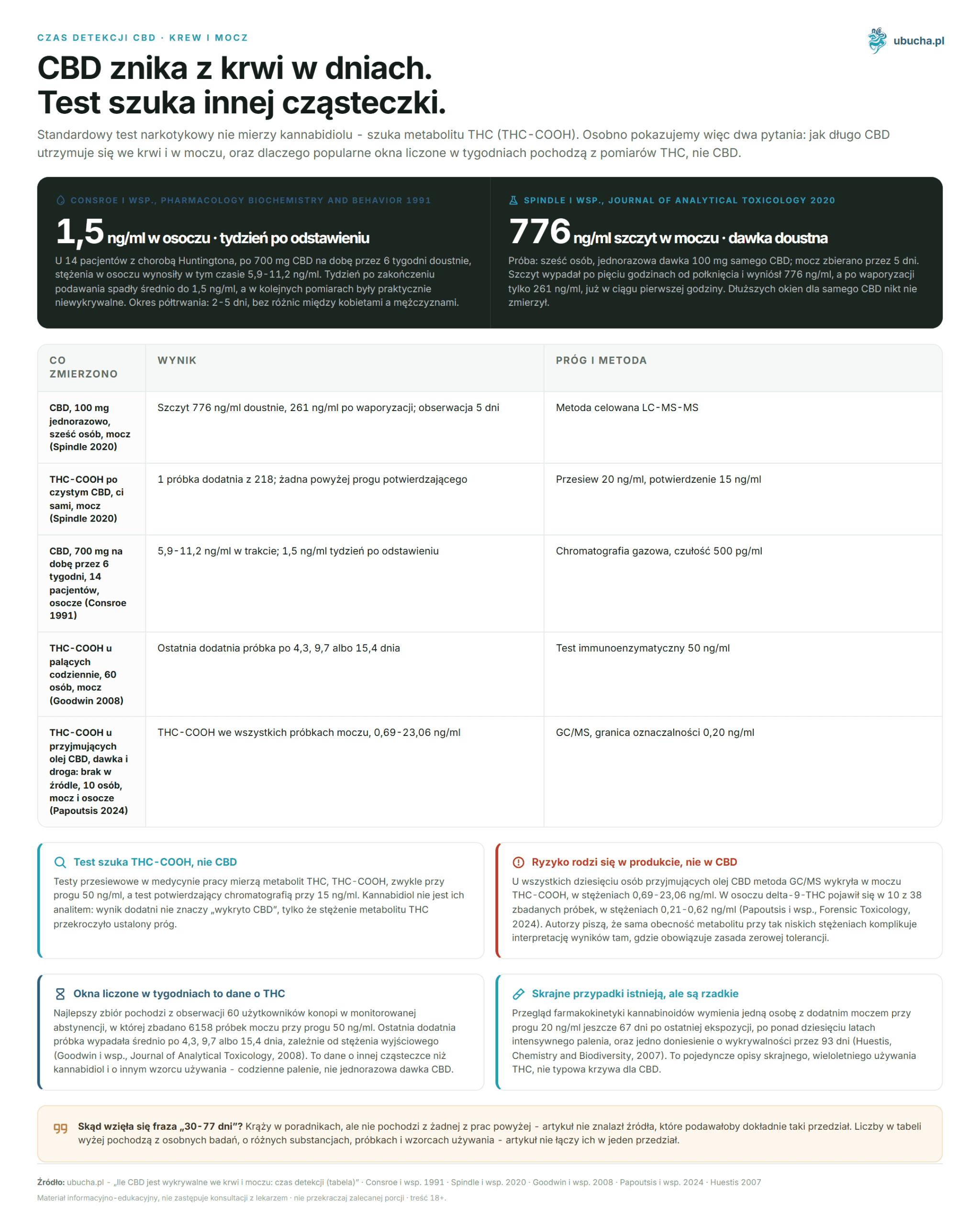
• Po jednorazowych 100 mg czystego CBD dodatnia była 1 próbka moczu z 218, i to przy obniżonym progu 20 ng/ml (Spindle i wsp., Journal of Analytical Toxicology, 2020).
• Osocze: przy 700 mg CBD na dobę przez sześć tygodni stężenia wynosiły 5,9-11,2 ng/ml, a tydzień po odstawieniu średnio 1,5 ng/ml (Consroe i wsp., 1991).
• Okna liczone w tygodniach pochodzą z pomiarów THC u osób palących codziennie, nie z pomiarów CBD (Goodwin i wsp., 2008).
• U wszystkich dziesięciu osób przyjmujących olej CBD wykryto w moczu THC-COOH, w stężeniach 0,69-23,06 ng/ml (Papoutsis i wsp., Forensic Toxicology, 2024).
Czego naprawdę szuka standardowy test narkotykowy?
Szuka THC-COOH, czyli 11-nor-9-karboksy-delta-9-THC. Testy immunoenzymatyczne stosowane w medycynie pracy pracują zwykle przy progu przesiewowym 50 ng/ml, a test potwierdzający metodą chromatografii sprzężonej ze spektrometrią mas przy progu 15 ng/ml; te dwie wartości pochodzą z wytycznych federalnych obowiązujących w Stanach Zjednoczonych, do których odnoszą się cytowane niżej badania. Sam kannabidiol nie jest analitem tych badań.
To rozróżnienie decyduje o interpretacji każdej liczby dni. Wynik dodatni nie znaczy „wykryto CBD”, tylko „stężenie metabolitu THC przekroczyło ustalony próg”. Ta sama próbka moczu przy progu 20 ng/ml bywa dodatnia, a przy 50 ng/ml ujemna, i dokładnie tak wyglądały wyniki w badaniu opisanym niżej. Dlatego okno detekcji podane bez progu i bez metody nie mówi nic.
Oznaczenie samego kannabidiolu jest technicznie możliwe, ale wymaga metody celowanej i zamawia się je w badaniach naukowych albo przy kontroli składu produktu. Pracodawca ani policja drogowa go nie zlecają, bo kannabidiol nie figuruje w wykazach substancji kontrolowanych i nie ma dla niego progu odpowiedzialności.
Stąd bierze się pozorny paradoks, który wraca w pytaniach czytelników. Stężenia kannabidiolu w moczu bywają wielokrotnie wyższe niż stężenia metabolitu THC, a mimo to wynik badania wychodzi ujemny, bo nikt tej substancji nie mierzy. Odwrotnie działa to przy produktach pełnospektralnych: kannabidiolu jest w nich najwięcej, ale o wyniku decyduje śladowa domieszka.
Jak długo CBD utrzymuje się we krwi?
Najdłuższy opublikowany pomiar u ludzi pochodzi z badania nad chorobą Huntingtona. Czternastu pacjentów przyjmowało doustnie 10 mg CBD na kilogram masy ciała na dobę, czyli około 700 mg dziennie, przez sześć tygodni. Średnie stężenia w osoczu wynosiły przez ten czas 5,9-11,2 ng/ml.
Najważniejsza dla tego tematu jest część po odstawieniu. Tydzień po zakończeniu podawania stężenie CBD wynosiło średnio 1,5 ng/ml, a w kolejnych pomiarach było praktycznie niewykrywalne. Okres półtrwania autorzy oszacowali na około 2-5 dni, bez różnic między kobietami a mężczyznami (Consroe i wsp., Pharmacology Biochemistry and Behavior, 1991).
Ta wartość zgadza się z przeglądem systematycznym danych farmakokinetycznych u ludzi, który podaje okres półtrwania 1,4-10,9 godziny po aerozolu na błonę śluzową, około 31 godzin po paleniu i 2-5 dni przy przewlekłym podawaniu doustnym (Millar i wsp., Frontiers in Pharmacology, 2018). Ten sam przegląd podaje, że bezwzględną biodostępność CBD zmierzono u ludzi wyłącznie po paleniu i wyniosła 31%. Krążące przedziały w rodzaju 6-19% dla drogi doustnej albo 31-56% dla waporyzacji nie mają za sobą pomiaru.
Warto zwrócić uwagę na skalę dawki. Siedemset miligramów dziennie przez sześć tygodni to schemat kliniczny w chorobie neurologicznej, wielokrotnie wyższy od typowej suplementacji, więc podane czasy są górnym, a nie przeciętnym oszacowaniem.
Ile kannabidiolu pojawia się w moczu i jak długo?
Najlepiej opisany pomiar objął sześcioro zdrowych dorosłych w układzie naprzemiennym z czterema wariantami: 100 mg CBD doustnie, 100 mg CBD w waporyzatorze, waporyzowane konopie o przewadze CBD (100 mg CBD i 3,7 mg THC) oraz placebo. Mocz zbierano przed podaniem i przez pięć dni po nim.
Stężenia samego kannabidiolu były wysokie: średnie stężenie szczytowe wyniosło 776 ng/ml po podaniu doustnym i 261 ng/ml po waporyzacji, przy czym szczyt wypadał po pięciu godzinach od połknięcia i w ciągu pierwszej godziny po inhalacji. Po czystym CBD dodatnia okazała się jedna próbka z 218, i to dopiero przy obniżonym progu 20 ng/ml, a żadna nie przekroczyła progu potwierdzającego 15 ng/ml. Po waporyzacji konopi o przewadze CBD dziewięć próbek wyszło dodatnio przy progu 20 ng/ml, dwie także przy 50 ng/ml, a cztery potwierdzono metodą celowaną (Spindle i wsp., Journal of Analytical Toxicology, 2020).
Ograniczenie tej pracy trzeba podać razem z wynikiem, bo w internecie krąży jej rozciągnięta wersja. Próbki zbierano przez pięć dni, więc badanie nie odpowiada na pytanie, co dzieje się w drugim ani trzecim tygodniu. Teksty, które powołują się na nie przy oknach detekcji rzędu 10-15 dni, przypisują mu ustalenia, których nie zawiera.
Skąd biorą się okna detekcji liczone w tygodniach?
Z pomiarów THC u osób palących konopie codziennie, nie z pomiarów kannabidiolu. To dwie różne cząsteczki o różnym metabolizmie i mieszanie ich danych jest najczęstszym błędem w tym temacie.
Najlepszy zbiór pochodzi z obserwacji 60 użytkowników konopi w warunkach monitorowanej abstynencji trwającej do 30 dni, w której zbadano 6158 próbek moczu przy progu 50 ng/ml. Ostatnia dodatnia próbka wypadała średnio po 4,3, 9,7 albo 15,4 dnia, zależnie od stężenia wyjściowego THC-COOH skorygowanego kreatyniną (Goodwin i wsp., Journal of Analytical Toxicology, 2008).
Przypadki skrajne istnieją, ale są opisywane pojedynczo. Przegląd farmakokinetyki kannabinoidów u ludzi wymienia jedną osobę, u której mocz był dodatni przy progu 20 ng/ml jeszcze 67 dni po ostatniej ekspozycji, po ponad dziesięciu latach intensywnego palenia, oraz jedno doniesienie o wykrywalności przez 93 dni (Huestis, Chemistry and Biodiversity, 2007). Powtarzana w poradnikach fraza „30-77 dni” nie pochodzi z żadnej z tych prac i nie udało się wskazać źródła, które podawałoby dokładnie taki przedział.
| Co zmierzono | Materiał | Wynik | Próg i metoda |
|---|---|---|---|
| CBD, 100 mg jednorazowo, sześć osób | mocz | szczyt 776 ng/ml doustnie, 261 ng/ml po waporyzacji; obserwacja 5 dni | metoda celowana LC-MS-MS |
| THC-COOH po czystym CBD, sześć osób | mocz | 1 próbka dodatnia z 218; żadna powyżej progu potwierdzającego | test przesiewowy 20 ng/ml, potwierdzenie 15 ng/ml |
| CBD, 700 mg na dobę przez 6 tygodni, 14 pacjentów | osocze | 5,9-11,2 ng/ml w trakcie; 1,5 ng/ml tydzień po odstawieniu | chromatografia gazowa, czułość 500 pg/ml |
| THC-COOH u palących codziennie, 60 osób | mocz | ostatnia dodatnia próbka po 4,3, 9,7 albo 15,4 dnia | test immunoenzymatyczny 50 ng/ml |
| THC-COOH u przyjmujących olej CBD, 10 osób | mocz i osocze | THC-COOH we wszystkich próbkach moczu, 0,69-23,06 ng/ml | GC/MS, granica oznaczalności 0,20 ng/ml |
Czy legalny olejek CBD może dać wynik dodatni?
Może, ale ryzyko nie leży w samej cząsteczce kannabidiolu, tylko w śladowym THC, które trafia do produktu razem z ekstraktem. Pomiar u dziesięciu osób przyjmujących olej CBD wykazał metodą GC/MS obecność THC-COOH we wszystkich próbkach moczu, w stężeniach 0,69-23,06 ng/ml, przy granicy oznaczalności 0,20 ng/ml.
Samego delta-9-THC w moczu nie wykryto, ale w osoczu pojawił się w 10 z 38 zbadanych próbek, w stężeniach 0,21-0,62 ng/ml (Papoutsis i wsp., Forensic Toxicology, 2024). Autorzy wyciągają z tego wniosek ostrożny: sama obecność metabolitu przy tak niskich stężeniach komplikuje interpretację wyników tam, gdzie obowiązuje zasada zerowej tolerancji.
Druga część problemu to skład produktów. W analizie 80 nieuregulowanych preparatów konopnych delta-9-THC wykryto powyżej granicy oznaczalności w 52 próbkach, w stężeniach od 0,008 do 2,071 mg/ml. Spośród 21 produktów opisanych jako pozbawione THC pięć zawierało wykrywalne stężenia, od 0,015 do 0,656 mg/ml (Johnson i wsp., Drug and Alcohol Dependence, 2022). Wcześniejsza analiza 84 preparatów kupionych przez internet wykryła THC w 21,4% próbek (Bonn-Miller i wsp., JAMA, 2017). Dlatego certyfikat analizy od niezależnego laboratorium jest jedyną informacją, która cokolwiek tu rozstrzyga. Jak działają same testy, rozkłada na czynniki nasz tekst o tym, czy CBD wychodzi na testach narkotykowych.
Co polskie prawo mówi o CBD, kierowcy i progu THC?
Kannabidiol nie figuruje w żadnym z wykazów substancji kontrolowanych. Nie ma dla niego ani progu odpowiedzialności, ani obowiązku badania. Wykazy prowadzi rozporządzenie Ministra Zdrowia z 17 sierpnia 2018 r. w sprawie wykazu substancji psychotropowych, środków odurzających oraz nowych substancji psychoaktywnych (t.j. Dz.U. 2024 poz. 1139 ze zmianami), a słowo „kannabidiol” nie występuje w nim ani razu.
Wartość 0,3% bywa w poradnikach przedstawiana jako dopuszczalna zawartość THC w produkcie CBD i to jest błąd. Próg ten definiuje konopie włókniste: jest to suma delta-9-THC oraz kwasu tetrahydrokannabinolowego w kwiatowych lub owocujących wierzchołkach rośliny, z których nie usunięto żywicy, zaokrąglona do jednego miejsca po przecinku. Podstawą jest art. 4 pkt 5 ustawy z 29 lipca 2005 r. o przeciwdziałaniu narkomanii (t.j. Dz.U. 2023 poz. 1939), w brzmieniu nadanym ustawą z 24 marca 2022 r. (Dz.U. 2022 poz. 763). Dotyczy rośliny, nie gotowego wyrobu, i nie jest zezwoleniem na zawartość THC w olejku.
Dla kierowcy polskie prawo nie ustala liczbowego progu stężenia. Badanie na obecność środków działających podobnie do alkoholu prowadzi się na podstawie art. 129j Prawa o ruchu drogowym, a wartość 1 ng/ml, którą poradniki podają jako granicę odpowiedzialności, jest granicą oznaczalności metody z rozporządzenia z 2014 r. (Dz.U. 2014 poz. 948). Dla śliny rozporządzenie nie zna żadnego progu. Osobno warto pamiętać, że CBD pozostaje w Unii nieautoryzowaną nową żywnością, a powiadomienie sanitarne nie jest autoryzacją.
Najczęściej zadawane pytania
Czy CBD wychodzi na standardowym teście narkotykowym?
Samo CBD praktycznie nie daje wyniku dodatniego, bo testy przesiewowe mierzą THC-COOH, a nie kannabidiol. Po jednorazowej dawce 100 mg czystego CBD dodatnia była jedna próbka z 218, i to przy obniżonym progu 20 ng/ml, a żadna nie przekroczyła progu potwierdzającego 15 ng/ml (Spindle i wsp., 2020). Ryzyko wnosi śladowe THC obecne w produkcie.
Jak długo CBD jest wykrywalne we krwi?
Przy 700 mg na dobę przez sześć tygodni stężenia w osoczu wynosiły 5,9-11,2 ng/ml, tydzień po odstawieniu spadły średnio do 1,5 ng/ml, a potem były praktycznie niewykrywalne (Consroe i wsp., 1991). Okres półtrwania przy przewlekłym podawaniu doustnym oszacowano na 2-5 dni. Przy dawkach suplementacyjnych stężenia są odpowiednio niższe.
Jak długo CBD pozostaje w moczu?
Jedyny kontrolowany pomiar zbierał mocz przez pięć dni po jednorazowych 100 mg i wykazał stężenia szczytowe 776 ng/ml po podaniu doustnym oraz 261 ng/ml po waporyzacji (Spindle i wsp., 2020). Dłuższych okien dla kannabidiolu nikt nie zmierzył, więc podawane w poradnikach 10-15 dni jest liczbą bez badania.
Skąd biorą się liczby w rodzaju 15 albo 30 dni?
Z pomiarów THC-COOH u osób palących konopie codziennie. W obserwacji 60 użytkowników przy progu 50 ng/ml ostatnia dodatnia próbka moczu wypadała średnio po 4,3, 9,7 albo 15,4 dnia, zależnie od stężenia wyjściowego (Goodwin i wsp., 2008). To dane o innej cząsteczce niż kannabidiol i o innym wzorcu używania.
Czy izolat CBD jest bezpieczniejszy niż olejek pełnospektralny?
Pod względem ryzyka wyniku dodatniego tak, bo źródłem problemu jest THC, a nie kannabidiol. Gwarancji to jednak nie daje: w analizie 80 preparatów pięć z 21 opisanych jako pozbawione THC zawierało wykrywalne stężenia tej substancji (Johnson i wsp., 2022). Rozstrzyga wyłącznie certyfikat analizy konkretnej partii.
Czy polskie prawo wyznacza próg THC dla kierowcy?
Nie. Przepisy nie podają liczbowej granicy stężenia dla kierującego, a wartość 1 ng/ml z rozporządzenia z 2014 r. (Dz.U. 2014 poz. 948) jest granicą oznaczalności metody, nie progiem odpowiedzialności. Dla śliny żadnego progu w przepisach nie ma. Podstawą badania na obecność środków działających podobnie do alkoholu jest art. 129j Prawa o ruchu drogowym.
Olejki dostępne w naszym sklepie zebraliśmy w kategorii olejki; certyfikat analizy sprawdzaj zawsze dla konkretnej partii. Szersze omówienie samego czasu wykrywalności zebraliśmy w tekście o tym, ile CBD utrzymuje się w moczu, a dane o samym THC w tekście o tym, ile marihuana pozostaje w organizmie.
Artykuł ma charakter informacyjno-edukacyjny i nie stanowi porady prawnej. Stan prawny opisany w artykule obowiązuje na dzień publikacji: regulacje dotyczące konopi mogą ulec zmianie. Przed podjęciem decyzji konsultuj się z prawnikiem lub aktualnymi aktami prawnymi.
Autor: Michał Waluk · Opublikowano: 2026-07-31 · Aktualizacja: 2026-08-16