
Spasticity in multiple sclerosis: what meta-analyses have shown and what has not been tested for dried flower
Among the eight indications described in this comparison, spasticity has the most solid evidence, yet it is narrow: two meta-analyses describe one disease and preparations with established composition, not dried flower sold under the strain name.
What have studies shown about hemp in relation to spasticity?
Two meta-analyses of randomized studies describe a measurable but narrow improvement. The first reports a reduction in spasticity of 0.25 standard deviations compared to placebo, while the second reports an odds ratio for improvement of 2.41 in patients resistant to standard treatment. Both pertain to multiple sclerosis and preparations with a fixed composition, not dried flower described by strain name.
Among the eight indications described in this summary, spasticity has the most solid evidence, and it must be stated plainly. The work of Torres-Moreno and co-authors from 2018 in JAMA Network Open (PMID:30646241) is a systematic review with a meta-analysis of randomized, double-blind, placebo-controlled studies, encompassing 17 studies and 3161 participants with multiple sclerosis. Compared to placebo, cannabinoids reduced spasticity as assessed by the patient by 0.25 standard deviations (95 percent confidence interval from minus 0.38 to minus 0.13), pain by 0.17, and bladder dysfunction by 0.11. The term 'limited efficacy' comes from the authors themselves, not from our editorial caution.
The second entry is a systematic review by Kleiner and co-authors from 2023 in Current Neuropharmacology (PMID:37519000), consisting of 7 randomized studies and 1128 participants. In patients resistant to standard treatment, nabiximols added to existing therapy resulted in an odds ratio for improvement on a numerical spasticity scale of 2.41 (95 percent confidence interval from 1.39 to 4.18). The authors reported at least some reservations in the assessment of the risk of systematic error and noted that the dose, duration of treatment, and timing of initiation are not established.
| Work | Study model | What was measured | Outcome | Outcome boundary |
|---|---|---|---|---|
| Torres-Moreno 2018, JAMA Network Open | systematic review with a meta-analysis of randomized, double-blind, placebo-controlled studies; 17 studies, 3161 participants with multiple sclerosis | spasticity assessed by the patient | reduction of 0.25 standard deviations compared to placebo | the authors called efficacy limited |
| Kleiner 2023, Current Neuropharmacology | systematic review with a meta-analysis of randomized studies; 7 studies in the meta-analysis, 1128 participants | improvement on a numerical spasticity scale in patients resistant to standard treatment | odds ratio of 2.41 | at least some reservations in the assessment of the risk of systematic error; dose and duration of treatment not established |
The effect measured in these meta-analyses is based on the assessment made by the patient, not on a scale filled out by the examiner, and the authors themselves call it limited. The evidence pertains to one disease, multiple sclerosis, and to preparations with a fixed composition administered orally or to the mucosa of the oral cavity. There are no studies examining dried hemp described by strain name, either in multiple sclerosis or in spasticity of other origins.
What is spasticity and in whom has it been studied?
Spasticity is a velocity-dependent increase in muscle tone that occurs after damage to the upper motor neuron. It manifests as resistance during passive movement and painful spasms. Both meta-analyses included only patients with multiple sclerosis, so they say nothing about spasticity after a stroke, spinal cord injury, or in cerebral palsy.
Damage to the corticospinal pathways removes inhibition from the muscles, causing the stretch reflex to become excessive. The patient experiences this as stiffness in the limb, painful nocturnal cramps, and difficulty initiating movement. Multiple sclerosis is just one of the causes of such a condition, as spasticity also accompanies the aftermath of a stroke, spinal cord injuries, and motor neuron diseases.
Narrowing the evidence to one disease is not a methodological detail. The response to treatment was measured in those 3161 and 1128 individuals who were included in both reviews, all of whom had diagnosed multiple sclerosis. Transferring such a result to spasticity of a different origin would be a conclusion that none of these studies make, and the question about dried flower under a specific name usually arises precisely outside of that one disease. Neuropathic pain It has a separate entry in this compilation because evidence for it was gathered in different studies and on different patients.
Who assesses spasticity in these studies?
The patient. The improvement reported by both meta-analyses comes from the assessment made by the patient, and the second study refers to this assessment as a numerical spasticity scale. The Ashworth scale, which is filled out by the examiner after passive movement of the limb, measures muscle resistance, not the patient's perception, and it is not the one that provided the cited number.
The modified Ashworth scale assesses the resistance that the muscle offers during passive movement performed by the examiner and assigns it a degree on a short point scale. The assessment made by the patient asks about something different: how much stiffness interferes with them during the day. Both measures can diverge in the same study because they refer to two different things called spasticity.
A size of 0.25 standard deviations describes a small effect. The confidence interval from minus 0.38 to minus 0.13 lies entirely on the side of improvement, but it is all within the range of small values, so a statistically significant result does not translate here into a noticeable change in fortune. The same work reported alongside spasticity an effect for pain equal to 0.17 and for bladder dysfunction equal to 0.11, which is even smaller than that concerning muscle stiffness. Hence the cautious tone of the first meta-analysis. It is worth reading these two things together: those who ask about the scale of benefits receive a different answer than those who ask about the mere fact of its existence.
What strain characteristics are important here?
None established. Neither the chemotype nor the terpene profile of a single strain has been tested in spasticity: both meta-analyses describe preparations with a defined composition, administered orally or on the mucous membrane of the oral cavity, rather than dried flower dispensed in pharmacies under the strain name. The difference between the two is the whole point here.
The register describes the positions of dried flower by the declared content of active substances, while commercial databases add the scent profile to this. None of this data has been linked to spasticity in a controlled study, so a statement about a strain chosen for this indication would be a fabrication, not a conclusion.
The data on composition is also not solid ground. Out of 145 positions with specified shares of aromatic components, the total of these shares adds up to exactly one hundred in only twelve cases, exceeds one hundred in six, and the highest reaches 125. The denominator is therefore unknown and varies in different compilations, which is why we do not provide shares numerically.
The names under which dried flower enters circulation are collected dried flower category, and the individual aromatic components describe separate entries in this compilation, including the one dedicated to mircenowi. A list of positions available in Polish pharmacies is maintained a summary of available strains.
How long does the effect last after vaporization, and how long after ingestion?
It depends on the route of administration, not the strain name. The distinction matters here more than usual, as both meta-analyses evaluated preparations that were swallowed or sprayed on the mucous membrane of the oral cavity, which is a slower route with a longer episode than inhalation from a vaporizer. The following ranges pertain to the entire group of raw material.
The route of administration determines the course more than the variety itself. After vaporization, the substance passes from the lungs to the blood almost immediately, so the first sensations appear after a few minutes, the intensity increases for another ten to thirty minutes, and the whole effect lasts for two to four hours. After ingestion, the raw material first passes through the intestine and liver, so the first sensations are awaited from half an hour to two hours, and the episode can last six, sometimes eight hours. Hence the most common mistake with oral administration: anyone who thinks nothing is happening after thirty minutes and takes another dose will receive both doses at once. The above ranges describe the route of administration, not this variety; pharmacokinetic studies for a single cultivar have not been published.
This is important when reading both reviews. Since they measured oral administration and administration to the mucous membrane of the oral cavity, the inhalation process described above with a vaporizer is not what was evaluated in these studies. Osobny wpis tego zestawienia This explains why the device's setting does not equal the temperature of the raw material itself.
What does the doctor decide, and what does the patient decide?
The doctor in charge decides everything related to treatment. In Poland, this raw material is dispensed solely by prescription, in the Rpw category, and there is no approved list of indications for it, so the doctor determines whether to use it for a specific patient, in what form, and for how long.
Nabiximols, a standardized extract sprayed on the mucous membrane of the oral cavity, have registered medicinal product status in Poland, with an indication limited to spasticity in multiple sclerosis patients for whom previous treatment has not improved their condition. Dried hemp does not have such a record in documentation, as it remains a raw material from which a medicine is prepared, not a ready-made preparation with a studied indication.
On the patient's side remains what no one can do for them: describing their own symptoms, reporting adverse effects, and adhering to the arrangements from the visit. Independently changing the dose or route of administration goes beyond what the doctor planned. Advertising medicinal products dispensed by prescription to the public is prohibited, so this text describes the state of evidence and stops there. The availability of individual positions changes over time, as permits for the admission of raw materials are time-limited, and supplies can be interrupted, so the conversation in the office also concerns what can currently be realized in the pharmacy.
What adverse effects have been reported in studies on this indication?
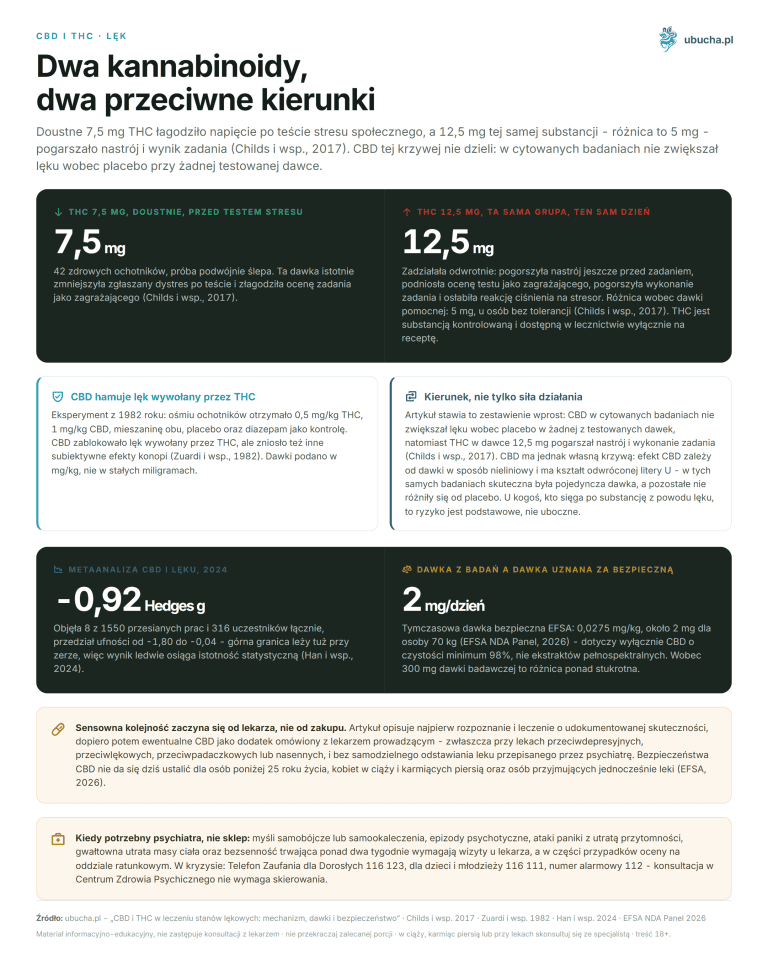
More frequent than with placebo. In a systematic review with a meta-analysis of 17 randomized, double-blind, placebo-controlled studies, the overall risk of adverse events was 1.72 times higher, and withdrawals from the study due to them were 2.95 times higher. For serious adverse events, the difference was not significant.
Both of these values are risk ratios compared to placebo, not the frequency of a single symptom. They indicate how many times more often the event occurred in the group receiving cannabinoids, and nothing more. Withdrawals from the study are a stronger measure than the number of reports themselves, as each one represents a decision to discontinue participation. The evidence base for this compilation does not carry separate numbers for safety from the 2023 review, so both values above come from a 2018 study.
Reports of adverse effects are collected for medicinal products with a batch number, not for the strain name, so the following pertains to hemp dried flower as a group of raw materials. The most frequently reported symptoms are dry mouth, red eyes, and increased heart rate. Dizziness upon rapid standing, daytime drowsiness, and temporary worsening of short-term memory are less frequently described, as well as anxiety that increases with dosage. A separate issue is medications taken concurrently, especially sedatives and those affecting coagulation: their assessment requires knowledge of the entire list of preparations, not just the description of the plant. We do not provide the frequency of these symptoms numerically, as public compilations for hemp dried flower in Poland do not separate them by individual products.
Frequently asked questions about spasticity and hemp
Has the dried flower described by strain name been studied in spasticity?
No. Both meta-analyses evaluated preparations with a defined composition administered orally or on the mucous membrane of the oral cavity. There are no studies for dried flower dispensed under the strain name, neither in multiple sclerosis nor in spasticity of other origins.
What does an improvement of 0.25 standard deviations mean?
It means that the difference compared to placebo was small. The standard deviation describes the spread of results in the studied group, and a quarter of that spread is a small shift, although in this meta-analysis, it was statistically significant. The authors of the 2018 study called the effectiveness limited.
How does the patient's assessment differ from the scale filled out by the examiner?
The patient's assessment describes the feeling of stiffness in daily life, while the Ashworth scale describes the resistance of the muscle during passive movement performed by the examiner. The cited improvement comes from the first of these measures, not the second.
Is nabiksimole the same as dried flower?
No. Nabiksimole is a registered medicinal product with a defined composition, sprayed onto the mucous membrane of the oral cavity. Dried flower is a pharmaceutical raw material with declared active substance content, without an approved indication.
How often were adverse effects reported in these studies?
In the 2018 review, the overall risk of adverse events was 1.72 times higher than with placebo, and withdrawals from the study due to them were 2.95 times higher. For serious adverse events, the difference was not significant.
Does this text replace a conversation with a doctor?
No. It describes the state of scientific evidence and is not therapeutic advice. The diagnosis, choice of treatment, and its management are determined by the attending physician, and dried flower is dispensed only by prescription.
Dried hemp is a pharmaceutical raw material dispensed by a doctor's prescription in the Rpw category. The material is informational in nature and does not replace medical advice. The editorial text was prepared by redakcja ubucha.pl.