
Resolving inflammation - lipoxins, resolvins, and the role of the CB2 receptor
Resolving inflammation — a mechanism explained simply, based on research. u Bucha.
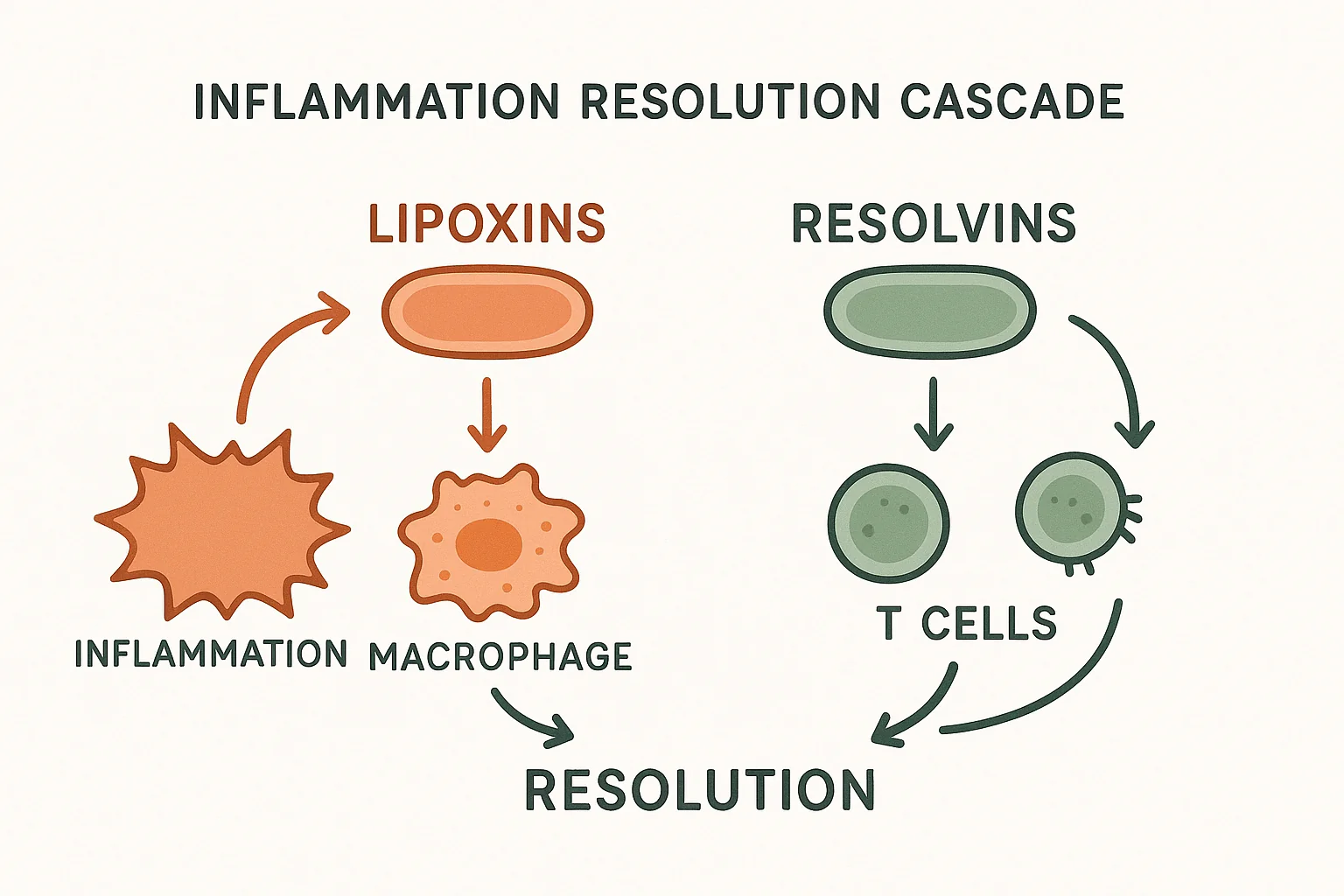
Inflammation should come to an end. In a healthy body, inflammation has a limited duration - defense is activated, after which an active resolution program is initiated. Serhan and colleagues discovered a class of molecules called SPM (specialized pro-resolving mediators), which do not inhibit inflammation like ibuprofen, but actively initiate its extinguishing by stimulating phagocytosis and tissue regeneration (Serhan, Annual Review of Immunology, 2014). The CB2 receptor of the endocannabinoid system works in a similar way - its activation promotes the pro-resolving phenotype of macrophages, mimicking the effect of endogenous SPM. This article explains how lipoxins and resolvins resolve inflammation, how CB2 fits into this pathway, and why chronic inflammation is often a defect in resolution, not an excess of inflammatory signals.
KEY INFORMATION
• SPM (lipoxins, resolvins, protectins) are bioactive lipids that actively resolve inflammation - not inhibiting it like NSAIDs (Serhan, Annual Review of Immunology, 2014).
• The CB2 receptor on macrophages promotes the transition from the pro-inflammatory M1 phenotype to the pro-resolving M2 - mimicking the effect of endogenous SPM.
• Omega-3 fatty acids (EPA, DHA) are substrates for the synthesis of resolvins and protectins - a diet low in omega-3 impairs the resolution of inflammation.
• Chronic inflammation often results from a defect in resolution (lack of SPM), rather than an excess of pro-inflammatory signals.
Two stages of inflammation - initiation and resolution
Inflammation is traditionally described by its initiation and maintenance: prostaglandins, leukotrienes, cytokines (TNF-alpha, IL-1beta, IL-6) as pro-inflammatory mediators. But that's only half the picture. Every acute inflammation that ends properly goes through an active resolution program - it is not simply "extinguished" by the cessation of the pro-inflammatory stimulus.
The resolution program is active and requires the synthesis of new signaling molecules. Serhan proposed the term "resolution of inflammation" in 2004 as a distinct, biologically regulated process - not a passive fade. Key evidence was the discovery that acute inflammation, even when the stimulus is removed, does not resolve spontaneously without active SPM synthesis. Blocking SPM synthesis leads to the transition of acute inflammation to chronic.
This is a revolution in thinking about chronic inflammation. Diseases like rheumatoid arthritis, Crohn's disease, or atherosclerosis are not solely the result of excessive "turning on" of inflammation - they can equally often be the result of a defect in "turning off." A lack of SPM, not an excess of pro-inflammatory cytokines, may be the key defect.
SPM - lipoksyny, rezolwiny, protektyny i marezyny
Lipoxins (LXA4, LXB4) are synthesized from arachidonic acid by lipoxygenase enzymes. They were the first discovered SPM - Serhan described them in 1984. They inhibit neutrophil recruitment to the site of inflammation and stimulate macrophages to phagocytose apoptotic neutrophils (efferocytosis). Their production is triggered by aspirin (acetylated COX-2 produces lipoxygenase 15-epi-LXA4 - hence "aspirin-triggered lipoxins").
We have noted that the aspirin paradox is rarely explained: aspirin works partially by inhibiting COX-2, but acetylated COX-2 shifts to producing aspirin-triggered lipoxins - anti-inflammatory SPM. This is one of the mechanisms by which low doses of aspirin have cardio- and neuroprotective effects - not solely by inhibiting COX-1 in platelets. This duality of aspirin/SPM is a textbook example of the complexity of inflammation pharmacology and indicates that "inhibiting inflammation" is an incomplete description of aspirin's action.
Resolvins, protectins, and maresins are synthesized from EPA (omega-3 from fish) and DHA (omega-3 from algae and fish). E series resolvins (RvE1, RvE2) come from EPA, D series resolvins (RvD1-RvD6) and protectins from DHA. Maresins (MaR1, MaR2) also have DHA as a substrate. All exhibit stronger pro-resolving activity than lipoxins and act at nanomolar concentrations.
| SPM | Substrate | Receptor | Main action |
|---|---|---|---|
| Lipoxin LXA4 | Arachidonic (omega-6) | ALX/FPR2 | Inhibition of neutrophils, efferocytosis |
| Resolvin RvD1 | DHA (omega-3) | DRV1/GPR32 | Phagocytosis, reduction of IL-1beta |
| Resolvin RvE1 | EPA (omega-3) | ChemR23, BLT1 | Reduction of TNF-alpha, tissue regeneration |
| Protectin PD1 | DHA (omega-3) | GPR37 | Neuroprotection, reduction of apoptosis |
| Marexyn MaR1 | DHA (omega-3) | LGR6 | Tissue regeneration, pain control |
CB2 receptor as a mediator of pro-resolving macrophage phenotype
The CB2 receptor is primarily expressed on immune system cells: macrophages, dendritic cells, B cells, and NK cells. Unlike CB1 (dominant in the CNS), CB2 plays a role as a modulator of the immune response. Its activation by endocannabinoids (2-AG is a strong agonist of CB2) or phytocannabinoids promotes the M2 macrophage phenotype.
M1 macrophages are the "soldiers of inflammation": they secrete TNF-alpha, IL-1beta, IL-6, reactive oxygen species, and iNOS. M2 macrophages are the "cleaners": they secrete IL-10, TGF-beta, arginase I, and promote efferocytosis, angiogenesis, and tissue repair. The M1/M2 polarization is not a binary decision but a spectrum - macrophages can shift between phenotypes in response to microenvironmental signals.
Activation of CB2 by 2-AG or selective CB2 agonists shifts macrophages towards M2 via the cAMP-PKA pathway, which inhibits NFkB and activates STAT6 - a transcriptional regulator of M2 polarization. The effect is similar to that of resolvin RvD1 on macrophages through the DRV1/GPR32 receptor. This is not a coincidence: both endocannabinoids through CB2 and SPM through their receptors direct the same cellular machinery towards resolving inflammation (O’Sullivan, British Journal of Pharmacology, 2016).
How does CBD fit into the inflammation resolution pathway?
CBD has weak direct affinity for CB2 - it is not a strong agonist of this receptor. However, CBD engages the inflammation resolution pathway through several other points. Firstly, through PPAR-gamma: activation of PPAR-gamma by CBD inhibits NF-kB (transrepression) and may promote the expression of M2 genes. Secondly, through FAAH inhibition: raising the level of 2-AG indirectly enhances CB2 signaling. Thirdly, through adenosine: higher levels of adenosine through ENT1 blockade activate the A2A receptor on macrophages, which independently promotes the M2 phenotype.
Our observations indicate that questions about the "anti-inflammatory effects of CBD" usually focus on the inhibition of pro-inflammatory cytokines - measured by concentrations of TNF-alpha, IL-6, or CRP. Less often, active resolution of inflammation is considered a therapeutic target. Meanwhile, it is precisely the defect in resolution - not an excess of initiation - that may be a key mechanism of chronic inflammatory states. CBD, acting through CB2 (indirectly), PPAR-gamma, and adenosine, may address this "resolution gap" in a way that is not fully described by measuring classical inflammatory markers.
Esposito and colleagues demonstrated that CBD administered in a neuroinflammation model reduced the expression of inflammatory genes in astrocytes and microglia. The key mechanism was the activation of PPAR-gamma (abolished by the antagonist GW9662) and indirectly CB2 (Esposito et al., PNAS, 2011). Although the study concerned a model, not a clinical setting, it indicates a direction: CBD can promote what SPM do through dedicated receptors via multiple pathways simultaneously.
Efferocytosis - a key process in resolving inflammation, driven jointly by SPM and CB2.
Efferocytosis is the phagocytosis of apoptotic (dying) cells by macrophages. It is one of the most important processes in resolving inflammation - dead neutrophils must be removed before they begin to undergo secondary necrosis and release pro-inflammatory cellular contents. If efferocytosis fails, inflammation persists: the accumulation of necrotic neutrophils maintains the recruitment of new inflammatory cells by releasing DAMPs (damage-associated molecular patterns).
Lipoxin LXA4 is one of the strongest known stimulators of efferocytosis - it activates the phagocytic machinery through the ALX/FPR2 receptor on macrophages while simultaneously inhibiting the release of signals that recruit new neutrophils. Resolvin RvD1 acts synergistically through the DRV1/GPR32 receptor. Together, they create a "signal of resolution" for inflammation: clear the debris, stop recruitment, rebuild tissue (Serhan, Annual Review of Immunology, 2014).
Activation of CB2 by endocannabinoids (2-AG) enhances efferocytosis through a convergent but independent pathway - cAMP/PKA. 2-AG released by apoptotic cells (the "find me" signal) activates CB2 on nearby macrophages, attracting them and preparing them for phagocytosis. This is a neat example of how the endocannabinoid system and the SPM pathway converge in a single biological process - efferocytosis - acting on different receptors but with the same effect: effective cleanup at the site of inflammation.
Chronic inflammation as a "trap" of resolution - the role of SPM deficiency in civilization diseases.
Recent studies have revealed that SPM levels in tissues are reduced in many chronic diseases: atherosclerosis, Alzheimer's disease, rheumatoid arthritis, and inflammatory bowel diseases. Importantly, the reduction of SPM is not always a consequence of the disease - it can be a cause. Individuals with low omega-3 content in their diet produce fewer resolvins and protectins, which may weaken their ability to resolve inflammation caused by infections or injuries.
The Western diet - low in omega-3, high in omega-6 - systematically lowers the EPA/DHA ratio to arachidonic acid in cell membranes. This structurally limits the synthesis of resolvins (which requires EPA/DHA) and promotes the synthesis of leukotrienes and prostaglandins (from arachidonic acid). Omega-3 supplementation at doses of 2-4 g EPA+DHA per day restores this ratio and raises SPM levels in plasma and tissues. This is one of the mechanisms by which omega-3 has clinically confirmed effects in inflammatory diseases - not only by inhibiting the synthesis of prostaglandins but also by actively enhancing resolution (Serhan, Annual Review of Immunology, 2014).
Frequently Asked Questions
What are lipoxins and resolvins?
Lipoxins and resolvins are specialized pro-resolving mediators (SPM) - bioactive lipids that actively initiate the resolution of inflammation. Lipoxins are synthesized from arachidonic acid, while resolvins are derived from omega-3 fatty acids (EPA and DHA). They stimulate the phagocytosis of inflammatory debris, inhibit the recruitment of neutrophils, and promote tissue rebuilding (Serhan, Annual Review of Immunology, 2014).
What is the role of the CB2 receptor in resolving inflammation?
The CB2 receptor on macrophages promotes the transition from the pro-inflammatory M1 phenotype to the pro-resolving M2 - through the cAMP-PKA pathway that inhibits NF-kB and activates STAT6. The effect is similar to that of resolvins on macrophages through their receptors. Activation of CB2 by 2-AG or phytocannabinoids enhances efferocytosis and the production of anti-inflammatory IL-10 and TGF-beta.
Does CBD activate the CB2 receptor?
CBD exhibits weak affinity for CB2 as a partial agonist - significantly weaker than CBG or THCV. Part of CBD's anti-inflammatory action may be mediated by CB2, but the key mechanisms of CBD (PPAR-gamma, 5-HT1A, adenosine, FAAH inhibition) are independent of CB2. Indirectly, CBD enhances CB2 signaling by raising the level of 2-AG through FAAH inhibition.
How does omega-3 in the diet support the production of SPM?
EPA and DHA from omega-3 are substrates for the synthesis of resolvins, protectins, and maresins. A diet low in omega-3 limits SPM synthesis - inflammation may not be effectively resolved and can progress to a chronic state. Omega-3 supplementation raises SPM levels in blood and tissues (Serhan, Annual Review of Immunology, 2014).
What is the difference between inhibiting inflammation and resolving it?
Inhibition of inflammation (NSAIDs, corticosteroids) blocks the production of pro-inflammatory mediators. Resolution of inflammation is an active program: removal of dead cells, tissue rebuilding, restoration of homeostasis - mediated by SPM and CB2. Chronic inflammation often results from a defect in resolution (lack of SPM), not from an excess of initiation - this is a key difference for therapy.
This article is for informational and educational purposes and does not constitute legal advice. The legal status described in the article is valid as of the publication date - regulations regarding cannabis may change. Consult a lawyer or current legal acts before making decisions.
Author: Michał Waluk · Published: 2026-05-04 · Updated: 2026-05-04