
Diabetes and THCV - a cannabinoid that blocks CB1 and improves insulin sensitivity
Cukrzyca a THCV — mechanizm wyjasniony prosto, w oparciu o badania. u Bucha.
THC stimulates appetite and may worsen insulin sensitivity. Its shorter relative - THCV (tetrahydrocannabivarin) - does exactly the opposite: it blocks the CB1 receptor and may improve glucose metabolism. Jadoon and colleagues conducted a 13-week randomized controlled trial (RCT) in 2016 on patients with type 2 diabetes, showing that THCV reduced fasting blood glucose and improved pancreatic beta cell function compared to placebo (Jadoon et al., Diabetes Care, 2016). It is one of the few phytocannabinoids with clinical evidence of its impact on glucose metabolism in humans. This article explains how THCV works at the molecular level, what studies say, and why a structural difference of just one carbon chain changes everything.
KEY INFORMATION
• THCV acts as a CB1 antagonist at low doses - the opposite of THC, which is a CB1 agonist (O’Sullivan et al., British Journal of Pharmacology, 2016).
• 13-week RCT: THCV 5 mg twice daily reduced fasting glycemia and improved beta cell function in patients with type 2 diabetes (Jadoon et al., Diabetes Care, 2016).
• THCV suppresses appetite - the opposite effect of THC - through antagonism of CB1 receptors in the hypothalamus.
• THCV also activates the CB2 receptor at higher doses, which may provide anti-inflammatory effects independent of glucose metabolism.
What is THCV and how does it differ so much from THC?
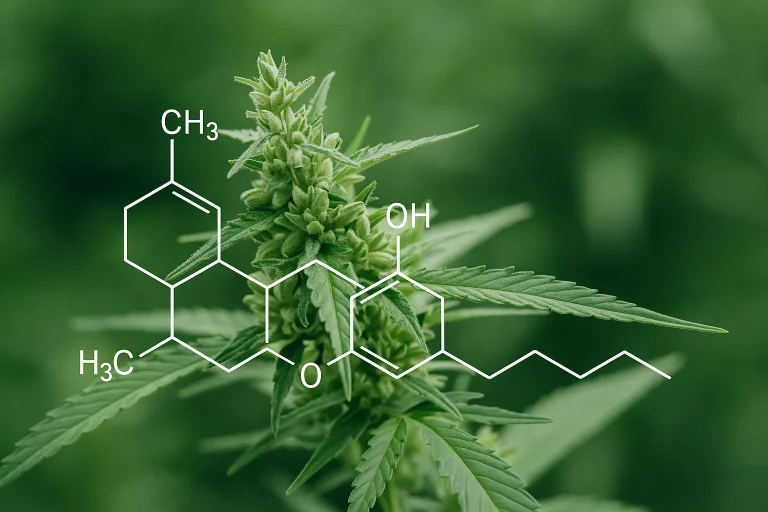
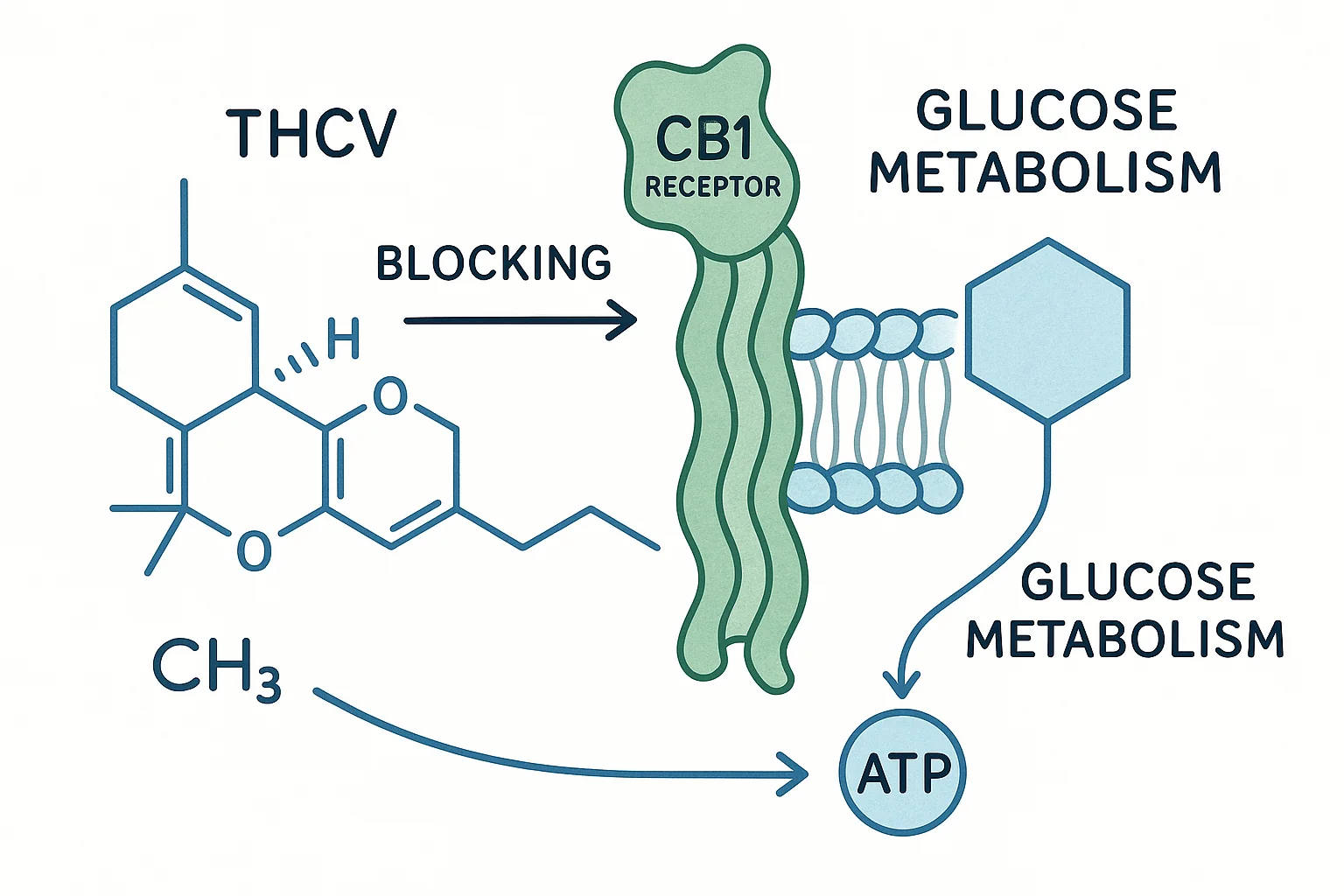
THCV (tetrahydrocannabivarin) has nearly identical chemical structure to THC - differing only in one aspect: the side chain. THC has a pentyl chain (five carbons). THCV has a propyl chain (three carbons). Two fewer carbon atoms. This seemingly minor detail completely reverses the pharmacological profile of the molecule.
What accounts for this dramatic difference? The binding pocket of the CB1 receptor is adapted to ligands with longer side chains - the pentyl chain of THC fits perfectly and activates the receptor. The propyl chain of THCV fits less well: it occupies the binding site but does not induce the active conformation of the receptor. Instead of activating CB1, THCV blocks it. This is a classic example of how a minimal structural change translates into a shift from agonist to antagonist - a fundamental principle of receptor pharmacology.
At higher doses, THCV behaves somewhat differently: data suggest that at concentrations above 1 μM, it begins to exhibit agonism towards CB2 (cannabinoid receptor type 2, primarily present in immune cells). This is important for its anti-inflammatory profile - and explains why the effects of THCV are dose-dependent in a not entirely linear manner.
Receptor CB1 a metabolizm glukozy - dlaczego blokowanie pomaga?
The CB1 receptor is expressed not only in the brain - it is also present in the liver, skeletal muscles, adipose tissue, and pancreas. Chronic overactivity of CB1 in these tissues - observed, among others, in obesity and poor diet - reduces insulin sensitivity and promotes fat accumulation. The mechanism involves the inhibitory phosphorylation of the insulin receptor substrate IRS-1 by kinases activated by the CB1-Gi/o pathway.
We have noted that a prescription for this problem has already been pharmacologically tested: rimonabant, a synthetic CB1 antagonist, was registered in Europe as a weight loss drug from 2006 to 2008. It worked - reducing body weight and improving metabolic profile. However, it caused serious psychiatric side effects (depression, suicidal thoughts) and was withdrawn from the market in 2008. THCV, acting as a CB1 antagonist at low doses and without fully blocking CB1 in the brain, is an attempt to achieve the metabolic effect of rimonabant without its neuropsychiatric side effects. This is an important context that rarely appears in articles about THCV.
THCV, by blocking CB1 in the liver, reduces de novo lipogenesis and steatosis. In skeletal muscles - it improves insulin signaling. In adipocytes - it inhibits triglyceride accumulation. In the pancreas - it may protect beta cells from glucotoxicity by reducing CB1-dependent oxidative stress. This is a multi-organ effect of a single mechanism.
| Tissue | Effect of CB1 Overactivity | Effect of THCV Blocking CB1 |
|---|---|---|
| Liver | Increased lipogenesis, steatosis | Decreased lipogenesis, improved glucose metabolism |
| Skeletal Muscles | Decreased insulin sensitivity (IRS-1↓) | Improved glucose uptake via GLUT4 |
| Adipose Tissue | Triglyceride accumulation, adipogenesis | Reduced adipogenesis, lipolysis |
| Pancreas (beta cells) | Glucotoxicity, oxidative stress | Protection of beta cells, improved insulin secretion |
| Hypothalamus | Increased appetite ("munchies") | Appetite suppression, weight reduction |
Clinical study of THCV in type 2 diabetes - what exactly has been demonstrated?
Jadoon and colleagues from GW Pharmaceuticals conducted a 13-week double-blind RCT with 62 patients with type 2 diabetes treated with diet or metformin. Patients were randomized into four groups: THCV 5 mg twice daily, CBD 100 mg twice daily, a combination of THCV+CBD, or placebo. The primary endpoint was metabolic markers of glucose.
Results of the THCV group: significant reduction in fasting glycemia (glucose AUC during the glucose tolerance test), improvement in HOMA2-B index (beta cell function of the pancreas), and increase in adiponectin (protective adipokine improving insulin sensitivity). The results of the CBD group were significantly different: CBD reduced the concentration of the incretin GIP and increased the concentration of apolipoprotein A, but did not significantly affect glycemia - confirming that THCV and CBD have different metabolic profiles despite both being cannabinoids (Jadoon et al., Diabetes Care, 2016).
Important caveat: the study had a small sample size (62 individuals), a short observation period (13 weeks), and was not powered statistically to detect first-line clinical effects. The results are promising as proof of concept, not as confirmation of clinical efficacy. Phase III studies with hundreds of patients are needed for that.
THCV and appetite and body weight - more than just glucose metabolism
The appetite-suppressing effect of THCV through CB1 antagonism in the hypothalamus is likely independent of peripheral metabolic effects. Studies in rodents have shown that THCV administered to obese mice reduced body weight, decreased energy intake, and improved lipid profile. These effects correlated with the blockade of CB1 receptors in the hypothalamus, as they were reversed by the administration of a CB1 agonist (Riedel et al., British Journal of Pharmacology, 2009).
Our observations suggest that THCV is one of the most interesting phytocatalysts among people with diabetes or insulin resistance who inquire about cannabinoids. However, the availability of products with controlled THCV content in Poland is very limited. Most CBD oils and full-spectrum hemp extracts contain trace amounts of THCV - too small to achieve pharmacologically significant concentrations. The Jadoon study used a standardized pharmaceutical preparation of 5 mg of pure THCV twice daily - this is a significant difference.
THCV and the pancreas - can it protect beta cells from glucotoxicity?
Beta cells of the pancreatic islets of Langerhans produce insulin. In type 2 diabetes, they are exposed to chronic glucotoxicity - damage from persistently elevated glucose levels - and lipotoxicity (damage from excess fatty acids). Both processes lead to a gradual loss of functional beta cell mass, exacerbating insulin deficiency. The CB1 receptor in the pancreas modulates insulin secretion: its overactivity is associated with oxidative stress in beta cells and apoptosis.
Studies on beta cell lines (MIN6, INS-1) have shown that selective CB1 antagonists reduce glucotoxicity-induced apoptosis and improve cell survival under high glucose conditions. THCV, as a CB1 antagonist, exhibited a similar protective effect in vitro. In the Jadoon clinical study, the improvement in the HOMA2-B index (beta cell function) in the THCV group was statistically significant - suggesting that the effect is not solely due to improved insulin sensitivity in peripheral tissues, but may also include protection of beta cells (Jadoon et al., Diabetes Care, 2016).
The protective mechanism of THCV in the pancreas may be multi-faceted: direct blockade of CB1 (reducing oxidative stress), activation of CB2 (anti-inflammatory effect), and indirect action through improved glycemia (less glucotoxicity). Distinguishing between these pathways requires studies with selective blockade of individual receptors - which has not been conducted in available clinical studies.
Prospects for THCV research - what awaits us in the next 5 years?
THCV is gaining increasing interest as a candidate for phase II clinical trials in several metabolic indications: type 2 diabetes without adequate glycemic control, obesity with insulin resistance, and non-alcoholic steatohepatitis (NASH). GW Pharmaceuticals (acquired by Jazz Pharmaceuticals) has submitted preliminary documents regarding THCV studies following promising results from Jadoon, although the clinical trial program is slower than expected.
The main barrier is not clinical data, but regulations and availability of raw materials. Chemical synthesis of THCV is possible but costly. Extraction from hemp is challenging due to low natural concentrations in most European strains. Selective breeding of THCV-rich strains (programs in the USA and Israel) may solve the availability issue. If phase II studies confirm the pilot results, THCV may achieve orphan drug status for treating metformin-resistant diabetes within 5-7 years - which would be a breakthrough for the entire class of phytocannabinoids as metabolic drugs.
Frequently Asked Questions
What is THCV and how does it differ from THC?
THCV (tetrahydrocannabivarin) differs from THC by a shorter side chain - propyl instead of pentyl. This change reverses the pharmacological profile: THCV at low doses is a CB1 antagonist, while THC is a CB1 agonist. THCV does not induce intoxication and suppresses appetite instead of stimulating it.
How does THCV affect glucose metabolism?
THCV, through CB1 antagonism, blocks the pathway by which CB1 hyperactivity in the liver and muscles reduces insulin sensitivity. In a 13-week RCT, 5 mg of THCV taken twice daily lowered fasting glycemia and improved pancreatic beta cell function in patients with type 2 diabetes (Jadoon et al., Diabetes Care, 2016).
Can THCV replace diabetes medications?
No. A single 13-week pilot study is insufficient to recommend THCV as a treatment. Drugs like metformin have decades of safety research. THCV may be a candidate for research as an adjunct therapy - not a substitute. Any changes in diabetes treatment should be consulted with an endocrinologist.
Why does THCV suppress appetite instead of stimulating it like THC?
THC, as a CB1 agonist, activates receptors in the hypothalamus responsible for appetite. THCV, as a CB1 antagonist, blocks these receptors, producing the opposite effect - appetite suppression. Studies on obese rodents confirm that this effect is mediated by CB1 in the hypothalamus (Riedel et al., British Journal of Pharmacology, 2009).
In which cannabis strains is THCV abundant?
THCV is most abundant in cannabis strains from East and Central Africa (landraces). Strains rich in THCV include Durban Poison and Doug's Varin. In Europe, certified industrial hemp strains usually contain trace amounts of THCV (below 0.1%). Standardized THCV preparations used in clinical studies are not available in the supplemental market in Poland.
This article is for informational and educational purposes and does not replace consultation with a doctor. If you are pregnant, breastfeeding, taking medications, or have chronic conditions, consult the use of supplements or herbs with a specialist.
Author: Michał Waluk · Published: 2026-05-04 · Updated: 2026-05-04