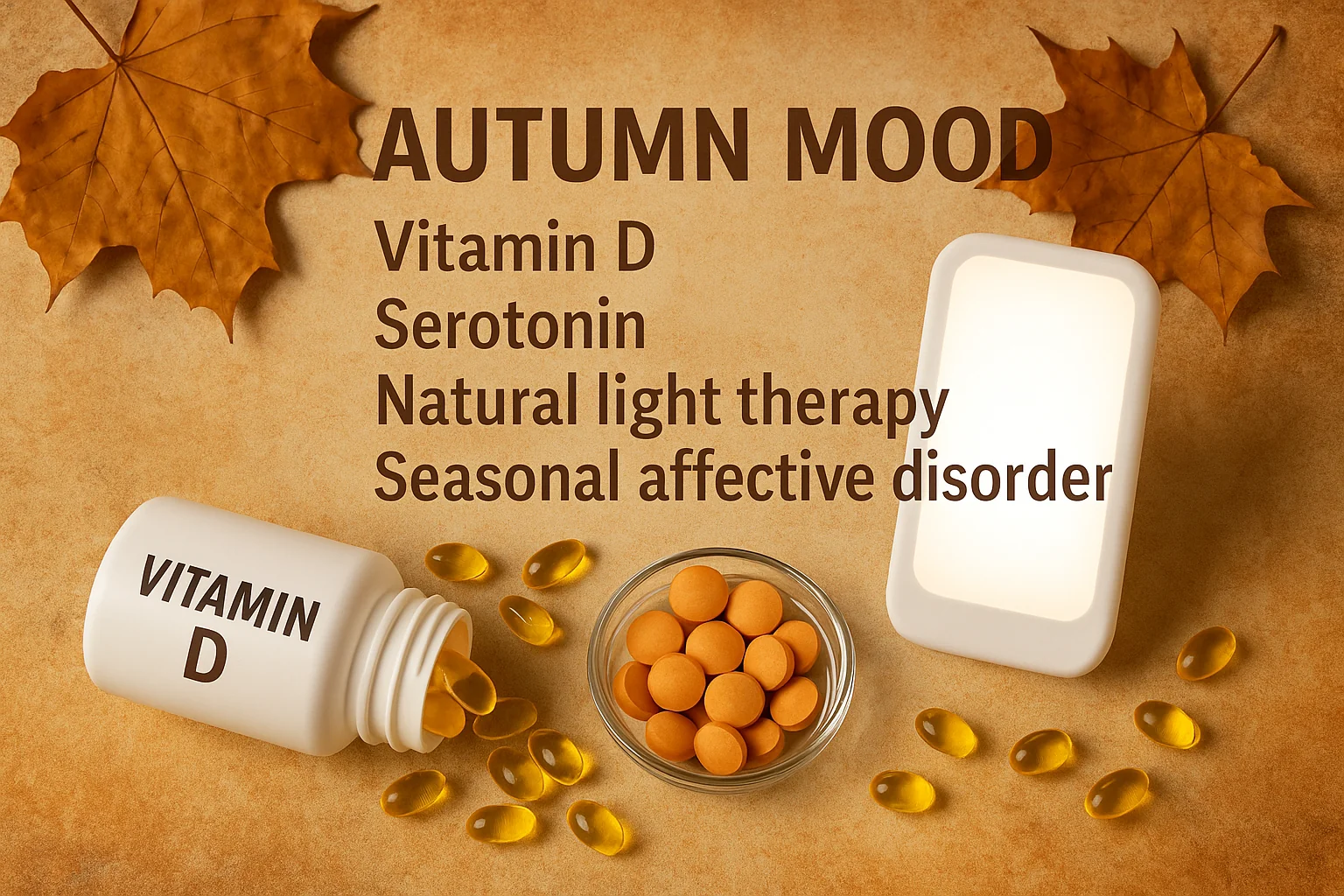

Supplements for autumn blues and SAD: what really helps (ranking)
Ranking of supplements for autumn blues and SAD according to the strength of evidence: saffron, omega-3, vitamin D3, magnesium, ashwagandha. Prices from the store, status as of 08.2026.
In autumn, the day in Poland shortens by half, and along with it, mood, energy, and the desire to leave the house decline. For some people, this ends in seasonal lethargy. For others, it develops into seasonal affective disorder (SAD), a clinically recognized form of depression with a winter rhythm. The supplement market offers a ready answer to this. We checked what withstands scrutiny against research: we read the studies cited by manufacturers and then compared them with what is actually on our shelf. The ranking below arranges seven substances according to the strength of evidence, not by margin. We start with the most important thing, which is the threshold beyond which a supplement ceases to be a solution.
KEY INFORMATION
• In winter and spring, 89.9% of Polish adults have 25(OH)D levels below 30 ng/ml (Płudowski et al., 2016).
• In SAD, bright light therapy is effective: 67% response rate, the same as fluoxetine (Lam et al., 2006).
• None of the supplements on this list treat SAD.
• The strongest result is from saffron, which we do not have in our offer.
• Ceny ze sklepowego API, stan na 8 sierpnia 2026.
What distinguishes autumn blues from seasonal depression?
The difference is formal and has practical implications. SAD is a full depressive episode with a seasonal rhythm: symptoms appear in autumn or winter and recede in spring, and the diagnosis is made by a doctor. Autumn blues is a milder set of the same symptoms that does not meet the criteria for a depressive episode.
Magnusson and Partonen described in a 2005 review a feature that distinguishes SAD from classical depression: vegetative symptoms are reversed. Instead of insomnia and loss of appetite, there is excessive sleepiness and increased appetite, usually for carbohydrates. The authors also emphasize that symptoms improve with exposure to daylight or light therapy. The frequency of diagnoses increases with latitude, which was confirmed in a study of four locations in the United States. Rosen et al. (1990).
What does this not imply? That a diagnosis can be made independently. The SPAQ screening questionnaire, which measured the frequency of SAD in the cited studies, is a research tool, not a diagnosis. If a low mood persists for more than two weeks and interferes with work or relationships, the appropriate address is a doctor's office, not a shelf of supplements. This text describes the state of knowledge about supplements and is not intended for self-diagnosis.
Co realnie leczy SAD, a czego suplement nie zrobi?
The method with the strongest result in SAD is bright light therapy, not a supplement. In a Canadian study, Can-SAD (Lam i wsp., 2006) 96 patients with a winter pattern of depression were randomly assigned to eight weeks of treatment with 10,000 lux light for 30 minutes in the morning or to fluoxetine at a dose of 20 mg. The response rate to treatment was 67% in both groups, and the remission rate was 50% and 54%.
This study conveys two messages at once. First, SAD is treatable and has established methods. Second, the benchmark for any other intervention is precisely this level of effectiveness, and no product from the latter part of the text has ever been compared to it.
Why does light work? Levy et al. (2006) demonstrated that in patients with winter depression, the severity of symptoms is associated with a phase shift in the circadian rhythm, and appropriately planned exposure to bright light corrects this phase. In the same work, the authors refer to appropriately planned exposure to bright light as the treatment of choice.
Where does a supplement fit in? Where there is a deficiency to be supplemented or a single symptom to alleviate: sleep, tension, fatigue. Not where an episode of depression needs to be treated. A dietary supplement, by legal definition, is not a medication and is not approved for the treatment of any disease, and postponing a doctor's visit in favor of a capsule prolongs the time without help.
Which supplement has the strongest evidence for improving mood?
The short answer: saffron, and it has a clear advantage over the rest of the field. A meta-analysis of 23 randomized studies showed a large effect size compared to placebo (g = 0.99), and in direct comparisons, the preparation was on par with antidepressants (Marx i wsp., 2019). However, the authors themselves caution that there is a publication bias in the collected material.
The table below organizes seven substances according to what their studies actually show. The order is based on the quality and consistency of evidence, not on the popularity of the preparation. The last column indicates whether the substance is available for purchase, as the ranking and assortment diverge at the top.
| Place | Substance | Co pokazuje badanie | W sklepie |
|---|---|---|---|
| 1 | Szafran | 23 randomized studies, large effect compared to placebo (g = 0.99), indicated publication bias | NO |
| 2 | Omega-3 EPA | Cochrane review, 35 studies, small effect deemed clinically insignificant, very low certainty of evidence | Yes |
| 3 | Vitamin D3 | Common deficiency in Poland, but a randomized study in SAD did not show superiority over placebo | Yes |
| 4 | Melatonin | The outcome depends on the timing of administration; the mechanism is the correction of the circadian rhythm phase | Yes |
| 5 | Magnesium | 18 studies on anxiety, suggestive results, quality of evidence rated by the authors as poor | Yes |
| 6 | Ashwagandha | Randomized study on 60 individuals, decrease in HAM-A scores and morning cortisol after 60 days | Yes |
| 7 | B vitamins | Randomized study on 215 men, improvement in perceived stress, but a multi-ingredient preparation | Yes |
Four items from this list have never been studied in SAD alone, only in depression, anxiety, or stress in individuals without a seasonal diagnosis. This does not mean they do not work. It means we are transferring results obtained elsewhere to autumn blues, and we prefer to state this directly rather than mask it with a letter in the column "level of evidence".
Vitamin D3: how much is lacking for Poles and how much to take?
Deficiencies are common and well-documented. In a cross-sectional study of 5775 adults from 22 Polish cities, conducted in late winter and spring of 2014, the average concentration of 25(OH)D was 18.0 ng/ml. Below 20 ng/ml were 65.8% of the participants, below 30 ng/ml as much as 89.9%, and the optimal value of 30-50 ng/ml was achieved by only 9.1% (Płudowski et al., 2016).
So how much should one take? Aktualizacja polskich wytycznych z 2023 roku, prepared by 34 authors and a consensus of eight scientific societies, recommends for healthy adults 1000-2000 IU of cholecalciferol daily throughout the year, if sun exposure recommendations are not followed. The upper tolerable daily dose is 4000 IU for normal body weight and 10,000 IU for overweight or obesity.
This matters when shopping. Most vitamin D preparations in our catalog contain 10,000 IU per capsule, which is a dose intended for use under medical supervision and measurement of 25(OH)D, not for daily blind consumption by a person of normal body weight.
Will supplementing the deficiency improve mood? Here one must be cautious. The only randomized study that directly examined vitamin D in seasonal symptoms involved 34 healthcare workers taking 70 µg daily for three months and did not show a difference compared to placebo on the SIGH-SAD scale (p = 0.7). The authors themselves admit that the sample was too small (Frandsen i wsp., 2014). A broader meta-analysis of seven studies with 3191 participants also found no overall effect, although in the subgroup of individuals with clinically significant depressive symptoms, the effect was moderate (Shaffer i wsp., 2014). The conclusion is less impressive than the headlines: vitamin D is worth supplementing because it is lacking, not because it boosts mood.
How much does a daily portion cost and what is on the shelf?
We calculated the price of the package to the cost of one daily portion, as this is the only number that allows for comparison between a tablet and a gummy. The range is large: from 0.08 PLN for a vitamin D3 tablet to 1.50 PLN for a melatonin gummy. All prices are from the store API, as of August 8, 2026.
| Product | What distinguishes | Price | Koszt porcji dziennej |
|---|---|---|---|
| Witamina D3 4000 IU, 240 tabletek | Cholekalcyferol z lanoliny, jedna tabletka to porcja dzienna | 19.99 zł | 0.08 PLN |
| Omega 3 1000 mg, EPA 330 mg / DHA 220 mg, 90 capsules | Przewaga EPA nad DHA, dodatek witaminy E | 26.50 PLN | 0.29 PLN |
| Navigator Omega 3, EPA 180 mg / DHA 120 mg, 120 capsules | Lower EPA dose, packaging for four months | 47.90 PLN | 0.40 zł |
| Magnesium Complex three forms 400 mg, 120 capsules | 400 mg of magnesium in three forms in one capsule | 38.00 zł | 0.32 zł |
| Navigator Magnesium 400 mg, 180 capsules | Vegetarian coating, the manufacturer recommends a dose in the evening | 59.90 PLN | 0.33 zł |
| Himalaya Ashwagandha, 60 tabletek | 250 mg ekstraktu z korzenia, zalecane dwie tabletki dziennie | 20.99 PLN | 0.70 PLN |
| Witamina B Complex, osiem witamin, 120 tabletek | A complete set of eight B vitamins in one tablet | 18.59 PLN | 0.15 PLN |
| Good Sleep Forte gummies with melatonin, 30 pieces | 1 mg of melatonin per gummy, plus valerian root and L-theanine | 45.00 zł | 1.50 PLN |
Two things become clear only after calculation. The cheapest options are simple, single-ingredient tablets in large packages, while the most expensive are forms that you pay for convenience or taste. A gummy with melatonin costs almost nineteen times as much per day as a vitamin D3 tablet, with a content of 1 mg of melatonin, which is considered a small dose in studies on circadian rhythms.
What is missing from this table? Saffron. We searched the catalog by Polish, English, and Latin names, and then by the compositions of all 386 items available for sale. The substance at the top of the ranking does not appear in our offer in any form, neither alone nor as an ingredient in a mixture. We prefer to state this rather than substitute something similarly sounding in its place.
How to combine these supplements and when do you see the effect?
There is one sensible order: first, supplement what you are definitely lacking, then add the rest one by one. Vitamin D3 and omega-3 form the base, as both dissolve in fats and should be taken with a meal containing fat. The manufacturers of both products in the table recommend one capsule daily with food.
Magnesium makes sense in the evening, and that is also suggested by the manufacturers of both magnesium products in our offer. Ashwagandha in the Himalaya version is taken twice a day with meals. Melatonin is taken just before sleep and only then, because in studies on circadian rhythms, the timing of administration determines the outcome, not the size of the dose.
What not to do? Don't add everything at once in one week, because with seven supplements, you won't be able to tell later what helped and what caused an allergy. Do not exceed the portion on the label, especially with vitamin D3, where the upper daily limit is stated directly in the guidelines. If you are taking anticoagulants or antidepressants, discuss each of these supplements with your doctor or pharmacist before starting.
When do you see the effect? The honest answer is: the cited studies do not answer this question well. It lasted from 33 days with B vitamins, through 60 days with ashwagandha, to 12 weeks with vitamin D, and the measurement was taken at the end, not along the way. Earlier timeframes simply have not been measured reliably, so any number like 'effect after two weeks' is just a guess.
Frequently Asked Questions
Can a supplement replace the treatment of seasonal depression?
No. A dietary supplement is not a medication and is not approved for the treatment of depression. In the Can-SAD study, light therapy at 10,000 lux resulted in a 67% response rate, which is the same as fluoxetine. None of the products in this ranking have been compared to such a level of effectiveness.
Which supplement for mood decline has the strongest evidence?
Saffron. A meta-analysis of 23 randomized studies showed a large effect size compared to placebo (g = 0.99) and no advantage of antidepressants in direct comparisons. The authors caution about the presence of publication bias, and saffron products are not available in our offer, as noted in the table.
How much vitamin D3 do Polish guidelines recommend daily?
The updated Polish guidelines from 2023 recommend 1000-2000 IU of cholecalciferol daily for healthy adults throughout the year when sun exposure recommendations are not followed. The upper tolerable daily dose is 4000 IU for normal body weight and 10,000 IU for overweight or obesity.
Does vitamin D3 improve mood in autumn?
The evidence for this is weak. A randomized study involving 34 individuals with seasonal symptoms showed no difference compared to placebo on the SIGH-SAD scale. A meta-analysis of seven studies with 3191 participants also found no overall effect, although there was a moderate effect in individuals with clinically significant depressive symptoms.
Do magnesium and ashwagandha help with autumn blues?
This has not been directly studied. A review of 18 studies on magnesium describes the result as suggestive with weak evidence quality. Ashwagandha has one study involving 60 individuals with stress: a decrease in HAM-A scores and morning cortisol after 60 days. Both studies concern anxiety and stress, not seasonal mood decline.
How to tell if it's no longer just a regular blues?
By the duration and effects. If a low mood lasts longer than two weeks, drains energy for work and social interactions, or if there are thoughts of resignation, it is a matter for a family doctor or psychiatrist. A diagnosis of seasonal affective disorder should not be made independently.
You can find products with vitamin D3 and omega-3 in the category supplements, and gummies with melatonin in the category jelly candy. Check the stock on-site, as it changes more frequently than this article.
This article is for informational and educational purposes and does not constitute medical advice. Before starting supplementation, consult your doctor, especially if you are taking medications regularly, are pregnant or breastfeeding, or have a chronic illness.
Author: Michał Waluk · Opublikowano: 2026-06-29 · Aktualizacja: 2026-08-08