
Pycnogenol (pine bark) - for circulation, blood vessels, and skin (table)
Pyknogenol: tabela, ile, kiedy i jak. Przewodnik u Bucha.
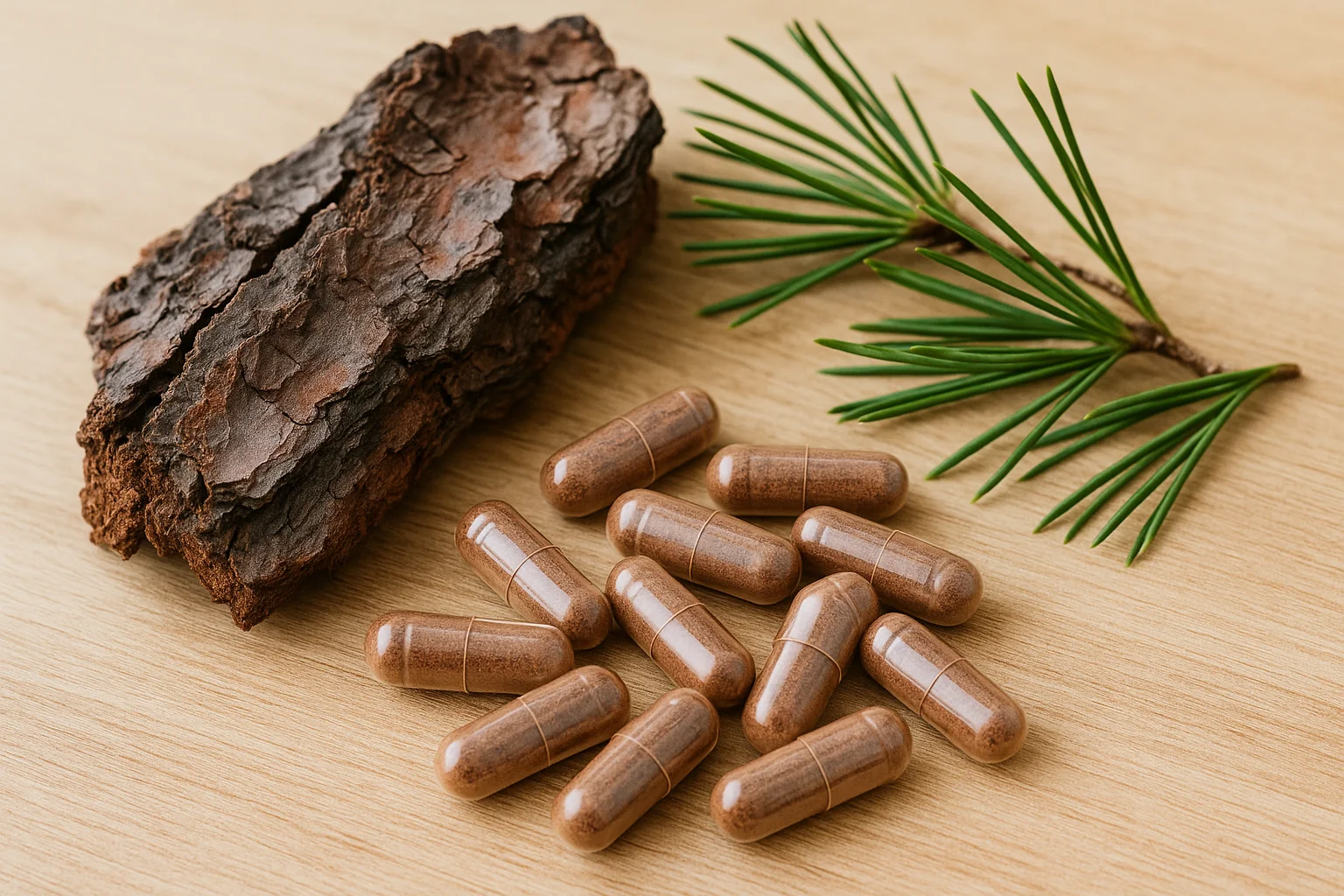
Pycnogenol is one of the most researched plant extracts on the supplement market - the manufacturer Horphag Research has funded over 160 clinical studies involving it. The extract from maritime pine bark (Pinus pinaster) contains oligomeric proanthocyanidins (OPC), catechins, and phenolic acids, which work synergistically as antioxidants and modulators of vascular endothelium. A systematic review of 29 randomized clinical trials showed that pycnogenol significantly improves blood flow parameters, reduces lower limb swelling, and exhibits anti-inflammatory effects (Gulati, 2015). This article provides you with specific data: a dosage table, an overview of indications, and information on how to safely use pycnogenol.
KEY INFORMATION
• Pycnogenol is a standardized extract from maritime pine bark (Pinus pinaster) - not every “OPC extract” or “pine bark extract” is the same product.
• A review of 29 clinical studies confirms its effectiveness in improving microcirculation, reducing swelling, and exhibiting anti-inflammatory effects (Gulati, 2015).
• Standard clinical doses: 40-150 mg daily depending on the indication.
• Pycnogenol enhances the effects of anticoagulant and antiplatelet medications - consultation with a doctor is necessary when undergoing pharmacotherapy.
• Effects on the skin (elasticity, hydration, discoloration) appear after 8-12 weeks of regular supplementation.
What is pycnogenol and how does it work?
Pycnogenol is derived exclusively from the bark of the maritime pine (Pinus pinaster Ait.) cultivated in the Les Landes region of southwestern France - this is a key disclaimer, as the name 'Pycnogenol' is a patented brand. The extract is standardized to 65-75% proanthocyanidins - oligomeric polyphenol condensates with strong antioxidant properties.
The mechanisms of action of pycnogenol are multifaceted. First, OPCs are powerful free radical scavengers - studies show that proanthocyanidins from pine bark exhibit antioxidant activity 20 times higher than vitamin C and 50 times higher than vitamin E measured by the ORAC method (Packer et al., Free Radical Biology and Medicine, 1999). Second, pycnogenol inhibits the activity of NF-κB - a key regulator of inflammation - which translates to reduced secretion of pro-inflammatory cytokines. Third, the extract stimulates the production of nitric oxide (NO) in the vascular endothelium, improving vasodilation and blood flow. Fourth, it inhibits the enzymes collagenase and elastase - protecting collagen and elastin fibers from degradation, which is important for both blood vessel walls and skin.
Tabela dawkowania pyknogenolu - ile, kiedy i jak
The dosage of pycnogenol depends on the indication. The table below is based on data from clinical studies - not on the manufacturer's recommendations.
| Indication | Starting Dose | Standard dose | Maximum dose | When to take | Time to effect |
|---|---|---|---|---|---|
| Chronic venous insufficiency / limb swelling | 100 mg | 100-150 mg | 200 mg | With a meal (1-2 doses) | 4-8 weeks |
| Improvement of skin condition (elasticity, hydration) | 40 mg | 40-100 mg | 150 mg | With a meal | 8-12 weeks |
| Support for blood pressure | 100 mg | 100-150 mg | 200 mg | With a meal | 8-12 weeks |
| Support for glycemia (type 2 diabetes) | 100 mg | 100-200 mg | 200 mg | With a meal | 8-12 weeks |
| Antioxidant protection / general prevention | 40 mg | 40-80 mg | 100 mg | With a meal | 4-8 weeks |
| Attention: Pycnogenol is best absorbed with a meal. Do not use simultaneously with anticoagulant medications without consulting a doctor. In diabetes, monitor glucose levels - it may amplify the hypoglycemic effect of medications. | |||||
Pycnogenol for circulation and chronic venous insufficiency
Chronic venous insufficiency (CVI) is a condition in which the venous valves do not close properly, causing blood to flow backward and swelling to accumulate in the lower limbs. This condition is common - it is estimated to affect about 15-40% of the adult population to varying degrees.
A randomized clinical study published in Angiology showed that 150 mg of pycnogenol daily for 4 months reduced lower limb swelling by 35% and perceived discomfort (leg heaviness, pain) by 64% compared to placebo (Arcangeli, 2000). Mechanism: inhibition of collagen-degrading enzymes in vessel walls + inhibition of leukocyte adhesion to the endothelium (reduction of inflammation in veins) + improvement of venous tone through NO stimulation.
A study conducted by Belcarena and colleagues also showed that pycnogenol reduces the risk of deep vein thrombosis in long-haul flight passengers - a double-blind trial with 204 participants demonstrated a 5-fold reduction in the risk of thrombosis at a dose of 200 mg daily taken 2-3 hours before the flight and 6 hours after (Belcaro et al., Clinical and Applied Thrombosis, 2004). This is an interesting indication for frequent air travelers - but due to its antiplatelet action, it requires discussion with a doctor for those on pharmacotherapy.
Pycnogenol for the skin - what do studies say?
A randomized clinical trial in postmenopausal women showed that 75 mg of pycnogenol daily for 12 weeks increased skin hydration by 21% and elasticity by 9% compared to placebo (Ni et al., Skin Pharmacology and Physiology, 2009). Another study showed a reduction in pigmentation (melasma) after 30 mg of pycnogenol daily for 30 days. Mechanism of action on the skin: inhibition of tyrosinase (the enzyme responsible for melanin synthesis) + inhibition of collagenase (protection of skin collagen) + antioxidant action (reduction of oxidative stress in fibroblasts).
Pycnogenol is a valuable addition to collagen supplementation - while collagen provides building amino acids for the synthesis of new fibers, pycnogenol protects existing collagen from enzymatic and oxidative degradation. These are two complementary mechanisms that work well together.
Frequently Asked Questions
How much pycnogenol should be taken daily?
Clinical studies used 40-200 mg daily depending on the indication. For improving microcirculation and reducing limb swelling: 100-150 mg daily for at least 4-8 weeks. For improving skin condition: 40-100 mg for 12 weeks. As a preventive measure: 40-80 mg daily. Take all doses with a meal.
What is pycnogenol good for?
Documented indications in clinical studies: chronic venous insufficiency and limb swelling, improvement of skin elasticity and hydration, antioxidant protection, support for blood pressure (through ACE inhibition), support for glycemia in type 2 diabetes, and reduction of thrombosis risk during long flights.
What is pycnogenol and where does it come from?
Pycnogenol is a trademarked extract from the bark of the maritime pine (Pinus pinaster Ait.) from Les Landes in France. Standardized to 65-75% oligomeric proanthocyanidins (OPC). Not every "pine bark extract" on the market is Pycnogenol - quality and composition can vary significantly.
Does pycnogenol interact with medications?
Yes - it enhances the effects of antiplatelet and anticoagulant medications (aspirin, warfarin, clopidogrel) and may amplify the hypoglycemic effect of diabetes medications. Consultation with a doctor before supplementation is essential with any pharmacotherapy.
How long should I take pycnogenol to see effects?
Effects on circulation and limb swelling usually appear after 4-6 weeks. Effects on the skin after 8-12 weeks. Long-term studies lasted up to 12 months without signs of loss of efficacy or toxicity at doses of 100-200 mg daily.
Pycnogenol and type 2 diabetes and blood pressure
Two lesser-known but well-documented properties of pycnogenol relate to glycemia and hypertension. In terms of glycemia, a randomized clinical trial showed that 100 mg of pycnogenol daily for 12 weeks reduced fasting glucose levels by 23.7 mg/dl and hemoglobin A1c (HbA1c) by 0.8% in patients with type 2 diabetes treated with metformin compared to the placebo group (Liu et al., Life Sciences, 2004). Mechanism: inhibition of alpha-glucosidase (a carbohydrate-digesting enzyme - similar mechanism to the drug acarbose) and improvement of insulin sensitivity by enhancing insulin signaling in muscles.
Practical note for diabetics: pycnogenol taken together with glucose-lowering medications (metformin, sulfonylurea derivatives, insulin) may enhance the hypoglycemic effect. Consultation with a doctor and monitoring glucose levels at the beginning of supplementation is necessary. The effect is additive, not substitutive - pycnogenol supports treatment but does not replace medications.
In terms of blood pressure, a meta-analysis of 5 clinical studies showed that pycnogenol reduced systolic blood pressure by an average of 3.2 mmHg and diastolic by 1.6 mmHg (Zibadi et al., Nutrition Research, 2008). Mechanism: inhibition of angiotensin-converting enzyme (ACE) - similar to medications from the ACE inhibitor group (enalapril, perindopril). The effect is moderate but statistically significant. In individuals with hypertension taking ACE inhibitors or sartans, pycnogenol may enhance the effect - consultation with a cardiologist is necessary.
Pycnogenol and attention and cognitive functions
Recent studies also analyze the impact of pycnogenol on cognitive functions. A randomized study in students showed that 100 mg of pycnogenol daily for 8 weeks improved attention, working memory, and concentration tests compared to placebo. The mechanism is likely related to improved cerebral microcirculation through NO stimulation and anti-inflammatory action at the level of cerebral vessels. A study on older adults with mild cognitive impairment showed improvement in memory and verbal fluency indicators after 3 months of supplementation with 150 mg daily (Luzzi et al., Panminerva Medica, 2011). This is a promising area, although the studies are relatively small and require replication in larger groups.
For women, studies on alleviating menopausal symptoms are particularly interesting. A randomized study showed that 200 mg of pycnogenol daily for 8 weeks significantly reduced the severity of hot flashes, night sweats, and sleep disturbances in perimenopausal women compared to placebo. The effect may be related to its impact on vascular endothelium and nitric oxide regulation - although the mechanism is not fully understood.
Pycnogenol and sports and muscle recovery
Proanthocyanidins from pycnogenol have documented properties that improve microcirculation and reduce inflammation - two key factors for recovery after physical exertion. A randomized clinical study in runners showed that 100 mg of pycnogenol daily for 8 weeks significantly reduced muscle soreness after exercise (DOMS - delayed onset muscle soreness) and shortened recovery time compared to placebo (Vinciguerra et al., Journal of Sports Medicine, 2013). The mechanism is multifaceted: pycnogenol reduces the release of pro-inflammatory cytokines (IL-6, TNF-alpha) after exercise, improves microcirculation in the muscles facilitating the removal of lactate and metabolic products, and additionally supports increased blood flow through the muscles during exertion by inhibiting ACE and stimulating NO.
Pycnogenol also exhibits anti-aggregatory properties - it reduces platelet aggregation, which may lower the risk of thrombosis during intense physical exertion or long flights. A clinical study demonstrated the effectiveness of 100-200 mg of pycnogenol taken 2-3 days before and during a long flight in reducing the risk of venous thrombosis in travelers with reduced mobility (Belcaro et al., 2004). The anti-aggregatory effect of pycnogenol is clinically significant - individuals taking antiplatelet or anticoagulant medications must consult with a doctor before starting supplementation.
How to choose a supplement with pycnogenol - what to check before purchasing?
There are two main types of products available on the market: original extracts from the Pycnogenol brand (Horphag Research, Switzerland) and generic "coastal pine bark extracts." The difference is significant from the perspective of scientific documentation. Practically all 160+ clinical studies cited in this article and in the scientific literature were conducted with the proprietary Pycnogenol extract standardized to 65-75% OPC. Generic extracts may have a different phytochemical profile and different bioavailability - there are no direct comparative studies confirming their equivalence.
When purchasing, check: (1) whether the label clearly states "Pycnogenol" or provides information on the percentage of OPC content (minimum 65%); (2) the dose per serving - most studies used 100-200 mg daily, with the lower dose (100 mg) being effective for most indications; (3) additional ingredients - pycnogenol works well with vitamin C (antioxidant synergy), which justifies the choice of combined products or separate supplementation with vitamin C. Form: capsules or tablets - there are no significant differences in bioavailability between these forms for this substance.
This article is for informational and educational purposes and does not replace consultation with a doctor. If you are pregnant, breastfeeding, taking medications, or have chronic conditions, consult the use of supplements or herbs with a specialist.
Author: Michał Waluk · Published: 2026-05-04 · Updated: 2026-05-04