
Glycine for sleep and recovery - how much and when to take (table)
Glycine for sleep and recovery: dosage table, how much to take, when, and how to start. A practical guide from u Bucha.
Glycine improves sleep quality in adults without the side effects typical of sleeping pills. A randomized study by Bannai et al. published in Sleep and Biological Rhythms (2012) showed that just 3 g of glycine before sleep shortened the time to fall asleep and improved subjective sleep quality. The amino acid works by lowering deep body temperature, which is the same mechanism that triggers the body's natural readiness for sleep. In this article, you will find a dosage table, a discussion of the mechanism of action, and practical tips on when and how to take glycine.
KEY INFORMATION
• 3 g of glycine before sleep improves sleep quality and shortens the time to fall asleep in RCT studies (Bannai et al., Sleep and Biological Rhythms, 2012)
• Glycine lowers deep body temperature by dilating peripheral blood vessels, which initiates sleep
• The body produces about 3 g of glycine daily, but the requirement is about 10 g/day - this gap is common
• Glycine is classified as GRAS by the FDA and is non-addictive
What is glycine and why is it worth knowing about?
Glycine is the smallest amino acid in the human body, making up about 33% of collagen composition. The body produces it endogenously at about 3 g daily, but the total metabolic requirement is estimated at about 10 g/day (Meléndez-Hevia et al., Journal of Biosciences, 2009). This 'glycine gap' makes supplementation truly justified.
Glycine serves several roles in the body simultaneously. It is a building block of connective tissue, skin, and cartilage. It acts as an inhibitory neurotransmitter in the spinal cord and brainstem. It participates in the synthesis of glutathione, creatine, and porphyrins. No other commonly available supplement combines so many different functions at such a low dose.
Glycine deficiency is difficult to detect with standard blood tests because the body maintains its concentration within a narrow range at the expense of other processes. The result of silent deficiency may be slower tendon recovery after injury, poorer sleep quality, or higher homocysteine levels. The Western diet provides an average of 2-3 g of glycine daily, which, given the requirement of 10 g/day, leaves real deficiencies to be filled.
From our observations, glycine in powder form is underrated compared to expensive sleep products. It costs a few zlotys per dose, has a slightly sweet taste, and dissolves in water in a few seconds. Meanwhile, many 'sleep' products with vitamin B6, lemon balm, and L-theanine contain glycine as one of the main ingredients - without explicitly stating it.
How does glycine improve sleep? Mechanism of action
Glycine lowers deep body temperature by dilating blood vessels in the limbs, which accelerates heat dissipation. A drop in core body temperature of 0.5-1°C is one of the key signals initiating sleep. Bannai and Kawai demonstrated this mechanism in a study published in Frontiers in Neurology (PMC4397399, 2012).
Glycine also acts as an NMDA receptor agonist in the hypothalamus, modulating the circadian rhythm. In animal model studies, it influenced the shortening of the REM phase and increased the proportion of slow-wave sleep. The effect is not a mimicry of sleeping pills - glycine does not globally calm the nervous system, but addresses a specific physiological signal.
It is important to note that glycine does not cause drowsiness the next day. In the study by Bannai et al. (2012), participants in the glycine group reported less morning fatigue and better alertness during the day than the placebo group. This distinguishes it from melatonin, which can cause a 'fog' effect in the morning for some individuals.
How much glycine to take? Dosage table
The dose of glycine depends on the purpose. For sleep, 3 g is sufficient, which is the directly studied dose in RCT studies (Bannai and Kawai, Frontiers in Neurology, 2012). For supporting connective tissue and collagen, the range is 5-10 g daily. In metabolic studies, doses of 10-60 g were used without observing toxicity, confirming a wide safety window.
| Purpose | Dose (g) | Time of intake | Time before sleep | Form | Effect (duration) |
|---|---|---|---|---|---|
| Improvement in sleep quality (mild) | 3 g | Evening | 30-60 min | Powder or capsules | From the first dose, full effect after 3-5 days |
| Shortening the time to fall asleep | 3 g | Evening | 45-60 min | Powder dissolved in water | From the first dose |
| Recovery after training | 5-10 g | Post-workout or evening | Anytime | Proszek w shake’u lub wodzie | Gradual improvement over 4-8 weeks |
| Health of connective tissue and skin | 5-10 g | Any time | - | Powder or with collagen | Visible after 8-12 weeks of continuous use |
| Support for liver function | 3-5 g | With a meal | - | Powder or capsules | Long-term effect |
| Diabetes/insulin sensitivity | 3-5 g | With a meal | - | Powder | Effect after 4 weeks of regular use |
When to take glycine to maximize its effects?
For improving sleep, glycine should be taken 30-60 minutes before the planned bedtime. This interval allows time for absorption and the initiation of the thermal effect. The study by Bannai et al. (2012) used this exact scheme, achieving a statistically significant improvement in sleep latency (PMC4397399).
For muscle and connective tissue recovery, a dose of 5-10 g can be split: take half after training and half in the evening. Glycine directly participates in collagen synthesis, and training increases the tissues' demand for building materials. Nighttime is when recovery occurs most intensively.
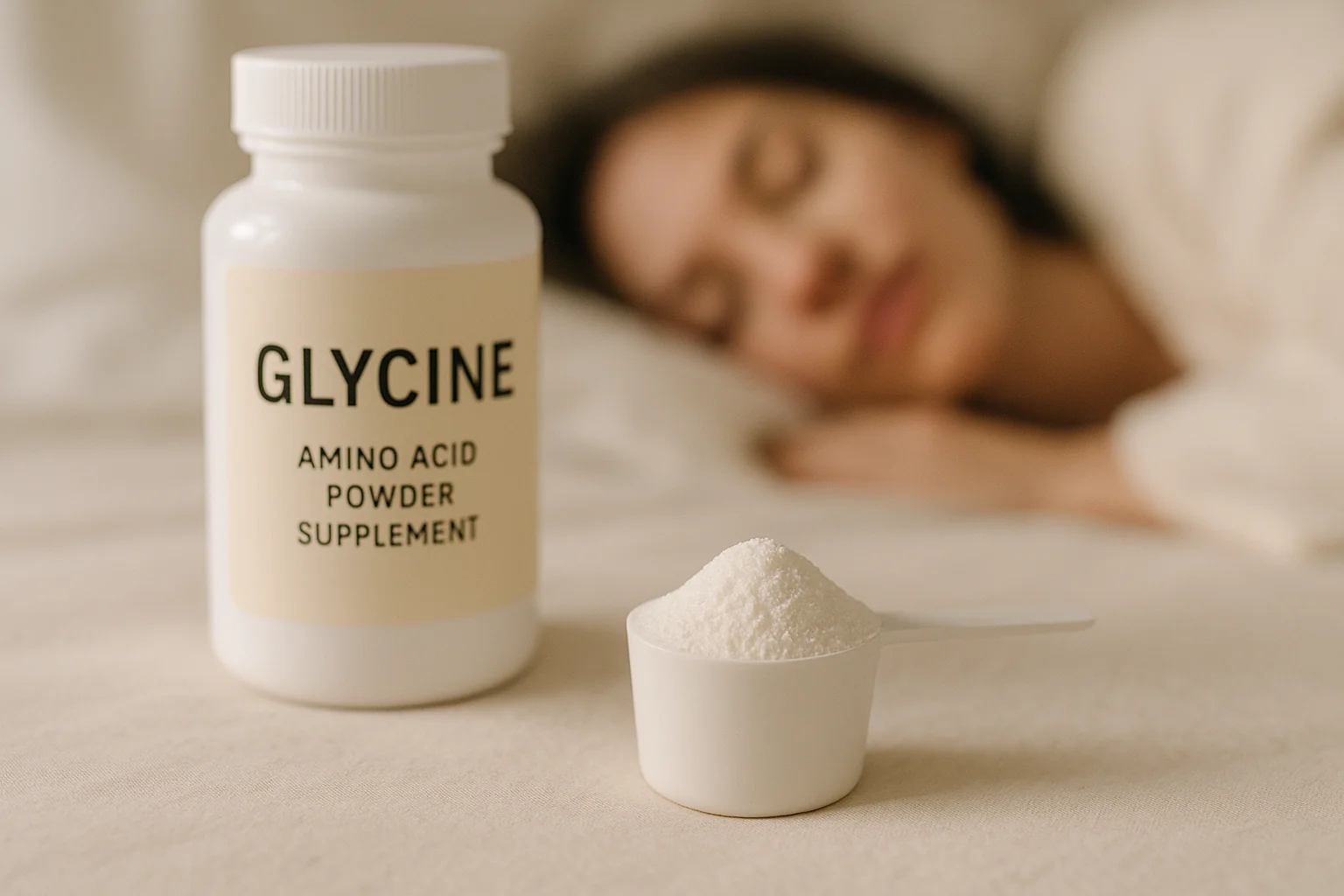
Glycine powder has a slightly sweet taste and dissolves perfectly in water, tea, or warm infusions. Capsules are more convenient for travel but require taking 4-6 pieces at a dose of 3 g (a typical capsule contains 500-750 mg). If you need quick action, the powder absorbs slightly more efficiently.
Is glycine for sleep safe? Safety profile
Glycine has an exceptionally wide safety margin. The FDA classifies it as GRAS (generally recognized as safe). In metabolic studies, doses of 10-60 g per day were used without observing toxicity (PubChem, NIH). It is an endogenous amino acid - the body produces it on its own and recognizes it as its own substance.
Glycine does not cause tolerance or dependence. There is no rebound effect after discontinuation, which distinguishes it from benzodiazepines, zolpidem, or even melatonin at higher doses. It can be used long-term without the need for breaks. This is a significant advantage for those with chronic difficulties falling asleep.
The only groups that should exercise caution are individuals with severe kidney failure (reduced ability to metabolize amino acids) and pregnant women (lack of clinical trial data for supplemental doses during pregnancy). In these cases, it is advisable to consult supplementation with a doctor before starting.
What to combine glycine with to enhance its effects?
Glycine works synergistically with several other substances. The best-studied combination is glycine and vitamin C. The hydroxylation of proline and lysine, which are key reactions in collagen synthesis, requires vitamin C as an enzymatic cofactor. Without adequate levels of vitamin C, glycine cannot effectively build collagen (Pullar et al., Nutrients, 2017).
Another valuable combination is glycine with magnesium in the evening. Magnesium activates GABA receptors, and glycine lowers body temperature - both mechanisms support the calming of the nervous system before sleep. Magnesium glycinate combines both substances in one molecule. Is it worth paying more for this form? The bioavailability is higher than that of magnesium oxide, but you don't have to give up a separate glycine powder.
From our experience, individuals who combine 3 g of glycine in the evening with 400 mg of magnesium citrate report a more noticeable improvement in sleep than those who use each of these ingredients separately. It is difficult to verify without a controlled study, but the convergence is frequent enough to be worth noting.
Glycine and collagen and connective tissue regeneration
Glycine constitutes about 33% of the amino acids in collagen, making it an absolutely essential building block for connective tissue, skin, tendons, and cartilage. Collagen synthesis requires a constant and sufficient supply of glycine. With a glycine gap of about 7 g/day, supplementation has a direct impact on the rate of regeneration (Meléndez-Hevia et al., Journal of Biosciences, 2009).
For individuals engaged in strength training or recovering from connective tissue injuries, a dose of 5-10 g of glycine per day is well justified. Cartilage and tendons will renew more slowly than muscles because they have poorer blood supply. Regular glycine supplementation, combined with vitamin C, provides building material when tissues are most metabolically active.
The study by Shaw et al. published in American Journal of Clinical Nutrition (2017) showed that consuming 15 g of gelatin (rich in glycine) one hour before triple jump exercises increased collagen synthesis in connective tissue by about 50% compared to placebo (Shaw et al., AJCN, 2017). Glycine delivered just before the mechanical stimulus reaches active tissues faster than after training.
Glycine also supports recovery after nightly micro-drops in temperature. During deep sleep, the body produces growth hormone more intensively, and collagen is synthesized at night faster than during the day. Taking glycine before sleep thus combines two effects: improving sleep itself and providing building material for nighttime repair processes in tissues.
Frequently Asked Questions
How much glycine should I take before sleep?
The clinically studied and effective dose of glycine for sleep is 3 g taken 30-60 minutes before falling asleep. Bannai et al. (Sleep and Biological Rhythms, 2012) used this dose in an RCT study and achieved a statistically significant improvement in sleep quality. A higher dose does not provide proportionally better effects on sleep, although it is safe (Bannai and Kawai, PMC4397399, 2012).
When should I take glycine to improve sleep?
Take glycine for sleep 30-60 minutes before your planned bedtime. During this time, the amino acid lowers deep body temperature by dilating peripheral blood vessels, which naturally triggers readiness for sleep. The powder can be dissolved in a glass of water or warm tea. Consistency in timing enhances the effect (Bannai and Kawai, 2012).
Is glycine addictive?
Glycine is not addictive. It is an endogenous amino acid that the body produces on its own in an amount of about 3 g/day. It is classified as GRAS by the FDA. It can be used long-term without the risk of tolerance, physical dependence, or rebound effect after discontinuation. This is a significant advantage over pharmacological sleep aids (PubChem, NIH).
How long does glycine work for sleep?
The first effects of glycine appear after the first dose. Bannai et al. (Frontiers in Neurology, 2012) noted an improvement in sleep quality and less morning fatigue the next day after taking 3 g. Full and stable benefits are observed after several days of regular use. Glycine does not require a saturation phase or gradual dose increase (PMC4397399).
Can glycine be combined with magnesium?
Yes, glycine and magnesium are a safe and beneficial combination. Magnesium (citrate, malate, or glycinate) activates GABA receptors that support relaxation, while glycine lowers body temperature. Both mechanisms work complementarily in the evening. Magnesium glycinate contains both substances in one molecule and shows high bioavailability compared to magnesium oxide.
This article is for informational and educational purposes and does not replace consultation with a doctor. If you are pregnant, breastfeeding, taking medications, or have chronic conditions, consult the use of supplements or herbs with a specialist.
Author: Michał Waluk · Published: 2026-05-04 · Updated: 2026-05-04