
Common yarrow - properties and uses (FAQ)
Krwawnik pospolity: odpowiedzi na najczestsze pytania i co mowia badania. u Bucha.
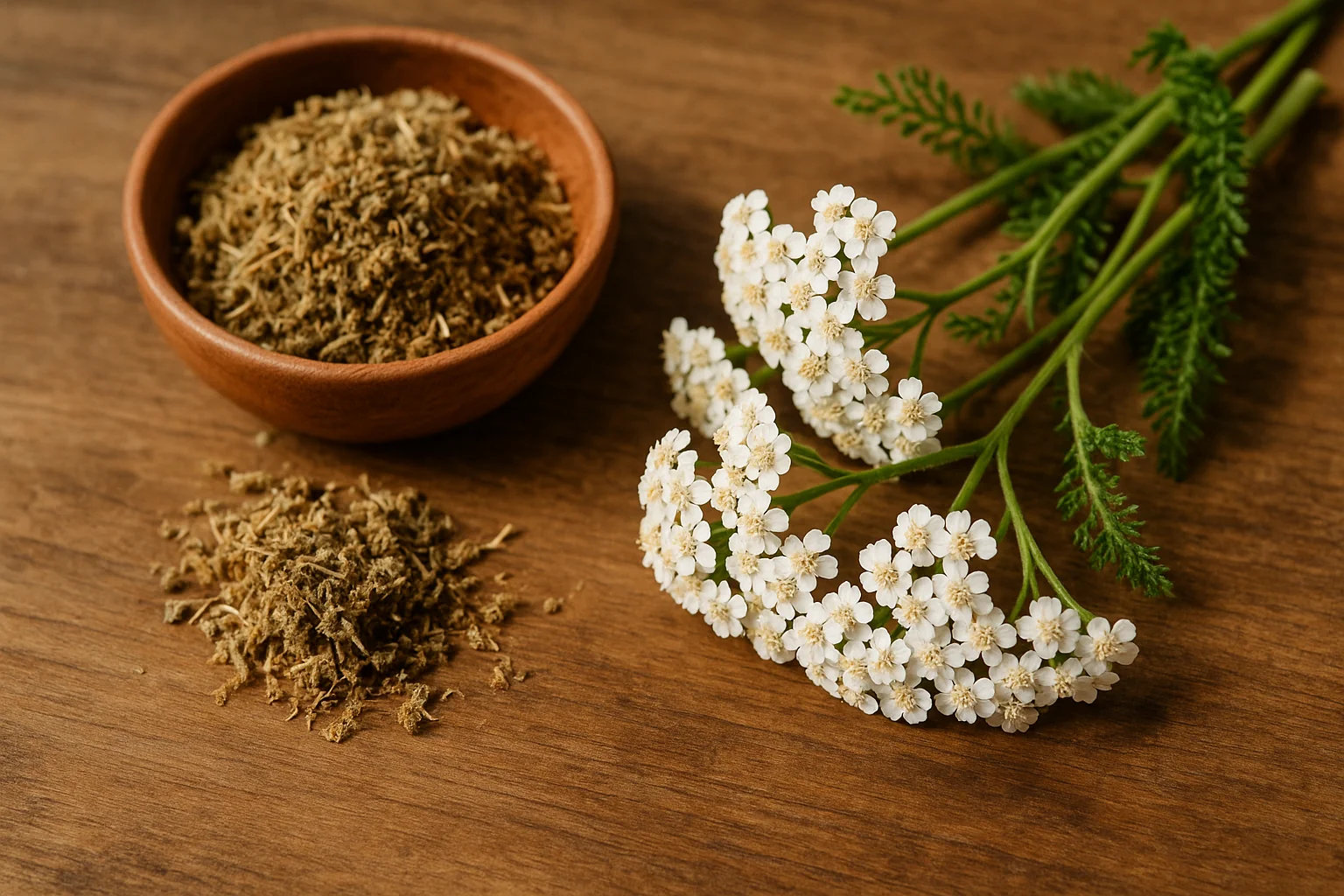
Common Yarrow (Achillea millefolium L.) grows commonly in Polish meadows and pastures, and its botanical name refers to the legend that Achilles healed the wounds of his soldiers with this plant. Regardless of mythology, yarrow has one of the most extensive EMA monographs among herbs: officially approved for digestive ailments, menstrual support, and wound healing (EMA, Millefolii herba). This article answers the most common questions about the properties and uses of yarrow.
KEY INFORMATION
• Yarrow has an EMA monograph for "well-established use" for: digestive complaints, supporting menstruation, and wound healing - three separate indications in one herb (EMA).
• Azulene (chamazulene) from yarrow essential oil shows strong anti-inflammatory and antiseptic effects - comparable to chamomile's component.
• Absolutely contraindicated in pregnancy - contains lactone sesquiterpenes that stimulate the uterus.
• Possible cross-allergy with other plants from the Asteraceae family: chamomile, arnica, marigold - check tolerance.
• For painful menstruation, use 15-30 minutes before a meal; for digestive issues - just before eating.
The ingredients of yarrow and their effects - what have studies revealed?
Yarrow herb (Millefolii herba) contains several groups of active compounds with various, complementary mechanisms. The essential oil (0.2-1.0%) includes beta-pinene, borneol, camphor, and azulene (chamazulene) - the latter is formed during steam distillation from colorless prochamazulene and is responsible for the bluish tint of some yarrow preparations. Azulene exhibits strong anti-inflammatory effects by inhibiting the enzyme phospholipase A2, which reduces the synthesis of inflammatory prostaglandins (PMC, 2018).
Lactone sesquiterpenes - primarily achilleine and millefolide - are bitter components responsible for the digestive action of yarrow. They stimulate bitter receptors on the tongue and in the stomach, which triggers reflexive secretion of bile, gastric juice, and pancreatic enzymes. The mechanism is identical to that of using bitters (gentiana, angelica) - hence yarrow is excellent for indigestion, bloating, and the feeling of fullness after meals.
A lesser-known property of yarrow: flavonoids (apigenin, luteolin, achilleine) have a spasmolytic effect on smooth muscles, including the walls of the intestine and uterus. This explains why yarrow alleviates both abdominal pain associated with indigestion (intestinal relaxation) and menstrual pain (uterine relaxation). No other digestive herb has such dual spasmolytic activity - most bitters act solely on secretion, not on spasms.
Achilleine - a betaine alkaloid - exhibits hemostatic action (stops bleeding) through vasoconstriction and platelet activation. This provides historical justification for using yarrow on wounds. Today, yarrow preparations are used externally as agents that accelerate healing and reduce skin inflammation - effectiveness has been confirmed in small clinical studies, mainly for healing postoperative wounds and skin ulcers.
A special place among yarrow's ingredients is held by achilleine. This betaine alkaloid is directly responsible for the plant's hemostatic action: it activates platelets and induces local constriction of blood vessels, effectively limiting bleeding from minor wounds and abrasions (PMC, 2018). This very mechanism underlies the ancient use of yarrow as a wound herb - the plant was valued by soldiers and medics long before its chemical composition was understood. The legend of Achilles, who was said to heal the wounds of his warriors with the leaves of this plant, gave it its Latin genus name. Achillea - botanists recognized that such strong hemostatic properties deserved to be commemorated in the species name. Modern studies confirm that achilleine not only limits bleeding but also exhibits synergistic anti-inflammatory action with azulene, which explains the effectiveness of yarrow in treating both fresh wounds and chronic skin inflammations.
Yarrow for digestion - how and when to use it?
For digestive complaints - indigestion, bloating, feeling of fullness, weak bile secretion - yarrow is used as a "herbal bitter": an infusion taken 15-30 minutes before the main meal. This is an important detail that distinguishes yarrow from many other digestive herbs: the bitter effect is strongest when the herb interacts with the receptors in the mouth and stomach before food intake, rather than after.
Infusion: 1.5-2 g of dried flowering tops of yarrow in 200 ml of boiling water, steep covered for 10 minutes. Drink 3 times a day before meals, for 2-4 weeks. When blocking the bitter taste with sweet additives (honey, sugar), you reduce the digestive effect - the lactones of the bitter herb need contact with taste receptors, not just the stomach. A small amount of honey is acceptable, but do not completely mask the bitterness.
| Indication | Form and dose | When to drink | Duration of use |
|---|---|---|---|
| Indigestion, bloating | 1,5-2 g ziela / napar 200 ml | 15-30 min before a meal | 2-4 weeks |
| Painful menstruation | 2 g of herb / infusion 200 ml | Between meals, 3 times a day. | 3 days before + the first 3 days of the cycle |
| Wound healing (externally) | Strong infusion 5 g / 200 ml | Kompresy 2-3× dz. | Until healed |
| Fever (sweating) | 2 g of herb / infusion 200 ml | Hot, in bed | As needed |
Data updated: May 4, 2026
Yarrow vs. digestive herbs - how does it compare to chamomile and dandelion?
Yarrow and chamomile have a common denominator: both contain azulene (chamazulene) formed during the processing of the raw material and both exhibit anti-inflammatory effects on the mucous membrane of the digestive tract (EMA, Millefolii herba). The difference lies in the action profile: yarrow is distinctly more bitter, which translates into a stronger choleretic and appetite-stimulating effect - chamomile is milder and primarily acts spasmolytically and anti-ulcer. In cases of gastric inflammation or reflux, chamomile will be a better choice due to its lower bitterness and stronger protective action. Yarrow, on the other hand, surpasses chamomile in one important respect: it has documented hemostatic action, which chamomile exhibits only to a marginal extent.
Comparing yarrow with dandelion (Taraxacum officinale), the picture becomes clearer. Dandelion has a stronger choleretic effect - its bitter sesquiterpenes and taraxacin intensely stimulate bile secretion, making it a better choice for intolerance to fatty foods and bile flow issues. Yarrow, however, is more effective for painful intestinal cramps associated with indigestion, as it combines bitter and spasmolytic actions. Dandelion has no hemostatic action, and its spasmolytic effect is weaker than that of yarrow.
From a practical standpoint, the choice between these herbs should depend on the dominant symptom. For bloating and a feeling of fullness without pain, all three herbs work similarly and can be used interchangeably or combined in mixtures. For painful cramps after meals, yarrow is the first choice - it acts on both secretion and relaxation. For difficulties digesting fatty foods and liver insufficiency, dandelion provides a quicker and more pronounced choleretic effect. Chamomile is reserved for those accompanied by mucosal irritation or stress - its calming and anti-ulcer action is irreplaceable.
Allergy to yarrow - who should be cautious?
Yarrow belongs to the Asteraceae/Compositae family - the same as chamomile, arnica, marigold, echinacea, dandelion, and sunflower. Individuals allergic to pollen or extracts from plants in this family may experience a cross-reactive allergic reaction to yarrow. Symptoms usually include contact dermatitis with external use or gastrointestinal and skin reactions with oral use.
The prevalence of allergies to yarrow in the general population is relatively low, but for individuals with atopy or pollen allergies (allergy to grasses, mugwort), the cross-reactivity risk is significant. Before using yarrow infusion for the first time, especially if there are known allergies to Asteraceae plants, it is advisable to conduct a skin test or start with a small dose (0.5 g) and observe the reaction for 24 hours.
Practical observation: yarrow is one of the most versatile Polish herbs - it acts on digestion, menstruation, and wounds. However, this versatility can be misleading: individuals seeking help for indigestion often do not realize that the same herb that heals their stomach can also help their daughter with painful menstruation. Education about the full profile of yarrow's action translates into better therapeutic outcomes - the herb is used in the right context and at the right time.
Frequently Asked Questions
What does common yarrow do?
Yarrow has an EMA monograph for three indications: mild gastric and digestive disorders (bitter lactones stimulate the secretion of bile and digestive enzymes), support for menstruation in painful menstruation (spasmolytic action of flavonoids), and wounds and skin inflammations (azulene and achillein have antiseptic properties and accelerate healing) (EMA).
How to make yarrow infusion?
Pour 1.5-2 g of dried flowering tops of yarrow with 200 ml of boiling water, cover, and steep for 10-15 minutes. Drink 3 times a day. For digestive issues: 15-30 minutes before a meal - the bitterness must reach the receptors in the mouth and stomach before the meal to stimulate the secretion of digestive juices. Do not completely mask the bitterness with honey - this reduces the effect.
Is yarrow safe during pregnancy?
No. Yarrow is absolutely contraindicated during pregnancy - lactone sesquiterpenes and thujones can stimulate uterine contractions and act embryotoxic at higher doses. EMA lists pregnancy as an absolute contraindication (EMA). Breastfeeding: avoid due to lack of safety data.
Does yarrow interact with medications?
Yes - the most important interactions: anticoagulant medications (warfarin) - achilleine may enhance anticoagulant effects, increasing the risk of bleeding. Diuretics - additive diuretic effect, risk of hypokalemia. Sedatives and tranquilizers - possible enhancement of sedative effects. Antihypertensive medications - additive lowering of blood pressure. In chronic pharmacotherapy: always consult with a doctor or pharmacist.
Does yarrow help with painful menstruation?
Yes - this is an officially approved indication by EMA. Flavonoids and essential oil act spasmolytically on the uterine muscle, reducing the intensity of contractions. The infusion used 3 days before the expected menstruation and during the first 3 days of the cycle may reduce pain complaints. Its action is milder than NSAIDs, but without the risk of gastric irritation or increased bleeding.
Can yarrow be used externally on the skin?
Yes - external use is officially approved by EMA as part of the monograph. Millefolii herba (EMA). Preparation: Pour 5 g of dried yarrow herb with 200 ml of boiling water, steep covered for 15 minutes, cool to body temperature. Soak a compress in the infusion and apply to affected areas 2-3 times a day. Such a strong infusion contains a higher concentration of azulene and achilleine, which have antiseptic, anti-inflammatory properties and accelerate the healing of wounds, abrasions, and skin ulcers. Before the first external use, conduct a patch test on a small area of skin - individuals allergic to plants from the Asteraceae family (chamomile, arnica, marigold) may react with contact dermatitis. For extensive wounds or long-healing skin changes, consultation with a doctor is necessary.
This article is for informational and educational purposes and does not replace consultation with a doctor. If you are pregnant, breastfeeding, taking medications, or have chronic conditions, consult the use of supplements or herbs with a specialist.
Author: Michał Waluk · Published: 2026-05-04 · Updated: 2026-05-04