
Betaine TMG - for homocysteine and methylation: dosage (table).
Betaina TMG: tabela, ile, kiedy i jak. Przewodnik u Bucha.
Betaine (trimethylglycine, TMG) is a compound that has been known for decades primarily in the food and agricultural industry as an additive to animal feed. Today, TMG supplementation is gaining increasing interest in three areas: lowering elevated homocysteine (an independent risk factor for cardiovascular diseases), supporting methylation processes, and - from a sports perspective - improving body composition and strength. A randomized clinical trial showed that 6 g of TMG daily for 6 weeks reduced fasting homocysteine levels by 20% in individuals with hyperhomocysteinemia (Olthof et al., Journal of Nutrition, 2003). This article provides you with specific data: a dosage table, mechanisms of action, and indications for whom TMG is the most valuable choice.
KEY INFORMATION
• TMG is a direct methyl group donor - it lowers homocysteine faster than folate, acting independently of MTHFR.
• Studies confirm the effectiveness of 1500-6000 mg of TMG daily in lowering homocysteine by 10-20%.
• TMG works synergistically with methylfolate and methylcobalamin (B12) - together they create a complete methylation protocol.
• Note: doses above 4000 mg may raise LDL cholesterol levels - important for individuals with hypercholesterolemia.
• Betaine TMG is not the same as betaine HCl (which supports digestion) - they are completely different products.
What is betaine TMG and how does it work in the methylation cycle?
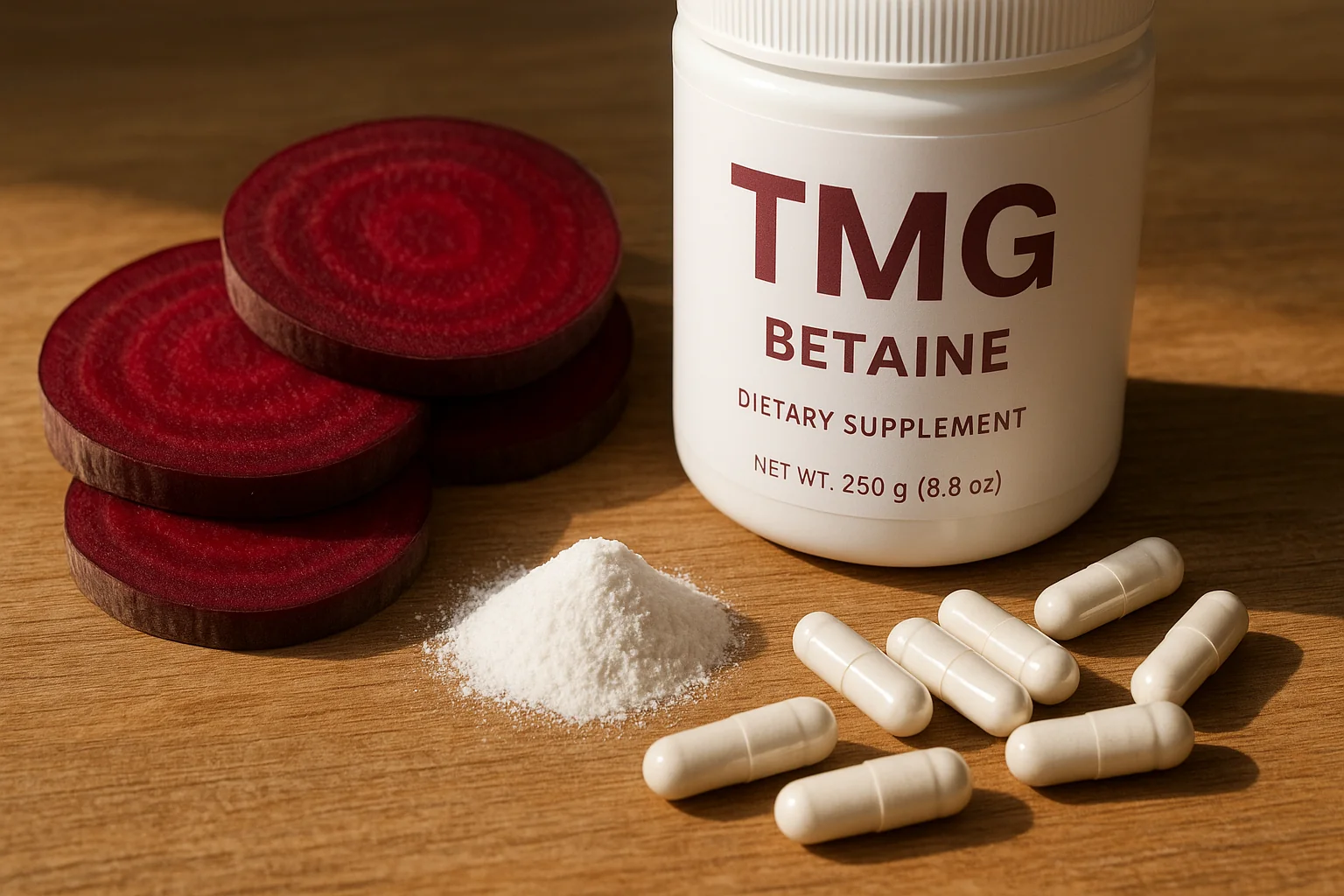
Trimethylglycine (TMG) is a betaine - a zwitterionic organic compound that carries three methyl groups attached to a nitrogen atom. It naturally occurs in beets (0.3-0.5% of fresh mass), spinach, quinoa, and wheat germ. In the human body, it serves two essential biological functions.
The first function is osmoprotection - TMG is an organic osmolyte that protects cells from dehydration and osmotic stress. It accumulates in the cells of the kidneys, liver, and brain, stabilizing their function during fluctuations in osmotic pressure.
The second and key function from a supplementation perspective is its role as a methyl donor. TMG donates a methyl group in a reaction catalyzed by the enzyme BHMT (betaine-homocysteine S-methyltransferase), converting homocysteine into methionine. The resulting dimethylglycine (DMG) can be further metabolized or excreted. A key advantage of TMG over folate and B12 in lowering homocysteine: it acts through the BHMT pathway, which is independent of MTHFR - meaning that individuals with the MTHFR C677T polymorphism can fully benefit from TMG supplementation without limitations due to a faulty enzyme.
Methionine, in turn, is a substrate for the synthesis of SAMe (S-adenosyl-L-methionine) - the main donor of methyl groups in over 200 enzymatic reactions in the body: DNA methylation (regulation of gene expression), synthesis of neurotransmitters (serotonin, dopamine, melatonin), histone methylation (regulation of chromatin), and synthesis of creatine. Thus, TMG serves as an entry point into a broad methylation network.
Tabela dawkowania betainy TMG - ile, kiedy i jak
The dosage of TMG depends on the indication. The table below summarizes protocols from published clinical studies.
| Purpose of use | Starting Dose | Standard dose | Maximum dose | When to take | Notes |
|---|---|---|---|---|---|
| Lowering homocysteine | 1500 mg | 3000 mg | 6000 mg | With meals (2 doses) | Combine with methylfolate + B12 |
| Support for methylation / general | 500 mg | 1000-1500 mg | 3000 mg | With a meal | Synergistic with B-complex |
| Sport (body composition / strength) | 1250 mg | 2500 mg | 5000 mg | Before training or with a meal | Effects after 6 weeks |
| Liver support (NAFLD) | 1500 mg | 3000 mg | 6000 mg | With meals | Consultation with a hepatologist |
| Attention: Divide the daily dose into 2 portions (morning and evening with meals). For doses above 4000 mg/day, monitor LDL cholesterol levels. Individuals with kidney or liver diseases - consult a doctor. | |||||
Betaine TMG and homocysteine - what do clinical studies confirm?
Elevated homocysteine (hyperhomocysteinemia) is an independent risk factor for cardiovascular diseases, stroke, and dementia. The normal level is below 15 µmol/L, although some cardiologists consider values below 10 µmol/L as the target. It is estimated that 5 to 10% of the general population has elevated homocysteine levels, and among older adults, this percentage rises to 30-40%.
The study by Olthof et al. from 2003 - a double-blind, placebo-controlled trial with randomization - showed that 6 g of TMG daily for 6 weeks reduced fasting homocysteine by 20% compared to placebo in individuals with moderate hyperhomocysteinemia (Olthof et al., 2003). The effect was quicker than with folic acid supplementation - TMG acts independently of MTHFR, through the alternative BHMT pathway.
An important caveat: the mentioned study also found that a high dose of TMG (6 g/day) raised LDL cholesterol and triglyceride levels. This effect was moderate but statistically significant. This means that in individuals with hypercholesterolemia, aggressive TMG supplementation should be monitored with a lipid profile. A compromise is to use lower doses (1500-3000 mg) in combination with methylfolate and B12 - together they provide effective lowering of homocysteine without the risk of worsening the lipid profile.
Betaine TMG and sports and body composition
Interest in TMG in sports is associated with several mechanisms: TMG is a precursor to creatine (methionine → creatine - TMG supports this pathway by raising SAMe levels), has osmotic properties (can improve hydration of muscle cells), and may increase nitric oxide synthesis.
A randomized clinical study published in Journal of the International Society of Sports Nutrition showed that 2.5 g of TMG daily for 6 weeks increased lower limb strength and improved body composition (increase in lean body mass by 1.3 kg) in exercising men compared to placebo (Cholewa et al., 2013). Other studies show improvements in sprint endurance. The ergogenic effects of TMG are real, although more modest than those of creatine - and require several weeks of regular supplementation.
Frequently Asked Questions
How much TMG betaine should be taken daily?
To lower homocysteine: 1500-6000 mg daily in two doses with meals - clinical studies used 6 g with a 20% reduction in homocysteine (Olthof et al., 2003). For general methylation support: 500-1500 mg. For athletes: 2500 mg. For doses above 4000 mg, monitor the lipid profile.
What is TMG betaine and where does it come from?
Trimethylglycine (TMG) is a natural compound found in beets, spinach, and quinoa. In the body, it performs osmoprotective and methylation functions - it is a direct donor of a methyl group for the remethylation of homocysteine to methionine via the BHMT pathway, independent of MTHFR.
Does TMG betaine lower homocysteine?
Yes - this is one of the most well-established effects. 6 g of TMG daily reduced homocysteine by 20% in RCT. The effect is independent of MTHFR status - TMG works via an alternative pathway through the BHMT enzyme. For optimal effect, combine TMG with methylfolate and methylcobalamin (B12).
How does TMG betaine differ from betaine HCl?
These are completely different products. Betaine TMG (trimethylglycine) is a methyl group donor used metabolically and cardiologically. Betaine HCl (betaine hydrochloride) is an acid that supports digestion by increasing stomach acidity - it has no effect on homocysteine or methylation. Always check the label when purchasing.
Is TMG betaine safe?
At doses up to 4000 mg per day - good safety profile. At higher doses, it may raise LDL and triglycerides - monitor your lipid profile. Possible mild side effects: nausea or stomach discomfort (take with food). Individuals with kidney or liver diseases - consult a doctor.
Betaine TMG and liver health - non-alcoholic fatty liver disease (NAFLD)
The liver is the center of methionine and homocysteine metabolism. With a deficiency of betaine (or folates and B12), excess homocysteine disrupts DNA methylation in the liver and the accumulation of phospholipids in hepatocytes, promoting fatty liver. Animal studies have shown that a diet low in betaine dramatically accelerates the development of fatty liver and cirrhosis, while TMG supplementation reversed these changes.
In humans, clinical studies confirm promising results. A randomized study published in American Journal of Clinical Nutrition showed that 20 g of TMG daily (a high therapeutic dose) for a year significantly reduced liver fat measured by biopsy in patients with non-alcoholic steatohepatitis (NASH), compared to placebo (Abdelmalek et al., AJCN, 2009). Lower supplemental doses (1500-3000 mg daily) do not have such strong evidence in NAFLD, but the results regarding homocysteine reduction - a factor that exacerbates oxidative stress in hepatocytes - support their use in prevention with elevated risks.
The hepatoprotective mechanism of TMG is multifaceted: lowering homocysteine reduces oxidative stress in hepatocytes; increasing SAMe supports DNA methylation in hepatocytes and the expression of antioxidant enzymes; the osmolytic properties of TMG stabilize hepatocytes during osmotic pressure increases caused by fat accumulation. This makes TMG an interesting addition to the protocol for individuals with NAFLD - always in consultation with a hepatologist.
TMG betaine and epigenetics and longevity
One of the most fascinating, yet still explored areas of TMG action is its role in the epigenetic regulation of gene expression. DNA methylation - the addition of a methyl group to cytosine in CpG sequences of gene promoters - is a key mechanism controlling which genes are active and which are silenced. Defects in DNA methylation accumulate with age and are associated with so-called epigenetic aging, measured by the Horvath methylation clock.
SAMe, synthesized from methionine (which is derived from the betaine pathway), is the main methyl group donor for DNA, histone, and RNA methylation. SAMe deficiency - resulting from a lack of betaine, folates, or B12 - can accelerate epigenetic aging. An observational study showed a correlation between low dietary betaine intake and an accelerated Horvath epigenetic clock (Perła et al., Nutrients, 2019).
Does TMG supplementation slow down epigenetic aging? There are still no large, randomized clinical trials with hard endpoints in this area - it is an active research field. However, it is known that maintaining adequate methylation status (sufficient intake of TMG + folates + B12 + choline) is an essential condition for proper epigenetic regulation at any age. TMG in reasonable doses (500-1500 mg daily) is one of the cheapest and most researched ways to support this network.
Betaine TMG in the diet - natural sources and when supplementation makes sense
The best food source of betaine is beetroot (127-297 mg/100 g), spinach (600-645 mg/100 g of fresh leaves), quinoa (390 mg/100 g dry), wheat germ (1339 mg/100 g), and wheat bran. A diet rich in these products typically provides 1-3 g of betaine daily - enough to maintain osmolytic functions, but may not be sufficient to effectively lower elevated homocysteine if we do not simultaneously meet the requirements for folates and B12.
TMG supplementation has clear justification in the following situations: confirmed hyperhomocysteinemia (above 15 µmol/L) - especially with MTHFR C677T polymorphism; a diet low in leafy vegetables; oxidative stress during intense training; support for the methylation protocol together with methylfolate and methylcobalamin B12. Individuals on a plant-based diet may be particularly at risk for vitamin B12 deficiency, which exacerbates the burden of homocysteine - TMG, as a direct methyl donor, works independently of B12 and can be a valuable supplement.
This article is for informational and educational purposes and does not replace consultation with a doctor. If you are pregnant, breastfeeding, taking medications, or have chronic conditions, consult the use of supplements or herbs with a specialist.
Author: Michał Waluk · Published: 2026-05-04 · Updated: 2026-05-04