
Ointment vs CBD transdermal patch: local action vs absorption into the bloodstream
CBD ointment works in the skin, transdermal patch is supposed to deliver CBD to the bloodstream. How much does the skin really absorb, what studies say, and what the u Bucha store gets from it.
Type "CBD ointment" and "CBD transdermal patch" into the search engine, and you will get products described almost identically. However, the difference is pharmacological, not marketing. In a crossover study from 2026, twenty healthy adults received the same preparation with hemp extract once orally and once on the skin: after oral administration, the area under the CBD concentration curve was 281 h·ng/ml, while after skin application, it was only 19, and in some participants, CBD was below the limit of quantification (Jain et al., Pharmaceuticals, 2026). Below you will find what this means when choosing a form, why the skin is such an effective barrier, and what to look for on the label to avoid paying for a claim that no one has verified.
KEY INFORMATION
• The same preparation yielded 281 h·ng/ml CBD in plasma orally and 19 after skin application (Jain et al., Pharmaceuticals 2026).
• Ointment and gel work in the skin, not in the bloodstream.
• A transdermal patch is a form of medication, not a cosmetic. It is not available in the u Bucha catalog.
• No one has measured the absolute bioavailability of CBD after skin application in humans.
Does CBD ointment enter the bloodstream?
Not in amounts that change anything. In a randomized crossover study, twenty healthy adults received the same preparation with hemp extract once orally and once on the skin, with a fifteen-day break. After skin application, CBD concentrations in plasma were low and often below the limit of quantification, and the metabolite 7-OH-CBD did not appear at all (Jain et al., Pharmaceuticals, 2026).
The same dose given orally produced an area under the curve of 281 h·ng/ml compared to 19 h·ng/ml after skin application, meaning an exposure several times higher. The peak concentration occurred 3 hours after ingestion and only after 24 hours after application to the skin. A slower and lower profile is not a flaw of the preparation, but a description of what it was made for.
The cosmetic manufacturer has no reason to want otherwise. A preparation that intentionally delivers the active substance into systemic circulation goes beyond the definition of a cosmetic and falls into the category of medicinal products, along with the entire registration procedure. Therefore, ointments and gels with hemp are designed so that the substance remains in the skin, and reviews of dermatological formulations explicitly aim to deposit in the skin while minimizing systemic exposure (Pareek et al., Pharmaceutics, 2026).
Why does the skin block CBD so effectively?
Because that’s exactly what it was designed for. The stratum corneum, or the outer layer of the epidermis, consists of flat, dead corneocytes embedded in a multilayer lipid matrix. A review of the dermatological applications of cannabinoids cites poor water solubility, lipophilicity, and variable skin penetration as reasons why translating CBD into a proven topical therapy has still not succeeded (Pareek et al., Pharmaceutics, 2026).
The lipophilicity of CBD acts ambiguously here. The affinity for lipids facilitates the molecule's entry into the intercellular matrix of the epidermis, but hinders its exit into the aqueous environment of the dermis, where capillaries are waiting. Therefore, CBD gets stuck in the layers it has entered. From the perspective of a sore knee, this is an advantage because the substance stays where you applied it.
Transdermal system manufacturers circumvent this barrier with penetration enhancers. Terpenes and surfactants temporarily loosen the lipid matrix of the stratum corneum, and newer approaches use liposomes or microneedles. All these solutions share one thing. They require designing a carrier, not just adding an extract to a ready-made cream base. A hemp cosmetic off the shelf does not go through this process and has no reason to.
How does a transdermal patch differ from an ointment?
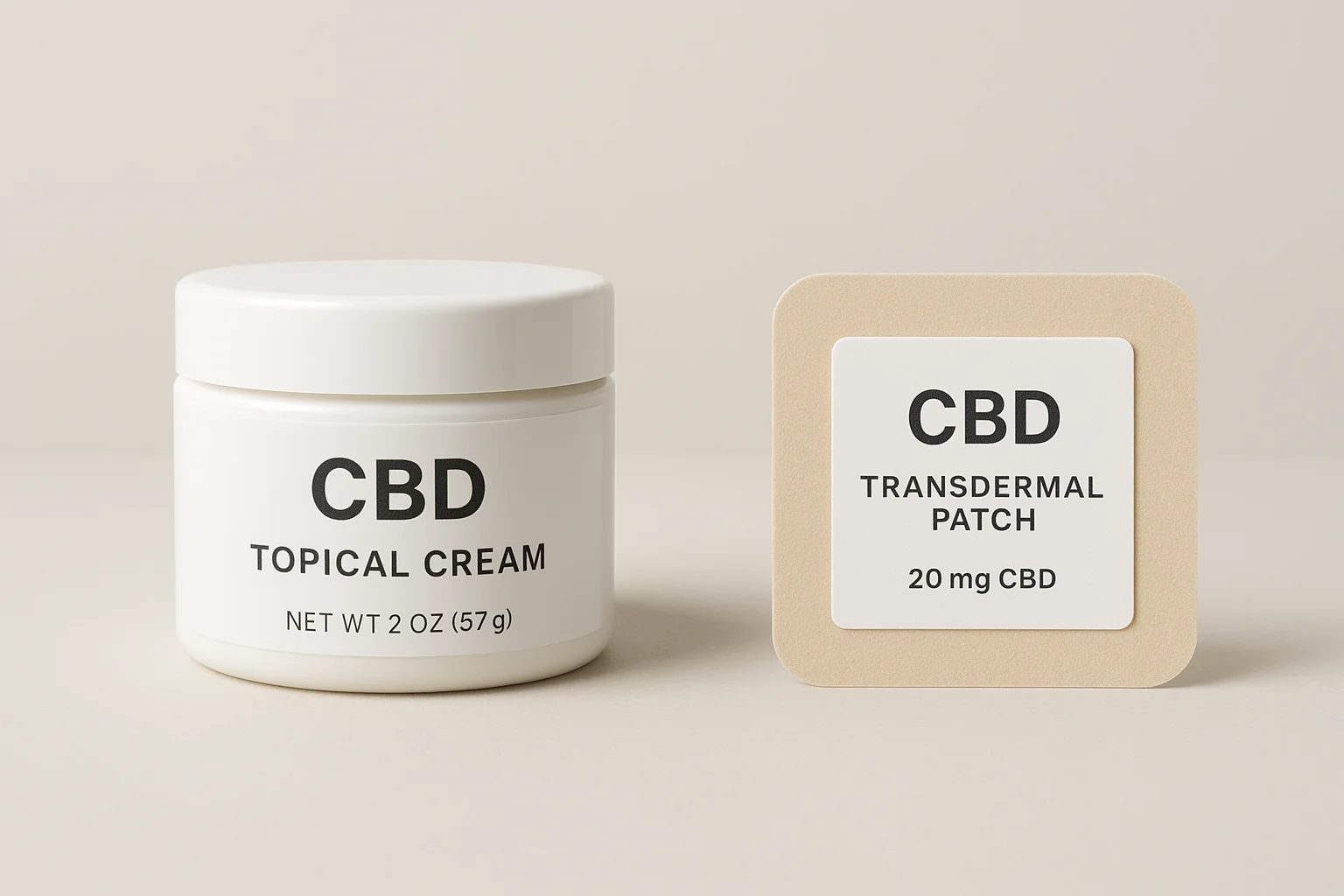
By purpose, not composition. Ointments, gels, and balms are meant to keep the substance in the skin. A transdermal patch is designed to push it through the skin to achieve a concentration in the blood, so it is a form of medication with a specified daily dose. The table below compares both constructs according to parameters that are visible in practice.
| Feature | Ointment, gel, balm | Transdermal patch |
|---|---|---|
| Cel konstrukcji | Action in the skin and subcutaneous tissue | Concentration of the substance in the bloodstream |
| Status produktu | Cosmetic | Form of medication |
| Carrier | Fatty or gel base | Adhesive layer with penetration enhancers |
| CBD w osoczu | Low, often below the limit of quantification (Jain 2026) | Measurable, increasing with dose (Hammell 2016) |
| Dose control | Amount applied, difficult to measure | Daily dose specified by design |
| Ryzyko interakcji z lekami | LOW | Jak przy podaniu doustnym |
| Availability at u Bucha | Ointments, gels, and hemp lotion | Brak w katalogu, stan 2026-08-08 |
The label with the word transdermal does not determine anything in this table. It clarifies the composition of the adhesive layer and the declared daily dose, not the trade name. We have noticed that in the Polish market, most products described as CBD patches are cosmetic dressings that release extract to the epidermis and stop working there. If the manufacturer does not provide the daily dose or the composition of the adhesive layer, you are dealing with a cosmetic.
How much CBD enters the bloodstream from each route of administration?
The honest answer is: for most routes of administration, no one has measured this in humans. A systematic review of CBD pharmacokinetics searched 792 articles, found 24 with pharmacokinetic data in humans, and established that absolute bioavailability was reported only for smoking, where it was 31%. No such measurement has been made for any other route of administration (Millar et al., Frontiers in Pharmacology, 2018).
Therefore, numbers like "13-45% transdermal bioavailability" or "6-19% orally," circulating in Polish product descriptions, have no basis in the literature. However, relative exposure can be compared, meaning how much CBD actually ended up in the plasma after the same dose was administered via two routes in the same individuals. This is what Jain et al. measured.
Note what this chart does not say. It does not say that the ointment does not work. It says that its action does not occur through the blood, so when evaluating a cosmetic based on whether it improves sleep or relaxes the whole body, you are measuring the wrong thing.
What does CBD do in the skin if it does not enter the blood?
It works locally, on the skin's own endocannabinoid system. The skin has a complete, brain-independent endocannabinoid system: its own receptors, endogenous ligands, and enzymes that create and break them down. It has been found in keratinocytes, sebocytes, and sensory nerve endings, and disruption of its balance is associated with acne, seborrhea, and itching (Bíró et al., Trends in Pharmacological Sciences, 2009).
The mechanism of CBD in the skin turned out to be different from what most product descriptions assume. In a study on human sebocytes and in organotypic skin culture, CBD inhibited lipogenesis and sebocyte proliferation by activating TRPV4 channels, not through CB1 or CB2 receptors. The anti-inflammatory action, on the other hand, occurred via the adenosine A2a receptor and inhibition of the NF-kB pathway (Oláh et al., Journal of Clinical Investigation, 2014).
We have noticed that this distinction regularly disappears from Polish texts about cannabis in cosmetics, where activation of CB2 receptors appears as a ready explanation for every effect. Oláh's work shows something contrary: the sebostatic effect of CBD occurred through a non-receptor pathway for CB1 and CB2, so explaining it with these receptors has no basis in it.
When is an ointment sufficient, and when is systemic action needed?
It depends on where the problem lies. If a specific area hurts, the applied preparation reaches exactly there and achieves concentrations in the tissue that are unattainable orally without burdening the entire body. In an animal model with knee joint inflammation, a transdermal gel with CBD reduced joint swelling, immune cell infiltration, and thickening of the synovial membrane depending on the dose (Hammell et al., European Journal of Pain, 2016).
It is worth remembering how this study was conducted. These were rats, a gel designed for transdermal penetration, doses from 0.6 to 62.3 mg per day over four days, and the concentration of CBD in the plasma increased linearly from 0.6 to 6.2 mg per day. In other words: a preparation that truly penetrates also enters the blood. Translating this directly to a cosmetic applied once a day to human skin would be an overreach.
If, on the other hand, you are looking for a general effect, such as sleep, calmness, or support for ailments spread throughout the body, no topical preparation will provide that. Here, a route that actually delivers CBD to the circulation is needed. An ointment applied to the neck will not replace an oil taken sublingually.
What skin products does the u Bucha store have?
The catalog includes seven items for topical use that fit the topic of this article: one ointment, five massage gels, and body lotion. There are no transdermal patches available. The patch category is listed in the store, but the Store API does not return a single item available for purchase from it. The prices below are from the Store API, as of 2026-08-08.
| Product | What distinguishes | Capacity | Price | Koszt 100 ml |
|---|---|---|---|---|
| PALACIO Tea Tree Ointment | Emollient base, without hemp | 100 ml | 21.87 PLN | 21.87 PLN |
| PALACIO CBD Chill Cooling Massage Gel | Declared CBD, cooling formula | 200 ml | 9.99 PLN | 5.00 PLN |
| PALACIO CéBéDé Fortis Massage Gel | Olej konopny z CBD i kolagenem sojowym | 200 ml | 31.00 PLN | 15.50 PLN |
| PALACIO CANNACOOL Cooling Gel | 5% oleju z nasion konopi plus mentol | 200 ml | 16.88 PLN | 8.44 zł |
| PALACIO Tiger Massage Gel with Hemp | Heating formula, 94.3% plant ingredients | 380 ml | 13.99 zł | 3.68 zł |
| PALACIO Bee Venom Massage Gel | Bee venom, large tube for regular massages | 200 ml | 23.49 zł | 11.75 zł |
| Medicprogress Hemp Body Milk | 5% hemp oil, panthenol, and shea butter | 200 ml | 22.00 zł | 11.00 zł |
The column with the cost of 100 ml shows why comparing shelf prices can be misleading. Tea tree ointment costs nine złoty less than Fortis gel, but when adjusted for volume, it is over 40% more expensive. The composition needs to be read separately: hemp has five out of seven items, while cannabidiol is declared by two. You can find the full selection in the cosmetics category, and the only ointment in the ointments category.
Does CBD ointment interact with medications?
When applied to the skin, the risk is minimal, as only a negligible amount of CBD enters the bloodstream. The problem arises with systemic routes. CBD affects the isoenzymes CYP3A4 and CYP2C19 as well as P-glycoprotein, and a review of registration data assesses the potential for interactions with commonly used medications as high (Brown and Winterstein, Journal of Clinical Medicine, 2019).
The same study reports that nearly half of CBD users experienced adverse effects, with a clear dose-dependent relationship, most commonly elevated transaminases and drowsiness. The WHO report from 2018 assesses CBD as a well-tolerated substance with a favorable safety profile and notes that reported adverse effects may arise from interactions with medications taken by the patient (WHO Expert Committee on Drug Dependence, 2018).
For a product applied to the skin, mainly local reactions remain: redness or irritation on damaged skin, and less frequently, allergy to essential oils. Test the new product on a small patch of forearm and wait a day before applying it to a larger area. If you are on regular medication, discuss switching to an oral product with your doctor, not the seller.
How to recognize a good CBD product for the skin?
Start by checking if the manufacturer shows the test results. An analysis of 84 CBD extracts purchased online found that only 30.95% were labeled according to their actual content. 26.19% of samples had less CBD than declared, 42.85% had more, and 21% contained THC, up to 6.43 mg/ml (Bonn-Miller et al., JAMA, 2017).
A caveat that usually disappears in Polish citations of this work: oils, tinctures, and vaporization liquids were studied, not cosmetics. Directly transferring this result to ointments is an overinterpretation. However, it shows how the CBD product market looks without independent control, so as an argument for demanding a certificate of analysis, it also applies to skin products.
Practically: look for concentration stated in milligrams per gram or milliliter, not just the total content on the package. A product with 300 mg of CBD in 200 ml gives 1.5 mg/ml, while the same 300 mg in 30 ml gives 10 mg/ml, which is over six times more in the same amount applied to the skin. Also check whether the hemp in the composition is an extract from flowers or just seed oil, which practically contains no cannabidiol.
Frequently Asked Questions
Does CBD ointment enter the bloodstream?
Not in measurable amounts. In a crossover study of twenty adults, the same hemp preparation resulted in low CBD concentrations after skin application, often below the detection limit, with exposure of 19 h·ng/ml compared to 281 h·ng/ml after oral administration (Jain et al., Pharmaceuticals 2026).
What is the difference between a transdermal patch and a regular CBD patch?
A regular patch is a carrier for a cosmetic and acts like an ointment adhered to the skin. A transdermal patch is a form of medication: it has a layer with penetration enhancers and a set daily dose, and its goal is to achieve a concentration of the substance in the blood. The mere word transdermal on the label does not determine anything.
How long does it take for a CBD preparation applied to the skin to take effect?
For local effect, no one has measured this, and numbers like "15-45 minutes" circulating in product descriptions have no source. However, the time to peak concentration in plasma has been measured: 24 hours after application to the skin compared to 3 hours after oral administration (Jain et al., Pharmaceuticals 2026).
Can hemp ointment falsify a doping test?
In a crossover study, the urine test for COOH-THC was positive in 38% of participants after oral administration of the hemp preparation and in none after skin application (Jain et al., Pharmaceuticals 2026). The risk with cosmetics is low, but not zero: 21% of CBD extracts on the market contained detectable THC (Bonn-Miller et al., JAMA 2017).
Czy sklep u Bucha ma plastry transdermalne z CBD?
No. The store API does not return a single item in the patch category, as of 2026-08-08. For topical use, there are ointments, five massage gels, and hemp body lotion, all in the cosmetics category. None of them are transdermal systems.
If you are looking for a product to apply to a specific area, browse the cosmetics category. For systemic effect, look in the oils category, not on the skin.
This article is for informational and educational purposes. It contains internal links to product categories available in the u Bucha store. Prices and specifications may change: check the current data on the product page before purchasing.
Author: Michał Waluk · Opublikowano: 2026-08-05 · Aktualizacja: 2026-08-08