
PPAR-gamma - how CBD acts on the nuclear receptor and glucose metabolism
PPAR-gamma — mechanizm dzialania wyjasniony prosto, w oparciu o badania. u Bucha.
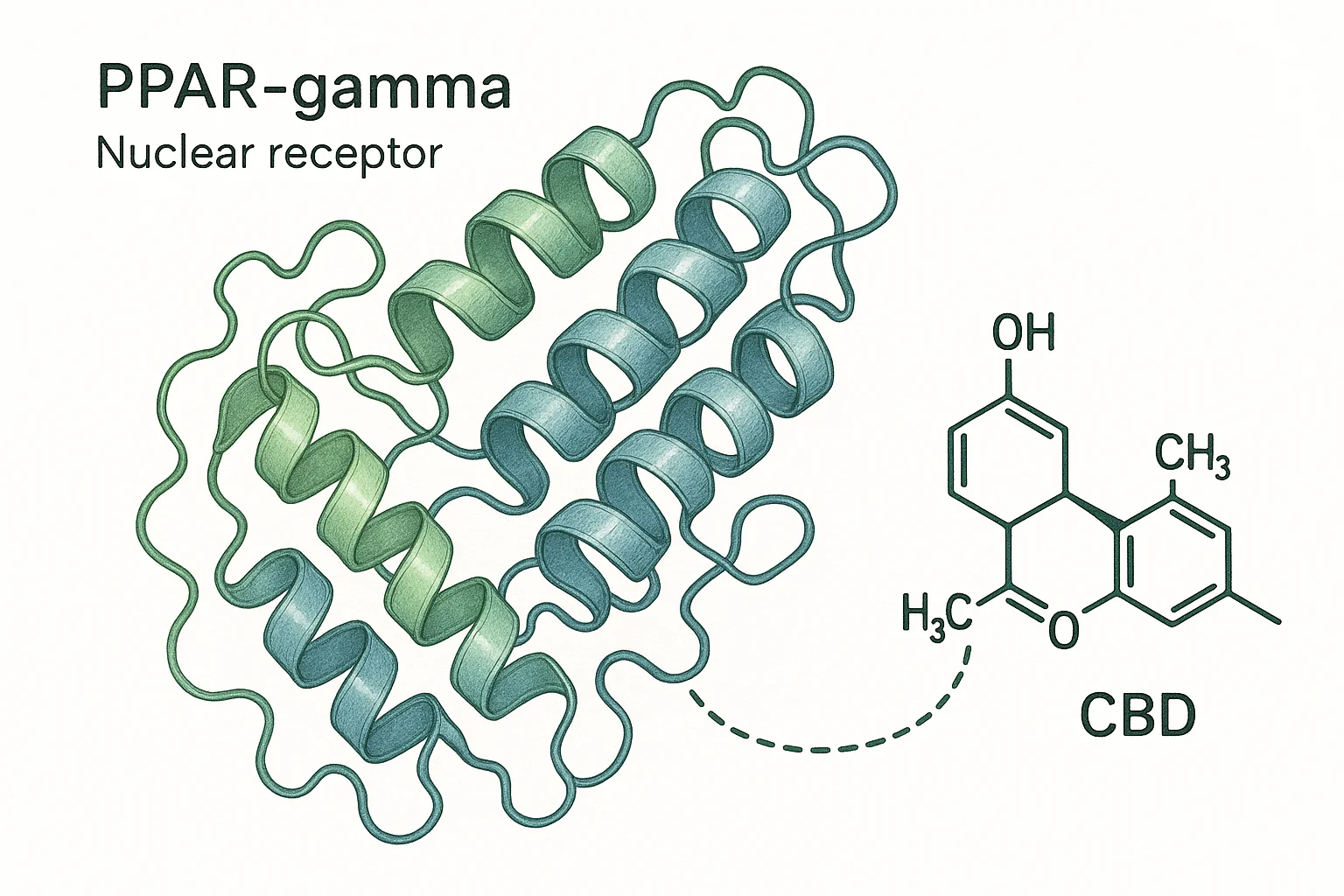
When you hear about CBD receptors, you likely think of CB1 and CB2. But CBD also interacts with nuclear receptors - including PPAR-gamma, a transcription factor regulating genes related to glucose metabolism, fat tissue, and inflammation. O'Sullivan demonstrated in 2016 that CBD is a partial agonist of PPAR-gamma, which explains part of its metabolic actions independent of the endocannabinoid system (O’Sullivan, British Journal of Pharmacology, 2016). This article explains what PPAR-gamma is, how CBD affects it, and what this means for glucose metabolism and inflammation.
KEY INFORMATION
• CBD is a partial agonist of PPAR-gamma with an effective strength of about 10-20% of the maximum activation of synthetic ligands (O’Sullivan, British Journal of Pharmacology, 2016).
• PPAR-gamma regulates the expression of GLUT4 - a glucose transporter crucial for insulin sensitivity in muscles and fat tissue.
• Activation of PPAR-gamma by CBD inhibits the NF-kB pathway, leading to an anti-inflammatory effect independent of CB1/CB2.
• The action of PPAR-gamma is slow (hours to days) because it requires the synthesis of new proteins - this is an adaptive mechanism, not an acute one.
What is PPAR-gamma and how does it work in the cell?
PPAR-gamma (peroxisome proliferator-activated receptor gamma) belongs to the nuclear receptor superfamily. Unlike membrane receptors like CB1 or 5-HT1A, PPAR-gamma acts inside the cell nucleus as a transcription factor - a protein that, when activated by a ligand, binds directly to DNA and regulates the expression of hundreds of genes. It does not transmit signals through secondary messengers, but directly alters the genetic program of the cell.
In metabolism, PPAR-gamma acts as a "fat tissue dispatcher." It controls adipogenesis (the formation of adipocytes), fatty acid uptake, and lipid storage. Its activation in muscles and the liver increases insulin sensitivity by inducing the expression of GLUT4 - an insulin-dependent glucose transporter. Therefore, PPAR-gamma agonists (thiazolidinediones) have become antidiabetic drugs. Pioglitazone and rosiglitazone are synthetic, full agonists of this receptor, significantly stronger than CBD.
Endogenous ligands of PPAR-gamma are fatty acids (especially polyunsaturated) and prostaglandins. CBD, as a phytocannabinoid with a structure containing a terpenophenolic group, has the appropriate physicochemical properties to interact with the hydrophobic binding pocket of this receptor.
How CBD binds to PPAR-gamma - molecular mechanism
O'Sullivan's studies using recombinant PPAR-gamma showed that CBD binds to the ligand-binding domain (LBD) of the receptor and activates the co-activator CBP in a co-transfection assay. The effect was dose-dependent and inhibited by GW9662, a selective antagonist of PPAR-gamma. The activation strength by CBD was about 10-20% of the maximum response observed for rosiglitazone (O’Sullivan, British Journal of Pharmacology, 2016).
We have noticed that in popular articles about CBD, the PPAR-gamma mechanism is almost never mentioned - the focus is on CB1, CB2, and 5-HT1A. Meanwhile, it is PPAR-gamma that may account for some of the long-term effects of CBD observed in metabolic studies: improvement of the lipid profile, reduction of inflammatory markers, and normalization of glycemia. This is important because these effects appear only after weeks, not hours - which correlates well with the pace of transcriptional regulation by nuclear receptors.
In the neurological context, PPAR-gamma is expressed in astrocytes and microglia - glial cells of the brain. Esposito and colleagues demonstrated in 2011 that CBD administered in a neuroinflammation model reduces the expression of pro-inflammatory cytokines by activating PPAR-gamma in astrocytes. Blocking PPAR-gamma with the antagonist GW9662 nullified the anti-inflammatory effect of CBD in this model (Esposito et al., PNAS, 2011).
PPAR-gamma and glucose metabolism - table of mechanisms
Activation of PPAR-gamma by CBD triggers a cascade of gene expression changes that translate into glucose metabolism. The table below shows which genes are modulated and what functional effect this has in the cell.
| Gene/protein | Effect of PPAR-gamma activation | Metabolic significance |
|---|---|---|
| GLUT4 | Increased expression | Better glucose uptake from the blood under the influence of insulin |
| IRS-1/IRS-2 | Increased expression | Enhancement of insulin signaling |
| aP2 (FABP4) | Increased expression | Uptake of fatty acids by adipocytes |
| TNF-alpha, IL-6 | Reduced expression (transrepression of NF-kB) | Reduction of metabolic inflammation in adipose tissue |
| Adiponectin | Increased expression | Improvement of insulin sensitivity in peripheral tissues |
It is worth emphasizing that the strength of these effects for CBD as a partial agonist is significantly weaker than for synthetic thiazolidinediones. CBD does not replace antidiabetic medications - it acts more as a gentle modulator that may be interesting in the context of prevention rather than therapy.
PPAR-gamma and the anti-inflammatory action of CBD
One of the key mechanisms through which PPAR-gamma exhibits anti-inflammatory action is the transrepression of the transcription factor NF-kB. NF-kB is the main "switch" for inflammation in the cell - it activates genes encoding pro-inflammatory cytokines (TNF-alpha, IL-1beta, IL-6) and pro-inflammatory enzymes (COX-2, iNOS). PPAR-gamma, when activated by CBD, physically interacts with NF-kB subunits, blocking its binding to DNA without degrading NF-kB proteins.
This is a mechanism of transrepression, distinct from classical transactivation, where PPAR-gamma directly promotes gene expression. Transrepression is particularly important because it means that the anti-inflammatory effect of CBD through PPAR-gamma operates independently of CB1 and CB2 receptors. This may explain why CBD exhibits anti-inflammatory effects in models where CB1/CB2 are pharmacologically blocked.
Our observations indicate that researchers are increasingly pointing to PPAR-gamma as a mechanism of a "distinct branch" of CBD action. This is practically important: the metabolic and strongly anti-inflammatory effects of CBD may occur on a different timescale than acute effects (anxiolytic, analgesic). Consumers expecting immediate metabolic effects from CBD may be disappointed - transcriptional regulation is a process that takes weeks, not minutes.
Can CBD through PPAR-gamma help with diabetes?
This is a question to which science does not yet have a clear clinical answer. Preclinical studies on type 2 diabetes mouse models (db/db mice) have shown that CBD reduces fasting glucose levels and decreases markers of pancreatic inflammation. However, translating results from rodent models to humans is fraught with significant uncertainty. Doses used in rodents, when converted to human body weight, would be extremely high.
There are almost no published RCTs examining the effect of CBD on glycemia in humans with diabetes. Existing pilot studies have mainly focused on obesity-related diabetes and have shown a neutral impact on HbA1c in short-term observations (Jadoon et al., Diabetes Care, 2016). The PPAR-gamma receptor is a promising mechanism, but its clinical significance for CBD in humans requires much larger and longer studies.
PPAR-gamma and neuroinflammation - what have studies shown in an Alzheimer's model?
One of the areas where PPAR-gamma attracts the most scientific interest is neuroinflammation - a chronic inflammation of brain tissue that plays a key role in Alzheimer's disease, Parkinson's disease, and multiple sclerosis. Microglia, the tissue macrophages of the brain, express PPAR-gamma at high levels. Activation of PPAR-gamma by CBD or synthetic ligands switches microglia from the pro-inflammatory M1 phenotype (releasing TNF-alpha, IL-1beta, free radicals) to the pro-resolving M2 phenotype (releasing IL-10, TGF-beta, neurotrophic factors).
Esposito and colleagues used a transgenic mouse model with amyloid plaque accumulation (APP/PS1 - an Alzheimer's disease model), administering CBD for 7 weeks. CBD reduced the number of amyloid plaques, levels of pro-inflammatory cytokines, and reactive gliosis. Importantly, the effect was abolished by GW9662 (a PPAR-gamma antagonist), confirming the central role of this receptor (Esposito et al., PNAS, 2011). Although this is an animal model, it suggests that PPAR-gamma in microglia may be a pharmacologically significant target in neurodegeneration.
Why is PPAR-gamma so valuable in the brain? This receptor in astrocytes and microglia controls the expression of genes related to the clearance of beta-amyloid (neprilysin, an insulin-degrading enzyme), energy metabolism, and the expression of antioxidant enzymes (SOD2, catalase). Therefore, activation of PPAR-gamma by CBD in the brain may simultaneously inhibit inflammation and support beta-amyloid clearance mechanisms - two independent therapeutic targets in one signaling pathway.
How does the dose of CBD affect PPAR-gamma activation?
Activation of PPAR-gamma by CBD is dose-dependent, but this relationship is not straightforward. At low concentrations (1-5 μM), CBD may act as an allosteric modulator, changing the receptor's conformation without strong transcriptional activation. At higher concentrations (10-50 μM), transcriptional activation is measurable in reporter assays. The problem is that concentrations of 10-50 μM in human tissues require high oral doses - on the order of hundreds of milligrams - which exceeds typical supplementation.
At supplemental doses (10-50 mg of CBD daily), concentrations in the brain and peripheral tissues likely fall within the submicromolar to several μM range. This may be sufficient for allosteric modulation of PPAR-gamma, but not necessarily for strong transcriptional activation. From a clinical perspective, this means that the metabolic effects of CBD through PPAR-gamma - if they are at all significant in humans - likely require higher doses or prolonged use to allow accumulation in fatty tissues.
Fatty acids from carrier oils (MCT, olive oil) may act synergistically with CBD through PPAR-gamma - the fatty acids themselves are endogenous ligands for this receptor. MCT oil (lauric acid, caprylic acid) weakly activates PPAR-gamma, but the simultaneous presence of CBD may enhance this effect. This is a hypothesis that requires verification, but it is physiologically justified by the shared receptor activation pathway.
Frequently Asked Questions
What is PPAR-gamma and why is it important for metabolism?
PPAR-gamma is a transcription factor in the cell nucleus that regulates genes responsible for adipocyte differentiation, glucose uptake, and lipid storage. It is a target for antidiabetic drugs from the thiazolidinedione class. Activation of PPAR-gamma increases insulin sensitivity by promoting the expression of GLUT4 and adiponectin in peripheral tissues.
How does CBD activate the PPAR-gamma receptor?
CBD binds to the ligand-binding domain of PPAR-gamma and acts as a partial agonist. The effect is about 10-20% of the maximum activation for synthetic thiazolidinediones, but it is sufficient to trigger the expression of PPAR-gamma-dependent genes, including GLUT4 responsible for glucose uptake (O’Sullivan, British Journal of Pharmacology, 2016).
Can CBD improve insulin sensitivity?
Preclinical studies suggest that CBD, through activation of PPAR-gamma, may increase GLUT4 translocation to the cell membrane, facilitating glucose uptake. Effects have been observed in cell and animal models. Clinical studies in humans are limited - clinically effective doses of CBD improving glycemia comparable to medications have not been confirmed (Jadoon et al., Diabetes Care, 2016).
Does CBD's PPAR-gamma have a connection to anti-inflammatory action?
Yes. PPAR-gamma activated by CBD inhibits the expression of pro-inflammatory cytokines (TNF-alpha, IL-6) by interfering with the NF-kB pathway - a mechanism of transrepression. This effect is independent of CB1/CB2 receptors (Esposito et al., PNAS, 2011). The anti-inflammatory effect appears on a timescale of hours to days.
How does PPAR-gamma relate to other CBD receptors?
PPAR-gamma is a nuclear receptor - unlike CB1/CB2 located in the cell membrane. Activation of PPAR-gamma takes longer (hours to days, as it requires the synthesis of new proteins), while effects through CB1/CB2 or 5-HT1A appear within minutes. PPAR-gamma explains the long-term, adaptive effects of CBD on metabolism and inflammation.
This article is for informational and educational purposes and does not constitute legal advice. The legal status described in the article is valid as of the publication date - regulations regarding cannabis may change. Consult a lawyer or current legal acts before making decisions.
Author: Michał Waluk · Published: 2026-05-04 · Updated: 2026-05-04