
Muira puama and catuaba - for libido and energy (FAQ)
Muira puama and catuaba: answers to frequently asked questions and what studies say. u Bucha.
Muira puama and catuaba are two Brazilian plant raw materials that have functioned for centuries in Amazonian folk medicine as aphrodisiacs and tonics that enhance life energy. When in the 1990s Dr. Jacques Waynberg from the Paris Institute de Sexologie conducted the first formal clinical studies on muira puama with a group of over 260 men with libido disorders, the substance made its way to the West. The results were interesting enough to spur further research - although the evidence base remains more modest than that for ashwagandha or maca. This article explains what we know for sure, what is still a hypothesis, how to dose, and who these supplements may be useful for.
KEY INFORMATION
• Muira puama (Ptychopetalum olacoides) originates from the Amazon and has centuries of tradition as an aphrodisiac and energy tonic.
• The clinical study by Waynberg and Bruhn (1994) showed an improvement in libido in 51% and erectile function in 62% of men after 2 weeks of using the extract.
• Catuaba (Trichilia catigua or Erythroxylum catuaba) has shown neuroprotective effects and modulation of dopamine and serotonin neurotransmitters in preclinical studies.
• Both raw materials act cumulatively - effects after 2-4 weeks of regular use.
• Catuaba: caution with serotonergic medications (SSRIs, SNRIs).
• During pregnancy and breastfeeding - do not use.
Muira puama - Amazonian tree of strength
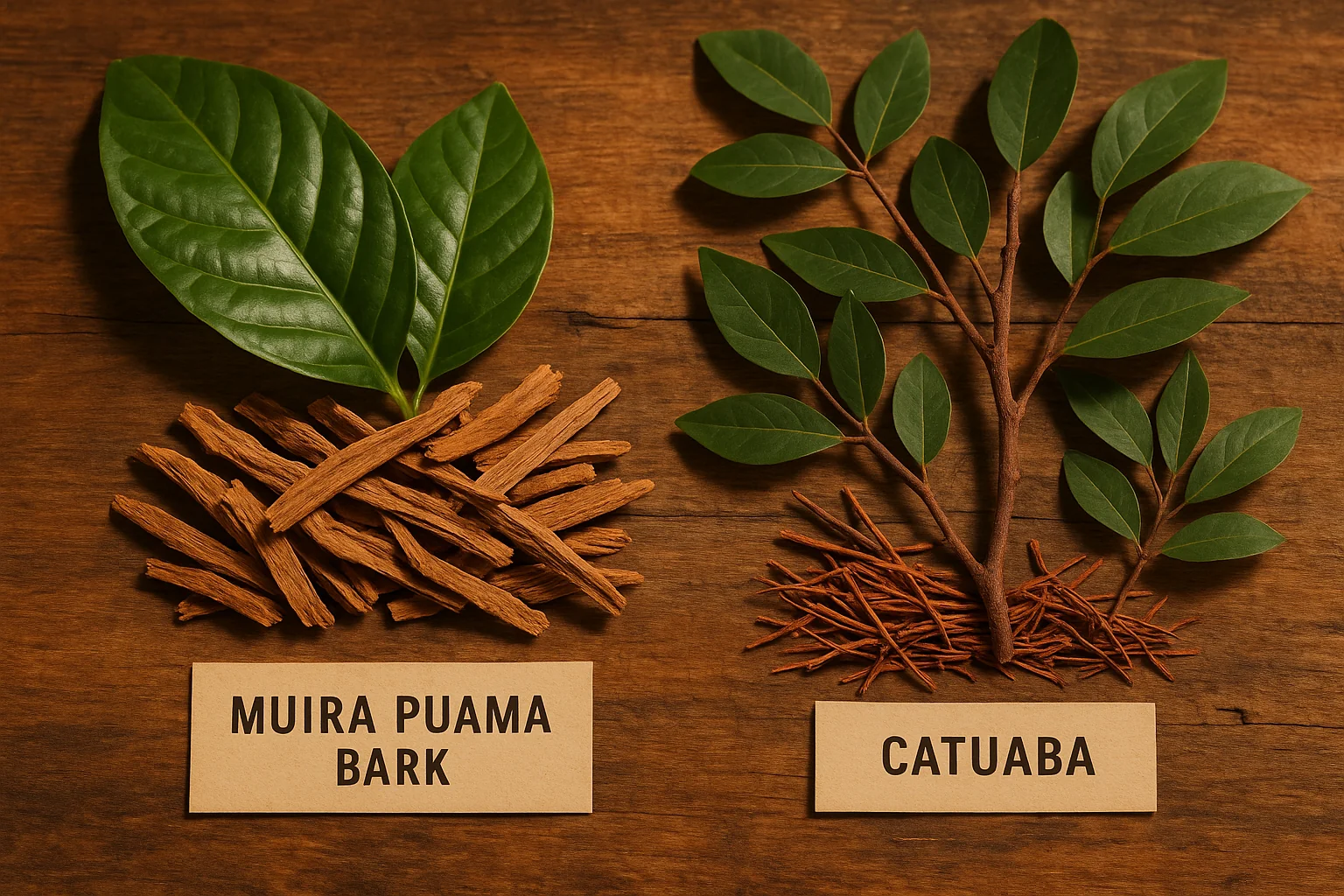
Muira puama (Ptychopetalum olacoides) it is a small tree from the Olacaceae family growing in the humid tropical forests of the Amazon basin, mainly in Brazil. The name comes from the language of indigenous peoples and roughly means "tree of strength" or "tree of potency". Traditionally, it was used by Tikuna, Panoan, and other Amazonian communities: the bark and roots were boiled as a decoction to enhance libido, treat impotence, alleviate fatigue, and improve neurological functions.
Chemical analysis has revealed the presence of several groups of bioactive substances. Beta-sitosterol and lupeol are phytoestrogens with anti-inflammatory effects and a possible influence on hormonal balance. Alkaloids from muira puama (not fully characterized) act on the central nervous system. Long-chain fatty acids show cholinergic activity in vitro - the inhibition of acetylcholinesterase may explain the observed neuroprotective and pro-cognitive effects.
A key clinical study was conducted by Dr. Jacques Waynberg from the Paris Institut de Sexologie in 1994. 262 men with diminished libido and erectile dysfunction received muira puama extract for 2 weeks. Results: 51% reported a significant improvement in libido, and 62% - an improvement in erectile function. The study lacked a placebo control group, which is a significant limitation - the placebo effect in sexological studies typically ranges from 20-30%. Nevertheless, the results were compelling enough to warrant further research.
Catuaba - brazylijski tonik neuroprotekcyjny
Catuaba is a commercial name encompassing several different species of Brazilian trees, which leads to inconsistencies in the scientific literature. The best-studied species are Trichilia catigua (true catuaba, also known as catigua) and Erythroxylum catuaba. Both are used in Brazilian phytotherapy but have somewhat different chemical compositions.
Trichilia catigua contains phenylpropanoids (cinnamoyltyramine and derivatives), flavonoids (flavan-3-ol), and imbombine. In vitro and rodent studies have shown that extracts Trichilia catigua they inhibit the reuptake of dopamine and serotonin - a mechanism similar to that of SSRIs and SNRIs, although much weaker. This explains the traditional use of catuaba as a mood enhancer and sexual energy booster.
A Brazilian study published in Journal of Ethnopharmacology demonstrated the neuroprotective effects of the extract Trichilia catigua in a model of oxidative stress in neurons in vitro. Another study indicated antidepressant effects in mice in the forced swimming test - results comparable to those of imipramine. These data are promising, but they pertain to animal studies; there is a lack of large randomized clinical trials in humans.
| Feature | Muira puama | Catuaba |
|---|---|---|
| Species (main) | Ptychopetalum olacoides | Trichilia catigua or Erythroxylum catuaba |
| Main active substances | Beta-sitosterol, lupeol, alkaloids, fatty acids | Phenylpropanoids, imbombin, flavonoids |
| Mechanism of action | Cholinergic, anti-inflammatory, hormonal | Dopaminergic/serotonergic, neuroprotective |
| Clinical studies in humans | 2 studies (no placebo), + 1 on women | Mainly in vitro and in vivo on rodents |
| Dosage of extract | 1-1.5 g/day (2 servings) | 1-2 g/day (2 servings) |
| Time to effect | 2-4 tygodnie regularnego stosowania | 2-4 tygodnie regularnego stosowania |
| Particular caution | With hormonal medications | With SSRIs, SNRIs, MAO inhibitors |
How to use muira puama and catuaba - a practical guide
Muira puama and catuaba are often sold together as a blend or as separate supplements for simultaneous use. In Brazilian tradition, decoctions from the bark or root were used - this method is still available, but standardized extracts in capsules or alcoholic tinctures are more practical.
When choosing a catuaba supplement, it is important to check the species name on the label. The name "catuaba" is used for several different plant species with non-identical compositions. The best-studied and most commonly used are Trichilia catigua i Erythroxylum catuaba - a good manufacturer states the species directly, not just the trade name.
Both raw materials do not act like caffeine - they do not provide immediate stimulation. They work cumulatively: the first effects usually appear after 10-14 days of regular use. A typical protocol is 4-6 weeks of treatment, followed by an assessment of effects and a possible break. Continuous use without interruption for many months is not recommended due to limited data on long-term safety.
Muira puama and catuaba vs. other herbs for libido - a comparison
The supplement market for libido is dominated by three categories: adaptogenic herbs (ashwagandha, rhodiola rosea), directly aphrodisiac herbs (muira puama, catuaba, tribulus terrestris, maca), and hormonal precursor supplements (DHEA, ZMA). Muira puama and catuaba belong to the second category - they work by influencing neurotransmitters and local blood flow, not by altering the hormonal profile.
In comparison to ashwagandha: ashwagandha has stronger clinical evidence for improving testosterone parameters in men with deficiency and a regular impact on stress - which indirectly improves libido by lowering cortisol. Muira puama acts faster on the subjective feeling of libido and sexual desire, but without measurable effects on hormone levels. These are different mechanisms and can be used concurrently.
Maca (Lepidium meyenii) it is another popular aphrodisiac raw material - the Andean equivalent of Brazilian muira puama. Maca has more randomized clinical studies with a placebo group, making its evidence base more solid. Muira puama, on the other hand, has a longer ethnomedical history and a specific profile of active substances (cholinergic) that distinguishes it from maca (isothiocyanates, benzylglucosinolates). The combination of maca with muira puama is popular and unexplored for synergy - but also without known negative interactions.
Frequently Asked Questions
What are muira puama and catuaba and where do they come from?
Muira puama (Ptychopetalum olacoides) is a tree from the Amazon rainforest of Brazil, used by indigenous people as an aphrodisiac and tonic for centuries. Catuaba (Trichilia catigua or Erythroxylum catuaba) is a Brazilian tree with a similar application in folk medicine. Both raw materials are used in Brazilian phytotherapy as agents supporting libido, energy, and neurological functions.
What do scientific studies say about muira puama?
The study by Waynberg and Bruhn (1994) involving 262 men with libido disorders showed that 51% of participants reported improved libido after 2 weeks of using muira puama extract, and 62% reported improved erectile function. The study had methodological limitations - lack of placebo. Newer preclinical studies indicate the inhibition of acetylcholinesterase and anti-inflammatory action by beta-sitosterol.
What do scientific studies say about catuaba?
Catuaba is less studied than muira puama. Preclinical studies indicate neuroprotective and antidepressant effects - extracts from Trichilia catigua inhibit the reuptake of dopamine and serotonin. There is a lack of large randomized clinical trials in humans - most evidence comes from in vitro studies and studies on rodents.
How to dose muira puama and catuaba?
Muira puama: standardized extract 1-1.5 g daily (2 servings) or tincture 1-2 ml 2-3 times daily. Catuaba: extract 1-2 g daily or tincture 2-4 ml 2-3 times daily. Both work cumulatively - effects after 2-4 weeks of regular use. They are often used together as a synergistic combination.
Are muira puama and catuaba safe?
Both raw materials have a long tradition of safe use in Brazil. Serious adverse effects at typical doses have not been reported. However, data on long-term safety are limited. Individuals taking serotonergic medications (SSRIs, SNRIs) should exercise caution with catuaba. During pregnancy and breastfeeding - do not use.
Can muira puama be combined with other libido supplements?
Muira puama and catuaba are often combined together - historically used together. Other popular combinations include muira puama with ashwagandha (libido support + cortisol regulation). When combined with serotonergic medications or MAO inhibitors, medical consultation is required due to catuaba's effect on neurotransmitters.
Does it work for women - not just for men?
Yes - both raw materials are used in Brazilian traditional medicine by men and women. The Waynberg study (2000) included a group of menopausal women - 65% of participants reported improved libido and satisfaction with their sex life after using muira puama extract. The study was small and lacked a placebo control group, but indicates that there is no effect solely in men.
How to distinguish a good catuaba supplement from a counterfeit?
Catuaba is a name that encompasses several different species of plants. A good supplement should provide the full species name (Trichilia catigua or Erythroxylum catuaba), not just the trade name. Standardization on phenylpropanoids or alkaloids indicates a higher standard of the product. Avoid products without the specified species and without a certificate of analysis (COA).
This article is for informational and educational purposes and does not replace consultation with a doctor. If you are pregnant, breastfeeding, taking medications, or have chronic conditions, consult the use of supplements or herbs with a specialist.
Author: Michał Waluk · Published: 2026-05-04 · Updated: 2026-05-04