


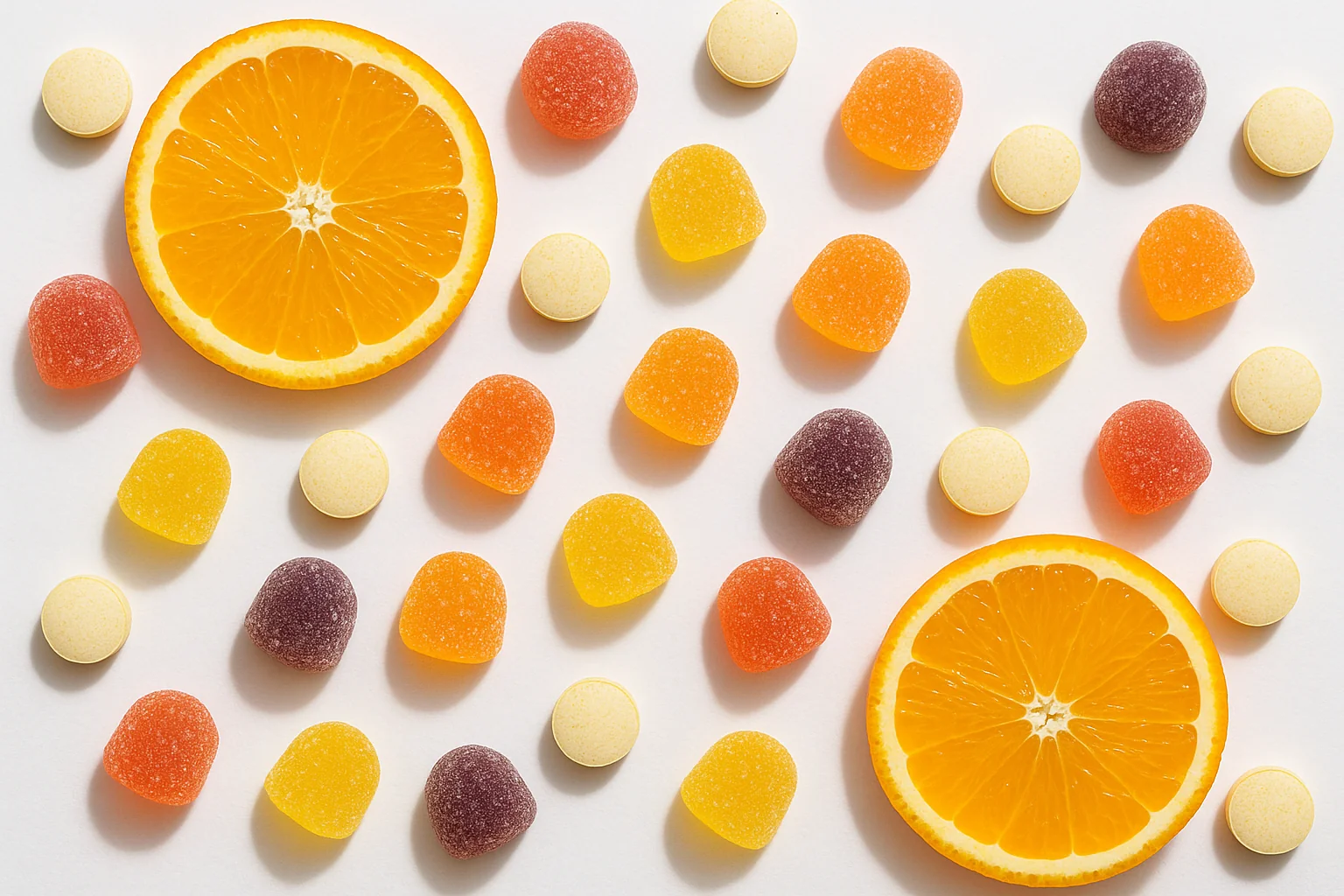

Vitamin C in gummies: does it work the same as tablets and how much should you take daily?
Vitamin C in gummies – does it have the same bioavailability as tablets? How much vitamin C to take daily and when to choose gummies over tablets. Facts and figures.
Gummies with vitamin C are taking pharmacies and supplement stores by storm, offering a more pleasant alternative to traditional effervescent tablets and capsules. But does the form matter for the bioavailability of vitamin C? Is ascorbic acid in a gummy matrix absorbed the same way as in a tablet? And how much vitamin C do gummies actually contain — because that number can be surprisingly low? Our answers are based on clinical studies and EFSA regulatory data, not on supplement labels.
KEY INFORMATION
• The bioavailability of vitamin C in gummies and tablets is comparable (~70–90% at doses up to 200 mg) — the form has little significance (Padayatty et al., JAMA, 2004).
• EFSA RDA: 110 mg/day (women), 125 mg/day (men) — check if your gummy provides that much.
• A typical gummy with vitamin C contains 10–80 mg/piece — often too little for effective supplementation.
• Sugar: 3–4 g/piece with regular use means 6–8 g of added sugar daily.
• Cochrane Review (2013): vitamin C shortens colds by 8% in adults, does not prevent them in the general population.
Bioavailability of vitamin C — are gummies and tablets equivalent?
Vitamin C (ascorbic acid) is water-soluble and actively absorbed by the SVCT1 and SVCT2 transporters in the small intestine. Absorption is dose-dependent: at 200 mg, absorption is about 90%, at 1000 mg it drops to about 50%, and excess is excreted by the kidneys. Padayatty et al. (JAMA, 2004) demonstrated that the bioavailability of vitamin C from various oral forms (tablets, capsules, drinks) is comparable — the route of administration is of secondary importance.
No direct pharmacokinetic studies comparing gummies to tablets have been found. However, the absorption mechanism of vitamin C is identical — ascorbic acid must be released from the gummy matrix (which happens quickly after digestion) and then absorbed by the same intestinal transporters. There is no biological basis for the gummy form to radically change the absorption of vitamin C.
Practical conclusion: if a gummy contains 100 mg of vitamin C from ascorbic acid or sodium ascorbate, the bioavailability is similar to that of a 100 mg tablet. The issue is not the form, but the dose — and many gummies contain very little vitamin C per piece.
How much vitamin C in gummies is too little? Check the label before you buy.
This is a key issue when purchasing vitamin C gummies: many products contain a nominal dose. We find gummies with 10 mg, 15 mg, and 20 mg of vitamin C per gummy—that's 10–201 TP3T of your daily requirement in one gummy. The recommendation of "1–2 gummies per day" provides 20–40 mg of vitamin C, when you need 110–125 mg. You can supplement this through your diet (citrus fruits, bell peppers, broccoli), but a supplement should be supplemental—not just a token aid.
Look for gummies with at least 50–100 mg of vitamin C per piece. Gummies with 80 mg/piece at a dose of 2/day provide 160 mg — that’s above the RDA and sufficient for supplementation. Gummies with 500 mg/piece are a therapeutic dose — they may be reasonable for needs higher than the RDA (intense exercise, oxidative stress, smokers), but be cautious about sugar intake and use them carefully with a sensitive stomach.
Sugar in vitamin gummies — a hidden problem for dental health.
Vitamin C gummies combine two potentially problematic ingredients for teeth: ascorbic acid (slightly acidic, pH 2.5–3.0 in pure form, though buffered in the gummy) and sugar (the main cause of cavities). The gummy's sticky consistency causes it to adhere to teeth longer than a tablet or capsule dissolved in the stomach.
For healthy adults without cavity issues and with normal oral hygiene — the risk is minimal with 1–2 gummies daily. But with diabetes, sensitive teeth, a history of enamel erosion, or when consuming 4+ gummies daily — vitamin C gummies may be less safe for dental health than a sugar-free tablet.
Practical rule: after consuming vitamin C gummies, rinse your mouth with water (wait 30 minutes before brushing — as with acidic drinks). If you are prone to cavities or wear braces — consider vitamin C in sugar-free tablets or capsules instead of gummies.
Vitamin C from gummies and immunity — what do studies actually say?
The belief that "vitamin C cures colds" is deeply ingrained in culture, but meta-analyses don't support this simple picture. A 2013 Cochrane review (Hemilä and Chalker) included 29 clinical trials with a total of over 11,000 participants and found that regular vitamin C intake (200 mg/day or more) did not reduce the frequency of colds in the general population. However, it did shorten their duration by about 8% in adults and 14% in children—a real, but modest, effect.
The only proven preventive effect of vitamin C on colds is the protection of individuals exposed to extreme physical stress in cold environments — marathon runners, skiers, soldiers during winter exercises. In this group, regular supplementation of vitamin C reduces the risk of colds by about 50%. For the average office adult — the preventive effect is statistically insignificant.
Our observations: Vitamin C has real value as an antioxidant and a cofactor in collagen synthesis — and these functions are proven regardless of colds. Users who report the greatest subjective benefits from vitamin C are often those with deficiencies (a diet low in vegetables and fruits, smokers, individuals under significant stress). In these cases, supplementation of 200–500 mg/day from gummies or tablets makes evident sense.
Dosage of vitamin C — how much to take from gummies daily?
European recommendations: RDA (Recommended Daily Allowance) for adults according to EFSA is 110 mg/day (women) and 125 mg/day (men). Smokers need an additional 35–40 mg due to higher consumption from oxidative stress. Pregnant women: 105 mg/day, breastfeeding: 155 mg/day (higher requirement due to transfer to milk).
Therapeutic doses (above RDA) used in certain health protocols: 500 mg/day for immune support during infection season, 1000 mg/day during intense physical exertion or after a deficiency diagnosis. The upper safe limit (UL) is 2000 mg/day — above this dose, the risk of side effects (diarrhea, stomach cramps) significantly increases.
How to take vitamin C gummies? Divided doses are better than a single high dose — the body absorbs more with smaller portions. A gummy in the morning and a gummy in the evening (totaling 200 mg) is a better protocol than taking 4 gummies at once (200 mg absorbed less effectively). Take with a meal containing non-heme iron (spinach, lentils, tofu) — vitamin C triples the absorption of non-heme iron. Melatonin B12 C and D3 Vitamin Gummies: What's the Difference and What to Choose?
When to choose tablets and when gummies with vitamin C?
Gummies with vitamin C make sense if: you have difficulty swallowing tablets, you are looking for a supplement form that encourages regularity (a tasty gummy is easier to maintain in habits), or you are looking for a product for children (gummies are child-friendly — though check the manufacturer's age limits and dosage for the specific age group).
Sugar-free tablets or capsules are better when: you have diabetes or are reducing sugar, you have sensitive teeth or a history of enamel erosion, you need a high dose (500–1000 mg/day) without proportional sugar intake, or you are looking for the cheapest cost per mg of vitamin C. Tablets with 1000 mg of vitamin C cost pennies per dose — gummies are many times more expensive per mg.
We do not recommend effervescent tablets with vitamin C — a popular alternative — for those with sensitive teeth: dissolving in water creates an acidic drink that can erode enamel with regular use. A swallowable tablet or capsule is dentally safer than an effervescent or gummy.
Vitamin C and other supplements — what is worth combining?
Vitamin C works well with several other supplements. Non-heme iron and vitamin C — this is a synergistic combination: ascorbic acid converts ferric iron (Fe3+) to ferrous iron (Fe2+), which is absorbed 3 times better. If you are supplementing iron or have low ferritin levels, simultaneous intake with vitamin C of 100–200 mg is the standard recommendation.
Vitamin C and vitamin E — both are antioxidants, but of different types. Vitamin C (hydrophilic) regenerates oxidized vitamin E (lipophilic) in cell membranes. Together, they create an effective antioxidant network. The combination is safe and rational for supplementation for skin health and antioxidant protection.
Vitamin C and zinc — a popular combination for immunity. Both ingredients support immune function through different mechanisms. There are no interactions between them — safe to use together. Gummies combining vitamin C and zinc in one formula are a rational option for seasonal immune supplementation.
What should not be combined with vitamin C? At higher doses (above 1000 mg), vitamin C may interfere with the absorption of copper — an important mineral for iron metabolism and enzyme functions. With chronically high doses of vitamin C, it is worth monitoring supplementation or diet for copper. Another potential issue: vitamin C (as a reducer) may interfere with some laboratory blood and urine tests — inform your doctor if you are taking high doses before tests.
Is the „liposomal vitamin C” form better than gummies?
"Liposomal vitamin C" is available on the supplement market—ascorbic acid encapsulated in liposomes (fatty vesicles), which is supposed to provide higher bioavailability. Manufacturers claim that liposomes bypass the limitations of the intestinal transporter and allow for higher absorption. Is this true?
The study by Carr and Cook (Nutrients, 2018) compared liposomal vitamin C with standard vitamin C — liposomal achieved higher blood concentrations at the same dose, but the difference was significant mainly at very high doses (4000 mg and more). At standard supplementation doses (100–500 mg/day), the difference is minimal and does not justify the significantly higher price of the liposomal form.
Conclusion: for typical vitamin C supplementation of 100–500 mg/day, gummies, tablets, and capsules are economically and effectively equivalent. The liposomal form has potential advantages at mega doses (1000+ mg), but that is the domain of specialized health protocols, not daily supplementation.
Diet and vitamin C gummies — is supplementation necessary?
The Polish diet provides an average of about 100–130 mg of vitamin C daily with regular consumption of vegetables and fruits — which is close to or above RDA. Products particularly rich in vitamin C: red bell pepper (180 mg/100g), black currants (180 mg/100g), parsley (170 mg/100g), broccoli (90 mg/100g), kiwi (80 mg/100g), strawberries (60 mg/100g), oranges (50 mg/100g).
If you regularly eat fruits and vegetables, it's possible that vitamin C supplementation isn't necessary at all. Vitamin C gummies make sense as insurance for a diet low in fruits and vegetables, with higher needs (stress, smoking, intense exercise), or for seasonal deficiencies (winter, when fresh vegetable consumption drops). A daily 100 mg vitamin C gummy as a "policy" is economically sensible for those who don't trust their diet.
Vitamin C and skin — can gummies help?
Vitamin C is essential for collagen synthesis — the structural protein of skin, joints, and blood vessels. A deficiency of vitamin C leads to scurvy (historically), but also to slower wound healing, susceptibility to bruising, and poorer skin quality. Regular supplementation of vitamin C in doses of 200–500 mg/day supports collagen production and has an antioxidant effect on the skin (protection against photoaging).
Do vitamin C gummies improve skin? If they contain the appropriate dose of ascorbic acid, yes, just like a tablet or capsule. The key is consistency (daily use for months) and a sufficient dose (200+ mg/day). Marketing claims of "drastic skin improvement" at low doses (20-30 mg/piece) are exaggerated.
Frequently Asked Questions
Is vitamin C in gummies as bioavailable as in tablets?
The bioavailability of vitamin C in gummies is comparable to tablets — in both forms, absorption is about 70–90% at doses up to 200 mg (Padayatty et al., JAMA, 2004). The method of administration is of secondary importance — what matters is the dose in mg.
How much vitamin C should gummies contain daily?
EFSA sets the RDA for vitamin C at 110–125 mg/day for adults. Gummies should contain at least 50–100 mg each, so that two gummies a day meet the requirement. Many gummies contain only 10–20 mg each — check the label carefully.
When should I take vitamin C gummies?
Divided doses are better — a gummy in the morning and evening (totaling 200 mg) is absorbed better than 4 gummies at once. Take with a meal containing non-heme iron to enhance iron absorption.
Is sugar in vitamin C gummies a problem?
Typical gummies contain 3–4 g of sugar each — with 2 gummies a day, that’s 6–8 g of added sugar. If you have diabetes or are on a keto diet, choose tablets or gummies sweetened with stevia. For healthy adults, this amount is generally acceptable.
Does vitamin C from gummies protect against colds?
A Cochrane review (Hemilä and Chalker, 2013) found that vitamin C does not reduce the incidence of colds in the general population, but it shortens their duration by about 8% in adults. It is only effective prophylactically in individuals exposed to extreme physical stress in cold.
Can I overdose on vitamin C from gummies?
At typical doses (100–500 mg/day), overdose is unlikely — excess is excreted by the kidneys. The upper safe limit (UL) is 2000 mg/day. Above 1000 mg at once, gastrointestinal symptoms may occur.
This article is for informational and educational purposes and does not constitute medical advice. Before starting to use cannabis or CBD for therapeutic purposes, consult a doctor, especially if you are taking other medications, are pregnant, or breastfeeding.
Author: Michał Waluk · Published: 2026-05-04 · Updated: 2026-05-04