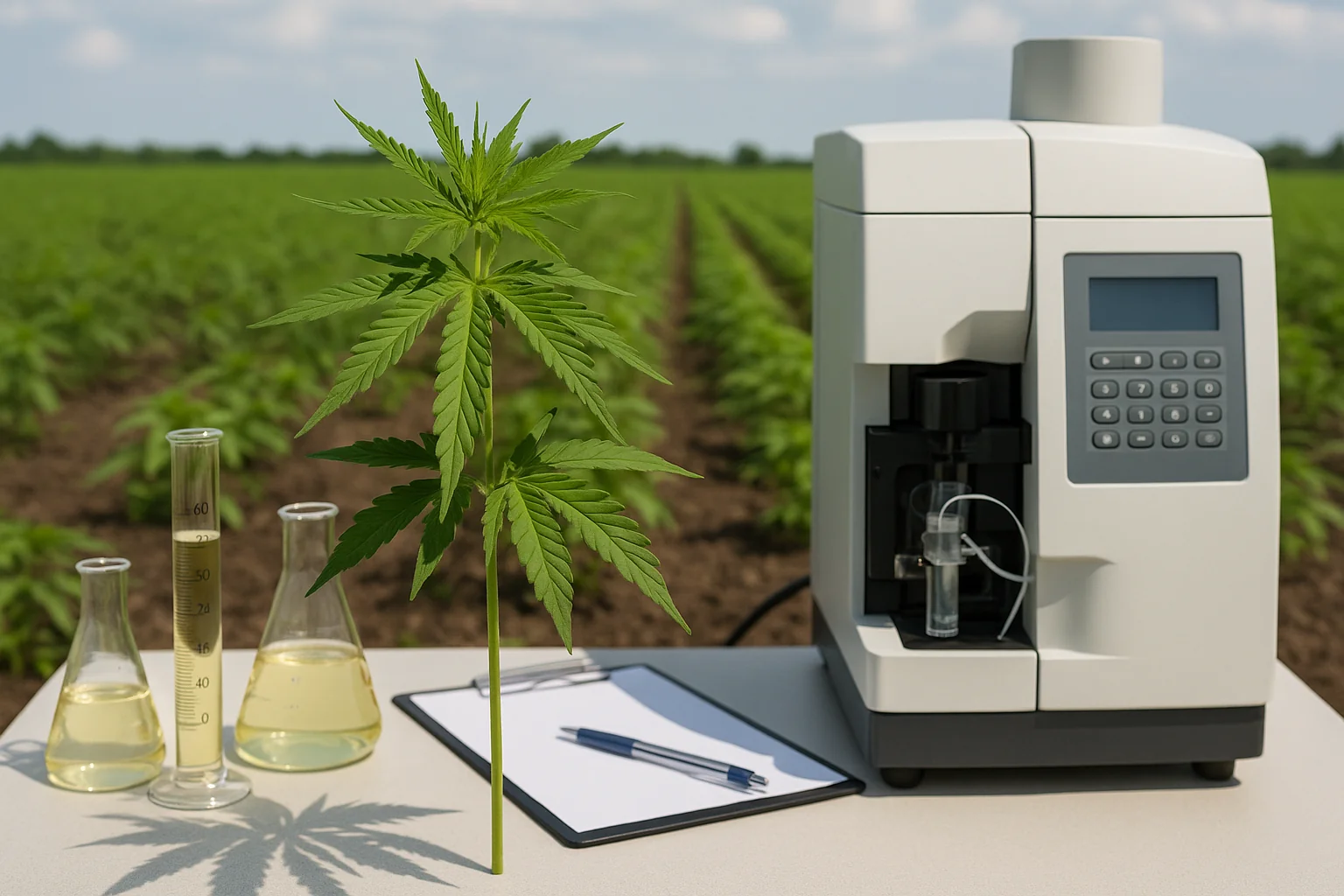

Heavy metals in CBD products - where they come from and how to detect them (table)
Heavy metals in CBD products: safety, contraindications, and legal status in the table. u Bucha.
Cannabis is one of the few cultivated plants that actively absorbs heavy metals from the soil - a process called phytoremediation. This same property that makes cannabis a useful tool for cleaning contaminated soils also means that cultivation on contaminated land can lead to the presence of lead, cadmium, or arsenic in finished CBD products. A study published in Science of the Total Environment found that lead was detected in 42% of tested edible CBD products, and arsenic in 28% (Bonn-Miller et al., 2022). This article explains where contaminants come from, what the acceptable limits are, and how to read a CoA certificate to choose a safe product.
KEY INFORMATION
• Cannabis is a phytoremediator - actively absorbs heavy metals from the soil into the plant tissues.
• The "big four" metals in CBD tests: lead (Pb), cadmium (Cd), arsenic (As), mercury (Hg).
• About 12% of CBD products on the market exceed safety limits for heavy metals (JCR, 2021).
• The only verification is a CoA certificate with an ICP-MS test from an independent laboratory.
• Certified European crops on controlled soils significantly reduce the risk of contamination.
Why do cannabis plants accumulate heavy metals?
Cannabis (Cannabis sativa L.) has been classified as a hyperaccumulator of heavy metals - meaning it absorbs them from the soil and stores them in its tissues at concentrations many times higher than those in the soil. The biological mechanism behind this is quite rational: plants have developed systems for the active transport of metal ions into cells, allowing them to 'select' mineral components from the soil. The problem is that these transporters do not distinguish between zinc (needed by the plant) and cadmium (toxic) - both have similar chemical properties and are transported by the same carrier proteins.
In practice, this means that the soil in which cannabis grows should be systematically tested for heavy metal content before sowing. Meanwhile - especially in the case of producers from countries with less regulated agriculture - such tests are not standard. Cannabis can grow in historically contaminated soils (e.g., areas near former foundries, mines, or industrial landfills), and the plants do not signal this with any visible symptoms. A contaminated plant looks identical to a healthy one.
An additional source of heavy metals may be pesticides used during cultivation (some contain arsenic or copper) and water used for irrigation. The CBD extraction process - especially solvent methods - can concentrate metal contaminants from the entire plant mass into a relatively small volume of extract. The concentration effect means that even low metal content in the raw material can lead to exceedances of limits in the final product.
Table of heavy metal limits in CBD products (EU standards and Ph. Eur.)
Limits for heavy metal contamination in CBD products depend on the regulatory category of the product. Dietary supplements are subject to milder food standards, while medicinal products are subject to stricter pharmacopoeial standards. The table below compares current limits and typical concentration ranges found in market studies.
| Metal | EU food limit (supplements) | Pharmacopoeial limit (Ph. Eur. 2.4.20) | Most commonly detected range in CBD | Risk when exceeded |
|---|---|---|---|---|
| Lead (Pb) | 0.1-3 mg/kg (depends on the matrix) | 5 ppm (plant substances) | 0,01-2,5 ppm | Neurotoxicity, kidney damage |
| Cadmium (Cd) | 0,05-1 mg/kg | 0.5 ppm | 0,001-0,4 ppm | Kidney damage, bone issues, cancers |
| Arsenic (As) | 0,1-1 mg/kg | 2 ppm (inorganic arsenic) | 0,001-0,3 ppm | Carcinogenicity, neurotoxicity |
| Mercury (Hg) | 0.1 mg/kg | 0.1 ppm | 0,001-0,05 ppm | Neurotoxicity, fetal damage |
| Chromium (Cr) | No general limit | Cr(VI): 0.5 ppm | 0,01-0,2 ppm | Carcinogenicity (Cr VI), kidney toxicity |
Data update: May 4, 2026 | Sources: EU Regulation 1881/2006, European Pharmacopoeia (Ph. Eur. 2.4.20)
How to read a CoA certificate for heavy metals?
A Certificate of Analysis (CoA) is a document issued by an independent laboratory that should confirm the composition of the CBD product - cannabinoid profile, presence of pesticides, solvent residues, and heavy metal content. Unfortunately, not all CoAs are created equal. Some producers publish results only for cannabinoids, omitting metal tests. It is important to know what to look for in the document.
Key elements of a good CoA for heavy metals: first, the section "Heavy Metals" - if it is missing, the CoA is incomplete. Second, the analysis method - it should be indicated as ICP-MS or ICP-OES. Colorimetric methods and older atomic absorption techniques have significantly higher detection limits and may not detect low concentrations that accumulate to dangerous levels with prolonged use. Third, check the units: results should be given in ppm (mg/kg) or ppb (µg/kg), and in the "Pass/Fail" column, it should state "Pass" for each metal. Fourth, the analysis date - the CoA should be issued for a specific batch of the product, not once a year for the entire product line.
The accreditation of the laboratory is equally important. In Poland, accredited laboratories are listed in the register of the Polish Centre for Accreditation (PCA). Certificates from laboratories with ISO 17025 accreditation have the highest credibility and are recognized by regulatory authorities.
How to minimize risk - a practical guide
When choosing a CBD product for metal purity, follow a few principles. The first and most important: choose products from certified European farms. The EU regulates heavy metal content in agricultural soils (Directive 86/278/EEC), which means that certified European farms are subject to stricter requirements than plantations from, for example, China or some Latin American countries.
Check if the producer uses supercritical CO2 extraction. CO2 extraction - unlike ethanol or hydrocarbon solvent extraction - is chemically selective and does not concentrate heavy metals as effectively as solvent methods. It does not eliminate the problem entirely (if the raw material is contaminated, CO2 will also extract metals), but with clean raw material, it provides a safer product.
Another rule: avoid products without CoA or with CoA covering only cannabinoids. A transparent producer has nothing to hide and provides full laboratory reports. If the CoA is not available on the product page and cannot be obtained upon request - choose another product.
Table of warning and positive signals when purchasing CBD
| Signal | Significance | Assessment |
|---|---|---|
| CoA with ICP-MS testing for metals (Pb, Cd, As, Hg) | Full verification of metal purity | Very good |
| Certified European cultivation (EU) | Soils regulated by directive 86/278/EEC | Good |
| Supercritical CO2 extraction | Selective method, concentrates fewer impurities | Good |
| CoA only for cannabinoids, no metals section | Lack of verification for key contaminants | Warning |
| No CoA or CoA not publicly available | Lack of transparency - it is unclear what is in the product | Serious warning |
| Cultivation in China or a country without agricultural soil regulations | Higher risk of contamination with heavy metals | Warning |
| Price significantly below market value | May indicate cheap raw materials without testing | Warning |
Data updated: May 04, 2026
How cannabis accumulates heavy metals - biological mechanism
Understanding the mechanism of cannabis phytoremediation allows for assessing which CBD products carry the greatest risk. Cannabis has developed active transport of metal ions through membrane proteins from the ZIP (zinc-iron permease) and CDF (cation diffusion facilitator) families. These proteins transport zinc, manganese, and iron essential for plant growth - but with increased availability of cadmium or lead in the soil, they transport them instead of or alongside the desired micronutrients. Cadmium and zinc have similar chemical properties (both belong to group 12 of the periodic table), which causes the plant to literally "confuse" them with each other.
Accumulation occurs sequentially. First, metals are absorbed by the roots, then transported via xylem to the stem, leaves, and flowers. Flowers and leaves - the same parts of the plant used to produce CBD extracts - accumulate metals more than the roots. This is the opposite pattern seen in many other plants. Studies have shown that the bioaccumulation factor (the ratio of concentration in plant tissue to concentration in soil) for cadmium in cannabis can exceed 1.0 - meaning that the concentration in the tissue is higher than in the soil (Husain et al., Ecotoxicology, 2019).
Extraction concentrates impurities. If one gram of flower contains 0.5 ppm of lead, and 50 grams of plant material are needed to produce 1 ml of CBD oil, the extract may contain a lead concentration 50 times higher. Of course, the efficiency of metal extraction differs from cannabinoid extraction (metals are less efficiently extracted by CO2 than by ethanol), but the concentration mechanism is real and justifies the requirement for testing the final product, not just the raw material.
Are CBD products from certified European farms safer?
The short answer: yes, statistically - but the "European" certificate is not a guarantee in itself. The difference lies in soil regulations. EU Directive 86/278/EEC on environmental protection when using sewage sludge in agriculture specifies maximum allowable concentrations of heavy metals in agricultural soils: lead max 300 mg/kg dry matter, cadmium max 3 mg/kg dry matter, mercury max 1.5 mg/kg dry matter. Non-EU countries - including China, India, and some Latin American countries - do not have analogous regulations or their enforcement is weaker.
Practical consequences: extract from certified European cultivation on soil monitored by agricultural inspection has statistically lower risk of exceeding heavy metal limits than extract from non-certified cultivation or from a country with weaker agricultural regulations. However, even in Europe, historical soil contamination can occur near former industrial facilities, mines, and foundries. The "European" certificate should be supported by specific soil testing on the given field, not just by geographical location.
The best practice is to verify at the finished product level. A CoA for a product batch with an ICP-MS test is proof of what actually goes into the bottle - regardless of the declared source of the raw material. Producers who regularly monitor the quality of each batch, not just cultivation certificates, provide consumers with a real guarantee of safety.
Frequently Asked Questions
Why can hemp contain heavy metals?
Cannabis is a phytoremediation plant - it has the ability to actively absorb heavy metals from the soil and accumulate them in its tissues. This phenomenon has been deliberately used to clean contaminated lands. If cannabis grows in soil contaminated with lead, cadmium, arsenic, or mercury, these metals enter the plant and potentially into the CBD extract.
What heavy metals are most commonly detected in CBD products?
The most commonly detected metals in CBD products are lead (Pb), cadmium (Cd), arsenic (As), and mercury (Hg) - the "big four" in pharmaceutical regulations. A study in Science of the Total Environment (2022) found that lead was detected in 42% of tested edible CBD products, and arsenic in 28% - although exceedances of regulatory thresholds concerned a smaller percentage of samples.
How to check if a CBD product contains heavy metals?
The only sure way is a CoA from an independent laboratory with ICP-MS or ICP-OES test results. The CoA should contain a "Heavy Metals" section with values below limits for each metal. The CoA should be issued for a specific batch of the product and be publicly available or upon request.
Does Polish law regulate heavy metal limits in CBD?
Yes. CBD products as dietary supplements are subject to EU Regulation No. 1881/2006, which sets limits for lead and cadmium in food. Medicinal products containing CBD are subject to Ph. Eur. 2.4.20 standards. The limits in the pharmacopoeia are stricter than those for food and apply to medical cannabis products.
What is the ICP-MS method and why is it important for CBD safety?
ICP-MS (Inductively Coupled Plasma Mass Spectrometry) is a method that detects heavy metals at the ppb (parts per billion) level. The gold standard in pharmacy and food research - it is incomparably more sensitive than older methods. Only a CoA with ICP-MS or ICP-OES results provides reliable confirmation of the safety of a CBD product regarding metals.
Can carrier oil (MCT, olive oil) also contain heavy metals?
Yes, although the risk is significantly lower than with hemp extract. MCT oil (fractionated coconut oil) or olive oil makes up the majority of the volume of CBD oil, so their purity also matters. High-quality food-grade or pharmaceutical-grade MCT oils undergo their own heavy metal testing. A good CBD oil producer tests the finished product (not just the CBD extract), which takes into account possible metal contributions from the carrier oil. A full CoA for the finished product - not just for the extract itself - is the gold standard for verification.
This article is for informational and educational purposes and does not replace consultation with a doctor. If you are pregnant, breastfeeding, taking medications, or have chronic conditions, consult the use of supplements or herbs with a specialist.
Author: Michał Waluk · Published: 2026-05-04 · Updated: 2026-05-04