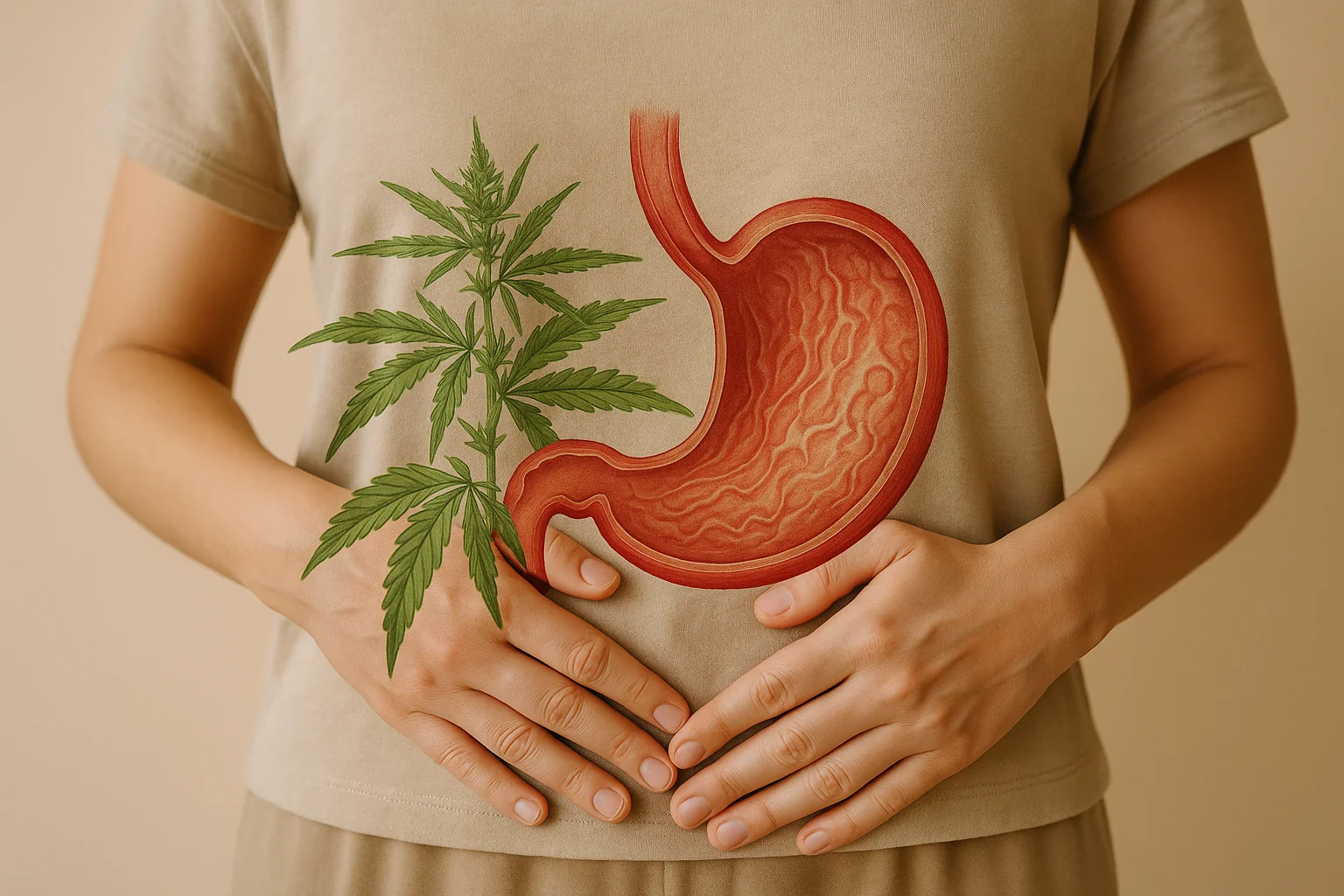

CBD and stomach ulcers and hyperacidity - what you should know (FAQ)
CBD and stomach ulcers and hyperacidity: answers to the most common questions and what studies say. u Bucha.
Stomach ulcers and hyperacidity are among the most common gastrointestinal problems - it is estimated that a peptic ulcer affects about 10% of the population in Western countries during their lifetime (Malik & Dua, StatPearls, 2023). More and more people are asking whether CBD can support stomach health or alleviate symptoms associated with hyperacidity. The endocannabinoid system is present throughout the gastrointestinal tract, and CB1 and CB2 receptors are expressed in the gastric mucosa - this provides a biological rationale for interest in CBD in this context. Gyires and colleagues demonstrated in an animal model that activation of CB1 in the stomach inhibits acid secretion and protects the mucosa (Gyires et al., Journal of Physiology, 2012). However, the path from preclinical results to clinical recommendations is long - this article describes the state of knowledge accurately, without exaggeration in either direction.
KEY INFORMATION
• CB1 and CB2 receptors are expressed in the gastric and intestinal mucosa - activation of CB1 inhibits gastric acid secretion in animal models (Gyires et al., Journal of Physiology, 2012).
• CBD is not a treatment for stomach ulcers - it does not replace the eradication of H. pylori or proton pump inhibitors.
• CBD inhibits CYP2C19 - the enzyme that metabolizes omeprazole and other PPIs - which may alter the concentration of medications when used simultaneously.
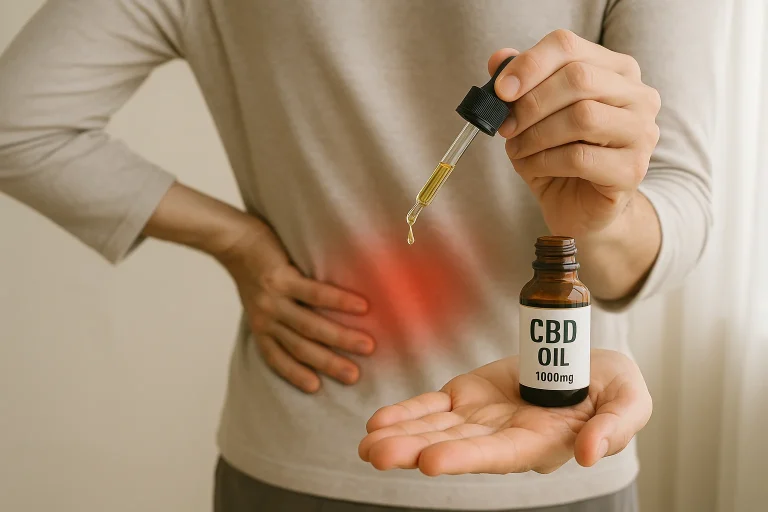
• Take CBD oil for stomach issues after meals, not on an empty stomach.
The endocannabinoid system in the stomach - what do we know?
The gastrointestinal tract is one of the richest areas of the body in cannabinoid receptors. CB1 receptors are present in the parietal cells of the gastric mucosa (responsible for secreting hydrochloric acid), in the neurons of the Auerbach and Meissner plexuses that regulate intestinal motility, and in the endothelial cells of the intestine. CB2 receptors are concentrated in the immune cells of the intestinal mucosa and are involved in regulating inflammation.
Studies in animal models show that activation of CB1 in the stomach consistently inhibits gastric acid secretion, slows gastric emptying, and reduces intestinal motility. These observations have proposed the hypothesis that modulation of the endocannabinoid system could be significant in hyperacidity and ulcer disease. However, CBD itself is not a strong CB1 agonist - it primarily works by increasing the level of endogenous anandamide (by inhibiting the FAAH enzyme) and through other pathways, such as TRPV1 and PPARγ. The effect on gastric acid secretion is therefore indirect and difficult to predict for a specific individual.
Does CBD help with acid reflux?
Gastroesophageal reflux disease (GERD) is associated with abnormal function of the lower esophageal sphincter. The mechanism that most often leads to reflux episodes is transient relaxations of the lower esophageal sphincter (TRLESR). Studies indicate that CB1 receptors present around the lower esophageal sphincter may modulate the frequency of TRLESR. CB1 agonists reduce their number in animal models, which has raised questions about CBD in the context of reflux.
However, there are no direct clinical studies for CBD in GERD. The available data consists of preclinical models and one small trial with cannabinoid agonists - not with CBD as such. People with reflux using CBD report various effects: some describe a reduction in discomfort, while others report an intensification of symptoms (especially with MCT oil taken on an empty stomach, which can itself exacerbate reflux). There is no basis to recommend CBD as a treatment for GERD, but there is also no evidence that CBD worsens reflux when used properly after meals.
| Condition | Biological mechanism of CBD | Level of clinical evidence |
|---|---|---|
| Acid reflux | Indirect modulation of CB1 → inhibition of HCl secretion | Only preclinical |
| Stomach ulcer | CB1/CB2 in the mucosa, anti-inflammatory action | Lack of clinical studies |
| Reflux (GERD) | CB1 at the lower esophageal sphincter | Only preclinical |
| Inflammatory bowel disease | CB2 in immune cells of the mucosa | Small pilot studies |
| Nausea and vomiting | CB1 in the vomiting center of the brainstem, 5-HT1A receptor | Moderate (mainly for cancers) |
CBD interactions with stomach medications
This is a topic that everyone taking medications for hyperacidity or ulcers should know if they want to include CBD. Proton pump inhibitors - omeprazole, pantoprazole, esomeprazole, lansoprazole - are metabolized by the CYP2C19 enzyme in the liver. CBD is an inhibitor of CYP2C19 (Bruni et al., Molecules, 2018). In practice, this means that simultaneous use of CBD may slow the breakdown of PPIs in the liver and raise their concentration in the blood - which may intensify the effects of the medication (or its side effects, such as headaches, diarrhea, hypomagnesemia with long-term use).
The clinical significance of this interaction depends on the dose of CBD and the specific medication. At low doses of CBD (below 25 mg per day), the impact on CYP2C19 is likely minimal, but at higher doses, it may be significant. Medications blocking H2 receptors (ranitidine - withdrawn, famotidine) are metabolized through a different pathway, and the risk of interaction with CBD is lower with them. Sucralfate used as a mucosal protector is not metabolized by liver enzymes - there is no metabolic interaction with CBD.
Diet and lifestyle with ulcers and CBD supplementation
In the case of stomach ulcers and hyperacidity, diet and elimination of irritating factors are of primary importance - significantly more than any supplement. Alcohol, tobacco smoking, and NSAIDs (ibuprofen, aspirin, naproxen) are the three strongest irritants to the gastric mucosa. Infection with H. pylori requires antibiotic eradication - without it, the ulcer will return regardless of the use of CBD or any other supplement. Stress indirectly increases gastric acid secretion by activating the sympathetic nervous system and increasing cortisol, which may explain why some people feel improvement with CBD - if CBD reduces stress, it may indirectly help calm the stress axis affecting the stomach.
If despite diet and causal treatment of ulcers you are considering CBD as a supplement, key practical rules are: take CBD after meals (fat improves absorption and protects the stomach), choose a form well-tolerated by your stomach (capsules or gummies instead of MCT oil on an empty stomach), start with a low dose and observe the reaction for a week, and be sure to inform your doctor if you are taking PPIs - the interaction with CYP2C19 may have clinical significance with the regular use of both substances.
Frequently Asked Questions
Can CBD help with stomach ulcers?
Preclinical studies suggest that the endocannabinoid system plays a role in regulating gastric acid secretion and protecting the mucosa. CB1 and CB2 receptors are expressed in the gastric mucosa. However, there are no clinical studies confirming the effectiveness of CBD in treating ulcers in humans - CBD does not replace the eradication of H. pylori or PPIs (Gyires et al., Journal of Physiology, 2012).
Can CBD exacerbate stomach ulcers?
CBD itself does not have irritating properties on the mucosa. However, MCT oil used as a carrier in CBD oils may cause discomfort or exacerbate reflux on an empty stomach in some individuals with a sensitive stomach. People with active ulcers should take CBD after meals and monitor their reaction.
Does CBD interact with ulcer medications?
Yes. CBD inhibits CYP2C19 - the enzyme that metabolizes omeprazole, pantoprazole, and other proton pump inhibitors. Inhibition of CYP2C19 may raise the concentration of PPIs in the blood. Before combining CBD with stomach medications, it is advisable to consult a doctor or pharmacist (Bruni et al., Molecules, 2018).
What effect does CBD have on stomach acid secretion?
Animal models show that activation of CB1 in the stomach inhibits stomach acid secretion. CBD indirectly raises levels of endocannabinoids by inhibiting FAAH, which may modulate this regulation. However, effects in animal models do not automatically translate to humans, and there is a lack of clinical studies on acid reflux (Gyires et al., Journal of Physiology, 2012).
What causes stomach ulcers and does CBD affect these causes?
Stomach ulcers are most commonly caused by infection with Helicobacter pylori (about 70-80% of duodenal ulcers) and long-term use of NSAIDs. CBD does not have antibacterial activity against H. pylori and does not replace antibiotic eradication. For ulcers caused by H. pylori, the standard is triple therapy - CBD does not change this approach.
How to use CBD for stomach issues?
CBD oil for stomach problems is best taken after meals - the fat from food improves CBD absorption and reduces the risk of irritation from the carrier oil. CBD capsules or CBD gummies may be better tolerated than sublingual oil with MCT by individuals with a sensitive stomach. Always start with a small dose and observe the reaction.
Can CBD help with gastroesophageal reflux?
CB1 receptors are involved in regulating the lower esophageal sphincter, and CB1 agonists reduce the number of reflux episodes in animal models. There are no direct clinical studies for CBD in GERD. Some individuals report improvement, while others report intensification of symptoms when taking CBD with MCT oil on an empty stomach. Taking it after meals reduces this risk.
This article is for informational and educational purposes and does not constitute medical advice. Before starting to use cannabis or CBD for therapeutic purposes, consult a doctor, especially if you are taking other medications, are pregnant, or breastfeeding.
Author: Michał Waluk · Published: 2026-05-04 · Updated: 2026-05-04