
48 hours that reset sensitivity - what brain imaging says about a two-day break
48 hours that reset sensitivity: responses based on research and practice. u Bucha.
If you have been taking CBD for months and feel like it has 'stopped working' - you probably don't need a higher dose. You need a short break. Hirvonen et al.'s 2012 PET brain study was the first to directly show that regular cannabinoid use reduces CB1 receptor density in the cerebral cortex and limbic structures - and that this change reverses after a break (Hirvonen et al., Molecular Psychiatry, 2012). With CBD, the tolerance effect is weaker than with THC, but the mechanism is biologically real. A two-day T-break every 3-4 weeks is a practical tool that Dr. Sulak incorporates into the supplementation cycle. This article answers the most frequently asked questions.
KEY INFORMATION
• Hirvonen's PET study (2012) showed that regular marijuana use decreases CB1 density in the brain - visually evident, reversible after abstinence.
• CBD, as a weaker CB1 ligand, causes slower tolerance, but at high doses, the effect is biologically possible.
• A 48-hour break every 3-4 weeks (T-break) is a protocol for restoring sensitivity at supplemental doses of CBD.
• After a break, receptor sensitivity increases - the same dose works stronger, and you can return to a lower one.
• CBD does not cause physical dependence - T-break is an optimization choice, not detox (WHO, 2018).
What does a PET brain scan show after months of cannabinoid use?
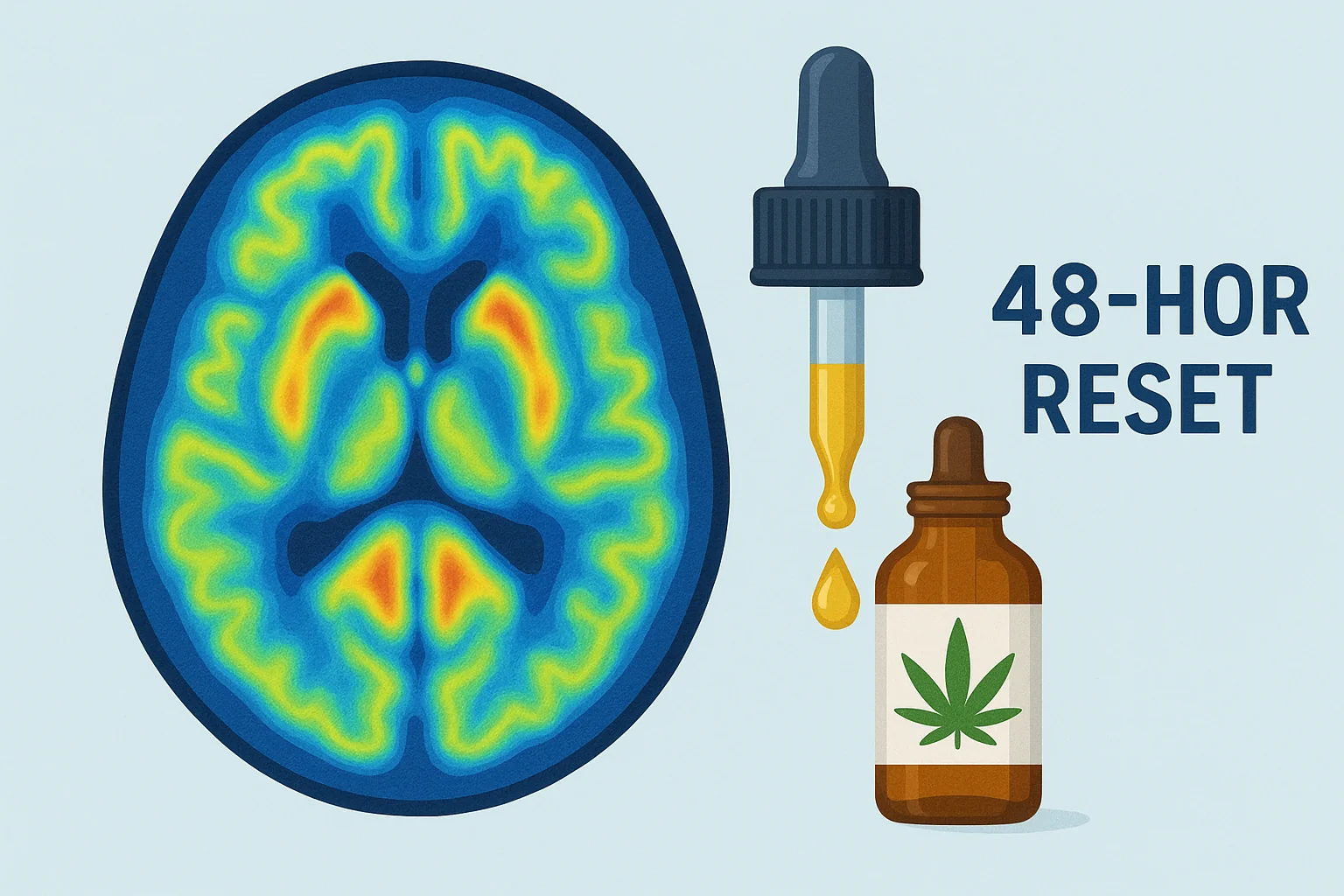
The study by Hirvonen et al. published in Molecular Psychiatry in 2012 used the PET ligand [11C]MePPEP, which selectively binds to CB1 receptors in the brain, allowing for their direct in vivo measurement. The researchers compared CB1 density in 30 regular marijuana smokers (using at least 4 times a week) with 30 non-users. The results were clear: marijuana users had 20% lower availability of CB1 receptors in the frontal cortex, anterior cingulate cortex, and other regions (Hirvonen et al., Molecular Psychiatry, 2012). After four weeks of abstinence, CB1 density returned to levels seen in non-users. This is the first visual confirmation that the brain actively regulates the number of CB1 receptors in response to their chronic stimulation.
Important caveat: Hirvonen's study concerned regular marijuana smoking, thus involving high doses of THC - a strong CB1 agonist. CBD is a weaker CB1 ligand and causes tolerance through an indirect mechanism (by increasing endogenous anandamide), not through direct receptor saturation. The reset time with CBD alone is likely shorter than with THC - hence the suggestion of a 48-hour, rather than a 4-week break.
Does CBD cause tolerance at all?
This question has two layers: pharmacological and practical. Pharmacologically - CBD shows low affinity for CB1 as a direct ligand. Its action on the ECS occurs mainly indirectly: by inhibiting FAAH (increasing anandamide), blocking the AEA transporter, and modulating the TRPV1 receptor. These indirect mechanisms are less likely to generate classic receptor tolerance than direct activation of CB1 by THC.
Practically, however - especially with high doses used long-term - some users report a weakening of the effect after a few weeks. This may result from: indirect desensitization of CB1 due to chronic increases in anandamide, adaptation of the 5-HT1A pathway, as well as non-pharmacological factors (perceptual habituation - 'you stop noticing' subtle effects). Regardless of the exact mechanism, a break works: it resets both biology and perception.
| Aspect | THC (strong CB1 agonist) | CBD (indirect ECS modulator) |
|---|---|---|
| CB1 tolerance | Fast, visible in PET (20% ↓ CB1) | Slower, indirect (through anandamide) |
| Reset time | Approx. 4 weeks (Hirvonen, 2012) | Probably 48-72h (Sulak protocol) |
| Physical dependence | Possible with intensive use | None (WHO, 2018) |
| Recommended break | 2-4 weeks | 48h co 3-4 tygodnie |
How to conduct a 48-hour T-break - practically
The break does not require special preparations. Choose two consecutive days when you do not have a particularly stressful schedule (the first T-breaks may slightly worsen sleep or mood - not because CBD is addictive, but because the body has 'gotten used' to a higher level of anandamide). Just do not take CBD for 48 hours.
After 48 hours, before returning to CBD, perform the Sulak sensitivity test: assess breath, body tension, and mood before the first dose and 45-60 minutes after. Start with a dose 20-30% lower than what you used before the break. A surprising observation from many users: this lower dose works just as well as the higher one before the break - because the receptors are more sensitive.
The T-break protocol has another, often overlooked effect: it forces a 48-hour observation of how you feel WITHOUT CBD. This is diagnostically valuable - it allows you to distinguish the effect of actual CBD action from perceptual habituation. If you feel significantly worse without CBD after 48h (sleep, mood, pain) - then CBD is likely having a real effect on you. If there is no difference - it is worth asking whether the dose was too small or too large.
When is a T-break not a good idea?
Most adults using CBD for wellness purposes can safely take 48-hour breaks. However, there are situations where a break requires consultation or is contraindicated. Individuals using CBD for diagnosed drug-resistant epilepsy - especially in Epidiolex or equivalent regimens - should not discontinue use without the knowledge of their treating neurologist. Sudden discontinuation of even supplemental CBD in such patients can lower the seizure threshold for several hours. A similar principle applies to those using CBD as a supplement to psychiatric therapy under medical supervision.
For healthy adults without clinical indications, a T-break is safe and even recommended by Sulak as part of a conscious supplementation protocol. It is also worth being aware that 48 hours is not a magic number - it is a minimal approximation based on the pharmacokinetics of CBD (half-life of about 18-32 hours with oral use) and clinical observations. Some users report that a 3-day break provides a clearer reset effect than a 2-day one. Experimenting with the length of the break in safe conditions is justified.
Frequently Asked Questions
Does CBD cause tolerance similar to THC?
CBD is not a strong CB1 agonist, so classic tolerance (as with THC) is significantly weaker. At supplemental doses (5-25 mg), most users do not experience clinically significant tolerance for months. At higher doses used long-term, indirect desensitization of endocannabinoid pathways is possible - hence the value of a T-break as a preventive tool.
How long does it take to reset CB1 receptors?
Hirvonen's PET study showed that after regular marijuana (THC) use, CB1 receptors return to normal after about 4 weeks of abstinence (Molecular Psychiatry, 2012). With CBD - a weaker CB1 ligand - the reset is likely faster. Sulak's clinical protocols suggest that a 48-hour break every 3-4 weeks is sufficient at supplemental doses.
What is a T-break and how to conduct it with CBD?
A T-break (tolerance break) is a planned 48-hour break from CBD every 3-4 weeks of regular use. During this time, mild worsening of sleep or mood may occur - this is a normal short-term adaptation, not a withdrawal symptom. After the break, return to a dose 20-30% lower and assess the effect - receptor sensitivity is higher.
Can you return to the same dose after a break from CBD?
Yes, but it often turns out that a lower dose is sufficient - that's the point. Restored CB1 sensitivity means that the same dose produces a stronger effect. After a T-break, it's a good time to reapply the Sulak sensitivity test and find a new, lower sweet spot.
Is a break from CBD safe?
Yes, for healthy adults, a short break is completely safe. CBD does not cause physical dependence - the WHO confirmed the lack of addictive potential of CBD in its 2018 report (WHO, 2018). Individuals using CBD for medical indications (epilepsy, psychosis) should not discontinue use without consulting a doctor.
How does brain PET imaging show tolerance to cannabinoids?
The PET ligand [11C]MePPEP selectively binds to CB1 receptors, allowing for their quantitative measurement in vivo. Hirvonen et al. showed a 20% lower CB1 density in the cortex of regular marijuana users vs. non-users. After 4 weeks of abstinence, density returned to normal - the first direct visual confirmation of the reversibility of CB1 tolerance (Molecular Psychiatry, 2012). The key word is 'reversibility' - this is not permanent damage to the endocannabinoid system, but a plastic receptor adaptation that the brain performs in response to chronic stimulation, which also reverses just as efficiently when stimulation ceases. This ability to regulate up and down is the biological justification for the T-break protocol.
This article is informational and educational in nature. It contains internal links to products available in the u Bucha store. Prices and specifications may change - please check the current data on the product page before purchasing.
Author: Michał Waluk · Published: 2026-05-04 · Updated: 2026-05-04