
Caffeine bags: what they are, how they work, and whether they are safe (ranking)
Caffeine pouches contain between 40 to 200 mg of caffeine per piece. We check how quickly they work, how much 100 mg of caffeine costs, and where EFSA sets the limit.
One pouch from the Poucher line contains 200 mg of caffeine. This is exactly the amount considered uncontroversial for a healthy adult. EFSA This coincidence explains why the question of safety regarding caffeine pouches is not just polite: in a pouch the size of a postage stamp, there is as much caffeine as in two strong coffees. Caffeine pouches are sachets placed under the lip instead of drinking coffee, without tobacco and without nicotine. Below you will find what is truly known about caffeine absorption through the mucous membrane, a complete overview of twenty pouches from the u Bucha offer along with the cost of 100 mg of caffeine, and the limits that are better not to exceed. Prices are sourced from the store API and reflect the state as of August 8, 2026.
KEY INFORMATION
• EFSA states 400 mg of caffeine per day and 200 mg in a single dose as unrestricted levels for healthy adults (EFSA).
• Caffeine from chewing gum peaked after 44.2-80.4 minutes, from a capsule after 84.0-120.0 (Kamimori et al., 2002).
• The store has 20 pouches, from 40 to 200 mg each.
• Withdrawal symptoms last 2-9 days (Juliano and Griffiths, 2004).
What are caffeine pouches and how do they differ from snus?
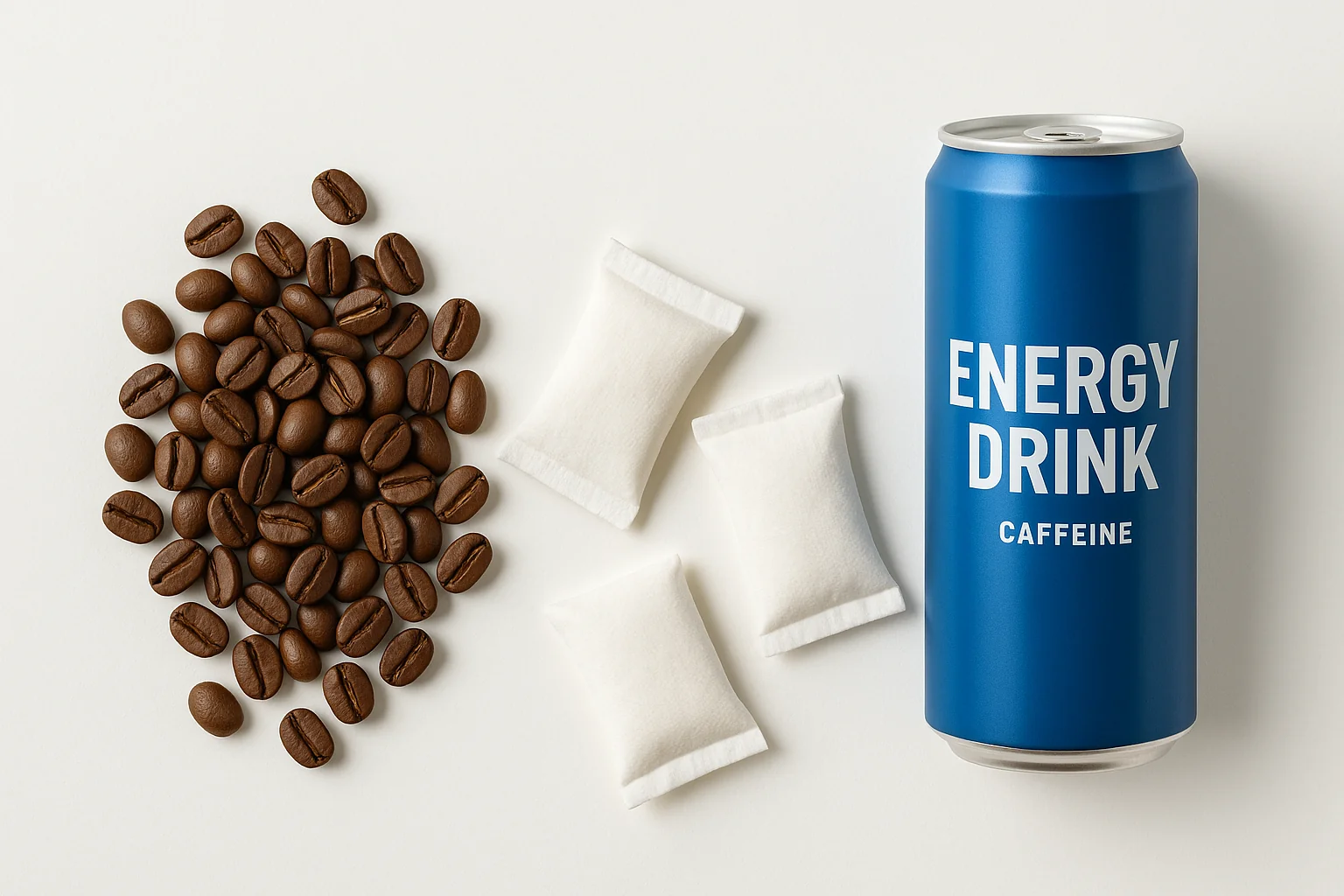
Caffeine pouches are cellulose sachets filled with caffeine, filler, and flavoring, which are placed under the lip for 20-30 minutes. They do not contain tobacco or nicotine, so they are different from both snus and nicotine pouches in terms of composition and the reason someone would reach for them.
The composition can be shorter than marketing suggests. The label of the Poucher line starts with microcrystalline cellulose (E460) and propylene glycol (E1520), with caffeine appearing only in fourth place, after demineralized water. This is not a plant extract, but a carrier of pure caffeine with added flavor. An exception in the store is the Fedrs Energy line, which adds L-theanine and vitamin B3 to caffeine.
The distinction between the three formats can be confusing in store descriptions. Traditional snus contains tobacco and nicotine. Nicotine pouches contain nicotine without tobacco. Caffeine pouches contain neither, and the only active substance is caffeine. However, the trade name can be misleading: some products in the store have the word SNUS in their name, even though the description clearly states 'without tobacco and without nicotine'.
The manufacturers themselves treat these pouches as a product for adults. The description of the Poucher line limits them to adults and states a maximum of two pouches per day. X-booster excludes individuals under 18 years of age as well as pregnant and breastfeeding women, and separately mentions those for whom a doctor has recommended limiting caffeine.
How quickly does caffeine from a pouch work?
There is no published pharmacokinetic study on caffeine pouches. The closest evidence comes from caffeine gum: peak blood concentration occurred after 44.2-80.4 minutes, compared to 84.0-120.0 minutes after a capsule (Kamimori i wsp., 2002). Faster than swallowing, but not within a few minutes.
It's important to know the scale of this study, as it is often cited carelessly. It involved 84 healthy, non-smoking men, with twelve in each group, and the doses were 50, 100, or 200 mg. Blood was collected from the fifth minute up to the twenty-ninth hour after administration. The authors state that the absorption rate from the gum was significantly faster and that this may indicate absorption through the buccal mucosa. At doses of 100 and 200 mg, the amount of caffeine that ultimately reached the bloodstream was similar for both forms.
We noticed that descriptions of caffeine pouches repeatedly mention the time to effect as "5-15 minutes." We did not find a study from which this could originate. The fastest measurement in the cited study is 44 minutes to peak, and the first blood draw was only performed at the fifth minute, so data on earlier effects simply do not exist.
The practical conclusion for training is more cautious than the promise of an immediate boost. The position of the International Society of Sports Nutrition states that caffeine gum may require a shorter interval before starting than a capsule, with a typical interval of 60 minutes for swallowed forms (Guest i wsp., 2021).
How much caffeine do the pouches available in the store contain?
In the caffeine pouch category at u Bucha, there are 20 items from four lines, and the dose per pouch ranges from 40 to 200 mg. The order in the ranking is based on two factors: whether the store provides complete data, i.e., the dose per pouch along with the number of pouches in the can, and how much 100 mg of caffeine ultimately costs.
| Place | Linia (wersje) | What distinguishes | Kofeina na woreczek | Price | Koszt 100 mg |
|---|---|---|---|---|---|
| 1 | Poucher 333 mg/g (4 smaki) | Most caffeine for a zloty, full label | 200 mg, 20 szt. | 24.99 zł | 0.62 zł |
| 2 | X-booster 80 mg (2 smaki) | Dose similar to strong coffee | 80 mg, 20 szt. | 16.90 zł | 1.06 zł |
| 3 | Fedrs Energy (3 smaki) | Cheapest can, L-theanine and vitamin B3 | 65 mg, 20 szt. | 14.00 PLN | 1.08 zł |
| 4 | X-booster 40 mg (2 smaki) | Najmniejsza dawka, wygodna na start | 40 mg, 20 szt. | 16.90 zł | 2.11 zł |
| 5 | Bezsen 250 mg/g (2 smaki) | Najmocniejszy wariant linii | ok. 150 mg, liczba sztuk niepodana | 22.90-24.99 zł | nie do policzenia |
| 6 | Bezsen 170 mg/g (4 smaki) | Largest selection of flavors | ok. 102 mg, liczba sztuk niepodana | 18.88-20.99 zł | nie do policzenia |
| 7 | Bezsen 85 mg/g (3 smaki) | Mildest variant of the line | ok. 51 mg, liczba sztuk niepodana | 15.45-17.99 zł | nie do policzenia |
The last three places are occupied by one line for the same reason. Bezsen provides the caffeine concentration per gram and the weight of the pouch as 0.6 g, but does not disclose how many pouches are in the can. The dose per piece can be calculated from this, but not the unit price. The number in the name indicates milligrams per gram, not per pouch, and the same trap applies to the name Poucher 333 mg.
Which pouch is the cheapest for 100 mg of caffeine?
The cheapest is Poucher: 0.62 zł for 100 mg of caffeine. The most expensive is X-booster in the 40 mg version, where the same 100 mg costs 2.11 zł, which is over three times more. The difference comes from the dose, not the price of the can, as both versions of X-booster cost the same.
However, this conversion does not determine the choice by itself. A 40 mg pouch allows for small step dosing and fits within the limit even after two coffees, while a 200 mg pouch does not allow for that. The manufacturer Poucher closes the matter by stating a maximum of two pouches per day, which gives 400 mg and exhausts the daily limit according to EFSA's opinion.
Our observations indicate that people transitioning from coffee most often aim for a dose similar to a cup, i.e., 60-90 mg. X-booster 80 mg and Fedrs Energy 65 mg fall within this range, and the cost difference for 100 mg between them is two grosze. The choice then comes down to flavor and whether you care about the addition of L-theanine.
Are caffeine pouches safe?
For a healthy adult, the safety of the pouch comes down to arithmetic. EFSA states that consumption of up to 400 mg of caffeine per day, about 5.7 mg per kilogram of body weight, raises no concerns, and single doses up to 200 mg, about 3 mg per kilogram, also do (EFSA). The pouch does not change these thresholds; it only changes the ease of exceeding them.
Above these values, undesirable effects described in sports literature begin to occur. The position of the International Society of Sports Nutrition indicates doses of 3-6 mg per kilogram of body weight as effective for improving performance, while doses around 9 mg per kilogram are associated with a high frequency of adverse effects without additional benefits (Guest i wsp., 2021). For a person weighing 70 kg, 9 mg per kilogram is 630 mg, which is just over three Poucher bags.
An additional issue is the format of the pouch, about which we know almost nothing regarding caffeine. In a clinical study of nicotine pouches, where fifteen smokers held a pouch in their mouths for 20 minutes, oral irritation occurred after all tested products, including the nicotine-free pouch (Mallock-Ohnesorg i wsp., 2024). This study does not pertain to caffeine, but it shows that the pouch held under the lip affects the mucosa regardless of its contents.
The groups for which the thresholds are lower are explicitly mentioned by EFSA. Pregnant and breastfeeding women have a limit of 200 mg per day from all sources. For children and adolescents, the proposed level is 3 mg per kilogram of body weight per day, which for a teenager weighing 50 kg amounts to 150 mg, or less than one Poucher bag.
Are caffeine pouches addictive?
Yes, exactly the same as coffee, because it is the substance that is addictive, not the format. A review of 57 experimental studies and 9 surveys showed that symptoms of caffeine withdrawal appear after habitual doses of around 100 mg per day (Juliano i Griffiths, 2004). To jeden woreczek X-booster 80 mg dziennie z niewielkim naddatkiem.
The course of withdrawal is described in this work with numbers that are worth knowing before taking a break. Headaches occurred in half of the participants in the experimental studies, symptoms usually began 12-24 hours after the last dose, peaked between the 20th and 51st hour, and lasted for 2-9 days. The authors verified ten categories of symptoms, including fatigue, low mood, and difficulty concentrating. They also note that avoiding these symptoms plays a central role in the habitual reach for caffeine, and the mere anticipation of them is not the main causal factor.
The number 1-3 days, which product descriptions repeat, is therefore underestimated compared to the range of 2-9 days from the review work. If you plan to take a break, spread it over a week with some buffer, not just a weekend.
When to let go of the pouch and how to store it?
The sharpest boundary concerns the time of day, not the dose. In a study where 400 mg of caffeine was administered at 0, 3, and 6 hours before sleep, the measured sleep time was shortened by 1.1-1.2 hours compared to placebo at each of these times, even with a six-hour interval (Drake i wsp., 2013).
This translates into a simple rule for pouches. If you go to bed at 11 PM, the last pouch should land under your lip before 5 PM, and with doses above 100 mg, rather earlier. The authors of this study considered six hours to be the minimum interval justified by measurement, not a precautionary recommendation.
Storage is much less dramatic, although it affects comfort. All labels in the store say the same: cool, dry, away from sunlight, and out of reach of children. A dried pouch releases flavor poorly and is harder to keep under the lip. A 62% humidity regulator in the 8 g version costs 4.50 PLN at u Bucha and fits in a standard can, and you can find it in the storage category.
Frequently Asked Questions
How many caffeine pouches can be taken in a day?
It depends on the dose in the pouch, not the number of pieces. EFSA states 400 mg of caffeine per day as an unrestricted level for healthy adults and 200 mg in a single dose. With pouches containing 40 mg, this amounts to ten pieces, while with 200 mg, only two, counting together with coffee consumed that same day.
Do caffeine pouches contain nicotine?
No. All 20 items in the caffeine pouch category at u Bucha have a label stating that they do not contain tobacco or nicotine. This distinguishes them from snus, which contains both ingredients, and from nicotine pouches that contain only nicotine. The active substance here is solely caffeine.
How long should the pouch be kept under the lip?
Manufacturers recommend 20-30 minutes. Poucher advises placing the pouch under the upper lip for a maximum of 30 minutes, while X-booster mentions about 20 minutes under the lip close to the gums. The pouch should not be swallowed or chewed, and after use, it should be disposed of.
Does the pouch work faster than coffee?
Probably yes, but not in a few minutes. In a study by Kamimori et al. from 2002, caffeine from chewing gum reached peak blood concentration after 44.2-80.4 minutes, and from a capsule after 84.0-120.0 minutes. No one has published such a measurement for caffeine pouches.
Can caffeine pouches be used by pregnant women?
EFSA states a limit of 200 mg of caffeine per day from all sources for pregnant and breastfeeding women. Manufacturers of pouches go further and explicitly exclude this group: descriptions from Poucher and X-booster state that the product is not suitable for pregnant and breastfeeding women.
What to do if your heart races and your hands tremble after using a pouch?
Remove the pouch and do not reach for another one that day. The position of the International Society of Sports Nutrition indicates that very high doses, around 9 mg per kilogram of body weight, are associated with a high frequency of adverse effects. If symptoms recur, consult your caffeine intake with a doctor.
You can find the current list of all twenty items in the category woreczki, and cans and humidity regulators in the category storage.
This article is for informational and educational purposes. It contains internal links to product categories available in the u Bucha store. Prices and specifications may change: check the current data on the product page before purchasing.
Author: Michał Waluk · Opublikowano: 2026-06-29 · Aktualizacja: 2026-08-08