
Hemp cosmetics: CBD cream, serum, and balm - do they really work on the skin
Cream, serum, and balm with CBD under the microscope of research: how much cannabidiol penetrates the skin, what is really known about acne and atopic dermatitis, and how to read the label.
On the label of a hemp cosmetic, you will rarely find a number that would allow you to assess what you are actually buying. You might see Cannabis Sativa Seed Oil, which is oil pressed from seeds and contains virtually no cannabinoids. Cannabidiol may be listed, but without a specified amount. This difference determines what you are paying for. In this article, we separate both ingredients, check how much cannabidiol actually penetrates the stratum corneum, and show what research says about acne, psoriasis, and atopic dermatitis. You will also learn how serum, cream, and balm differ.
KEY INFORMATION
• Cannabis Sativa Seed Oil is seed oil and is not a source of cannabidiol (Citti et al., Frontiers in Plant Science, 2019).
• On human skin, the best of the tested formulations delivered 5.25 percent of the applied CBD into the skin, while ready-made cosmetics performed worse (Lapteva et al., Pharmaceutics, 2024).
• Oláh's 2014 study, cited as evidence for acne, involved the culture of human sebocytes and skin, not a study on patients.
• Of the 80 tested CBD products, 37 deviated from the label by more than 10 percent (Johnson et al., Journal of Cannabis Research, 2022).
What is the difference between hemp seed oil and CBD in a cosmetic formulation?
These are two different ingredients. Cannabis Sativa Seed Oil is oil pressed from seeds, rich in omega-3 and omega-6 fatty acids, which contains virtually no cannabidiol. CBD is listed on the INCI as Cannabidiol or as an extract from leaves or flowers. A product may contain one, the other, or both at the same time.
The reason is botanical. Cannabinoids are produced in glandular hairs on flowers and leaves, not in seeds. The amounts detected in commercial seed oils come from contamination with plant material during harvesting and pressing. In the analysis of ten such oils, the cannabinoid profile varied significantly between samples (Citti i in., Frontiers in Plant Science, 2019), so it cannot be relied upon as a source of active substance.
This does not mean that seed oil is worthless. It is a good emollient, and its effects on the skin have been studied independently of cannabinoids: in Callaway et al. (Journal of Dermatological Treatment, 2005) a twenty-week diet with hemp oil reduced dryness and itching in atopic dermatitis. The fatty acids were responsible for this.
| Name on the INCI list | What it is | Source of cannabidiol |
|---|---|---|
| Cannabis Sativa Seed Oil | oil pressed from seeds | no, except for traces from contamination |
| Cannabis Sativa Seed Butter | utwardzona frakcja oleju z nasion | NO |
| Cannabidiol | wyizolowany kannabidiol | Yes |
| Cannabis Sativa Leaf Extract | extract from leaves or flowers | yes, in an amount dependent on the raw material |
Does CBD penetrate the skin and how deeply?
It penetrates, but poorly and superficially. Cannabidiol is highly lipophilic, so it tends to remain in the stratum corneum rather than traveling further. How much reaches the living layers depends more on the carrier than on the declared concentration in the product.
The first measurements on human skin were made by Stinchcomb et al. (Journal of Pharmacy and Pharmacology, 2004). The permeability for cannabidiol was found to be about ten times higher than for delta-8-THC, but a sensible flow was only achieved after adding ethanol at a concentration of 30 to 33 percent. The substance alone is not enough; a penetration enhancer is needed.
Newer studies show how important the base is. Casiraghi et al. (Pharmaceuticals, 2020) compared four solutions and two semi-solid formulations on human skin in Franz cells. The best performer was a hydrophilic gel based 79 percent on propylene glycol, rather than a fatty base. Lapteva et al. (Pharmaceutics, 2024) measured how much cannabidiol remains in the skin: the most effective colloidal gel delivered 5.25 percent of the applied amount, while two ready-made market cosmetics performed worse than the experimental formulations.
We have noticed that the descriptions of hemp cosmetics repeat the thesis about a fatty base as the best carrier for cannabidiol. Data from Franz cells do not support this. It is also useful to distinguish what advertisements blur: a topical preparation is supposed to act in the skin, while a transdermal one delivers the substance into the bloodstream and requires a patch. A store-bought cosmetic is a topical preparation.
What do cannabinoid receptors do in the skin?
The skin has its own endocannabinoid system. CB1 and CB2 receptors and TRPV family channels are present in keratinocytes, fibroblasts, Langerhans cells, and sebocytes (Bíró et al., Trends in Pharmacological Sciences, 2009). This system co-regulates the proliferation of epidermal cells, sebum production, and the inflammatory response.
This explains why cannabidiol is even considered as a cosmetic ingredient. However, this is not proof that it works straight from the package. The presence of a molecular target in the skin and the effectiveness of a finished product are two different things, separated by the penetration issue described above.
The mechanism itself is often described incorrectly. Wilkinson and Williamson (Journal of Dermatological Science, 2007) examined four phytocannabinoids on a line of excessively proliferating human keratinocytes. All inhibited proliferation depending on the concentration, but CB1 and CB2 receptor antagonists did not block this effect, so the popular explanation of action through CB1 in psoriasis does not correspond to the data.
What is the difference between hemp serum, cream, and balm?
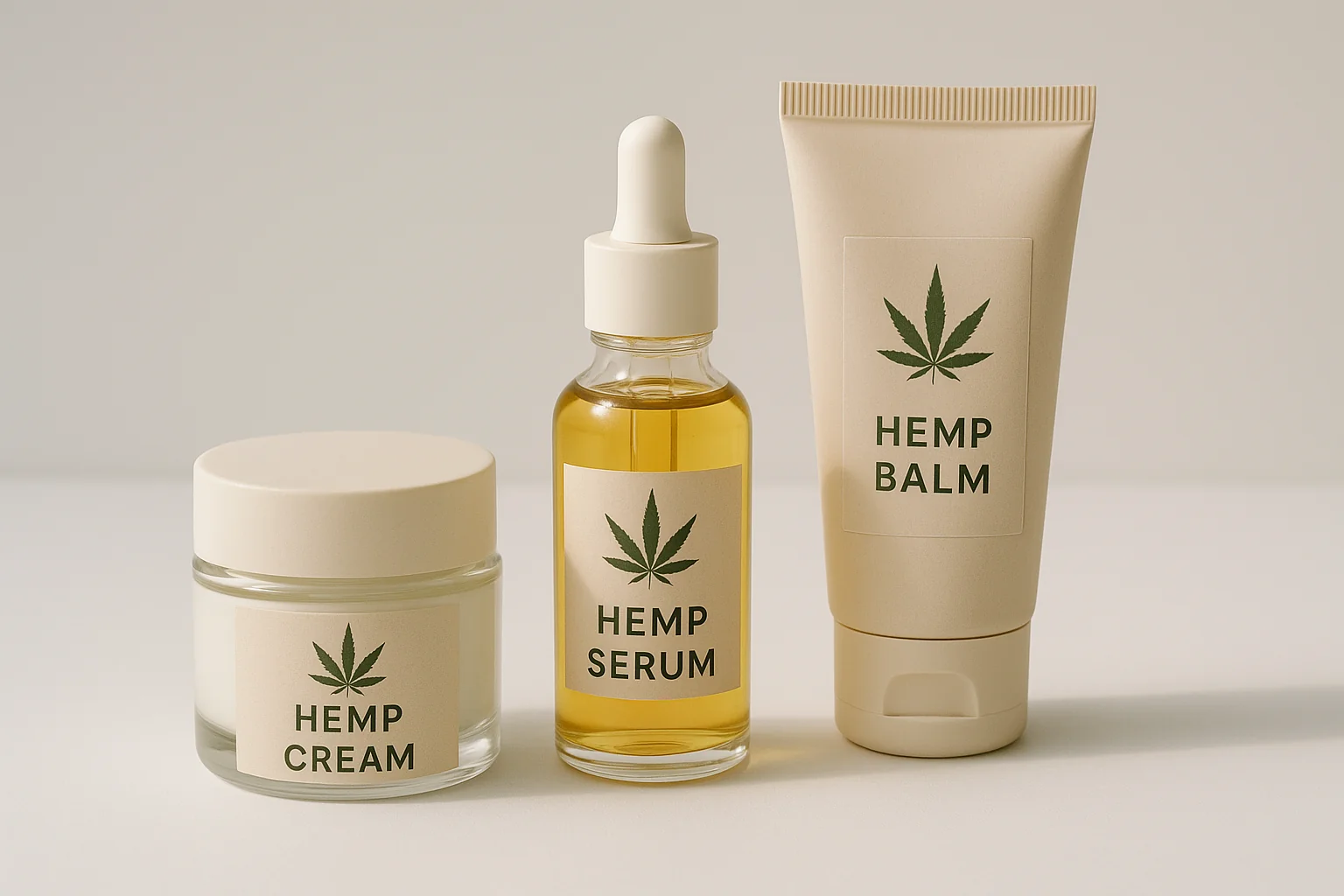
They differ primarily in the ratio of water to fat, not in the depth of cannabidiol penetration. Serum is light and absorbs quickly, cream is a moisturizing emulsion, and balm is thick and reduces water loss through the epidermis. The declared form says nothing about the CBD content.
The popular order, that is, serum before cream and balm at the end, results from the density of the products, not from research on cannabidiol. The principle is: from the thinnest to the thickest, because the occlusive layer applied first hinders the absorption of subsequent layers.
| Feature | Serum | Cream | Balsam |
|---|---|---|---|
| Consistency | lekka, wodnista | medium density emulsion | thick, oily |
| Main task | to deliver active substances | to moisturize and smooth | to reduce water loss |
| Effective for | oily and combination skin | daily facial care | very dry skin, elbows, heels |
| Order | jako pierwsze | po serum | at the end or for the body |
In retail practice under the banner of hemp cosmetics, you will find both types of products: those with only hemp seed oil and those that additionally declare cannabidiol. The commercial name with hemp in the background does not determine which group a given product belongs to. The ingredient list does.
Does a CBD cosmetic work for acne?
There is no evidence for this in humans. The most frequently cited work, Oláh et al. (Journal of Clinical Investigation, 2014), is a study on cultured human sebocytes and on skin in organ culture, not on patients with acne. It showed that cannabidiol inhibits lipogenesis through TRPV4 channels.
The results are mechanistically strong. Cannabidiol reduced sebocyte proliferation and suppressed the inflammatory response through the A2a adenosine receptor-dependent pathway. Subsequent studies followed the same path: Lee et al. (Archives of Dermatological Research, 2024) they worked on the cell lines of sebocytes SEB-1 and keratinocytes HaCaT.
Over the decade, mechanisms have increased, but not studies on patients. The review by Kuzumi et al. (American Journal of Clinical Dermatology, 2024) clearly summarizes this: there have been very few clinical studies on cannabidiol in the skin, and a separate issue remains the delivery of the substance deep into the epidermis.
Acne is a dermatological diagnosis with documented treatment efficacy. Topical retinoids, benzoyl peroxide, or isotretinoin in severe cases have studies backing them, which a cannabidiol cosmetic lacks. Delaying a visit to a dermatologist for inflammatory changes increases the risk of acne scars, which no cream can remove.
What is known about CBD in psoriasis and atopic dermatitis?
Not much, mainly from small studies without a control group. No randomized placebo-controlled study has been published for a cannabidiol cosmetic in psoriasis or atopic dermatitis. There are retrospective case series and pilot studies involving a few dozen individuals.
The most frequently cited work is by Palmieri et al. (Clinica Terapeutica, 2019), sometimes described as a clinical study involving twenty patients with atopic dermatitis. In reality, it is a retrospective analysis of twenty individuals without a control group, of which only five had psoriasis, five atopic dermatitis, and the remaining ten had scars. After three months, hydration, transepidermal water loss, and PASI scores improved. However, without a placebo, it is impossible to separate the effect of cannabidiol from that of the base ointment.
The pilot study by Burczyk et al. (Clinical, Cosmetic and Investigational Dermatology, 2025): nine individuals with atopic dermatitis, a compounded ointment with 30 percent cannabidiol and 5 percent cannabigerol, showed improvement in hydration, sebum levels, and erythema. Such concentrations are not found in over-the-counter cosmetics.
The only randomized double-blind study published so far in psoriasis concerned the oral route and yielded negative results on the primary endpoint. Roongpisuthipong et al. (Journal of Dermatological Treatment, 2026) administered 60 mg of cannabidiol daily or placebo to 28 individuals. The PASI score did not improve significantly, although less itching was noted in the eighth week.
Psoriasis and atopic dermatitis are chronic diseases with confirmed effective treatments: emollients, topical glucocorticoids, calcineurin inhibitors, and in severe psoriasis, systemic therapy. A hemp cosmetic may support the care of dry skin between flare-ups, but independently discontinuing treatment prescribed by a dermatologist is not supported by data.
How much cannabidiol does a cosmetic contain and how to check it?
Usually, this cannot be determined from the label. There is no study defining the minimum effective concentration of cannabidiol in a cosmetic, and cosmetic regulations do not require the amount of individual ingredients to be stated. Without milligrams on the packaging, you have nothing to compare.
The thresholds circulating online, such as 250 to 350 mg per 30 ml of product, sound precise but do not come from any scientific work. We could not find a source for them, and therefore we removed them from this text. A number without research backing is worse than having no number at all, as it appears to be knowledge.
A separate issue is the compliance of declarations with the actual state. Johnson et al. (Journal of Cannabis Research, 2022) tested 80 cannabidiol products available for sale using LC-MS/MS. Declarations ranged from 7.5 to 60 mg/ml, while measurements ranged from 2.9 to 61.3 mg/ml. Thirty-seven products deviated from the label by more than 10 percent, with twelve containing less than 90 percent of the declaration and twenty-five exceeding 110 percent.
What should you do when purchasing? Check where cannabidiol appears on the INCI list, as ingredients are listed in descending order of concentration. Look for the content stated in milligrams on the packaging, not just the term 'hemp.' Also, ask for a certificate of analysis; we discuss how to read it in the article How to read a CBD certificate. The absence of such data is a market standard, not evidence of fraud.
Does CBD balm relieve muscle and joint pain?
The data is preliminary and comes from outside cosmetics. Hammell et al. (European Journal of Pain, 2016) applied a transdermal gel to rats with knee joint inflammation. Swelling and infiltration of inflammatory cells decreased depending on the dose, with 6.2 and 62 mg per day being effective. This is an animal model, not a cosmetic.
In humans, there is one small randomized study. Xu et al. (Current Pharmaceutical Biotechnology, 2020) compared a cannabidiol oil applied topically to 29 individuals with peripheral neuropathy of the lower limbs to placebo for four weeks. The preparation contained 250 mg of cannabidiol in about 90 ml. In the CBD group, the intensity of sharp and stabbing pain, as well as sensations of cold and itching, decreased, with no adverse events reported. However, this concerns neuropathy, not post-workout soreness.
We also noticed that massage gels with hemp almost always contain menthol, camphor, or cinnamon oil. The cooling or warming sensation that occurs after a few seconds of application comes from these ingredients and would occur even without cannabidiol. Persistent joint pain requires diagnosis, as such a symptom may indicate an inflammatory disease requiring treatment.
What should you watch out for with hemp cosmetics?
Three things: lack of sun protection, the possibility of allergic reactions, and the temptation to discontinue treatment. Cannabidiol does not absorb UV radiation, so a hemp cream does not replace a sunscreen product. When used in the morning, it should be supplemented with photoprotection.
Allergic reactions have also been described for hemp seed oil itself. Clark et al. (Contact Dermatitis, 2022) presented a case of allergic contact dermatitis caused by this ingredient. However, more common sources of irritation are often fragrance additives and essential oils. Before using a new cosmetic for the first time, apply a small amount to the inner side of your forearm and wait a day.
Do not apply cannabis cosmetics to damaged skin, weeping lesions, or fresh wounds. During pregnancy, while breastfeeding, and in cases of skin disease during flare-ups, it is better to discuss the introduction of a new product with your attending physician. If burning, itching, or redness occurs after a few days of use, discontinue the product instead of waiting for your skin to adjust.
The last thing concerns expectations. A cosmetic with cannabidiol may improve the comfort of dry and irritated skin, as any well-formulated emollient does. If the manufacturer promises to cure a diagnosed skin disease, they are making a claim that data does not support, and cosmetic regulations explicitly prohibit attributing medicinal effects to cosmetics.
Frequently Asked Questions
Czy krem z olejem z nasion konopi to to samo co krem z CBD?
No. Cannabis Sativa Seed Oil is oil pressed from seeds, rich in fatty acids, but the seeds do not produce cannabinoids. Cannabidiol appears on the INCI list as Cannabidiol or as an extract from leaves or flower clusters. A cosmetic may contain either the seed oil, the cannabidiol, or both ingredients at once.
How much CBD should a cream contain to be effective?
Such a value has not been established. There is no study determining the minimum effective concentration of cannabidiol in a cosmetic, and the thresholds circulating online, such as 250 mg per 30 ml, have no basis in the literature. The only thing you can do is compare products that state the content in milligrams per package.
Czy CBD z kremu przechodzi do krwiobiegu?
In practice, not in amounts that matter. Cannabidiol is lipophilic and remains in the stratum corneum of the skin. In a study on human skin, the best formulation delivered 5.25 percent of the applied dose to the skin (Lapteva et al., Pharmaceutics, 2024). A cosmetic product works locally, not systemically.
Will a CBD cosmetic cure acne?
No. The work of Oláh et al. (Journal of Clinical Investigation, 2014), which manufacturers refer to, is a study on cultured human sebocytes and skin in organ culture, not on patients. Acne is treated with topical retinoids, benzoyl peroxide, or isotretinoin, and cosmetics do not replace them.
Can hemp cosmetics cause allergies?
They can. Allergic contact dermatitis caused by hemp seed oil alone has been described (Clark et al., Contact Dermatitis, 2022). However, a more common source of irritation is essential oils added to massage gels, such as menthol, camphor, or cinnamon oil. Before the first use, do a patch test on your forearm.
Can CBD oil for oral use be applied to the skin?
Yes, but it is not the same product as a cosmetic. Oil in an MCT carrier does not contain emulsifiers, pH regulators, or a preservative system intended for the skin. It can be used temporarily as an emollient for dry areas, but not as a daily facial care product.
How long does it take to assess the effects of a CBD cosmetic?
Studies on topical preparations with cannabidiol lasted from four weeks (Xu et al., 2020) to three months (Palmieri et al., 2019). A reasonable observation period for a cosmetic is 8 to 12 weeks of regular use. If nothing changes during this time, switching products makes more sense than increasing the amount.
You can find cannabis cosmetics available at u Bucha in the section hemp cosmetics, a preparaty doustne w dziale hemp oils. For each product, check the ingredient list to see if Cannabidiol is listed or just Cannabis Sativa Seed Oil.
This article is for informational and educational purposes and does not constitute medical advice. Before starting to use cannabis or CBD for therapeutic purposes, consult a doctor, especially if you are taking other medications, are pregnant, or breastfeeding.
Author: Michał Waluk · Opublikowano: 2026-06-22 · Aktualizacja: 2026-08-08