
Iodine (Lugol's solution) - dosing and safety (table)
Iodine: safety, contraindications, and interactions in the table. u Bucha.
Iodine is a trace element essential for the production of thyroid hormones - thyroxine (T4) and triiodothyronine (T3). According to NIH ODS iodine deficiency remains one of the most common and easily preventable causes of metabolic and cognitive disorders worldwide. In Poland, it is estimated that even 30-50% of adults do not meet their daily requirements despite the salt iodization program. This article compiles in one safety table what you really need to know: when iodine helps, when it harms, and how to dose it correctly.
KEY INFORMATION
• WHO recommends 150 µg of iodine daily for adults; the upper limit (UL) according to EFSA is 600 µg/day (EFSA 2014).
• Lugol's solution provides molecular iodine and potassium iodide - precise drop dosing facilitates adherence to norms.
• Individuals with Hashimoto's, Graves' disease, and hyperthyroidism require an endocrinologist's consultation before supplementation.
• "Megadose" doses (12.5 mg+) promoted online exceed physiological requirements by 80 times and carry a risk of complications.
• The table below indicates allowed groups, doses, and warning signals.
Why is iodine so important for the thyroid and beyond?
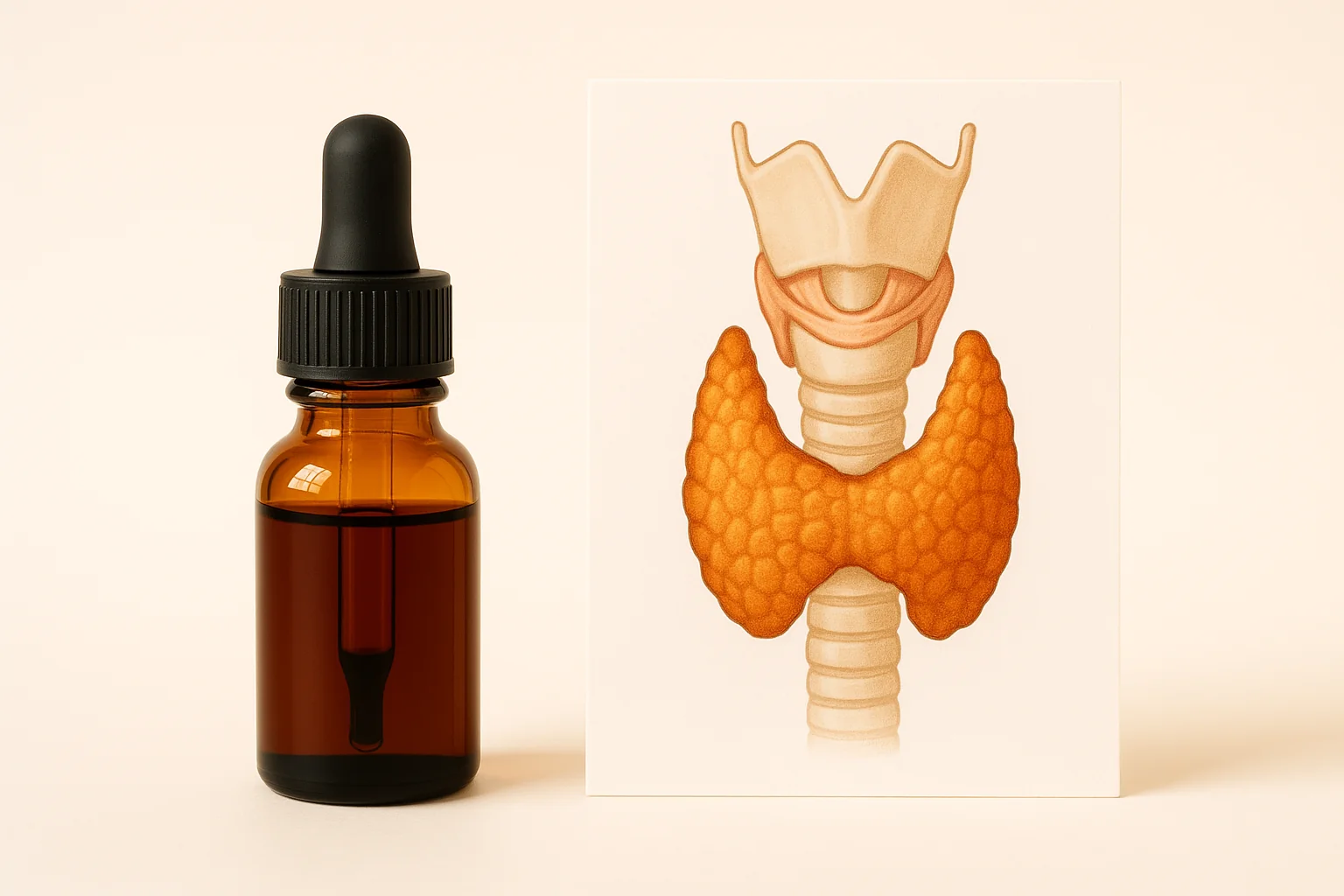
The thyroid absorbs over 70% of all iodine present in the body and uses it to synthesize T3 and T4 - hormones that regulate metabolism, body temperature, heart function, and neurological development (NIH, Endotext 2023). Iodine deficiency during pregnancy is the most common preventable cause of intellectual disability in children worldwide.
However, iodine also serves other functions. The mammary glands, ovaries, and prostate need iodine to function properly - hence the growing interest in this element among those with mastalgia and cysts. Clinical studies indicate a link between iodine deficiency and a higher incidence of benign changes in the breasts (Ghent et al., Canadian Journal of Surgery, 1993). However, caution is warranted: the results do not justify the use of megadoses - only covering the daily requirement.
Lugol's solution - an aqueous solution of iodine (I₂) and potassium iodide (KI) - is one of the oldest forms of iodine supplementation. Its advantage is the ability to dose precisely in drops and its availability over the counter in low concentrations. The downside is its characteristic taste and the need to dilute it in water or juice.
Iodine safety table - dosing, contraindications, interactions
EFSA in its 2014 opinion established the upper acceptable limit of iodine for adults at 600 µg per day (EFSA 2014). The table below summarizes the key parameters for safe use.
| Parameter | Value / description | Source |
|---|---|---|
| Daily dose for adults (AI) | 150 µg/day | WHO / EFSA 2014 |
| Dose for pregnant women | 220 µg/day | WHO 2007 |
| Dose for breastfeeding | 290 µg/day | WHO 2007 |
| Upper safe limit (UL) | 600 µg/day (adult) | EFSA 2014 |
| Lugol's solution 2% - 1 drop | ~2.5 mg of iodine + KI | Manufacturer data |
| Safe dose from Lugol's solution | 1-2 drops weekly (or 1 drop every 2-3 days) at a concentration of 2% | calculation based on UL EFSA |
| Absolute contraindications | Hyperthyroidism, Graves' disease, autonomous thyroid adenomas, iodine allergy | NIH Endotext 2023 |
| Caution (consult a doctor) | Hashimoto's (AIT), hypothyroidism on medication, pregnancy, infants | EFSA 2014; WHO |
| Drug interactions | Thyroid medications (methimazole, PTU, levothyroxine), amiodarone, lithium, ACE inhibitors | NIH MedlinePlus |
| Signs of exceeding the dose | Metallic taste in the mouth, burning in the esophagus, headaches, palpitations, thyroid swelling | NIH Endotext 2023 |
| Wolff-Chaikoff effect | In the case of a sudden excess of iodine, the thyroid temporarily halts hormone production - risk at doses >1 mg/day | Endocrine Reviews 2001 |
Price update: June 24, 2026
One key takeaway from the table: a single drop of Lugol's 2% solution provides about 2.5 mg of iodine - that’s over 16 times the daily requirement for an adult. Using several drops daily, as promoted by some bloggers, exceeds the safe upper limit by an order of magnitude. There are no reliable studies confirming the benefit of megadoses of iodine in healthy adults.
How to safely dose Lugol's solution - practical protocol
Since one drop of Lugol's 2% contains ~2.5 mg of iodine, and the daily norm is 0.15 mg, how can it be used safely? The key is rarity, not daily use. One drop every 2-3 days, diluted in a glass of water or juice, falls within the EFSA's monthly UL. This approach makes sense in the case of confirmed iodine deficiency.
Before starting supplementation, it is advisable to perform a test for iodine levels from a 24-hour urine collection (ioduria) or to measure TSH and FT4. This is the only way to check if supplementation is even necessary. Iodine deficiency with normal TSH and FT4 is rare in Poland due to iodized salt.
Protocol safe for a healthy adult without thyroid diseases: 1 drop of Lugol's 2% every 2-3 days in a glass of water, used for a maximum of 4-6 weeks, followed by a break and reassessment of need. If the diet regularly includes sea fish, seafood, and dairy, additional supplementation may be unnecessary.
the difference that is rarely mentioned: Lugol's solution provides both I₂ (molecular iodine) and KI (potassium iodide). Cellular studies suggest that molecular iodine may have distinct antioxidant and anticancer effects in glandular tissues, independent of thyroid function (Aceves et al., Thyroid, 2013). This difference means that Lugol's solution is not identical to supplements containing only KI.
Is Hashimoto's a contraindication for iodine?
This is one of the most frequently asked questions and one of the most controversial topics in micronutrient supplementation. The answer is: it depends on the dose and the current activity of the disease.
A meta-analysis from 2019 published in Thyroid has shown that excessive iodine intake - above 500 µg daily - is associated with a higher incidence and exacerbation of autoimmune thyroiditis in populations with previously low iodine intake (Leung et al., Thyroid, 2019). The mechanism involves increased immunogenicity of thyroglobulin with high iodine exposure.
On the other hand, meeting physiological requirements (150 µg daily) is safe even with Hashimoto - the thyroid needs iodine for hormone synthesis regardless of inflammatory status. The problem arises with doses exceeding the norm. That’s why individuals with Hashimoto should avoid Lugol's solution as a source of supplementation - it is difficult to control the drop dose precisely enough to stay around 150 µg daily. A better option is potassium iodide capsules at a dose of 100-150 µg, dedicated to those with thyroid issues. And always after consulting an endocrinologist.
An important context is also monitoring thyroid function during long-term iodine supplementation. In healthy adults, the thyroid has an autoregulatory mechanism called the Wolff-Chaikoff effect - with a sudden increase in iodine concentration, the gland temporarily halts hormone synthesis as a protection against excessive stimulation. This effect subsides after a few days (the "escape" phenomenon), but in individuals with subclinical thyroid disease, it may persist. Therefore, a practical rule for any iodine supplementation lasting more than a few weeks is to monitor TSH levels - the test is inexpensive, available in every laboratory, and provides a clear picture of whether the thyroid is responding appropriately to the altered iodine supply (NIH Endotext, Iodine Deficiency Disorders, 2023).
Iodine and selenium - why they cannot be supplemented in isolation
Selenium is the second key mineral for thyroid health. Deiodinase enzymes, which convert T4 into active T3, contain selenium as a cofactor (Winther et al., Nutrients, 2020). Without adequate selenium levels, even proper iodine intake may not translate into efficient hormone synthesis.
Iodine supplementation without selenium can, in extreme cases, increase oxidative stress in the thyroid gland. Polish dietary guidelines recommend 55 µg of selenium per day for adults. Population studies in Poland indicate that selenium deficiency is common due to selenium-poor soil (Charalabopoulos et al., Trace Elements in Medicine, 2017). Therefore, individuals supplementing iodine should also ensure they are getting selenomethionine or selenium from yeast at a dose of 100-200 µg daily.
By compiling inquiries from our customers, we notice a recurring pattern: individuals reaching for Lugol's solution often do not know that they should also supplement selenium simultaneously. Meanwhile, it is this duo - iodine + selenium - that provides the thyroid with a complete set of tools for efficient functioning.
Frequently Asked Questions
How much iodine does an adult need daily?
WHO recommends 150 µg of iodine daily for adults, 220 µg for pregnant women, and 290 µg for breastfeeding women. The upper limit (UL) is 600 µg per day for adults according to EFSA (EFSA 2014). With a standard European diet, even 50% of the population may not meet this requirement.
Is Lugol's solution safe over the counter?
Lugol's solution in low concentrations (1-5%) is available over the counter and safe at physiological doses (up to 600 µg/day according to EFSA). Higher doses - used in "megadosing" protocols - can trigger the Wolff-Chaikoff effect and disrupt thyroid function. A healthy adult should treat Lugol's as an occasional supplement of physiological doses, not a daily routine.
Who should absolutely avoid iodine supplementation?
Individuals with Graves' disease, autonomously functioning thyroid adenomas, hyperthyroidism, and confirmed iodine allergy. Individuals with Hashimoto and hypothyroidism on levothyroxine should consult an endocrinologist - supplementation may be possible but requires careful dose and TSH monitoring.
Is iodine from Lugol's solution different from iodine in capsules?
Lugol's solution contains both potassium iodide (KI) and molecular iodine (I₂), providing a broader biological profile. Capsules typically contain only KI or iodine from algae. Absorption is similar at physiological doses, but the liquid form requires greater caution in dosing - one drop is over 16 times the daily norm.
How should Lugol's solution be stored?
In a dark, airtight container, at a temperature of 15-25°C, away from children. Iodine evaporates and oxidizes under the influence of light and heat. Do not store in the refrigerator - condensation damages the dropper and promotes crystallization. Properly stored Lugol retains its properties for 2-3 years from the production date.
Does iodine help with hypothyroidism?
Iodine helps only when hypothyroidism is due to its deficiency - the so-called deficiency-induced hypothyroidism, which is rarer in Poland due to the widespread iodization of salt. The most common cause of hypothyroidism in Poland is Hashimoto's disease (autoimmune thyroiditis) - in this case, the problem is not a lack of iodine, but the destruction of glandular tissue by the immune system. Iodine supplementation in Hashimoto's requires caution and supervision by an endocrinologist. People with hypothyroidism treated with levothyroxine do not need iodine supplementation beyond physiological doses if their diet regularly includes dairy products and sea fish.
Is iodine from seaweed and algae a safe alternative to Lugol's solution?
Iodine from seaweed (e.g., kelp, wakame, nori) is a natural source, but its content is highly variable and difficult to standardize. Studies have shown that the iodine concentration in algae supplements can range from 45 µg to over 57,000 µg per serving - depending on the species, harvesting location, and season (Teas et al., Thyroid, 2004). This variability makes algae a risky source for people with thyroid diseases. Standardized potassium iodide capsules at a dose of 100-150 µg are a safer choice when precision in dosing is important.
This article is for informational and educational purposes and does not replace consultation with a doctor. If you are pregnant, breastfeeding, taking medications, or have chronic conditions, consult the use of supplements or herbs with a specialist.
Author: Michał Waluk · Published: 2026-05-04 · Updated: 2026-05-04