


Dietary supplement vs medicine: what is the difference and how to avoid being deceived
A supplement registers with GIS, while a medicine registers with URPL after clinical trials. Check what must be on the label and how to compare the price of the same dosage.
On the pharmacy shelf, two green magnesium capsules stand next to each other. They look the same, cost similarly, yet there is a regulatory chasm between them: one had to undergo clinical trials, while the other only required notification to the office. The Supreme Audit Office calculated that from 2017 to 2020, the Chief Sanitary Inspectorate received nearly 63,000 notifications about supplements and analyzed 11 percent of them. Therefore, verifying the label falls on the buyer. From this text, you will learn how a supplement differs from a medicine in the eyes of the law, what must be on the packaging, what the manufacturer is not allowed to write, how to compare two products with the same declared dosage, and which combinations with prescription medications require a conversation with a doctor.
KEY INFORMATION
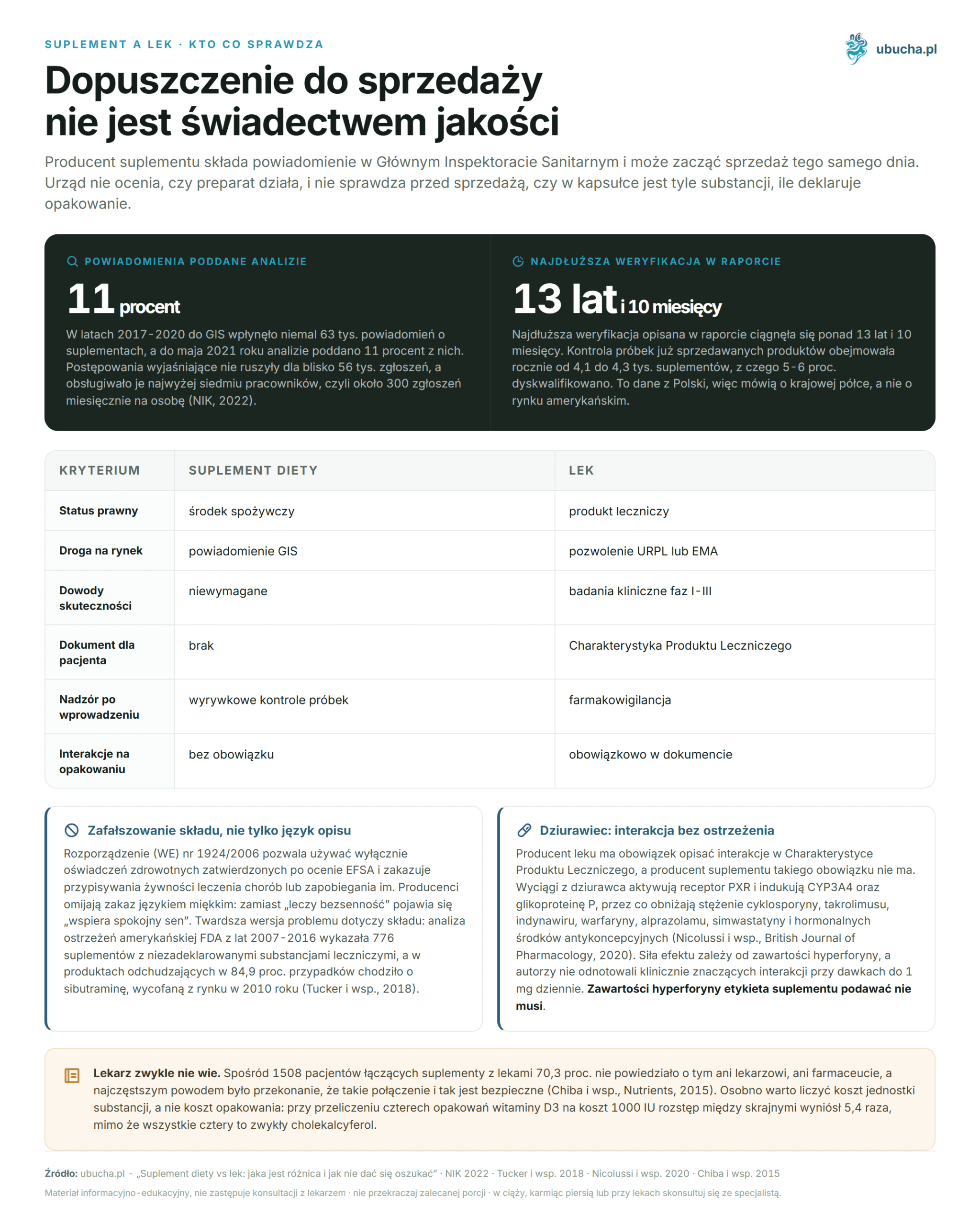
• From 2017 to 2020, GIS received nearly 63,000 notifications about supplements and analyzed 11 percent of them (NIK, 2022).
• A supplement is food and does not have to prove efficacy. A medicine must, in phases I-III of trials.
• Regulation (EC) No. 1924/2006 prohibits attributing healing properties to food or preventing diseases.
• The same dose of vitamin D3 can cost five times more when converted to 1000 IU.
What is the difference between a dietary supplement and a medicine under the law?
A dietary supplement is considered food under Polish and EU law, not a medicinal product. The manufacturer submits a notification to the Chief Sanitary Inspectorate and can start selling on the same day. A medicine undergoes registration with URPL or EMA and must prove its efficacy and safety in clinical trials beforehand.
The basis for supplements is dyrektywa 2002/46/WE and the Act of August 25, 2006, on food safety and nutrition. Medicines are regulated by the Pharmaceutical Law of September 6, 2001. The registration of a medicine takes years of work and money, which a product costing twenty zlotys will not recoup. This explains why the manufacturer of the same substance often chooses the food route.
| Criterion | Dietary Supplement | Lek |
|---|---|---|
| Legal status | food product | produkt leczniczy |
| Droga na rynek | powiadomienie GIS | pozwolenie URPL lub EMA |
| Evidence of effectiveness | niewymagane | badania kliniczne faz I-III |
| Dokument dla pacjenta | none | Charakterystyka Produktu Leczniczego |
| Supervision after introduction | random sampling inspections | pharmacovigilance and reporting adverse effects |
| Dopuszczalny przekaz | health claims from the EFSA list | wskazania terapeutyczne z ChPL |
This difference does not mean that a supplement is inherently inferior. It means that the proof of quality is provided voluntarily by the manufacturer, and finding it is the buyer's responsibility.
What does GIS check when a supplement is reported, and what does it not?
The Inspectorate verifies whether the product fits the definition of a supplement, whether the ingredients are permitted, and whether the label meets formal requirements. It does not assess whether the product works and does not check before sale whether the capsule contains as much substance as the packaging claims.
The scale of this gap was shown in the report of the Supreme Audit Office from January 18, 2022. From 2017 to 2020, nearly 63,000 notifications were submitted to GIS, and by May 2021, only 11% of them had been analyzed. Investigative proceedings had not started for nearly 56,000 reports. It was handled by at most seven employees, which means about 300 reports per month per person. The longest verification described in the report lasted over 13 years and 10 months.
The inspection of samples of already sold products covered from 4,100 to 4,300 supplements annually, of which 5-6% were disqualified. These are data from Poland, so they refer to your shelf, not the American market. The practical conclusion is simple: admission to sale is no guarantee of quality, as the office in most cases simply did not have time to read the notification.
What must be included on the dietary supplement label?
The scope of mandatory information is defined by Regulation (EU) No. 1169/2011 and national regulations. The packaging must include the designation "dietary supplement", the composition with the amount of active substances in the recommended daily portion, and a set of warnings.
- The designation "dietary supplement" as a category name, not just a trade name.
- Names of active ingredients along with the amount in the recommended daily portion.
- Warning about not exceeding the recommended daily dose.
- Information that the supplement does not replace a varied diet.
- Note about storing out of reach of small children.
- Percentage of reference intake values for vitamins and minerals.
What does not have to be on the label: the notification number from GIS. The medicine has a marketing authorization number printed on the box, while the supplement does not need such an identifier, making it difficult to verify in the register. There is also no obligation to provide the chemical form of the ingredient, which determines absorption. When purchasing from platforms outside the European Union, there is an additional risk: without notification in GIS, the product is not subject to any supervision in Poland, and the responsibility for the consequences falls on the buyer.
What cannot the supplement manufacturer write on the packaging?
Regulation (EC) No 1924/2006 allows the use of only health claims approved after EFSA assessment. Statements like 'vitamin C contributes to the normal functioning of the immune system' are allowed because they have a number on the EU list.
Everything suggesting the treatment of a disease or its prevention is prohibited: 'treats arthritis', 'reduces the risk of heart attack', 'fights cancer'. Such a message turns the supplement into a medicinal product placed on the market without permission, which is already being addressed by the sanitary inspection and URPL. In practice, manufacturers bypass the ban with softer language: instead of 'treats insomnia', it appears as 'supports restful sleep'. The line can be thin, but the rule for the label reader is clear. The name of the disease next to a verb indicating action is a signal that something is wrong.
A more serious version of this problem is the falsification of composition. An analysis of warnings from the American FDA from 2007-2016 described in JAMA Network Open (Tucker i wsp., 2018) showed 776 supplements with undeclared medicinal substances. This most often concerned products for potency, weight loss, and for bodybuilders, and in weight loss products, in 84.9% of cases, it involved sibutramine, withdrawn from the market in 2010.
How much does the same dose of vitamin D3 cost in our store?
The declared dose on the packaging says nothing about the price per unit of substance. We calculated the costs of four vitamin D3 packages from our catalog for 1000 IU, and the range turned out to be fivefold, even though all four products are regular cholecalciferol.
| Place | Product | What distinguishes | Price | Koszt 1000 IU |
|---|---|---|---|---|
| 1 | Witamina D3 4000 IU, 240 tabletek | cholekalcyferol z lanoliny, pochodzenie surowca podane wprost | 19.99 zł | 0.021 zł |
| 2 | Navigator Vitamin D3 10000 IU, 365 soft capsules | roczne opakowanie, dawka do stosowania okresowego | 105.90 zł | 0.029 zł |
| 3 | Navigator Vitamin D3 10000 IU, 180 soft capsules | ta sama dawka w mniejszym opakowaniu | 78.98 zł | 0.044 zł |
| 4 | Navigator Vitamin D3 10000 IU, 120 capsules | smallest package, highest unit cost | 135.90 zł | 0.113 zł |
Prices are from our store, as of August 8, 2026. A dose of 10000 IU is not a daily dose and requires monitoring of vitamin D levels in the blood, so the column with unit cost is for comparing packages, not for choosing a dose.
What besides price determines the value of a supplement?
The cost per unit of substance is the first filter, not the last. The second is the chemical form, as it determines how much of the declared dose is actually absorbed. The chart below shows how far apart the calculated prices from the previous table are.
In our supplement catalog, there are 174 items, and you can see two schools of description. Some provide the form directly in the name, like potassium citrate or magnesium in three forms. Others end with the word 'magnesium', leaving the buyer without information. Magnesium oxide is poorly absorbed, while citrate and diglycinate are significantly better. The same applies to folic acid: conversion to the active form is limited by the MTHFR gene variant, which in the study 1712 adult Poles (Wrzosek and Ślusarczyk, Biomedicines 2022) occurred in 8.6% in homozygous form and in 44% in heterozygous form. For more than half of the population, folate in its methylated form is therefore a better choice than regular folic acid.
When to choose a supplement and when a medication?
A supplement makes sense where you are addressing a deficiency or enhancing your diet: vitamin D3 during sunless months, vitamin B12 with a plant-based diet, magnesium with a diet low in vegetables and seeds. You choose medication when treating a diagnosed illness.
The distinction is sharper than suggested by the pharmacy shelf where both sit side by side. With iron deficiency anemia, you need a medicinal preparation at a dose tailored after testing morphology and ferritin, not an iron tablet "for strengthening." With a bacterial infection, you need an antibiotic, not a probiotic. Attempting to treat an active disease with a supplement delays appropriate therapy, and with cancer or heart failure, every lost week has clinical significance.
A separate category is herbal medicines. A standardized extract of valerian or a horse chestnut preparation can be registered as a medicinal product, with studies and a summary of product characteristics (SmPC). It looks like an herb from the shelf next door, but it has gone through a different path and should not be confused with a supplement of similar composition. You will recognize it by the license number on the packaging and the patient leaflet.
Which supplements interact with prescription medications?
The drug manufacturer is obliged to describe interactions in the SmPC. The supplement manufacturer does not have such an obligation, so you usually won't find warnings on the packaging, even when the risk is real and well-documented in the literature.
The best-documented case is St. John's Wort. A review Nicolussi i wsp. w British Journal of Pharmacology (2020) confirms that extracts of St. John's Wort activate the PXR receptor and induce CYP3A4 and P-glycoprotein, thereby lowering the concentration of cyclosporine, tacrolimus, indinavir, warfarin, alprazolam, simvastatin, and hormonal contraceptives. The strength of the effect depends on the content of hyperforin, and the authors did not record clinically significant interactions at doses up to 1 mg of hyperforin per day. The problem is that the content of hyperforin does not have to be stated on the supplement label.
The list does not end with St. John's Wort. Vitamin K weakens the effect of warfarin, and high doses of vitamin E and omega-3 fatty acids can enhance it. Vitamin C at doses above 2 g increases iron absorption, which can be dangerous in hemochromatosis. Before adding anything to your regular pharmacotherapy, check for interactions in the NIH Office of Dietary Supplements database or ask your pharmacist, as in Poland, they are obliged to provide such information. We have also gathered a set of practical rules in the post about NAC and its combination with medications.
Why should your doctor know about your supplements?
Because most often they do not. In a study Chiby i wsp. opublikowanym w Nutrients (2015) of 1508 patients combining supplements with medications, 70.3% did not inform either their doctor or pharmacist. The most common reason was the belief that such combinations are safe.
A simple rule clarifies the matter: list supplements alongside medications. When regularly taking more than two prescription preparations, ask your pharmacist for a medication review, which is a scheduled conversation where the entire therapy is checked, not just a single package. Before a planned surgical procedure, you hand over the list to the anesthesiologist, as omega-3 fatty acids, vitamin E, garlic, ginseng, and ginkgo biloba affect blood clotting and require prior discontinuation. Record the trade name along with the dose, not just the ingredient. Without the dose, no one can assess whether we are talking about preventive dietary supplementation or an amount that will change the effect of the medication.
It is worth applying the same caution to supplementation in competitive sports, where the risk of interactions comes with the risk of anti-doping results. We described this in more detail in the text about supplements for athletes compliant with regulations.
Frequently Asked Questions
Below are answers to the questions that frequently arise when comparing supplements with medications.
What is the difference between a dietary supplement and a medication?
A medicine undergoes registration with URPL or EMA and must first prove its efficacy and safety in clinical trials. A dietary supplement is food: the manufacturer submits a notification to GIS and can start selling immediately, without evidence of effect. A medicine has a Summary of Product Characteristics with indications, dosing, and interactions; a supplement does not have such documentation.
What must be on the label of a dietary supplement?
Mandatory: the term "dietary supplement," names of active ingredients with amounts in the recommended daily portion, a warning not to exceed the portion, information that the supplement does not replace a varied diet, and a note about storing out of reach of children. For vitamins and minerals, the percentage of reference intake values is provided. The notification number from the GIS does not have to be on the packaging.
How to check if a supplement is safe?
Look for the manufacturer's address in the European Union, a GMP certificate of the facility, and the batch test result, i.e., Certificate of Analysis. You can find the product in the GIS notification register. Athletes should additionally choose products with the Informed Sport certification or from the Cologne List, as only these are tested for substances banned by WADA.
Can a supplement claim to cure?
No. Regulation (EC) No. 1924/2006 prohibits attributing healing properties to food or preventing diseases. Only health claims from a list approved after EFSA assessment are allowed, for example, regarding the role of vitamin C in the proper functioning of the immune system. The words "heals" or "fights" next to a disease name are a warning signal.
What is an OTC medication, and what is a supplement?
An OTC medicine appears without a prescription but remains a legitimate medicinal product with URPL approval and proven efficacy. A supplement is food after notification to GIS, without such a requirement. Both may contain the same substance, but only a medicine is subject to pharmacovigilance and has clinical indications recorded in the Summary of Product Characteristics.
Which supplements should be discontinued before surgery?
Before a planned procedure, discontinue products that affect coagulation: high doses of omega-3 fatty acids, vitamin E, garlic, ginseng, ginkgo biloba, and St. John's wort. The timing is determined by the anesthesiologist, usually from one to two weeks before the surgery. Include supplements on the same list as medications that you submit before the procedure.
If you want to compare labels on specific products, check the section supplements.
This article is for informational and educational purposes and does not constitute medical advice. Before starting supplementation, consult your doctor, especially if you are taking medications regularly, are pregnant or breastfeeding, or have a chronic illness.
Author: Michał Waluk · Opublikowano: 2026-05-20 · Aktualizacja: 2026-08-08