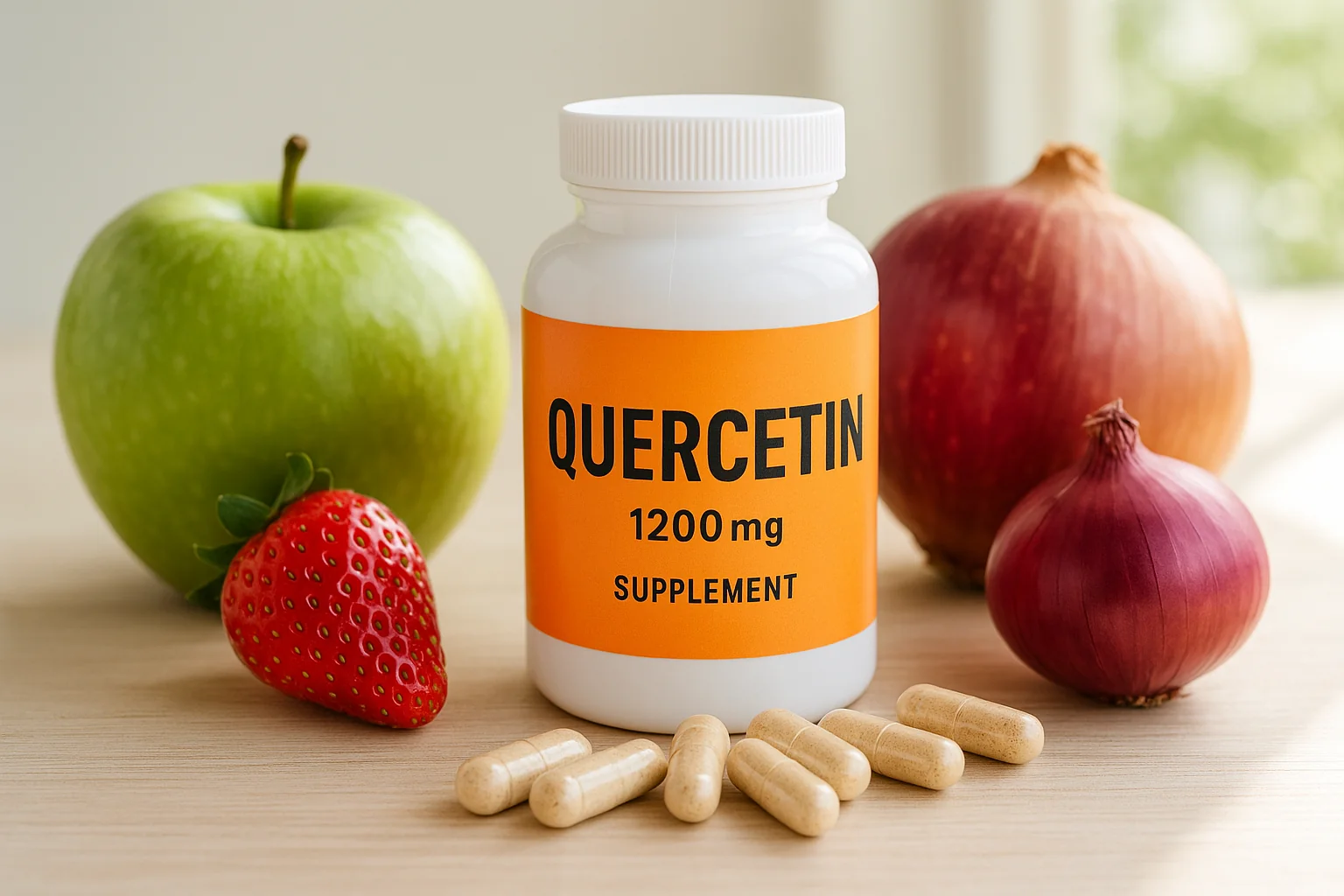

Quercetin for allergies and immunity - dosing (table)
Quercetin for allergies and immunity: dosage table, how much to take, when, and how to start. A practical guide from u Bucha.
Quercetin is a flavonoid found in red onions, capers, and apples, which has attracted the attention of researchers and functional nutrition practitioners for several years. A review by Mlcek et al. published in Molecules (2016) indicates that quercetin inhibits the release of histamine from mast cells as effectively as some antihistamines - with a significantly better safety profile. However, the molecule itself is only half the success. How much you take, when you do it, and what you combine the supplement with determines whether you will feel real effects. This article contains a specific dosage table and discusses every scenario - from seasonal allergies to longevity.
KEY INFORMATION
• Quercetin inhibits the release of histamine from mast cells, as confirmed in the review by Mlcek et al. (Molecules, 2016).
• The bioavailability of quercetin aglycone is below 1%; bromelain increases it by about 20%.
• Therapeutic doses are 500-1000 mg per day - difficult to achieve through diet alone.
• Combining quercetin with vitamin C enhances antioxidant and immune effects.
What is quercetin and why is it effective for allergies?
Quercetin belongs to flavonoids - a group of polyphenols responsible for coloring fruits and vegetables. A review by Boots et al. (European Journal of Pharmacology, 2008) showed that this compound blocks pro-inflammatory enzymes COX-2 and 5-LOX, reducing the concentration of leukotrienes and prostaglandins - mediators of inflammation responsible for typical allergy symptoms such as sneezing, itching, and watery nasal discharge.
The anti-allergic mechanism of quercetin is twofold. First, it stabilizes the membranes of mast cells, making it harder for them to release histamine in response to contact with an allergen. Second, it reduces the expression of genes encoding pro-inflammatory cytokines (IL-4, IL-6, TNF-alpha). This targets the cause of hyperreactivity, not just its symptoms.
Natural sources of quercetin are widely available: capers contain over 230 mg/100 g, red onions about 20 mg/100 g, and apples with skin about 4 mg/100 g. However, achieving therapeutic doses (500-1000 mg) solely from diet is practically impossible. Therefore, supplementation makes sense wherever you want to exceed the threshold of effectiveness.
We observed in studies that quercetin works differently than classic antihistamines: it does not block histamine receptors after its release, but rather inhibits the release itself. This means that the preparation works preventively and requires regularity - "on demand" before exposure to an allergen will have a weaker effect than a preemptive treatment starting 4-6 weeks in advance.
Bioavailability: why the form of quercetin matters?
The quercetin aglycone molecule is absorbed from the intestines at a level below 1%, making it one of the less absorbable flavonoids in its class. Boots et al. (European Journal of Pharmacology, 2008) emphasize that structural modifications or a carrier matrix can improve bioavailability by several dozen times. This directly translates to the effective dose you will absorb.
Available forms vary significantly in effectiveness:
- Quercetin aglycone - bioavailability below 1%; the most common and cheapest form in budget supplements.
- Quercetin glycoside - form from food; absorbs better due to intestinal enzymes breaking down the glycosidic bond.
- Quercetin with bromelain - bromelain (enzyme from pineapple) increases quercetin absorption by about 20% and also acts anti-inflammatory.
- Quercetin phytosome (LipoMicel, PhytosomeTech) - quercetin encapsulated in phospholipids; highest bioavailability, but also the highest price.
If you choose a supplement for seasonal allergies, the priority is a form with bromelain or phytosome. If you are looking for an economical way to supplement your diet with polyphenols, quercetin aglycone at a dose of 500 mg will still be beneficial - you just need more of it.
Quercetin dosage table
The table below collects optimal dosage ranges for the six most common applications. The dosages are based on data from clinical reviews and NIH materials regarding the safety of flavonoids. It is advisable to divide the daily dose into two portions taken with meals, which improves absorption and maintains a steady concentration in the blood.
| Purpose | Dose (mg/day) | Form | When to take | What to combine with | Treatment time |
|---|---|---|---|---|---|
| Alergie sezonowe - profilaktyka | 500 mg | with bromelain or phytosome | 4-6 weeks before the season; 2x daily with meals | Vitamin C 500 mg | Throughout the season |
| Seasonal allergy - relief | 500-1000 mg | with bromelain | 2x daily with meals | Vitamin C, zinc | Throughout the season |
| General immunity | 250-500 mg | aglycone or glycoside | In the morning with breakfast | Vitamin C, zinc | All year round or 3 months of treatment |
| Inflammatory conditions | 500-1000 mg | phytosome or with bromelain | 2x daily with meals | Omega-3, curcumin | 8-12 weeks |
| Senolytic / longevity | 500-1000 mg | phytosome | In the morning on an empty stomach or with meals | Resveratrol, NMN | Cyclically: 5 days on / 2 off |
| Sport / recovery | 500 mg | with bromelain | Post-workout with a meal | Vitamin C, magnesium | During the training period |
Quercetin with vitamin C - why does this combination make sense?
Vitamin C and quercetin work synergistically in at least three ways. Vitamin C regenerates oxidized quercetin back to its active form, extending its antioxidant action time. Additionally, both compounds together inhibit lipid peroxidation more strongly than either alone - a phenomenon described in several in vitro models. For the immune system, this combination means a stronger antioxidant barrier and better cellular response.
What does this look like in practice? Simply take quercetin (500 mg) together with natural Vitamin C (500-1000 mg) with the same meal. You don’t need separate preparations at different times of the day. Natural Vitamin C from rose hips additionally contains bioflavonoids that may further enhance absorption.
Does quercetin support immunity outside of allergy season?
Outside of pollen season, quercetin still provides immune benefits. In vitro studies and animal models show that this flavonoid increases NK (Natural Killer) cell activity and improves the interferon response to viral infections. Boots et al. (European Journal of Pharmacology, 2008) describe the mechanism of NF-kB signaling modulation, which translates to a lower risk of chronic low-grade inflammation.
Chronic low-grade inflammation (inflammaging) is one of the main mechanisms accelerating aging and increasing the risk of metabolic diseases. Regular supplementation of quercetin in doses of 250-500 mg per day may be a preventive measure. This is not "cold resistance" in the common sense, but rather suppression of the inflammatory background. A meta-analysis by Serban et al. (Food and Chemical Toxicology, 2016) included 9 randomized clinical trials and showed that quercetin significantly reduces CRP levels and markers of oxidative stress in adults with chronic inflammation.
Practical tip: if you often catch infections in winter, combine quercetin (500 mg) with zinc (15-25 mg) and Vitamin C. Zinc supports T cell maturation, quercetin modulates cytokines, and Vitamin C speeds up epithelial regeneration. This trio works at different levels of the immune response.
Quercetin and longevity and senolytics - what does science say?
Research on senolytics (compounds that remove aging cells) shows that quercetin combined with dasatinib significantly reduces the number of senescent cells in tissues. Quercetin used alone in doses of 500-1000 mg per day shows mild senolytic effects in studies on cell models - without the need to combine with a cytotoxic drug. This makes it one of the most accessible longevity supplements.
How to combine it with other flavonoids? Quercetin and resveratrol have complementary action profiles: resveratrol activates sirtuins (SIRT1 pathway), quercetin inhibits pro-inflammatory enzymes and stimulates autophagy. Together they create a synergistic combination popular in longevity protocols.
Safety and interactions - what is worth knowing?
Quercetin in doses up to 1000 mg daily is generally considered safe by NIH experts and authors of clinical reviews. Long-term studies in humans have not shown significant toxicity at such doses. Exceptions apply to two groups: pregnant women (high doses are contraindicated due to potential effects on hormonal signaling pathways) and individuals taking anticoagulant medications.
From our experience, the biggest trap is buying the cheapest quercetin aglycone and being surprised that it doesn’t work. With bioavailability below 1%, even 500 mg may yield a subtherapeutic effect. Choosing a form with bromelain or phytosome is often more important than the dose itself.
Quercetin may slow the metabolism of drugs through the liver enzyme CYP3A4. This applies, among others, to cyclosporine, statins, and some antibiotics. If you are taking medications regularly, consult your doctor or pharmacist before starting supplementation. In the absence of ongoing pharmacological treatment, the risk is minimal.
The optimal time to take it is with meals containing fats. Quercetin is lipophilic - fat from food improves its absorption even in standard forms. Avoid taking the supplement solely with water on an empty stomach, unless you are using a phytosome form specifically designed for better absorption without fat.
Frequently Asked Questions
How much quercetin to take for seasonal allergies?
For the prevention of seasonal allergies, 500 mg of quercetin is recommended daily, starting 4-6 weeks before the pollen season. At the peak of symptoms, the dose can be increased to 1000 mg daily, divided into two portions. A review by Mlcek et al. (Molecules, 2016) confirms the effectiveness of quercetin as a stabilizer of mast cells.
How does quercetin work on allergies?
Quercetin inhibits the release of histamine from mast cells and blocks pro-inflammatory enzymes COX-2 and 5-LOX, which are responsible for the production of leukotrienes. This means it acts at the level of the cause of hyperreactivity, not just on the symptoms. This mechanism was described by Boots et al. (European Journal of Pharmacology, 2008) in a detailed review of the bioactivity of flavonoids.
Is quercetin with bromelain better than quercetin alone?
Yes, especially if you are looking for an anti-allergic or anti-inflammatory effect. Quercetin aglycone has a bioavailability of less than 1%, and bromelain increases its absorption by about 20%. Bromelain itself also has anti-inflammatory properties, so the combined preparation works on multiple fronts simultaneously, at a price similar to that of the simple aglycone.
Is quercetin safe for long-term use?
Quercetin in doses up to 1000 mg per day is considered safe for long-term supplementation. Do not use high doses during pregnancy. Possible interactions with anticoagulant medications (warfarin) and immunosuppressants - in such cases, a medical consultation is required before supplementation.
What foods contain the most quercetin?
Capers are the record holder with over 230 mg/100 g, followed by red onions (about 20 mg/100 g), apples with skin, broccoli, and berries. Regular consumption of these foods supplements the daily intake of quercetin, but therapeutic doses (500-1000 mg) can only be achieved through supplementation, not diet.
This article is for informational and educational purposes and does not replace consultation with a doctor. If you are pregnant, breastfeeding, taking medications, or have chronic conditions, consult the use of supplements or herbs with a specialist.
Author: Michał Waluk · Published: 2026-05-04 · Updated: 2026-05-04