
Intermittent fasting and supplements: what can be taken on an empty stomach (table)
Which supplements have been studied on an empty stomach during intermittent fasting, and which recommendations are based solely on mechanisms? A table with sources and a list of risk groups.
Intermittent fasting, described in English as intermittent fasting, is outlined in a review by Vasim et al. (Nutrients, 2022) as a way of eating where all-day food intake fits within a designated window of the day. The question that often arises with it is: what can be consumed during the fasting window without ruining it? The answers circulating online are definitive, but most lack any measurement in humans, only reasoning about insulin and autophagy. This text separates these two layers. For each row in the table, we indicate whether there is a study with a specified population and result behind it, or just the mechanism. At the end, we list individuals for whom fasting may be contraindicated.
KEY INFORMATION
• We did not find a study in humans that would establish a caloric threshold that breaks a fast. Thresholds like 50 kcal are a convention of guides, not a measurement result.
• Autophagy in humans is rarely measured and indirectly. A pilot study with randomization involving 30 individuals noted a change in its index after a fasting-mimicking diet, although not at every measurement point (Espinoza et al., GeroScience, 2025); the study was sponsored by the producer of this diet.
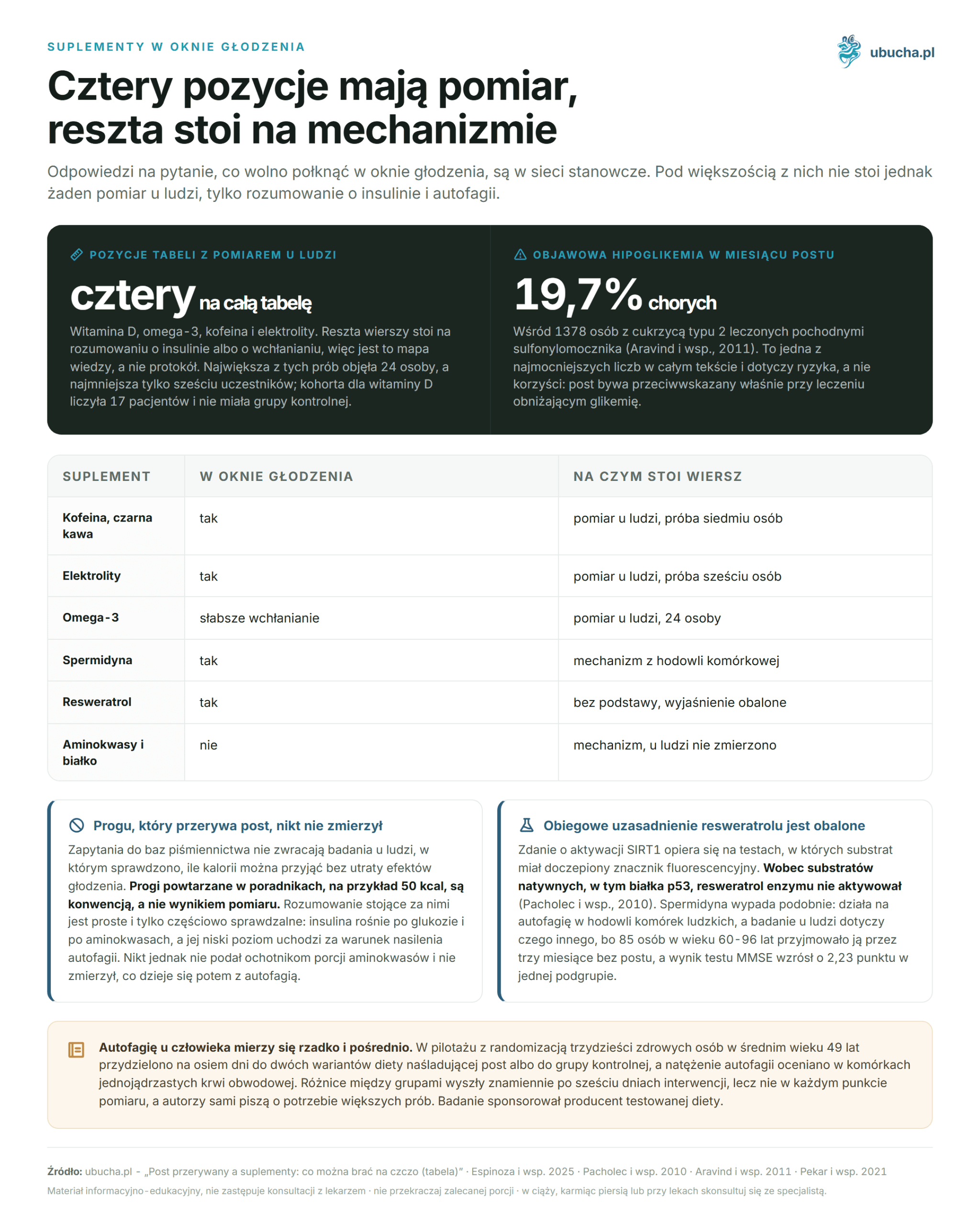
• The measurement in humans includes four items in the table: vitamin D, omega-3, caffeine, and electrolytes. The rest is based on mechanisms.
• The common justification for resveratrol is false: it does not directly activate SIRT1 against native substrates (Pacholec et al., J Biol Chem, 2010).
• Among 1378 individuals with type 2 diabetes treated with sulfonylurea derivatives, 19.7% reported symptomatic hypoglycemia during the month of fasting (Aravind et al., Curr Med Res Opin, 2011).
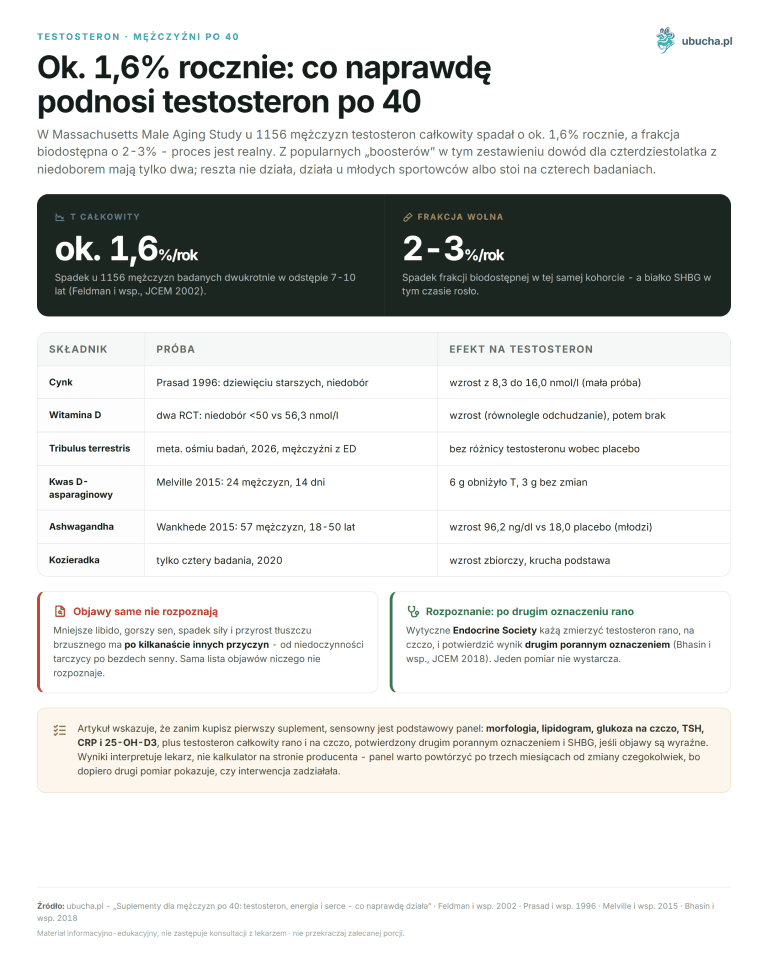
What really breaks intermittent fasting?
It is unknown because no one has measured the boundary. Queries to Europe PMC do not return studies in humans that checked how many calories can be consumed without losing the effects of fasting. Thresholds repeated in guides, such as 50 kcal, are conventions, not measurement results.
The reasoning behind these thresholds is simple and only partially verifiable. Insulin rises after glucose and amino acids, and its low level is considered a condition for enhancing autophagy. Hence the conclusion that a supplement without calories and amino acids does not spoil fasting. This is a mechanism, not a research result: no one has given volunteers a portion of amino acids and measured what happens to autophagy afterward.
Autophagy in humans is difficult to measure, and most claims about it come from yeast, cell cultures, and rodents. Measurements in humans exist but are weak. In a pilot randomized study, thirty healthy individuals with an average age of 49 were assigned for eight days to two variants of a fasting-mimicking diet or to a control group, and the intensity of autophagy was assessed in peripheral blood mononuclear cells. Differences between groups were significant after six days of intervention, but not at every measurement point, and the authors themselves mention the need for larger trials (Espinoza et al., GeroScience, 2025). The study was sponsored by the producer of the tested diet.
Which supplements have been studied on an empty stomach, and which have not?
Few have been studied. The table separates rows into those with studies in humans and those based solely on reasoning about insulin or absorption. The second group is larger, so it is a map of knowledge, not a protocol.
The system follows the 16:8 protocol with an eating window from 12:00 to 20:00. We discuss the timing of collagen intake in the text. Collagen at night or in the morning.
| Supplement | During the fasting window? | W oknie jedzenia? | Na czym stoi ten wiersz |
|---|---|---|---|
| Magnesium | yes | yes | Mechanism: without calories and amino acids; we found no comparisons with meals. |
| Vitamin C | yes | yes | Mechanizm: rozpuszczalna w wodzie |
| B vitamins | yes | yes | Mechanizm: rozpuszczalne w wodzie |
| Spermidine | yes | yes | Mechanism from cell culture, not measurement in fasting individuals. |
| Resveratrol | yes | yes | Without a basis: explanation through SIRT1 debunked (J Biol Chem, 2010) |
| Kofeina (czarna kawa) | yes | yes | Measurement in humans, trial of seven individuals (J Nutr Metab, 2021) |
| Electrolytes (sodium, potassium) | yes | yes | Measurement in humans, trial of six individuals (J Clin Invest, 1975) |
| Vitamin D | Technicznie tak | Tak, lepiej | Measurement in humans, cohort of 17 patients without control (J Bone Miner Res, 2010) |
| Vitamin K2 | Technicznie tak | Tak, lepiej | Mechanism: lipophilic. The work on vitamin D does not cover it |
| Omega-3 (EPA, DHA) | Weaker absorption. | Tak, lepiej | Pomiar u ludzi, 24 osoby (J Clin Lipidol, 2017) |
| Witaminy A oraz E | Brak danych | Tak, lepiej | Mechanism: lipophilic. No warnings about accumulation were substantiated. |
| Aminokwasy BCAA | no | yes | Mechanism: amino acids stimulate insulin and mTOR; the effect on autophagy in humans was not measured. |
| Collagen and whey protein. | no | yes | Mechanism: it's a protein. |
| Probiotics | Technicznie tak | Tak, lepiej | Measurement in a digestion model, not in humans (Benef Microbes, 2011) |
Does any supplement enhance the effects of fasting?
None have studies on fasting humans. The three substances mentioned in this role have varying levels of evidence, but none come from fasting studies.
Spermidine acts on autophagy in human cell cultures: it inhibits acetyltransferase EP300, and autophagy markers increase. The authors also confirmed the inhibition of this enzyme on purified protein, in vitro (Pietrocola et al., Cell Death Differ, 2015). There is also a study in humans, but on a different topic: 85 individuals aged 60-96 from six nursing homes took spermidine for three months in a double-blind setup, and in the subgroup with mild dementia and higher intake, the MMSE test score increased by 2.23 points (Pekar et al., Wien Klin Wochenschr, 2021). There was no fasting in this study.
Resveratrol is noted in the table because the circulating justification turned out to be false. The statement about SIRT1 activation is based on tests where the substrate had a fluorescent marker attached. Against native substrates, including protein p53, resveratrol did not activate the enzyme (Pacholec et al., J Biol Chem, 2010).
Caffeine has the measurement closest to the topic. In a controlled double-blind study, seven healthy volunteers consumed decaffeinated coffee with MCT oil or coconut oil, with caffeine or without. Caffeine raised the concentration of beta-hydroxybutyrate, most strongly in combination with tricaprylin (Baumeister et al., J Nutr Metab, 2021). Seven individuals is a trial from which no rules can be derived.
Why do lipophilic vitamins absorb better with meals?
Because they need micelles for absorption, which are formed from dietary fat and bile acids. However, the only measurement in this group is for vitamin D, and it is weaker than the popularity of the recommendation suggests.
Seventeen patients with vitamin D deficiency, for whom treatment was ineffective, were asked to move the supplement to the largest meal of the day. After two or three months, the concentration of 25-hydroxyvitamin D increased by an average of 56.7% (Mulligan and Licata, J Bone Miner Res, 2010). This is a cohort without a control group, and not a randomized study, so part of the change could be due to the passage of time or better adherence to recommendations.
This work should not be extended to other lipophilic vitamins. Vitamins A, D, E, and K are four different molecules with different kinetics, and only derivatives of vitamin D were studied. For vitamins K2, A, and E, we found no comparisons in fasting versus meals in humans. What is known about combining vitamin D3 with K2, and what is a myth in this regard, we break down in the text. Witamina K2 MK-7.
Omega-3 fatty acids have their own measurement. In a crossover study with 24 healthy individuals, the same preparation was administered in a fasted state, after a low-fat meal, and after a fatty meal. For EPA, the area under the concentration curve was clearly higher after the fatty meal than in the fasted state, while for DHA no difference was found (Lopez-Toledano et al., J Clin Lipidol, 2017). The result pertains to one form of ethyl esters, so for any fish oil, it is a guideline, not a rule.
How does intermittent fasting change the gut microbiome?
It remodels it during the duration and reverses the change after completion. This was measured in humans who fasted during the day and ate after dark for a month of Ramadan, thus in a setup similar to intermittent fasting.
Researchers collected stool and blood samples in two groups, in two different years, and characterized the microbiota composition using 16S sequencing. The proportion of the Lachnospiraceae family increased from 24.6% to 39.7%, and the Ruminococcaceae family from 13.4% to 23.2%. After the fasting period, the composition returned to baseline (Su et al., Am J Clin Nutr, 2021). The authors link the result to the production of butyric acid by Lachnospiraceae, but they do not mention inflammation in the summary, so such a conclusion should not be drawn from this work. We discuss how gut bacteria relate to mood in the text. Psychobiotyk.
For probiotics themselves, the foundation is weaker. The survival of strains was tested in a model of the upper gastrointestinal tract, meaning in apparatus, not in humans. Bacteria survived best with a meal or half an hour before it, worst half an hour after it, and the fat content was more significant than the protein content (Tompkins et al., Benef Microbes, 2011). The study was conducted by authors associated with the company selling the tested preparation. This work does not include prebiotics, such as inulin.
Do different fasting protocols require different supplementation?
It is unknown because no one has compared this. We did not find a study that compared the need for supplements with the 16:8, 18:6, OMAD, or 5:2 schemes. Any statement comparing protocols in this regard is a conclusion from physiology, not a result of measurement.
The physiology in question concerns sodium. An insulin infusion in six healthy individuals reduced sodium excretion in urine from 401 to 213 microequivalents per minute, with unchanged glomerular filtration and unchanged aldosterone concentration; potassium excretion decreased even more (DeFronzo et al., J Clin Invest, 1975). When insulin drops, this brake releases. Hence the belief that with prolonged fasting, the demand for electrolytes increases, but we did not find measurements in fasting individuals.
Creatine shows why the mechanism alone is not enough. The uptake of creatine into muscles indeed depends on insulin, but in a study with an euglycemic clamp in seven men, creatine content in muscle only increased at physiologically high or supraphysiological insulin concentrations (Steenge et al., Am J Physiol, 1998). A regular meal does not provide such concentrations, so the advice to take creatine with food is less substantiated than it is often presented.
Who is intermittent fasting not recommended for?
For individuals treated with insulin or sulfonylurea derivatives, pregnant and breastfeeding women, individuals with underweight or a history of eating disorders, as well as children and adolescents in developmental stages. This list is not a precaution: there are measurements for two of the items.
In an observation conducted in five countries, 1378 individuals with type 2 diabetes treated with glibenclamide, glimepiride, or gliclazide filled out diaries throughout the month of Ramadan fasting. Symptomatic hypoglycemia was reported by 19.7% of participants, and severe hypoglycemia, requiring assistance from another person, by 6.7% (Aravind et al., Curr Med Res Opin, 2011). This is an observational study, without randomization, but the scale is sufficient to avoid starting fasting without consulting a doctor about what to do with medication.
The second item concerns eating disorders. In a nationwide survey of 2762 teenagers and young adults in Canada, the use of intermittent fasting was associated with an increase in eating psychopathology across all gender groups studied, and with behaviors related to eating disorders most consistently in women (Ganson et al., Eat Behav, 2022). This cross-sectional study does not determine the direction of the relationship: it is unclear whether fasting triggers such symptoms or attracts them.
For pregnancy, breastfeeding, underweight, and developmental age, there are no measurements in this role. These are states of increased energy demand, in which extending breaks in eating requires a doctor's decision, not a table from the internet.
Frequently Asked Questions
Can magnesium be taken on an empty stomach during intermittent fasting?
We did not find a study that measured this. The reasoning goes like this: magnesium in powder or capsule form without fillers does not contribute calories or amino acids, so it does not stimulate insulin. Sugar tablets are a different case. This is a mechanism, not a measurement.
Does vitamin D break intermittent fasting?
It contributes negligibly in calories; absorption is more important. In a cohort of 17 patients without a control group, transferring the supplement to the largest meal of the day increased the concentration of 25-hydroxyvitamin D by an average of 56.7% (Mulligan and Licata, J Bone Miner Res, 2010). The result pertains only to vitamin D, not the entire lipophilic group.
Do spermidine or resveratrol enhance fasting?
This has not been measured in fasting individuals. Spermidine enhances autophagy in human cell cultures by inhibiting acetyltransferase EP300, and resveratrol does not directly activate SIRT1 against native substrates, contrary to the most commonly repeated explanation (Pacholec et al., J Biol Chem, 2010).
How many calories break intermittent fasting?
There is no measurement that would set such a boundary in humans. Thresholds like 50 kcal circulate in guides as a convention, not as a research result. In a strict sense, every calorie ends a fasting state, but what that changes for autophagy remains unmeasured.
Who might be harmed by intermittent fasting?
Individuals treated with insulin or sulfonylurea derivatives are at risk of hypoglycemia: in an observation of 1378 patients with type 2 diabetes, it was reported by 19.7% (Aravind et al., Curr Med Res Opin, 2011). Caution is also required for pregnancy, breastfeeding, underweight, developmental age, and a history of eating disorders. Make the decision with your doctor.
The supplements available in the store u Bucha have been gathered in the category Supplements.
This article is for informational and educational purposes and does not constitute medical advice. Before starting supplementation, consult your doctor, especially if you are taking medications regularly, are pregnant or breastfeeding, or have a chronic illness.
Author: Michał Waluk · Opublikowano: 2026-07-15 · Aktualizacja: 2026-08-16