
H4CBD - uwodorniony kannabidiol: co to i czy jest legalny (FAQ)
H4CBD — co to, jak dziala i na co. Zrozumialy przewodnik u Bucha.
A new compound has emerged in the cannabinoid market that raises more and more questions - H4CBD, or hexahydrocannabidiol. It's not CBD, it's not HHC, but something in between: a hydrogenated analog of cannabidiol that retains some characteristics of CBD while differing from it at the level of chemical structure and potential effects. If you are looking for a reliable explanation of what H4CBD is, how it is produced, whether it is psychoactive, and what its legal status is in Poland, you are in the right place. Below, we gather current scientific and legal data - without sensationalism, with specific sources.
KEY INFORMATION
• H4CBD (hexahydrocannabidiol) is a hydrogenated analog of CBD - four hydrogen atoms attached to the aromatic ring of the cannabidiol molecule (Ujváry and Hanuš, Drug Testing and Analysis, 2016).
• Unlike CBD, H4CBD exhibits a higher affinity for CB1 receptors, which may be associated with a different action profile.
• The legal status of H4CBD in Poland in 2026 is ambiguous - the compound is not mentioned by name in the Act on Counteracting Drug Addiction, but law enforcement may apply a broad interpretation of the regulations.
• Clinical data on the safety and efficacy of H4CBD in humans is very limited - caution is warranted.
What is H4CBD and how is it produced?
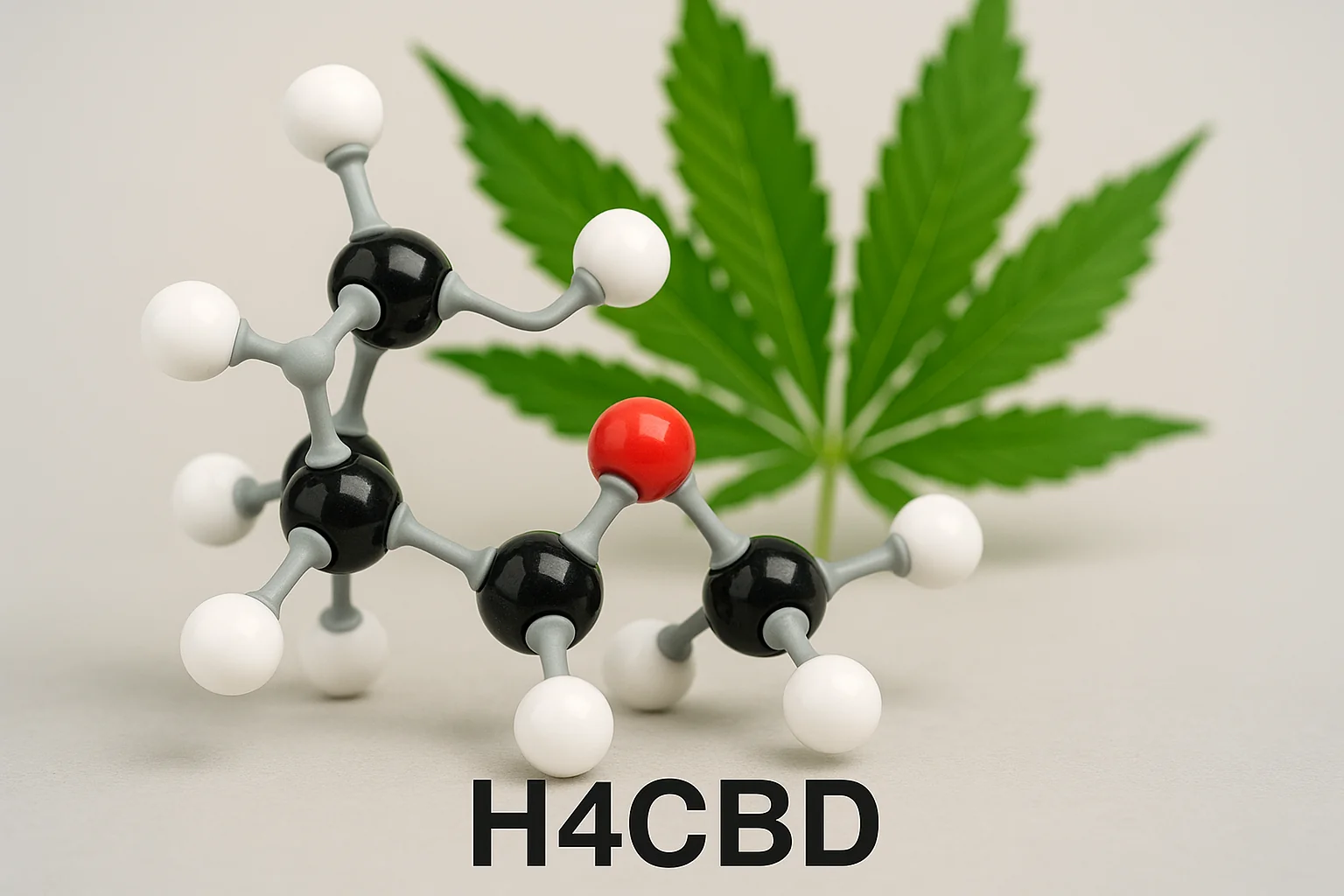
H4CBD, or hexahydrocannabidiol, is a chemical compound obtained from CBD through catalytic hydrogenation. In this process, the cannabidiol molecule is subjected to gaseous hydrogen in the presence of a catalyst - most often palladium or nickel. Four hydrogen atoms attach to the aromatic (benzene) ring of CBD, transforming it into a saturated cyclohexane ring. The result is a molecule that looks similar to CBD but has a different three-dimensional structure and different physicochemical properties.
The first systematic characterization of H4CBD and similar hydrogenated cannabinoids comes from the work of Ujváry and Hanuš published in Drug Testing and Analysis in 2016. The authors described a series of hexahydrocannabinoids - derivatives of CBD, THC, and other cannabinoids - and discussed their chemical properties (Ujváry, Hanuš, Drug Testing and Analysis, 2016). This was the starting point for later market interest in these compounds.
Hydrogenation increases the lipophilicity and chemical stability of the compound. H4CBD is less prone to oxidation and degradation under light or high temperature than CBD. This feature makes supplement manufacturers view H4CBD as a potentially attractive ingredient - a longer shelf life is a tangible technological benefit. However, it should be noted that hydrogenation is not a simple process and requires specialized conditions, so the purity of market products may vary.
H4CBD vs CBD vs HHC - comparison table
H4CBD often appears in the same context as CBD and HHC. These are three different molecules with different action profiles and legal statuses. The table below organizes the key differences between them to facilitate understanding of what we are actually dealing with in each of these compounds.
| Feature | CBD | H4CBD | HHC |
|---|---|---|---|
| Full name | Cannabidiol | Hexahydrocannabidiol | Hexahydrocannabinol |
| Precursor to synthesis | Natural (hemp plant) | CBD (semi-synthetic) | THC (semi-synthetic) |
| Metoda produkcji | Extraction from hemp | Hydrogenation of CBD | Hydrogenation of THC |
| Affinity for CB1 | Low / no agonistic activity | Moderate (higher than CBD) | High (strong CB1 agonist) |
| Psychoactivity | None | Weak / ambiguous | Yes (similar to THC) |
| Status in Poland 2026 | Legal (below 0.2% THC) | Szara strefa - brak wprost w przepisach | Szara strefa - podobne ryzyko prawne |
| Clinical data | Extensive (including phase III studies) | Very limited - no clinical studies | Very limited - mainly animal models |
The table clearly shows that H4CBD occupies an intermediate position. It is neither as well-studied as CBD nor as strongly psychoactive as HHC. This "gray area" of knowledge translates directly into a legal gray area, which we discuss further below.
Is H4CBD psychoactive? What does science say?
This is a question that everyone interested in H4CBD asks themselves. The answer is complex. CBD - the starting point for synthesizing H4CBD - does not significantly bind to CB1 receptors and does not cause intoxication. However, H4CBD has a different three-dimensional spatial structure, which changes the way it interacts with the receptors of the endocannabinoid system.
The work of Ujváry and Hanuš (2016) indicates that hydrogenated derivatives of CBD exhibit higher affinity for CB1 receptors than the CBD molecule itself. This means that H4CBD may interact with the endocannabinoid system in a way closer to THC than CBD - although probably weaker than HHC. The problem is that clinical studies in humans in this area are virtually non-existent. The data we have comes mainly from in vitro biochemical studies and structural modeling.
Some users of H4CBD describe the effects as slightly relaxing or psychomodulatory - distinctly different from CBD, but also not resembling the intense effects of THC or HHC. It is difficult to assess how reliable these reports are and how much depends on the placebo effect, differences in metabolism, or variable purity of market products. Without randomized controlled trials in humans, no definitive conclusions can be drawn about the effects of H4CBD on consciousness.
The key message is simple: if you are looking for a compound with no psychomodulating effects, CBD remains a better and better-studied choice. However, if you are interested in new cannabinoids, H4CBD is a candidate worth watching as science gathers more data.
The legal status of H4CBD in Poland and the European Union in 2026
H4CBD is not mentioned by name in any European or Polish legal act regulating psychoactive substances. The Polish Act on Counteracting Drug Addiction (Journal of Laws of 2023, item 1939) enumerates controlled substances on lists I-N, II-N, III-N, and IV-N - H4CBD does not appear on any of these lists under its own name. However, this does not mean full legality.
Polish regulations contain a clause regarding structural analogs of controlled substances. If a law enforcement agency or prosecutor determines that H4CBD is an analog of a regulated cannabinoid (e.g., HHC, which in some interpretations may be considered a controlled substance), they may attempt to subject H4CBD to the same regulations. This is a legally risky interpretation, but not impossible in practice.
At the European Union level, the situation is similar: neither Directive 1999/377/EC on psychotropic substances nor the EMCDDA regulations explicitly cover H4CBD (EMCDDA, Drug Profiles: Synthetic Cannabinoids). The EMCDDA monitors new psychoactive substances (NPS) and could direct H4CBD for risk assessment, which is a preliminary step before potential regulation at the EU level.
Practical conclusion: H4CBD operates in a legal gray area. The sale and possession are legally ambiguous in 2026. Before acquiring, selling, or transporting products containing H4CBD - especially across state borders - it is necessary to consult a lawyer specializing in pharmaceutical law or controlled substances law.
Safety of H4CBD - what we know, what we don't know
Data on the safety of H4CBD in humans is almost nonexistent. No registered clinical studies have yet been conducted to assess the toxicity, pharmacological profile, or drug interactions of H4CBD in humans. This means that risk assessment is based solely on extrapolation from data on CBD and other cannabinoids, as well as sporadic in vitro biochemical studies.
From what is known about cannabinoid metabolism, H4CBD is likely metabolized by cytochrome P450 enzymes in the liver - similar to CBD. This means potential interactions with medications that utilize the same enzymatic pathways: anticoagulants, some antiepileptic drugs, immunosuppressants. CBD exhibits similar interactions, which have been well documented (NIH, StatPearls: Cannabidiol, 2024).
Particular caution is advised for: pregnant or breastfeeding women, individuals taking medications metabolized by CYP3A4 and CYP2C9, individuals with liver diseases, as well as those with a history of psychotic disorders, since cannabinoids with a higher affinity for CB1 may theoretically exacerbate psychotic symptoms. These are not hypothetical warnings - they concern real patient groups that should approach H4CBD with great caution until solid clinical data emerges.
Frequently Asked Questions
What is H4CBD and how does it differ from CBD?
H4CBD (hexahydrocannabidiol) is a hydrogenated analog of CBD formed by the addition of four hydrogen atoms to the aromatic ring of the cannabidiol molecule. This change makes H4CBD more lipophilic and more chemically stable than CBD, and preliminary data suggest a higher affinity for CB1 receptors (Ujváry and Hanuš, Drug Testing and Analysis, 2016).
Is H4CBD psychoactive?
H4CBD shows a higher affinity for CB1 receptors than CBD, which distinguishes it from cannabidiol. Some users describe weak psychomodulatory effects; however, the lack of solid clinical studies prevents a definitive answer. H4CBD should not be equated with THC - the mechanism and strength of action are different, although the structural similarity to active cannabinoids is evident.
Is H4CBD legal in Poland in 2026?
The legal status of H4CBD in Poland in 2026 is ambiguous. The Act on Counteracting Drug Addiction (Journal of Laws of 2023) does not mention H4CBD by name, but clauses regarding structural analogs could be applied by law enforcement. Before acquiring products containing H4CBD, we recommend consulting a lawyer. The legal situation may change as a result of EMCDDA decisions or amendments to national regulations.
How is H4CBD produced?
H4CBD is produced through the catalytic hydrogenation of CBD: the cannabidiol molecule is subjected to gaseous hydrogen in the presence of a catalyst (palladium or nickel). Four hydrogen atoms attach to the benzene ring of CBD, transforming it into a saturated cyclohexane ring and creating hexahydrocannabidiol. The process requires specialized laboratory conditions.
How does H4CBD differ from HHC?
H4CBD is a hydrogenated analog of CBD (cannabidiol), while HHC (hexahydrocannabinol) is a hydrogenated analog of THC. Both are semi-synthetic and more stable than their precursors, but they differ in the starting point of synthesis and their action profile. HHC exhibits stronger psychoactive properties than H4CBD because it derives from a compound with high activity towards CB1, namely THC.
Is H4CBD safe?
Data on the safety of H4CBD in humans is very limited - there are no clinical studies, and the toxicological profile is not fully understood. Caution is advised, especially for pregnant women, individuals taking medications metabolized by CYP450, and those with a history of psychotic disorders. Consult a doctor before using H4CBD.
Where to buy H4CBD and what to watch out for?
Products containing H4CBD are appearing in cannabinoid shops and online sales. When purchasing, check if the manufacturer provides results from independent laboratory tests (certificate of analysis, COA). Due to the unclear legal status, avoid transporting products containing H4CBD across national borders without prior legal consultation. Choose sellers who are transparent about the composition and origin of the raw materials.
What forms of H4CBD are available on the market?
H4CBD mainly occurs in the form of oils, resins, and concentrates used for vaporization or oral consumption. It sometimes appears as an ingredient in capsules or topical products. Due to the early market stage, product standardization is limited - it is therefore particularly important to choose products with COA testing confirming composition and purity.
This article is for informational and educational purposes and does not constitute legal advice. The legal status described in the article is valid as of the publication date - regulations regarding cannabis may change. Consult a lawyer or current legal acts before making decisions.
Author: Michał Waluk · Published: 2026-05-04 · Updated: 2026-05-04