
CLA for fat tissue reduction - an honest assessment of the effect scale
CLA for fat tissue reduction: a reliable response based on research. u Bucha.
Conjugated linoleic acid (CLA) has been appearing in fat reduction supplement rankings for years. In advertisements, it is often associated with dramatic results, while meta-analyses show a different picture - the effect is real, but its scale requires a sober assessment. The study by Whigham et al. from 2007, still one of the best-conducted systematic reviews on this topic, showed a fat loss of about 0.09 kg per week over placebo (Whigham et al., AJCN, 2007). This article breaks down what we know about CLA based on reliable research, what doses are effective, and for whom this supplement may make sense.
KEY INFORMATION
• Meta-analysis of 18 RCTs: CLA causes fat loss of about 0.09 kg/week more than placebo - about 1.1 kg in 12 weeks (Whigham et al., AJCN, 2007).
• The effective dose is about 3.2 g per day - higher doses do not yield proportionately better results.
• The t10,c12-CLA isomer (dominant in supplements) may subclinically increase insulin resistance with long-term use.
• CLA alters body composition (more muscle, less fat) without always showing a visible change in total mass.
What is CLA and how does it work?
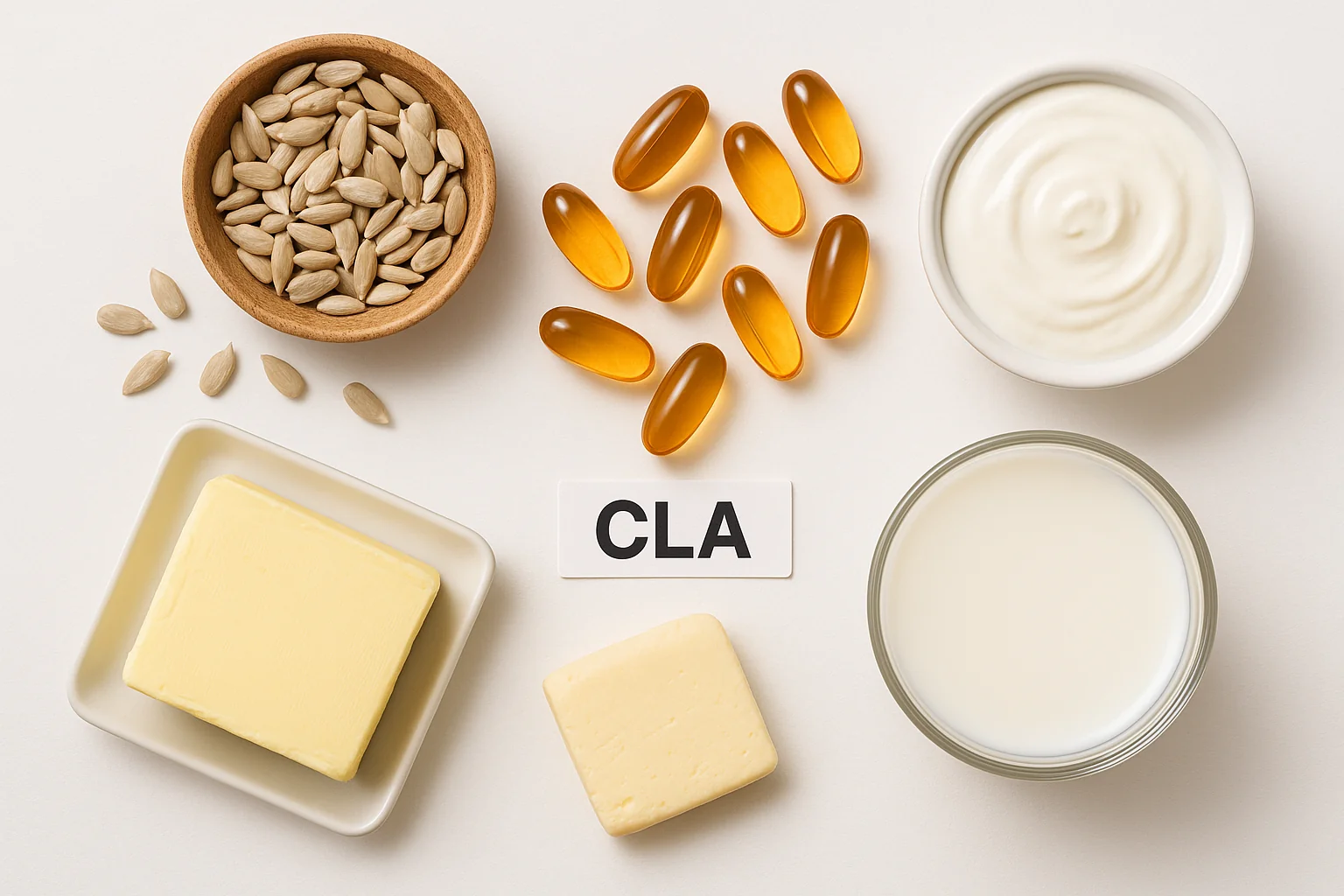
CLA (conjugated linoleic acid) is a group of geometric isomers of linoleic acid. It is naturally found in the meat and dairy of ruminant animals - cows, sheep, goats. The Western diet provides about 0.3-1.5 g of CLA per day, mainly from dairy. This amount is several times lower than the doses used in clinical studies, hence the interest in supplementation.
The mechanism of action of CLA on fat tissue is complex and still not fully understood. In vitro and animal studies suggest three pathways: reduction of lipoprotein lipase (the enzyme responsible for fat storage), enhancement of lipolysis in adipocytes, and activation of PPAR receptors that regulate lipid metabolism. In rodent studies, the effects of CLA are pronounced - in humans, they scale much more modestly.
Why do results differ between animals and humans? Primarily because the doses of CLA used in mice, when adjusted for body weight, are several dozen times higher than those in humans. Secondly, the regulation of fat tissue in humans is significantly more complex and environmentally dependent. This is a classic case where the biological mechanism is real, but it does not translate into a clinically significant effect.
What does the meta-analysis of 18 RCTs show?
Whigham et al. conducted a meta-analysis of 18 randomized placebo-controlled trials lasting from 4 to 52 weeks, involving over 800 participants in total (AJCN, 2007). Collective results show a fat tissue loss of 0.09 kg per week over placebo. This means 1.08 kg in 12 weeks and about 1.8 kg in 20 weeks - with consistent supplementation.
| Supplementation Duration | Estimated fat loss over placebo | Source |
|---|---|---|
| 4 weeks | about 0.36 kg | Whigham et al., 2007 |
| 12 weeks | about 1.08 kg | Whigham et al., 2007 |
| 20 weeks | about 1.8 kg | Whigham et al., 2007 |
| 52 weeks | about 3.7 kg (limited data) | Gaullier et al., 2005 |
An important observation from the meta-analysis: the effect of CLA on fat mass was more pronounced in studies where participants did not modify their diet during the intervention. When active caloric restriction was imposed, the difference between CLA and placebo decreased - likely because the caloric deficit dominated both arms of the study.
We noticed while analyzing individual studies that the effect of CLA on body composition change (more muscle, less fat) was sometimes present even when weight did not decrease. In several studies, fat tissue decreased by 1-2 kg, while lean muscle mass increased by a similar amount - the total weight was close to the placebo group. This means that the result on the scale is an insufficient measure of CLA's effectiveness.
CLA isomers - not all work the same.
CLA in supplements is usually a 50:50 mixture of c9,t11 and t10,c12 isomers. Both isomers have different biological properties and different safety profiles. The c9,t11 isomer dominates in natural food and has a more favorable profile - it exhibits anti-inflammatory and immunomodulatory effects. The t10,c12 isomer is more metabolically active, but it is responsible for most potential side effects.
Research indicates that the t10,c12 isomer is mainly responsible for the fat tissue reduction effect, but also for the adverse impact on insulin sensitivity. Risérus et al. demonstrated in a 2002 study that 12 weeks of supplementation with the t10,c12-CLA isomer in overweight men led to increased insulin resistance and inflammatory markers, including CRP (Risérus et al., Circulation, 2002). The effects were subclinical but measurable.
Who should consider CLA, and who should not?
CLA is not a supplement for everyone. The profile of a person for whom it may make sense: physically active, with a controlled diet, seeking marginal improvement in body composition. The effect of 1 kg of fat more than placebo in 12 weeks is realistic and documented - but its scale requires realistic expectations. Someone who is counting on large and rapid effects will be disappointed.
Who should exercise caution? Individuals with prediabetes, type 2 diabetes, or insulin resistance, as the t10,c12-CLA isomer may exacerbate these disorders with prolonged use. Pregnant and breastfeeding women, as there is a lack of safety data in these groups. Individuals with cardiovascular diseases should consult a doctor - the effect of CLA on lipids is mixed and depends on the dose and isomer.
Frequently Asked Questions
What is CLA and where does it come from?
CLA (conjugated linoleic acid) is a family of isomers of linoleic acid, naturally present in the meat and dairy of ruminants. The best-studied isomers are c9,t11-CLA (dominant in food) and t10,c12-CLA (used in supplements). CLA supplements are produced from safflower oil through isomerization and usually contain a mixture of both isomers in a ratio of about 50:50 (Whigham et al., AJCN, 2007).
How much does CLA reduce fat tissue according to meta-analyses?
A meta-analysis of 18 RCTs showed that CLA caused an average fat tissue loss of 0.09 kg per week over placebo. In a 12-week supplementation cycle, this translates to about 1.1 kg of fat more than placebo (Whigham et al., AJCN, 2007). The effect is statistically significant but clinically modest - it is a complement to a controlled diet, not a standalone weight loss agent.
What dose of CLA is used in studies?
Most clinical studies used 3.2-6.4 g of CLA daily. Dose-response analysis indicates that a plateau effect is reached at about 3.2 g per day - higher doses do not yield proportionately greater benefits with clearly higher risks of adverse effects (Whigham et al., AJCN, 2007).
Does CLA have side effects?
The t10,c12-CLA isomer may slightly increase insulin resistance and inflammatory markers (including CRP) with prolonged high-dose use. These effects are usually subclinical at 3.2 g daily, but individuals with prediabetes or diabetes should exercise caution and discuss supplementation with a doctor (Risérus et al., Circulation, 2002).
Does CLA change body composition without changing weight?
Yes. Some studies show that CLA reduces fat tissue while simultaneously increasing or maintaining muscle mass - the weight on the scale changes less than the fat tissue itself. This is an effect of body composition change, not just total mass. Therefore, body composition analysis (e.g., DEXA) is a better measure of CLA's effect than weight alone (Whigham et al., 2007).
Does CLA work the same for women and men?
Studies suggest some differences. In obese women, some studies showed a smaller effect or no effect on fat tissue at standard doses. The meta-analysis by Whigham et al. (2007) observed a combined effect - but results in subgroups indicate variability in response depending on gender and baseline BMI (Whigham et al., AJCN, 2007).
Does CLA from natural food work the same as a supplement?
Natural CLA from the milk of pasture-raised cows is mainly the c9,t11 isomer with a more favorable safety profile. Food intake is 0.3-1.5 g per day - significantly less than therapeutic doses (3.2-6.4 g). Supplements provide higher doses but with the t10,c12 isomer that potentially has a worse metabolic profile with prolonged use (Whigham et al., 2007).
Who might find CLA a sensible supplement?
CLA may be considered by physically active individuals with a controlled diet, seeking modest improvements in body composition. An effect of about 1 kg of fat more than placebo over 12 weeks is documented and realistic, but it requires realistic expectations. Individuals with metabolic disorders, those who are pregnant, or those with cardiovascular diseases should consult a doctor before use (Whigham et al., 2007).
This article is for informational and educational purposes and does not replace consultation with a doctor. If you are pregnant, breastfeeding, taking medications, or have chronic conditions, consult the use of supplements or herbs with a specialist.
Author: Michał Waluk · Published: 2026-05-04 · Updated: 2026-05-04