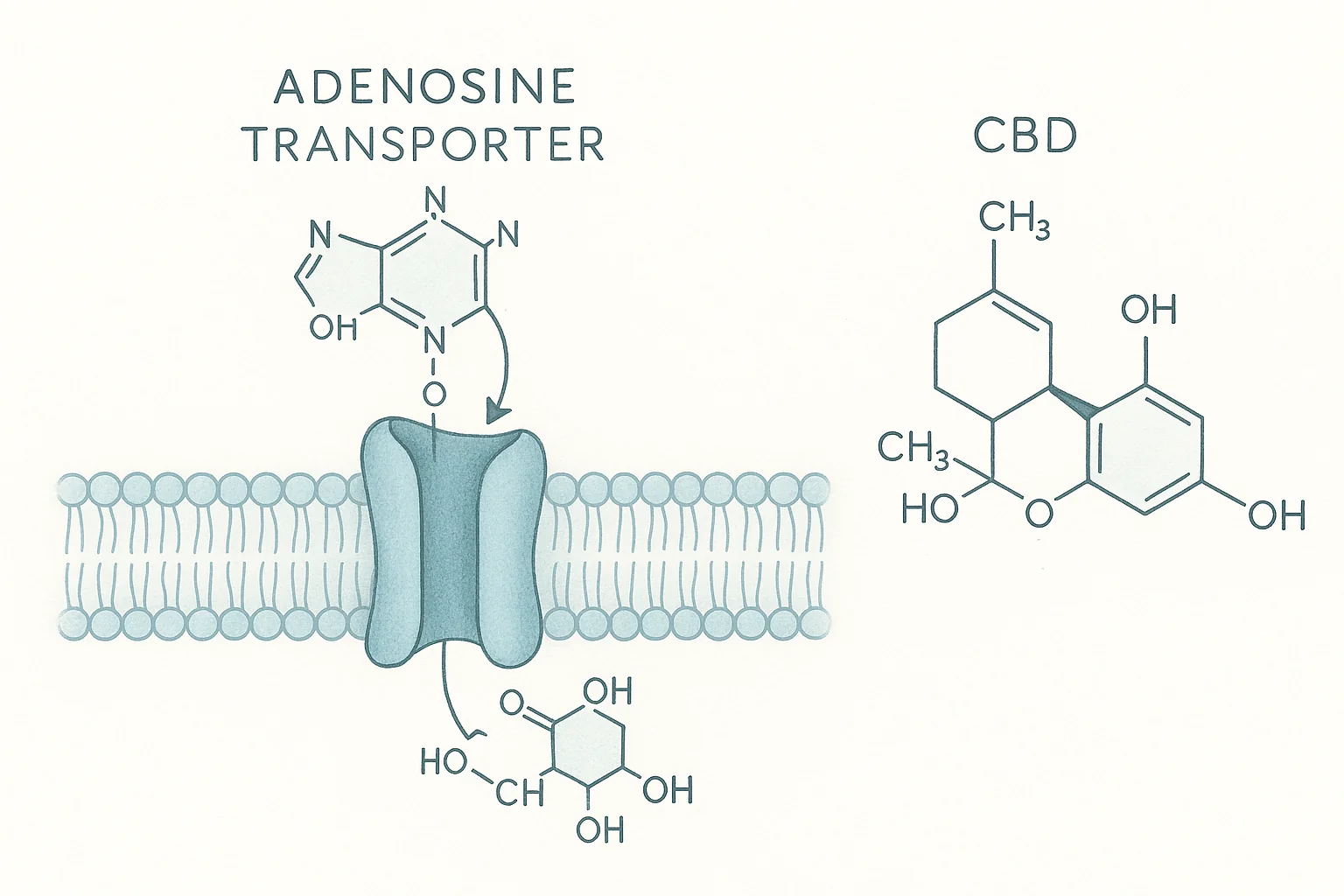

CBD and adenosine - why inhibiting reuptake has a calming effect
CBD a adenozyna — mechanizm dzialania wyjasniony prosto, w oparciu o badania. u Bucha.
Caffeine stimulates by blocking adenosine receptors. CBD, on the other hand, does the opposite - it blocks the transport of adenosine back into cells, causing its concentration to rise and potentially exert a stronger calming effect. Carrier and colleagues demonstrated in 2006 that CBD inhibits the nucleoside transporter ENT1, responsible for the uptake of adenosine from the extracellular space (Carrier et al., European Journal of Pharmacology, 2006). This is one of the lesser-known but fascinating mechanisms of CBD's action - a mechanism that exists independently of the endocannabinoid system and explains some of the calming and anti-inflammatory effects of this cannabinoid.
KEY INFORMATION
• CBD inhibits the ENT1 transporter, reducing adenosine uptake - which raises its extracellular concentration (Carrier et al., European Journal of Pharmacology, 2006).
• Adenosine through the A1 receptor inhibits neuronal activity - this is the biological basis of its calming and sedative effect.
• The mechanism is the opposite of caffeine's action - caffeine blocks A1/A2A adenosine receptors, while CBD increases its availability.
• The A2A adenosine receptor on immune cells inhibits the production of pro-inflammatory cytokines - CBD enhances this pathway through ENT1.
What is adenosine and why does it cause drowsiness?
Adenosine is a nucleoside - a small molecule compound produced as a byproduct of ATP (adenosine triphosphate) hydrolysis, the main 'energy currency' of cells. The more energy a cell consumes, the more adenosine it produces. In the nervous system, this relationship creates an elegant feedback mechanism: the more intensely you work mentally, the more adenosine accumulates in brain tissue, and the stronger the signal of drowsiness you receive.
Adenosine acts through four types of receptors: A1, A2A, A2B, and A3. The most significant for calming effects are A1 and A2A. The A1 receptor is most abundantly expressed in the cerebral cortex, hippocampus, and thalamus. Upon activation, it opens potassium channels (like 5-HT1A), which hyperpolarizes the neuron and decreases its excitability. This is the neurobiological substrate of sleepiness that builds up throughout the day - a phenomenon called 'sleep pressure' or 'sleep homeostasis.'
The A2A receptor plays different roles: in the striatum, it modulates dopaminergic signaling, and in immune cells, it inhibits inflammatory activation. Caffeine blocks both receptors - A1 and A2A - which explains both its stimulating properties and its weak anti-inflammatory action.
Jak CBD hamuje transporter ENT1 - mechanizm wychwytu adenozyny
Adenosine, once released into the synaptic space, is not enzymatically broken down like classical neurotransmitters. Instead, it is taken back into cells by nucleoside transporters. The most important of these is ENT1 (equilibrative nucleoside transporter 1) - a transport protein located in the cell membranes of neurons, astrocytes, and endothelial cells. ENT1 operates passively, directing adenosine from an area of higher concentration (extracellularly) to a lower one (intracellularly).
We have noticed that the adenosine mechanism of CBD is often overlooked even in specialized review articles. It is usually mentioned in a single sentence, while CB1/CB2 and 5-HT1A receive full paragraphs. Meanwhile, Carrier and colleagues have shown that ENT1 inhibition by CBD is pharmacologically significant at concentrations achievable with supplementation - making it likely one of the active mechanisms not only in vitro but also in vivo.
Carrier and colleagues demonstrated that CBD inhibits ENT1 with an IC50 value of about 250 nM - which is a relatively low concentration that can be achieved in the brain after CBD administration. Inhibition of ENT1 by CBD reduces adenosine uptake by cells, causing adenosine to accumulate in the extracellular space. Higher extracellular concentrations of adenosine mean more intense activation of A1 and A2A receptors, translating into a calming effect and inhibition of inflammation (Carrier et al., European Journal of Pharmacology, 2006).
CBD and adenosine - comparison with caffeine's action
The comparison of CBD and caffeine against the backdrop of the adenosine pathway shows how the same signaling system can be modulated in opposite directions. The table below summarizes the key differences.
| Feature | CBD | Caffeine |
|---|---|---|
| Molecular target | ENT1 transporter (inhibits adenosine reuptake) | A1 and A2A receptors (blocks the action of adenosine) |
| Effect on adenosine | Increases its extracellular availability | Blocks its receptors, reducing the signal |
| Net effect on stimulation | Calming, soothing | Stimulating, improves alertness |
| Effect on inflammation | Anti-inflammatory (A2A on immune cells) | Weakly anti-inflammatory (A2A blockade gives a complex effect) |
| Speed of effect | 15-60 min (depending on the route of administration) | 30-60 min (intestinal absorption) |
Adenosine, CBD and anti-inflammatory action
The A2A adenosine receptor is particularly significant outside the nervous system - it is expressed on immune cells: macrophages, neutrophils, T lymphocytes, and NK cells. Activation of A2A on these cells strongly inhibits their pro-inflammatory activity. The mechanism involves raising intracellular cAMP, which inhibits the secretion of TNF-alpha, IL-12, and reactive oxygen species by macrophages.
The immunosuppressive effect of adenosine through A2A is so strong that it has become the subject of intense research in oncology - cancer cells often localize in an adenosine-rich environment, which 'silences' cytotoxic T lymphocytes that defend the body. This is a paradox: the same mechanism that protects tissues from excessive inflammation may help tumors evade immune surveillance.
CBD, by inhibiting ENT1, raises adenosine levels, which enhances A2A signaling on immune cells. Carrier and colleagues observed that the anti-inflammatory effect of CBD in a septic model was partially abolished by blocking A2A adenosine receptors, which directly confirms the involvement of this pathway (Carrier et al., European Journal of Pharmacology, 2006).
Our observations suggest that knowledge of the adenosine mechanism helps explain a certain phenomenon: why some people using CBD in the afternoon or evening feel drowsy, which is not triggered by the same dose in the morning. Adenosine tension (i.e., the accumulation of adenosine throughout the day) is low in the morning - after a night of rest. In the evening, it is high, meaning that CBD through ENT1 may amplify an already existing sleep signal, rather than create it from scratch.
How important is the adenosine mechanism compared to the ECS?
This is a question without a simple answer, as the significance of each CBD mechanism depends on the dose, route of administration, and biological context. The general rule is this: at low concentrations of CBD (1-10 μM in tissue), ENT1 inhibition and effects through 5-HT1A are likely more important than CB1/CB2 activation. Higher concentrations (above 10 μM) engage more additional targets, including TRPV1 and ion channels. CBD as a molecule does not have one 'main' mechanism - it is a polypharmacological agent that modulates many pathways simultaneously.
The adenosine mechanism of CBD is a fascinating example of action independent of the endocannabinoid system. It explains some of the effects of CBD observed even after the pharmacological or genetic ablation of CB1 and CB2 receptors in animal models. For researchers, this is important evidence that CBD does not act 'only on the ECS' - its profile of biological activity is much richer.
Adenosine and the circadian rhythm - how CBD may influence sleep through ENT1
Adenosine plays a key role in sleep homeostasis - the biological mechanism of accumulating "sleep debt" throughout the day. Adenosine pressure increases linearly from waking, reaching its peak in the evening. This rise in adenosine concentration in the extracellular space of the cerebral cortex, particularly near cholinergic neurons in the basal forebrain, signals the brain's need for sleep. Blocking this signal - through caffeine - delays sleep. Enhancing it - through ENT1 inhibition by CBD - could theoretically speed up falling asleep.
Studies on rodents with a genetic knockout of the ENT1 transporter showed that animals without ENT1 fell asleep faster and had longer periods of slow-wave sleep. The effect was reversible by blocking A1 and A2A receptors. This is direct evidence that ENT1 is an important regulator of homeostatic sleep pressure by controlling the availability of adenosine (Carrier et al., European Journal of Pharmacology, 2006). Does CBD, by inhibiting ENT1, partially mimic this effect? This is a hypothesis not clinically verified, but mechanistically coherent.
It is important to emphasize the difference between the effect of CBD in the evening and in the morning. In the morning, after a night of rest, adenosine sleep pressure is low - ENT1 inhibition by CBD has little adenosine to "retain" and has a weaker effect on drowsiness. In the evening, after a whole day of activity, adenosine pressure is high - CBD through ENT1 can then more clearly amplify the natural sleep signal. This explains why the effects of CBD on sleep are less predictable than on anxiety: they strongly depend on the timing of administration relative to the circadian rhythm of adenosine.
Selectivity of CBD towards nucleoside transporters - ENT1 vs ENT2
In human tissues, there are four main types of nucleoside transporters: ENT1, ENT2, ENT3, and ENT4. ENT1 and ENT2 are located in the cell membrane and operate bidirectionally, depending on the concentration gradient. ENT3 and ENT4 are mainly found in intracellular organelles. CBD prefers ENT1 inhibition over ENT2 - ENT1 has a higher affinity for adenosine and is the dominant transporter regulating extracellular adenosine concentration in the brain.
This selectivity has clinical significance: ENT1 is the main "regulator" of adenosine tone in CNS synapses, while ENT2 is more important in peripheral and cardiac cells. Selective inhibition of ENT1 by CBD means that calming effects are more pronounced in the CNS than in the cardiovascular system. In comparison: dipyridamole - a classic ENT1 inhibitor used clinically as an antiplatelet drug - inhibits both types non-selectively, which explains its cardiovascular effects.
Does a full understanding of CBD's selectivity towards ENT1/ENT2 open up possibilities for designing new cannabinoid-like molecules that selectively modulate adenosine in the CNS? This is an active area of research. Several pharmaceutical groups are studying CBD analogs optimized for ENT1 inhibition without cannabinoid activity as potential sedative or anxiolytic drugs without the risk of tolerance through CB1.
Frequently Asked Questions
What is adenosine and how does it work in the nervous system?
Adenosine is a nucleoside formed as a product of ATP breakdown. In the nervous system, it accumulates during metabolic activity and activates A1 and A2A receptors, which inhibit neuronal activity. This is the biological mechanism of increasing drowsiness and calmness after mental exertion - the so-called sleep homeostasis.
How does CBD inhibit adenosine uptake?
CBD inhibits the ENT1 nucleoside transporter, which normally takes adenosine from the extracellular space into the cells. When ENT1 is blocked, adenosine accumulates extracellularly and more strongly activates A1 and A2A receptors, causing a calming and anti-inflammatory effect (Carrier et al., European Journal of Pharmacology, 2006).
Is this the same mechanism as with caffeine?
No - caffeine blocks A1 and A2A adenosine receptors, preventing adenosine from exerting a calming effect. CBD inhibits adenosine reuptake, increasing its availability. Both compounds act on the adenosine pathway, but in opposite directions - CBD enhances the adenosine signal, while caffeine blocks it.
Does adenosine have an anti-inflammatory effect through CBD?
Yes. Adenosine, through the A2A receptor on immune cells (macrophages, lymphocytes), inhibits the production of pro-inflammatory cytokines TNF-alpha and IL-12. By raising adenosine levels through ENT1 inhibition, CBD enhances this effect. Carrier and colleagues confirmed that blocking A2A receptors reduces the anti-inflammatory effect of CBD (Carrier et al., European Journal of Pharmacology, 2006).
How important is the adenosine mechanism compared to CB1/CB2?
At low concentrations of CBD (1-10 μM), ENT1 inhibition is likely more important than CB1/CB2 activation. Higher concentrations engage more and more molecular targets. CBD is a polypharmacologist - no single mechanism fully explains its biological effects. The adenosine mechanism explains part of the effects observed even with ECS disruption.
This article is for informational and educational purposes and does not replace consultation with a doctor. If you are pregnant, breastfeeding, taking medications, or have chronic conditions, consult the use of supplements or herbs with a specialist.
Author: Michał Waluk · Published: 2026-05-04 · Updated: 2026-05-04