
Where to buy CBD online in Poland? What to watch out for and how not to overpay
Where to buy CBD online in Poland: legal status, batch certificate, price conversion to 100 mg, and warning signals from the seller. What studies have shown about labels.
Two stores, the same percentage on the label, double the price difference. Which one to choose? You won't find the answer in the product description, as the description is written by the seller. In the analysis of 202 CBD products from the open market, 74% deviated from the declared potency by at least 10%, and solvent residues were detected in 181 of them (Gidal i in., Frontiers in Pharmacology, 2024). Therefore, purchasing CBD online comes down to two skills: reading documents instead of promises and reducing prices to a common measure. Below you will find both, along with the legal status described as it really is, and a list of signals by which you can recognize a store without a proper background.
KEY INFORMATION
• Of 84 CBD products purchased online, only 26 were within the compliance range with the label (Bonn-Miller et al., JAMA, 2017).
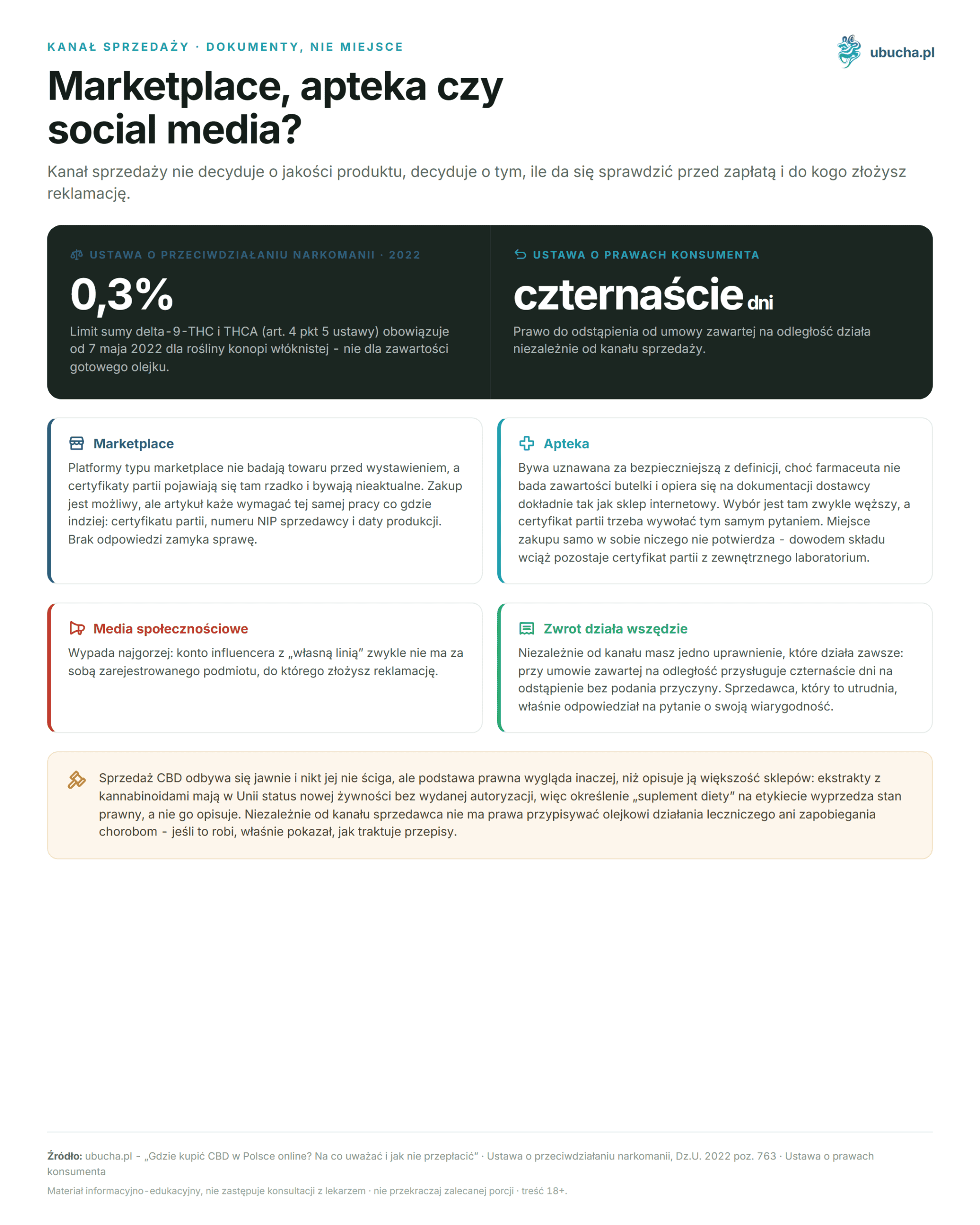
• The limit of 0.3%, calculated as the sum of delta-9-THC and THCA, describes the hemp plant, not the content of the finished oil.
• Hemp extracts with cannabinoids have novel food status in the EU and have not received authorization as a supplement ingredient.
• Compare the cost per 100 mg of CBD, not the price of the bottle.
• A batch certificate from an external laboratory is the only proof of composition available before payment.
Is buying CBD online legal in Poland?
Sales are conducted openly and no one is pursuing them, but the legal basis looks different than what most stores describe. Two simplifications are circulating, and both lead the buyer astray: that 0.3% THC is the limit for a bottle and that hemp oil is a registered dietary supplement.
The first simplification concerns the plant. In Polish law, hemp refers to those varieties in which the sum of delta-9-THC and tetrahydrocannabinolic acid in flowering or fruiting tops does not exceed 0.3% when calculated on a dry mass basis, with the sum rounded to one decimal place. This wording was established by the amendment effective from May 7, 2022 (Dz.U. 2022 poz. 763), and the threshold is stated in Article 4, point 5 of the Act on Counteracting Drug Addiction. It describes the raw material in the field, not the content of the extract in the finished product. Therefore, on the oil certificate, look for a separate result for THC stated in milligrams, instead of relying on the term "below 0.3%" from the store description.
The second simplification concerns food. Extracts from Cannabis sativa containing cannabinoids are listed in the EU novel food catalog as novel food, meaning products that require authorization before being allowed on the food market. No such authorization has been issued for cannabidiol. Therefore, products are available for sale, while the term „dietary supplement” on the label precedes the legal status rather than describes it. The practical conclusion for the buyer is clear: the seller has no right to attribute medicinal effects or disease prevention to the oil, and if they do, they have just shown how they treat the regulations.
Why is the CBD oil label not proof of content?
Because the label is printed by the manufacturer, and the content is measured by the laboratory, these two numbers often do not match in most tested products. Four independent analyses from 2017-2024 provided the same picture despite different markets, methods, and sample sizes.
Bonn-Miller and colleagues purchased 84 products online from 31 companies. Label compliance within 10% was achieved by 26 products: 36 contained more CBD than declared on the label, while 22 contained less. THC was detected in 18 samples, with concentrations reaching 6.43 mg per milliliter, although the labels did not declare it (Bonn-Miller i in., JAMA, 2017). Five years later, an analysis of 80 products from the American market showed a compliance level of 54%, with 12 products containing less than 90% of the declared amount, and 25 containing more than 110% (Johnson i in., Journal of Cannabis Research, 2022).
The European market showed similar results, although the study we rely on covered a single country. A team from Pecs and Szeged searched the Hungarian internet using the term "buy CBD" and purchased 12 oils from the stores found. They measured between 19.58 and 54.09 mg of CBD per milliliter: one product was underestimated, five were overestimated, and half were correctly labeled (Vida i in., Frontiers in Pharmacology, 2023). The authors noted that most of the purchased products were also available in stores outside Hungary, so the brands are the same as in the rest of Europe. The broadest of these studies covered 202 products and yielded the worst result: 74% deviated from the declared potency by at least 10%, and 26% did not correspond to the declared type of extract (Gidal et al., 2024). Since the declaration diverges from measurement in half of the cases, and in the broadest analysis in three-quarters of cases, comparing the declarations of two manufacturers resolves nothing.
What should a batch analysis certificate contain?
Five things whose absence disqualifies the document regardless of how nice it looks. The analysis certificate, referred to in the industry as a COA, describes a single batch of the product, not the brand or line. A report without a batch number tells you nothing about the bottle you have in your cart.
- Nazwa laboratorium i numer akredytacji. An independent unit from the manufacturer, preferably accredited by the Polish Accreditation Center or an equivalent.
- Numer partii i data badania. They must match the packaging. A report from three years ago describes a different plant material and a different process.
- The content of cannabinoids in milligrams. The percentage on the bottle is a derived notation, and the measurement is given in mg per milliliter or per package.
- Osobny wynik dla THC. Expressed in milligrams, not inherited from the limit for the plant.
- Contaminant panel. Heavy metals, pesticides, and solvent residues, each with a measured value and a reference threshold.
The last point is often overlooked, yet it distinguishes a certificate from a leaflet. In the analysis of 202 products, heavy metals were detected 52 times in 44 products, most often lead, while solvent residues were found 446 times in 181 products, and among 232 tested pesticides, 26 appeared 55 times in 30 products (Gidal et al., 2024). A small portion of the results exceeded the regulatory threshold, so panic is unwarranted; however, the frequency of detections shows how rarely the process is fully closed. A certificate available on the product page is worth more than a 'upon request' certificate because you can check the first before payment, while the second after. If you want to go through such a document line by line, we have a separate text: how to read a CBD certificate.
How to calculate if you are overpaying for CBD oil?
Divide the price by the number of milligrams of CBD in the package and multiply by one hundred. You will get the cost of 100 mg, which is the only number that compares bottles of different capacities and strengths. A more expensive bottle at checkout can turn out to be cheaper on a per mg basis, and a promotion on a large capacity can be the most expensive item in the cart.
| Oil | CBD w butelce | Price | Za 100 mg |
|---|---|---|---|
| CANNOVA Natural CBD Oil 5%, 10 ml | 500 mg | 65 zł | 13.00 zł |
| CANNOVA Natural CBD Oil 10%, 10 ml | 1000 mg | 110 zł | 11.00 zł |
| CANNOVA Natural CBD Oil 20%, 10 ml | 2000 mg | 190 zł | 9.50 zł |
Prices are valid in the store ubucha.pl, as of August 8, 2026. They reveal a rule that repeats among most manufacturers: the cost of 100 mg decreases with increasing concentration, as the bottle, pipette, packaging, and batch testing cost the same regardless of the extract content. This does not mean that a stronger oil is a better purchase for everyone, as you will consume a smaller bottle before the expiration date after opening.
We have noticed in conversations with customers that the most common disappointment arises not from choosing the wrong concentration, but from comparing bottles of different capacities. A 5% oil in 30 ml looks like a bargain at checkout compared to a 10% oil in 10 ml, although without recalculating, it is unclear which bottle provides more CBD for the same amount of money. A minute with a calculator organizes the entire cart. We dedicated a separate text to the percentages: what concentration of CBD to choose.
How to recognize a seller to avoid?
After the language of promises and what is missing from the site. The mentioned study of the Hungarian online market covered 16 stores: ten suggested health benefits indirectly, one attributed the product's use in COVID-19, and a total of thirty alleged indications were collected (Vida et al., 2023). Three stores did not mention therapeutic applications at all.
In the same study, three out of twelve purchased products had no information on how to use them. A seller who cannot specify how many drops and how often usually does not have access to batch data either. A separate trap is the naming. Hemp seed oil is a valuable food product, but it does not contain cannabinoids in amounts counted on the label. If the description mentions 'hemp oil' and does not provide the CBD content in milligrams, you are likely buying food oil at the price of an extract.
The rest of the signals are mundane: lack of name and address of the entity responsible for bringing the product to market, lack of a Polish label, lack of contact other than a form, lack of production date and expiration date, lack of information on the extraction method. From our experience, a store that does not respond to a question about the batch number rarely hides something intentionally. They simply buy the goods from an intermediary and do not know themselves. For the buyer, the effect is the same.
Specialty store, marketplace, or pharmacy: where to buy?
The sales channel does not determine the quality of the product; it determines how much can be verified before payment. From this perspective, the differences between an auction platform, a pharmacy, and a specialized store boil down to the availability of documents and who is responsible for complaints.
Marketplace platforms do not test goods before listing, and batch certificates appear there rarely and can be outdated. A purchase is possible, but it requires the same effort as elsewhere: ask for the batch certificate, check the seller's NIP number and production date. A lack of response closes the matter. Sales through social media perform the worst because an influencer's account with a 'own line' usually does not have a registered entity behind it to which you can submit a complaint.
A pharmacy is often considered safer by definition, although the pharmacist does not test the contents of the bottle and relies on the supplier's documentation just like an online store. The selection is usually narrower there, and the batch certificate must be requested with the same question. Regardless of the channel, you have one right that applies always: for a contract concluded at a distance, you are entitled to fourteen days to withdraw without giving a reason, in accordance with the Consumer Rights Act. A store that complicates this has just answered the question about its credibility.
How to store CBD oil after purchase?
In darkness, in coolness, and tightly closed, because cannabidiol decomposes under the influence of light, heat, and oxygen, and the products of this decomposition can be psychoactive (Bazzo i Stulzer, Drug Development and Industrial Pharmacy, 2026). The bottle should be glass and tinted, amber or green.
The loss scale due to light is measured and high. In an accelerated test under 8000 lux lighting, MCT oil retained about 20% of its initial cannabidiol content, while the powdered complex with hydroxypropyl-beta-cyclodextrin retained over 90% (Haidery i in., Journal of Pharmaceutical and Biomedical Analysis, 2026). This study compared carriers under laboratory conditions, not a bottle on a windowsill, but the direction is clear: the oil itself does not protect cannabidiol from light; the packaging does.
Keep hemp seed oil-based oils in the fridge, as unsaturated fatty acids oxidize faster than fractionated coconut oil. MCT oil preparations can simply be stored in a cool, dark cupboard away from the stove and windowsill. The expiration date after opening is provided by the manufacturer on the packaging, and only that date matters, as it depends on the formulation. Cloudiness after cooling does not indicate spoilage: it is a natural crystallization of fats that resolves after warming the bottle in your hand.
Screw the dropper cap back on after each use and do not leave an open bottle on the counter while measuring. Contact with air accumulates with each serving over months, and oxidation works in the same way as light. The bathroom is the worst place for such a bottle, as temperature and humidity fluctuate several times a day. You can find details in the text about this, how to store CBD oil.
Frequently Asked Questions
Is buying CBD online legal in Poland?
The sale and purchase of hemp oils occur openly, but the legal basis looks different than described by most stores. The limit of 0.3% calculated as the sum of delta-9-THC and THCA defines the hemp plant (Article 4, point 5 of the Act, wording from Journal of Laws 2022, item 763), not the finished oil. Cannabinoid extracts are listed in the EU catalog as novel food without issued authorization.
How to check if CBD oil has the declared potency?
Request a certificate of analysis for a specific batch from an external laboratory and compare the measured content with the label. The label alone is not enough: in the analysis of 202 products, 74% deviated from the declared potency by at least 10%, and previous studies showed 46% and 50% (Gidal et al., 2024; Johnson et al., 2022; Vida et al., 2023).
How much should a 10% CBD oil cost?
There is no official price, so count the cost of 100 mg of CBD instead of comparing bottle prices. In the table above, the same oil bottled in three concentrations ranges from 13.00 PLN to 9.50 PLN for 100 mg, based on prices as of August 8, 2026. This is a measure you can apply to any offer.
Can you buy CBD at a pharmacy?
Some pharmacies carry hemp oils, usually with a narrower selection than specialized stores. The place of purchase does not confirm anything by itself: proof of composition remains the batch certificate from an external laboratory, which you can request just as easily in a pharmacy as in an online store.
What is a certificate of analysis and why should I read it?
It is a laboratory report for a specific batch of the product, covering the measured content of cannabinoids as well as tests for heavy metals, pesticides, and solvent residues. This has practical implications: in the analysis of 202 products, heavy metals were detected in 44 products, and solvent residues in 181 (Gidal et al., Frontiers in Pharmacology, 2024).
Can I return CBD oil purchased online?
Yes. Under a distance contract, the consumer has fourteen days to withdraw without giving a reason, according to the Consumer Rights Act. A seller who makes returns difficult or does not provide the details of the responsible entity is breaking the law, and that is the simplest signal to order elsewhere.
Olejki konopne z polskiej uprawy, razem z opisem pochodzenia surowca, znajdziesz w dziale oils in the u Bucha store.
This article is for informational and educational purposes. It contains internal links to product categories available in the u Bucha store. Prices and specifications may change: check the current data on the product page before purchasing.
Author: Michał Waluk · Opublikowano: 2026-05-29 · Aktualizacja: 2026-08-15