

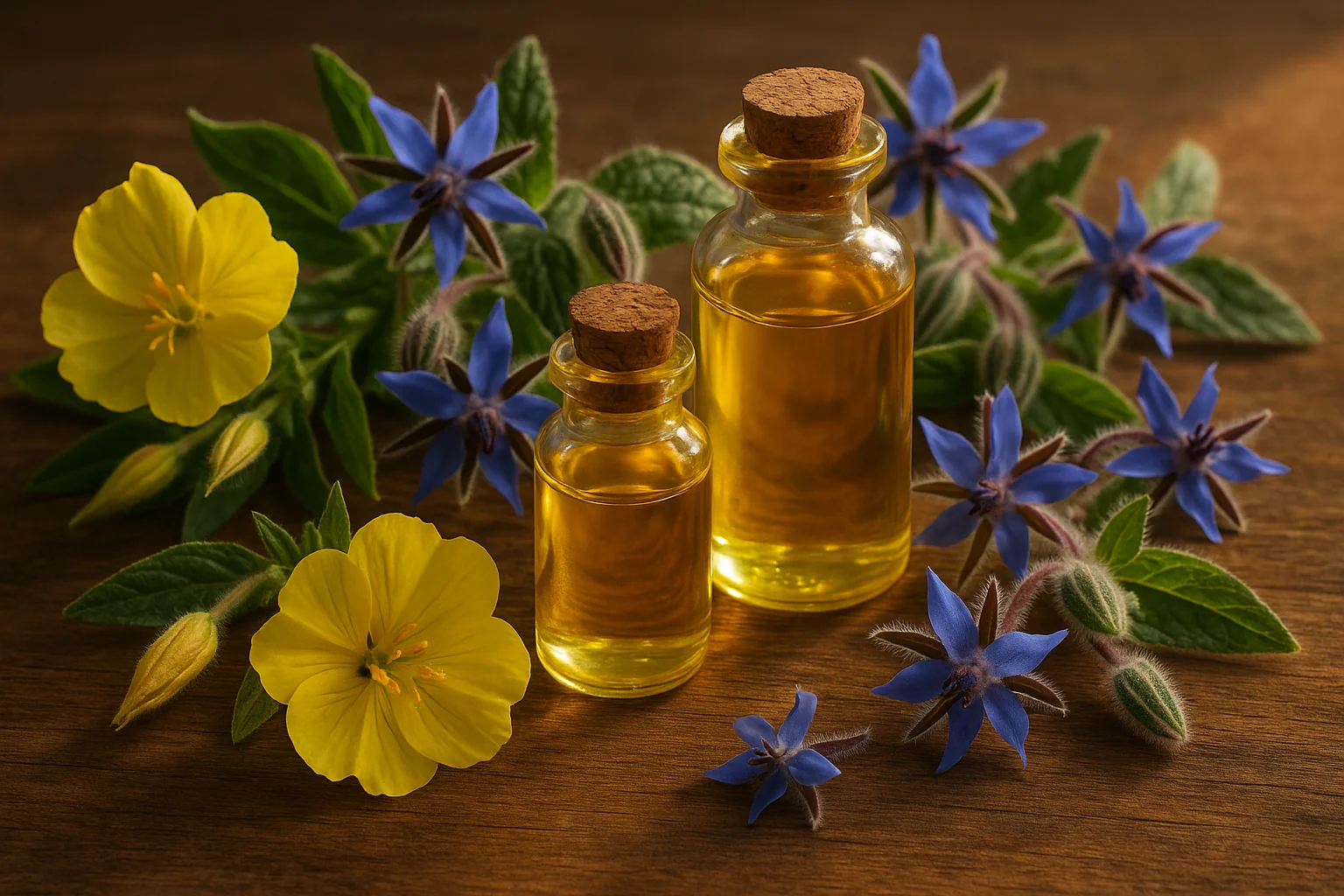

Evening primrose and borage oil (GLA) — for skin and hormones (table)
Evening primrose and borage oil: table, how much, when, and how. Guide from u Bucha.
Gamma-linolenic acid (GLA) is an omega-6 that the body normally produces from linoleic acid using the enzyme delta-6-desaturase. The problem is that the activity of this enzyme decreases with age, during oxidative stress, with deficiencies in zinc and magnesium, and with a diet high in trans fats. The effect? Lower levels of GLA mean a weaker skin barrier, greater susceptibility to inflammation, and — in women — increased PMS symptoms. The European Medicines Agency (EMA) has approved evening primrose oil as a traditional herbal medicine for alleviating PMS symptoms (EMA, HMPC). This article explains dosing, the difference between evening primrose and borage, and when GLA really works.
KEY INFORMATION
• GLA (gamma-linolenic acid) from evening primrose and borage oil is a precursor of series 1 prostaglandins (PGE1) — tissue hormones with anti-inflammatory effects.
• EMA has approved evening primrose oil as a traditional herbal medicine for PMS (EMA, HMPC).
• Borage oil contains 20–26% GLA vs 8–10% GLA in evening primrose oil — it is a more concentrated source.
• Skin effects visible after 4–8 weeks; full effects after 3 months of regular supplementation.
• The standard dose of GLA from clinical studies is 240–480 mg/day (equivalent to 3–6 capsules of 1000 mg evening primrose oil).
How does GLA affect the skin and the skin barrier?
The epidermis needs unsaturated fatty acids to build ceramides — lipids that fill the spaces between skin cells (corneocytes). GLA is particularly important for the synthesis of ceramide 1 (acylceramide), which forms lamellar bodies that seal the epidermis. A deficiency of GLA leads to increased transepidermal water loss (TEWL) — the skin loses moisture, becomes dry, and is prone to irritation (PMC6049590).
Clinical study published in International Journal of Cosmetic Science (2011) showed that supplementation with evening primrose oil for 12 weeks significantly reduced TEWL and improved skin hydration in women with dry skin. The effect was dose-dependent — higher doses of GLA (360 mg/day vs 180 mg/day) yielded better results. Similar results were obtained in studies with borage oil, which acted comparably at the same GLA content.
In atopic dermatitis (AD), studies have shown a deficiency of GLA in the blood of patients, which may be associated with impaired delta-6-desaturase activity in this group. A review of 26 clinical studies on GLA in AD (Cochrane, 2013) indicated improvement in subjective symptoms (itching, dryness) in about 60% of patients, although the effects were moderate. EMA recognizes this application as traditionally used.
GLA dosing table from evening primrose and borage oil
The key is to count the dose of GLA (gamma-linolenic acid), not milliliters of oil. Oils differ in GLA concentration, so more capsules of evening primrose are needed than borage to achieve the same dose of the active ingredient. Clinical studies on PMS and skin typically used 240–480 mg GLA/day (PMC6049590).
| Purpose of use | Daily GLA dose | Evening primrose (1000 mg/caps. = ~90 mg GLA) | Borage (1000 mg/caps. = ~230 mg GLA) | Treatment time |
|---|---|---|---|---|
| Dry skin, skin barrier | 240–360 mg GLA | 3–4 capsules | 1–2 capsules | Min. 8–12 weeks. |
| PMS, breast pain (mastalgia) | 240–480 mg GLA | 3–5 capsules | 1–2 capsules | 3–6 months; throughout the cycle |
| Atopic dermatitis (support) | 360–480 mg GLA | 4–5 capsules | 2 capsules | Min. 3 months |
| Prevention / general skin support | 120–240 mg GLA | 1–2 capsules (in the evening) | 0.5–1 capsule | Cyclically: 8 weeks ON / 4 weeks OFF |
| Inflammatory conditions (rheumatoid arthritis) | 360–480 mg GLA | 4–5 capsules | 2 capsules | Min. 6 months; medical consultation |
Price update: May 4, 2026
When to take evening primrose or borage oil? Capsules with oil are better absorbed with a meal containing fats. Most clinical protocols have used administration with main meals — splitting the dose into 2 portions (morning and evening) at higher therapeutic doses. These oils are sensitive to oxidation: store capsules in a cool, dark place and pay attention to the expiration date — oxidized oil loses value and can be pro-oxidative.
GLA and hormones — how evening primrose affects the cycle and PMS
GLA is a precursor to DGLA (dihomo-gamma-linolenic acid), from which series 1 prostaglandins (PGE1) are formed. These are tissue hormones that act anti-inflammatory and — importantly for PMS — modulate tissue sensitivity to prolactin. Elevated prolactin or increased sensitivity of breast tissues to prolactin is associated with cyclical mastalgia (breast pain in the second phase of the cycle) and other PMS symptoms (PMC6049590).
The Cochrane meta-analysis of studies on evening primrose oil in PMS (2002) rated the evidence as "limited but promising" — particularly in reducing cyclical mastalgia. Two of the four analyzed studies showed a statistically significant reduction in breast pain with GLA supplementation over 3–6 months. Effects on other PMS symptoms (mood swings, bloating) were less consistent.
A practical tip for women using GLA for PMS: full effects require a minimum of 2–3 cycles of regular supplementation. Some protocols recommend taking GLA throughout the cycle (not just in the second half), as the saturation of cell membranes with DGLA requires continuous supplementation, not just "on demand" in the luteal phase.
GLA and rheumatoid arthritis — omega-6 anti-inflammatory mechanism
Omega-6 is usually considered "pro-inflammatory" in contrast to "anti-inflammatory" omega-3. This is an oversimplification that does not capture the complexity of lipid metabolism. GLA is an exception in the omega-6 family — its derivative DGLA is a precursor to series 1 prostaglandins (PGE1) and lipoxins, which act anti-inflammatorily, not pro-inflammatorily. This explains why GLA may support the treatment of inflammatory conditions, despite being part of omega-6.
In rheumatoid arthritis (RA), a clinical study conducted by Zurier et al. (1996) on 56 patients showed that supplementation with borage oil (1.4 g GLA/day) for 6 months reduced the number of painful and swollen joints, disease activity (DAS), and the need for NSAIDs (PubMed, 1996). The doses used in RA were higher than for PMS or skin — 1–2 g GLA/day (equivalent to 4–9 capsules of borage oil). This indication shows where GLA exhibits clinically significant activity, but requires longer use and higher doses.
What mechanism underlies this activity? DGLA (a derivative of GLA) competes with arachidonic acid (AA) for the same enzymes (COX, LOX). When DGLA levels are high, less AA is converted into series 2 prostaglandins and leukotrienes — the main mediators of inflammation in the joints. This "redirecting" of the inflammatory pathway is biochemically elegant and logically explains why borage oil may reduce joint inflammation with regular supplementation.
Quality of evening primrose and borage oil — what to check when buying a supplement
GLA is a fatty acid highly susceptible to oxidation. Contact with oxygen, heat, and light initiates a free radical cascade that degrades GLA and creates lipid aldehydes — substances that, instead of protecting, can be pro-oxidative. For this reason, the quality and storage of GLA supplements directly affect their effectiveness and safety.
What should you pay attention to when choosing a GLA supplement? First, the form of packaging: gelatin capsules with a softgel coating are better than powder or liquid in a bottle — the coating isolates the oil from oxygen. Second, the presence of a natural antioxidant: a good supplement contains vitamin E (tocopherol) or rosemary extract, which stabilizes the oil during storage. Third, the stated GLA content in mg per capsule — this is the number to compare between products, not the weight of the "oil". Many supplements state the weight of the oil, hiding the actual GLA content at just 80–90 mg per 1000 mg capsule.
Certificates and tests: it is worth looking for an IFOS (International Fish Oil Standards) certificate or a similar one for plant oils, confirming low TBA values (oxidation index — thiobarbituric acid) and the absence of heavy metal contamination. Oils from evening primrose and borage grown in organic conditions are less prone to pesticide contamination — it is worth checking the source of the raw material.
Frequently Asked Questions
How much evening primrose or borage oil should I take daily?
The standard clinical dose is 240–480 mg GLA/day. Evening primrose oil contains 8–10% GLA — you need 3–6 capsules of 1000 mg daily. Borage oil contains 20–26% GLA — 1–2 capsules of 1000 mg are sufficient. Always calculate based on GLA content, not just milliliters of oil (PMC6049590).
How long should I take evening primrose oil to see effects on the skin?
The first effects (reduction of dryness, less itching) appear after 4–8 weeks. Full effects on the structure of the skin barrier are visible after 3 months. GLA needs time to saturate the cell membranes of keratinocytes DGLA — this is a biological process, not an immediate effect like a moisturizer.
Does evening primrose oil help with PMS and breast pain?
Yes, especially for cyclical mastalgia (breast pain in the second half of the cycle). EMA has approved evening primrose oil as a traditional herbal medicine for PMS. Two randomized clinical trials showed a reduction in breast pain after 3–6 months of supplementation. Effects on other PMS symptoms (mood, bloating) are less consistent in studies.
What is the difference between evening primrose oil and borage oil?
Both provide GLA, but in different concentrations: evening primrose 8–10% GLA, borage 20–26% GLA. Borage is a more concentrated and economical source of GLA — fewer capsules for the same dose. Evening primrose has a longer history of use in Europe and more clinical studies. Effectiveness at the appropriate GLA dose is comparable.
Does GLA from evening primrose or borage oil affect hormones?
GLA is a precursor to DGLA, from which PGE1 prostaglandins are formed — tissue hormones modulating tissue sensitivity to prolactin. This mechanism documents GLA's impact on cyclical mastalgia and PMS. However, GLA is not a "hormone regulator" in the sense of directly affecting estrogen or progesterone levels — it works through tissue prostaglandins. Evening primrose and borage do not cause any changes in hormone concentrations in blood tests — their hormonal effect is solely indirect and tissue-based, distinguishing them from phytoestrogens, black cohosh preparations, or Vitex agnus-castus. This is an important difference for women seeking hormonal support without direct modulation of the HPG axis (hypothalamus-pituitary-gonads).
This article is for informational and educational purposes and does not replace consultation with a doctor. If you are pregnant, breastfeeding, taking medications, or have chronic conditions, consult the use of supplements or herbs with a specialist.
Author: Michał Waluk · Published: 2026-05-04 · Updated: 2026-05-04