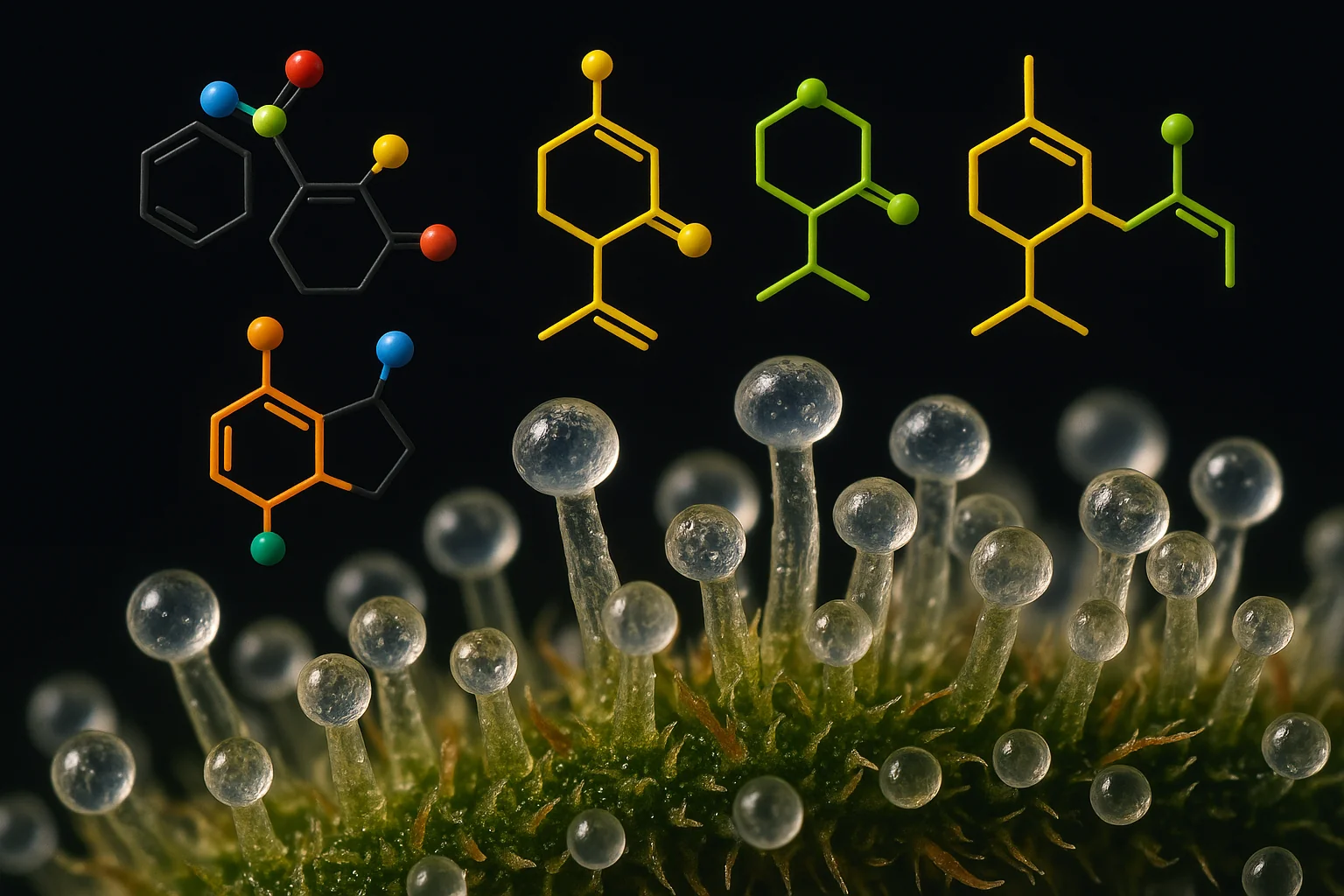

Why do some strains stimulate while others calm - chemovar, not indica/sativa
Why do some strains stimulate while others calm — what it is, how it works, and what to watch out for. u Bucha.
A seller in a CBD shop says: "this one is sativa - it gives energy, and that one is indica - it calms down." Sounds familiar, right? The problem is that this classification is a botanical myth transferred into marketing. Genetic studies published in the last decade consistently show that leaf morphology and the geographical origin of the strain do not correlate with its effect profile. What makes one strain stimulating and another sedating is chemistry - a specific set of terpenes and cannabinoids. In this article, we explain what a chemovar is and why the terpene profile says more about the effects of the strain than any botanical description.
KEY INFORMATION
• The indica/sativa classification describes the morphology of the plant, not the effect profile - the correlation between appearance and effect is minimal (Russo and McPartland, Journal of Cannabis Therapeutics, 2003).
• Chemovar defines a strain by its chemical profile: cannabinoids + terpenes.
• Limonene and alpha-pinene are associated with stimulating effects; myrcene and linalool - with calming effects.
• The final effect depends on the entire terpene profile and the ratio of CBD to THC, not on a single compound.
The indica vs sativa myth - where does it come from and why has it survived?
The division into Cannabis indica and Cannabis sativa was introduced by Swedish botanist Carl Linnaeus in 1753, describing the plant cultivated in Europe. Then, Jean-Baptiste Lamarck described Cannabis indica as a separate species from India with a different leaf appearance in 1785. For the next two centuries, botanists debated whether it was one or two species. During this time, recreational marijuana growers adopted the terminology and gave it new, practical meanings: sativa = stimulating and energizing, indica = calming and sedating. This rule of thumb is easy to remember, but it has no basis in the plant's chemistry (Russo and McPartland, Journal of Cannabis Therapeutics, 2003).
Why has the myth persisted? Because it partially worked - but for entirely different reasons than the label suggests. Strains traditionally classified as sativa often had higher limonene and lower myrcene, while "indicas" were rich in myrcene. It was the terpenes, not morphology, that drove the difference. When breeders began to cross strains intensively in the 80s and 90s, the boundary completely blurred. Today, genetic analyses of plants sold as indica or sativa show that both categories are almost identical in terms of genome (Sawler et al., PLOS ONE, 2015).
What is a chemovar and how does it change our thinking about strains?
Chemovar is a scientific term that refers to a strain characterized by its chemical profile, rather than by appearance or geographical origin. In the context of cannabis, a chemovar is defined by three layers: the dominant cannabinoid (THC, CBD, CBG, or others), the dominant terpene (myrcene, limonene, terpinolene, etc.), and the ratios between them. Two plants may look identical but have completely different terpene profiles and effects (Russo and McPartland, Journal of Cannabis Therapeutics, 2003).
We have noticed that customers asking for a "stimulating strain" react with surprise when we explain that the key lies in the terpene limonene or alpha-pinene, not in the word sativa on the label. Changing the conversation from morphology to chemistry is a small mental revolution for many people - but it quickly becomes useful. Knowing that you are looking for a strain rich in limonene is more practical than searching for "sativa."
The chemovar classification is more complicated to remember, but much more predictable. When a lab COA report states that the flower contains 2.1% limonene and 0.8% alpha-pinene with low myrcene below 0.5%, you can predict the effect profile with much greater certainty than by reading the word "sativa" on the label. This is the foundation of modern cannabis pharmacognosy.
| Terpene | Overall effect | Receptor/mechanism | Typical concentration in flower |
|---|---|---|---|
| Myrcene | Calming, sedative | GABA modulation, "couch-lock" effect | 0,5-3% |
| Limonene | Stimulating, anxiolytic | 5-HT1A, serotonin receptor | 0,1-2% |
| Alpha-pinene | Energizing, improves focus | Inhibition of acetylcholinesterase | 0,1-0,5% |
| Beta-caryophyllene | Anti-inflammatory, non-sedating | CB2 agonist | 0,2-1,5% |
| Linalool | Calming, anti-anxiety | GABA-A modulation, adenosine | 0,1-0,5% |
| Terpinolene | Energizing, fresh | Ambiguous mechanism | 0,1-1% |
Entourage effect - why is the whole greater than the sum of its parts?
The concept of the entourage effect was introduced by Raphael Mechoulam and Shimon Ben-Shabat in 1998, describing the observation that isolated cannabinoids act differently than the same compounds in the presence of other plant constituents (Ben-Shabat et al., European Journal of Pharmacology, 1998). For example, myrcene alone is a weak sedative, but in the presence of THC, it enhances its ability to cross the blood-brain barrier, intensifying the calming effect. Limonene, on the other hand, may alleviate THC-induced paranoia by modulating serotonin activity.
For consumers of legal hemp flower (THC below 0.3%), the entourage effect operates differently than with high THC. Here, CBD is the main actor, and terpenes modulate its effects. Flower rich in myrcene with high CBD may provide a more pronounced relaxing effect. Flower with limonene and alpha-pinene at the same CBD level may act more clearly and less sedatively. These are subtle differences, but real and increasingly well-documented in scientific literature.
Important disclaimer: the entourage effect is real, but not magical. Studies on isolated terpenes used in aromatherapy show effects at doses significantly higher than those present in typical flower. The terpenes in the plant form a complex system that works holistically - there is no single "mega-cannabinoid" substance. Approach claims about specific terpenes with healthy skepticism and check if there is clinical research backing them, not just cell models.
How to practically read the terpene profile of flower?
An increasing number of producers of legal hemp flower in Poland and Europe provide full certificates of analysis (COA) that include not only THC and CBD results but also a terpene panel. A good laboratory report lists at least 5-8 main terpenes with percentage values or in mg/g. When reading such a report, look for several signals: which terpenes dominate, what is the ratio of "energizing" terpenes (limonene, alpha-pinene, terpinolene) to "calming" ones (myrcene, linalool), and whether the total terpene content is sufficiently high (above 1% of the total flower mass).
From our experience, customers who have learned to read the terpene panel quickly stop looking at "indica/sativa" labels and start asking about specific terpenes. This change significantly improves product selection accuracy. The difference between flower with 2% myrcene and flower with 1% limonene is noticeable in a way that is hard to attribute to the placebo effect.
When purchasing hemp flower in 2026, also look for producers who provide information about the analytical method (GC-MS or HPLC-MS). Gas chromatography with mass spectrometry provides the most reliable terpene profile and is the standard in professional laboratories. Producers using advanced analytics typically cultivate and process their product more carefully.
How to apply knowledge of chemovars when purchasing legal flower?
Transitioning from the "sativa/indica" label to the chemovar label requires one habit change: instead of reading the marketing name of the strain, look for the terpene panel in the COA certificate or on the product page. If the manufacturer does not provide it - which unfortunately still happens often - you can infer the profile based on the aroma. Flower with a strong citrus scent (citrus = limonene) is likely to have a different effect than flower with an earthy and musky scent (earthiness, musk = myrcene).
It's also worth experimenting systematically. If you're trying a new strain of legal cannabis, take note: when you used it, what your mood was before consumption, what effects you observed, and how long they lasted. Five such notes from different strains will quickly reveal your personal reactivity profile to specific combinations of cannabinoids and terpenes. This is more valuable than any marketing description.
Also remember that "set and setting" - mood and context - have a huge impact on the experience with cannabis flower, regardless of the chemical profile. The same flower used in the morning with coffee will give different sensations than in the evening before sleep. Chemovar defines the potential of the plant, but the consumption environment shapes the actual experience. The science of chemovars provides tools for more conscious product selection - what you do with it depends on you and your body.
Frequently Asked Questions
What is a chemovar and why is it more important than indica/sativa?
A chemovar is a cannabis strain defined by its chemical profile - primarily the composition of cannabinoids and terpenes - rather than leaf morphology or geographical origin. The categories indica and sativa stem from 18th-century botanical taxonomy, not from effect profile. Genetic studies show that morphology does not correlate with cannabinoid profiles (Russo and McPartland, 2003).
Which terpenes are responsible for stimulating effects, and which for calming?
Limonene and alpha-pinene are most commonly associated with stimulating and concentration-enhancing effects. Myrcene and linalool are linked to calming and soothing effects. Beta-caryophyllene acts through the CB2 receptor, exhibiting anti-inflammatory effects without psychoactivity. The final effect depends on the proportions of all terpenes and cannabinoids together.
Does the ratio of CBD to THC affect stimulation or calming?
Yes, but it's complex. THC in small doses can have a stimulating effect by activating CB1 receptors, while in higher doses it induces sedation. CBD modulates the effect of THC - high CBD with low THC suppresses psychoactivity and promotes calmness without intoxication. Studies show 2-4 times differences in blood concentration after the same dose of THC among different individuals (Zuurman et al., British Journal of Pharmacology, 2010).
How to check the terpene profile of cannabis before purchase?
Look for products with a Certificate of Analysis (COA) that includes a terpene panel (not just THC and CBD). A good COA lists at least 5-10 main terpenes with percentage values, conducted using GC-MS or HPLC-MS methods. Manufacturers are increasingly providing this information on the product page or upon request.
Why can the same cannabis strain have different effects on different people?
The individual response depends on genetic polymorphisms of endocannabinoid receptors (CB1, CB2), the activity of the FAAH enzyme, baseline mood, and the context of consumption. Studies show 2-4 times differences in blood concentration after the same dose of THC among different individuals (Zuurman et al., British Journal of Pharmacology, 2010).
This article is for informational and educational purposes and does not replace consultation with a doctor. If you are pregnant, breastfeeding, taking medications, or have chronic conditions, consult the use of supplements or herbs with a specialist.
Author: Michał Waluk · Published: 2026-05-04 · Updated: 2026-05-04