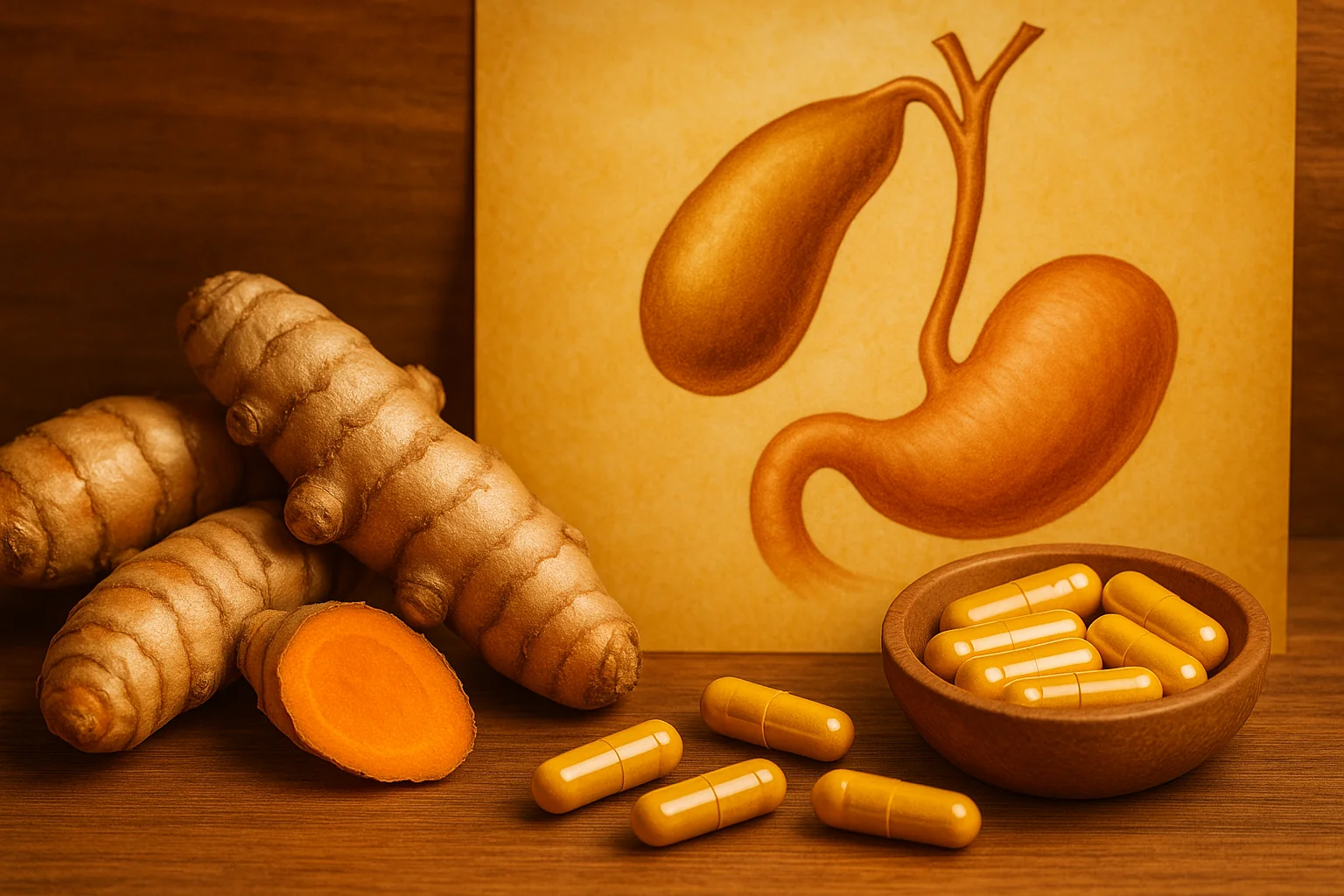

Curcumin and gallstones - when to exercise caution
Curcumin and gallstones: safety, contraindications, and interactions. u Bucha.
Curcumin - the active ingredient of turmeric - has gained popularity as a natural anti-inflammatory agent. However, one property that is rarely mentioned in the context of supplementation may pose a problem for a specific group of people: curcumin is a strong choleretic agent. Studies confirm that it induces contractions of the gallbladder and increases bile secretion (Rasyid & Lelo, Aliment Pharmacol Ther, 1999). For individuals with gallstones, this is a potentially dangerous combination. This article explains who should avoid curcumin, who it is safe for, and which drug interactions require attention.
KEY INFORMATION
• Curcumin stimulates contractions of the gallbladder - in the presence of gallstones, it may trigger colic (Rasyid & Lelo, 1999).
• EFSA has established the ADI for curcumin at 3 mg/kg of body weight per day (EFSA, 2010).
• Curcumin inhibits CYP3A4 and CYP2C9 - it may raise the concentration of warfarin and increase the risk of bleeding.
• The bioavailability of standard curcumin is very low - without piperine or liposomal form, most is not absorbed.
• Individuals with gallstones, bile duct obstruction, or those taking anticoagulants should consult a doctor before supplementation.
How does curcumin affect the gallbladder?
Curcumin has documented choleretic (cholagogue) effects - it stimulates gallbladder contractility and increases bile flow to the intestine. A study by Rasyid and Lelo conducted on healthy volunteers showed that a single dose of 20-40 mg of curcumin causes significant gallbladder contractions measured by ultrasound (Rasyid & Lelo, Aliment Pharmacol Ther, 1999). The higher the dose, the stronger the contraction effect.
Under normal circumstances, this is beneficial: better bile circulation aids in fat digestion and may reduce the risk of bile stasis. The problem arises when there are stones in the gallbladder. A sudden contraction of the gallbladder may move a stone into the bile duct - a narrowed channel through which bile drains into the duodenum. A stone that blocks this duct causes biliary colic: intense, spasmodic pain in the right upper quadrant, radiating to the shoulder blade. In severe cases - jaundice and cholangitis requiring hospitalization.
Does this mean that curcumin is bad? No - it means that it has specific mechanisms of action that become a risk for some individuals. Like any biologically active ingredient.
Safety table - risk groups and recommendations for curcumin use
The table below classifies groups according to the degree of risk associated with curcumin use, explains the mechanism of danger, and provides practical recommendations. This is an informational tool - the decision to supplement is made by a doctor or pharmacist after assessing the complete health picture.
| Situation / Disease | Risk level | Mechanism | Recommendation |
|---|---|---|---|
| Gallstones (asymptomatic) | High | Gallbladder contraction may displace a stone into the bile duct → colic | Avoid supplementation without consulting a gastroenterologist |
| Symptomatic gallstone disease (previous colics) | Very high | Active gallstone disease with mobile stones - risk of acute cholecystitis or cholangitis | Absolute contraindication to curcumin supplementation |
| Narrowing or obstruction of the bile ducts | Very high | Increased bile flow in obstruction leads to intrahepatic pressure. | Absolute contraindication. |
| Post-cholecystectomy state. | Moderate | No gallbladder - bile flows continuously; curcumin may exacerbate diarrhea and digestive discomfort | Possible cautious supplementation with small doses; monitor the reaction. |
| Anticoagulants (warfarin, acenocoumarol). | High | Curcumin inhibits CYP2C9 (metabolizes warfarin) and exhibits antiplatelet activity. | Do not use without consulting the attending physician and monitoring INR. |
| Immunosuppressive drugs (cyclosporine, tacrolimus). | High | Inhibition of CYP3A4 raises the concentration of immunosuppressants - risk of toxicity | Absolute consultation with a transplant specialist or nephrologist. |
| Pregnancy. | Caution. | High doses may stimulate the uterus; no data from RCT. | Avoid supplements with curcumin; consumption of turmeric as a spice is safe. |
| Healthy adults without the above factors. | LOW | No significant risks at ADI doses (≤210 mg of curcuminoids for 70 kg). | Safe supplementation in accordance with EFSA ADI. |
Bioavailability of curcumin - why the form of the preparation matters
Standard curcumin has an exceptionally low bioavailability - below 1% when taken orally. It is rapidly metabolized in the intestine and liver before it can reach target tissues (Hewlings & Kalman, Foods, 2017). This is the main reason why many clinical studies on curcumin show no effects - participants were taking an active ingredient that was largely not absorbed.
The pharmaceutical and supplement industries have developed several strategies to improve bioavailability. Piperine - an alkaloid from black pepper - inhibits the glucuronidation of curcumin in the intestine and liver, increasing its bioavailability by up to 20 times. Phospholipid complexes (e.g., Meriva) encase curcumin in phospholipids, facilitating absorption through the cell membrane. Nanostructured and liposomal forms improve bioavailability to several dozen percent compared to standard powder.
Practical implication: if you read a study on curcumin, check what form was used. A study on standard 500 mg powder and a study on Meriva 500 mg are different biological interventions - they cannot be compared one-to-one. Before purchasing a curcumin supplement, it is worth checking whether it uses a formulation with enhanced bioavailability, rather than just a cheap powder.
We have noticed that many curcumin supplements available in Poland do not specify the form of bioavailability on the label, and price is the main selection factor. Meanwhile, a cheap supplement with standard curcumin without piperine and without a phospholipid complex may have zero biological activity at high doses - and at the same time cause a choleretic effect due to the presence of curcumin in a non-standard form. This is the worst-case scenario: no benefits with retained risk.
What does science say about the effects of curcumin on inflammation?
Curcumin blocks the transcription factor NF-κB, which regulates the expression of pro-inflammatory genes - this is a documented mechanism in vitro and in vivo. A meta-analysis of 15 randomized controlled trials published in Phytotherapy Research showed a statistically significant reduction in CRP and IL-6 levels after curcumin supplementation compared to placebo (Sahebkar et al., Phytother Res, 2016). The effects were more pronounced in studies using forms with higher bioavailability.
Data regarding joint pain in degenerative disease are moderately positive. The C-CARE study (2021, n=160) showed that standardized curcumin extract reduced WOMAC pain scale scores comparably to ibuprofen 800 mg/day with a better tolerance profile (Kuptniratsaikul et al., 2009). These are not class A evidence, but they provide a real clinical justification - especially for those who cannot tolerate NSAIDs due to stomach issues.
Safe dosing of curcumin - what does EFSA say?
In its 2010 opinion, EFSA established the acceptable daily intake (ADI) for curcumin at 3 mg/kg body weight per day (EFSA, 2010). For a person weighing 70 kg, this is 210 mg of curcuminoids per day. Typical supplements on the Polish market contain 500-1500 mg of curcuminoids in the daily dose - often above the ADI value. Exceeding this value for a short time in the absence of risk factors is likely safe, but data on long-term use of high doses is limited.
Curcumin and the liver - what do studies say about hepatotoxicity?
At normal doses, curcumin exhibits hepatoprotective effects - it protects hepatocytes from oxidative stress and reduces markers of liver inflammation. Studies on animal models and small clinical trials suggest benefits in fatty liver disease (NAFLD) at doses of 500-1000 mg of standardized extract daily (Rahmani et al., J Nutr Sci Vitaminol, 2016).
However, since 2018, documented cases of drug-induced liver injury (DILI) associated with curcumin supplementation have emerged - particularly with preparations containing black pepper (piperine) or in high bioavailability forms used in large doses for extended periods. The European Food Safety Authority (EFSA) noted that data on hepatotoxicity with chronic use of piperine supplements requires further monitoring (EFSA, 2010).
How to interpret this practically? Curcumin as a culinary spice (typically 0.1-3 g of turmeric daily, corresponding to 5-150 mg of curcuminoids) has an excellent safety profile and has been consumed for thousands of years in Asia without documented harm. The risk of hepatotoxicity applies only to high bioavailability supplements used long-term at doses many times exceeding the ADI. Individuals with liver diseases or taking medications metabolized by CYP3A4 should exercise particular caution and inform their doctor about using curcumin preparations.
Warning sign: jaundice, dark urine, or pain in the right upper quadrant during curcumin use is an indication for immediate discontinuation and a doctor's visit - these may be symptoms of DILI. This is not common, but cases described in clinical literature indicate that 'natural' supplements are not free from risk at high doses.
Frequently Asked Questions
Is curcumin dangerous with gallstones?
Yes - curcumin stimulates gallbladder contractions. In a person with stones, this can trigger biliary colic when a stone is moved into the bile duct. In symptomatic gallstones, curcumin supplementation is absolutely contraindicated. In asymptomatic stones, a gastroenterologist consultation is required (Rasyid & Lelo, 1999).
Can curcumin be taken after gallbladder removal?
Generally yes, but with caution. After cholecystectomy, there is no longer a gallbladder that can contract, but curcumin still increases bile flow from the liver to the intestine. In some individuals, this causes diarrhea or digestive discomfort - especially at higher doses. Start with small doses and monitor your reaction.
What dose of curcumin is safe?
EFSA has established the ADI at 3 mg/kg body weight/day - for a 70 kg person, this is 210 mg of curcuminoids. Many supplements contain 500-1500 mg in the daily dose, exceeding the ADI. Short-term exceedance in healthy individuals without risk factors is likely safe, but long-term use of high doses requires medical supervision (EFSA, 2010).
Does curcumin interact with medications?
Yes - curcumin inhibits CYP3A4 and CYP2C9, which can raise the levels of warfarin, tacrolimus, and some statins. It also exhibits antiplatelet effects - when combined with aspirin or clopidogrel, it increases the risk of bleeding. Always inform your doctor about using curcumin, especially when on polytherapy.
Is curcumin effective for inflammation according to research?
The data is promising for forms with high bioavailability (with piperine, liposomal form, phospholipid complex). A meta-analysis showed a significant reduction in CRP and IL-6 (Sahebkar et al., 2016). Standard curcumin powder without improved bioavailability is absorbed at less than 1% - its biological effect is minimal.
This article is for informational and educational purposes and does not replace consultation with a doctor. If you are pregnant, breastfeeding, taking medications, or have chronic conditions, consult the use of supplements or herbs with a specialist.
Author: Michał Waluk · Published: 2026-05-04 · Updated: 2026-05-04