
Aronia and elderberry for immunity: which to choose (comparison)
Aronia or elderberry for immunity? A comparison of composition, mechanisms, and strength of evidence, with numbers sourced from the literature and a correction of a popular unit error.
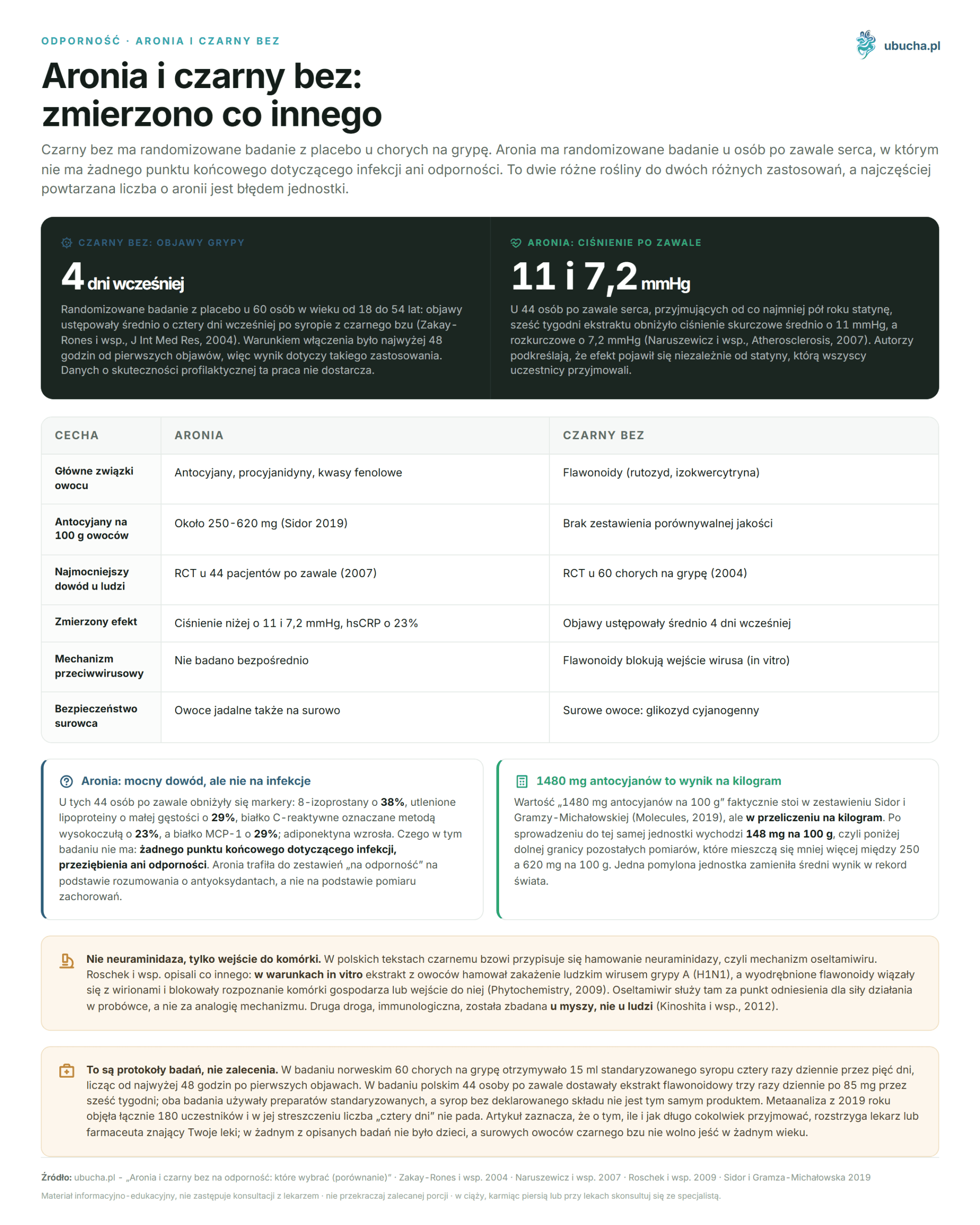
Aronia and elderberry appear in the same "for immunity" compilations, have similar colors, and a similar reputation. However, the similarity ends at appearance. Elderberry has a randomized placebo-controlled study behind it, in which flu symptoms resolved on average four days earlier (Zakay-Rones i wsp., The Journal of International Medical Research, 2004). Aronia has something different: a study on patients after a heart attack, in which six weeks of supplementation lowered blood pressure and inflammatory markers. These are two different plants for two different uses, and a significant portion of what is written about them is based on a repeated unit error. Below you will find what exactly was measured with each of these plants, what protocols were used in clinical studies, and at what point in the season each of them makes sense.
KEY INFORMATION
• In a randomized placebo-controlled study, flu symptoms resolved on average 4 days earlier after elderberry syrup (Zakay-Rones et al., J Int Med Res, 2004).
• Aronia contains from about 250 to over 600 mg of anthocyanins per 100 g of fresh fruit, not 1480: that number refers to a kilogram.
• Aronia extract lowered blood pressure by 11 and 7.2 mmHg in patients after a heart attack (Naruszewicz et al., Atherosclerosis, 2007).
• Raw elderberry fruits contain cyanogenic glycoside and are not suitable for consumption.
What do aronia and elderberry really contain?
Both plants provide anthocyanins, but aronia is among the richest known sources of polyphenols overall. A review of the composition of aronia fruits gathered results from several independent analyses and showed how widely they diverge: the total anthocyanin content ranged from about 250 to over 600 mg per 100 g of fresh fruit, depending on the variety, harvest time, and processing (Sidor and Gramza-Michałowska, Molecules, 2019). Freezing increased the reading, while blanching nearly halved it.
In addition to anthocyanins, aronia carries procyanidins and phenolic acids, including chlorogenic and neochlorogenic acids. It is this group of compounds, rather than the pigments themselves, that is behind the research results on the endothelium and blood pressure, which we will return to below.
By the way, we clarify the number that almost every Polish text about aronia repeats. "1480 mg of anthocyanins per 100 g" is not an inflated or fabricated measurement: such a value actually appears in the compilation by Sidor and Gramza-Michałowska, only in conversion na kilogram. When converted to the same unit, it comes out to 148 mg per 100 g, which is below the lower limit of other measurements. One mistaken unit turned an average result into a world record, and it has been circulating on the internet for years.
Elderberry has a different profile. Its fruits contain flavonoids, mainly rutin and isoquercitrin, as well as sambunigrin, a cyanogenic glycoside responsible for the toxicity of the raw material. These two groups of compounds can easily be confused in commercial descriptions, and the difference is crucial: antiviral activity has been demonstrated for flavonoids, while sambunigrin is the reason why the fruits should not be eaten raw.
Aronia and elderberry: what can be compared?
One can compare the profile of ingredients, the strength of evidence, and the situations in which each plant makes sense. It is not possible to reliably compare "antioxidant strength," as popular indicators like ORAC measure reactions in a test tube and do not directly translate to effects in humans. The table below adheres to what has been measured.
| Feature | Aronia | Elderberry |
|---|---|---|
| Main compounds of the fruit | Antocyjany, procyjanidyny, kwasy fenolowe | Flawonoidy (rutozyd, izokwercytryna), antocyjany |
| Anthocyanins per 100 g of fresh fruit | Approximately 250-620 mg (Sidor 2019) | No aggregate comparison of comparable quality |
| Strongest evidence in humans | RCT in 44 patients after a heart attack (Naruszewicz 2007) | RCT in 60 patients with influenza (Zakay-Rones 2004) |
| Measured effect | Blood pressure down by 11 and 7.2 mmHg, hsCRP down by 23% | Symptoms resolved on average 4 days earlier |
| Mechanizm przeciwwirusowy | Not studied directly | Flavonoids bind the virion and block entry into the cell (in vitro) |
| Typowe formy | Juice, dried fruits, capsules, tea | Syrup from cooked fruits, capsules, infusion from flowers |
| Safety of the raw material | Edible fruits also raw | Raw fruits contain a cyanogenic glycoside |
| A situation in which it makes sense | Regular dietary supplement, cardiovascular risk | Pierwsze objawy infekcji grypopodobnej |
What do clinical studies on elderberry show?
The strongest single result remains the Norwegian study from the 1999/2000 season. Zakay-Rones and colleagues included 60 individuals aged 18 to 54, whose flu-like symptoms lasted no longer than 48 hours. Participants received 15 ml of elderberry syrup or placebo, four times a day for five days, and recorded the severity of symptoms on a visual analog scale. Symptoms resolved on average four days earlier, and patients reached for rescue medications less frequently.
A meta-analysis from 2019 gathered available randomized studies and included a total of 180 participants (Hawkins i wsp., Complementary Therapies in Medicine, 2019). The authors conclude that elderberry supplementation significantly reduces symptoms from the upper respiratory tract, with a large effect size. Note two things: the summary of this meta-analysis does not mention the number "four days," which belongs to the single study by Zakay-Rones, and 180 participants is a small sample for conclusions about an entire category of products.
The third observation concerns the timing of initiation. In the Norwegian study, the inclusion criterion was no more than 48 hours from the onset of the first symptoms, so the described effect pertains specifically to such use. This work does not provide data on preventive efficacy when taken throughout the season.
How does elderberry work against the flu virus?
The laboratory answer is: flavonoids attach to the virus and prevent it from entering the cell. Roschek and colleagues demonstrated in vitro that an extract from elderberry fruit inhibited infection by the human influenza virus A (H1N1), and the isolated flavonoids directly bound to the virions, blocking recognition by the host cell or entry into it (Roschek i wsp., Phytochemistry, 2009).
It is worth clarifying a common simplification here. In Polish texts, elderberry is attributed with inhibiting neuraminidase, which is the mechanism of oseltamivir. Roschek's work describes something different: blocking the virus's entry into the cell, thus an earlier stage. Oseltamivir serves as a reference point for the strength of action in vitro, not as an analogy for the mechanism.
The second pathway is immunological and has been studied in animals. Oral administration of high-molecular-weight fractions of elderberry juice to mice infected with the flu virus reduced viral replication in bronchoalveolar lavage and increased the level of specific neutralizing antibodies in serum and secretory immunoglobulin A (Kinoshita i wsp., Bioscience, Biotechnology, and Biochemistry, 2012). The fraction containing acidic polysaccharides provided the strongest defense. In cell culture, the same juice acted weakly, and the authors attribute the effect in mice to the stimulation of the immune response.
What has been studied about aronia, and what has not?
Aronia has strong evidence, but not for infections. Naruszewicz and colleagues conducted a double-blind placebo-controlled study with 44 individuals after a heart attack, who had been taking a statin for at least six months (Naruszewicz i wsp., Atherosclerosis, 2007). Participants received flavonoid extract from aronia fruit in three doses of 85 mg daily or a placebo for six weeks.
The results after six weeks were clear. Systolic blood pressure dropped by an average of 11 mmHg, diastolic by 7.2 mmHg. The concentration of 8-isoprostanes decreased by 38%, oxidized low-density lipoproteins by 29%, high-sensitivity C-reactive protein by 23%, and MCP-1 protein by 29%. Adiponectin increased. The authors emphasize that the effect appeared independently of the statin that all participants were taking.
What is missing in this study: any endpoints related to infections, colds, or immunity. Aronia made it to the "immune support" listings based on reasoning about antioxidants, not based on measuring illness rates. This does not mean it is useless, only that its documented benefit lies elsewhere than suggested by the store shelf. A separate text discusses which ingredients have evidence in this area. supplements for autumn and immunity.
Jakie dawki stosowano w badaniach?
The following numbers describe study protocols, not recommendations for you. The difference is practical: participants were a selected group, under supervision, for a specified time, and the result pertains to that group, not every reader.
In a Norwegian study on elderberry, 60 patients with the flu received 15 ml of standardized syrup four times a day for five days, starting no more than 48 hours after the first symptoms. In a Polish study on aronia, 44 individuals after a heart attack received flavonoid extract three times a day at 85 mg for six weeks; the declared composition of the extract is about 25% anthocyanins, about 50% polymeric procyanidins, and about 9% phenolic acids.
Two notes about transferring these numbers to store products. First, both studies used standardized preparations, meaning that the content of active compounds is declared and controlled; syrup with a list of ingredients without any declaration is not the same product, even if it has the same name. Second, how much and how long to take anything is determined by a doctor or pharmacist who knows your medications, not by an article. This especially applies to those undergoing chronic treatment.
When to reach for aronia and when for elderberry?
The purpose determines the choice, not the strength. Elderberry has evidence regarding the duration of symptoms of flu-like infections that started no more than two days earlier. Aronia has evidence regarding blood pressure and inflammatory markers in individuals after a heart attack, when taken systematically for six weeks. Neither of these roles replaces the other.
With elderberry, the form matters. Raw fruits contain sambunigrin, which under enzymatic conditions releases cyanide and causes gastrointestinal discomfort. Safe are products made from cooked fruits and preparations from fruit extract, while the bark and leaves have a different profile and are not considered food raw material. An infusion of flowers is a separate matter with a milder effect and a different tradition of use.
Combining both plants is not contradictory, as the mechanisms do not exclude each other, but there is no study that has tested this combination. Special caution is warranted for children, as none of the studies described above included them. The situation with medications is different than it might seem: in the study on aronia, all participants were taking a statin, and the effect appeared despite this, while for other groups of medications, such verification simply does not exist. If you are looking for a summary of what makes sense in this group, refer to the text about immune supplements for children, and for recurrent respiratory infections to the review of studies on NAC in flu and respiratory infections.
Frequently Asked Questions
Which plant works better for immunity?
It depends on what you call effectiveness. Elderberry has a randomized placebo-controlled study involving 60 patients, in which flu symptoms resolved on average four days earlier (Zakay-Rones et al., 2004). Aronia does not have such a study on infections; its strongest evidence in humans concerns blood pressure and inflammatory markers after a heart attack.
Does aronia really contain 1480 mg of anthocyanins per 100 g?
No. This number comes from the compilation by Sidor and Gramza-Michałowska (Molecules, 2019), but it describes milligrams per kilogram, which means 148 mg per 100 g. Real measurements for fresh fruits range roughly between 250 and 620 mg per 100 g, depending on the variety and processing method. The unit error has been circulating in Polish texts for years.
Does elderberry inhibit neuraminidase like Tamiflu?
Not based on the study cited here. Roschek et al. (Phytochemistry, 2009) demonstrated in vitro that elderberry flavonoids bind to H1N1 virions and block recognition by or entry into host cells. Oseltamivir is mentioned there solely as a reference point for the strength of action, not as an analogy of the mechanism.
Can aronia be combined with elderberry?
Nothing suggests that they exclude each other: they act through different mechanisms, and both raw materials have long been part of the diet. However, there is no study that has tested this combination, so its superiority over a single raw material remains an assumption. For medications taken regularly, leave the decision to combine anything to your doctor or pharmacist.
Are aronia and elderberry safe for children?
Aronia fruits and juice from them are edible, but concentrated extracts and capsules have not been studied in children, so there is no basis for administering them without consulting a pediatrician. With elderberry, the rule is stricter: raw fruits contain cyanogenic glycoside and are not suitable for consumption at any age; only processed products made from cooked fruits are safe.
The article is informational and educational in nature and does not replace consultation with a doctor. If you are pregnant, breastfeeding, taking medications, or have chronic conditions, consult the use of supplements or herbs with a specialist.
Author: Michał Waluk · Opublikowano: 2026-07-08 · Aktualizacja: 2026-08-15