
Marijuana in the Czech Republic, Germany, and the EU 2026: what is allowed for tourists
Limits from the German KCanG law, Czech thresholds effective from January 1, 2026, and penalties under Article 55 for transport across the border. Regulations read from the source.
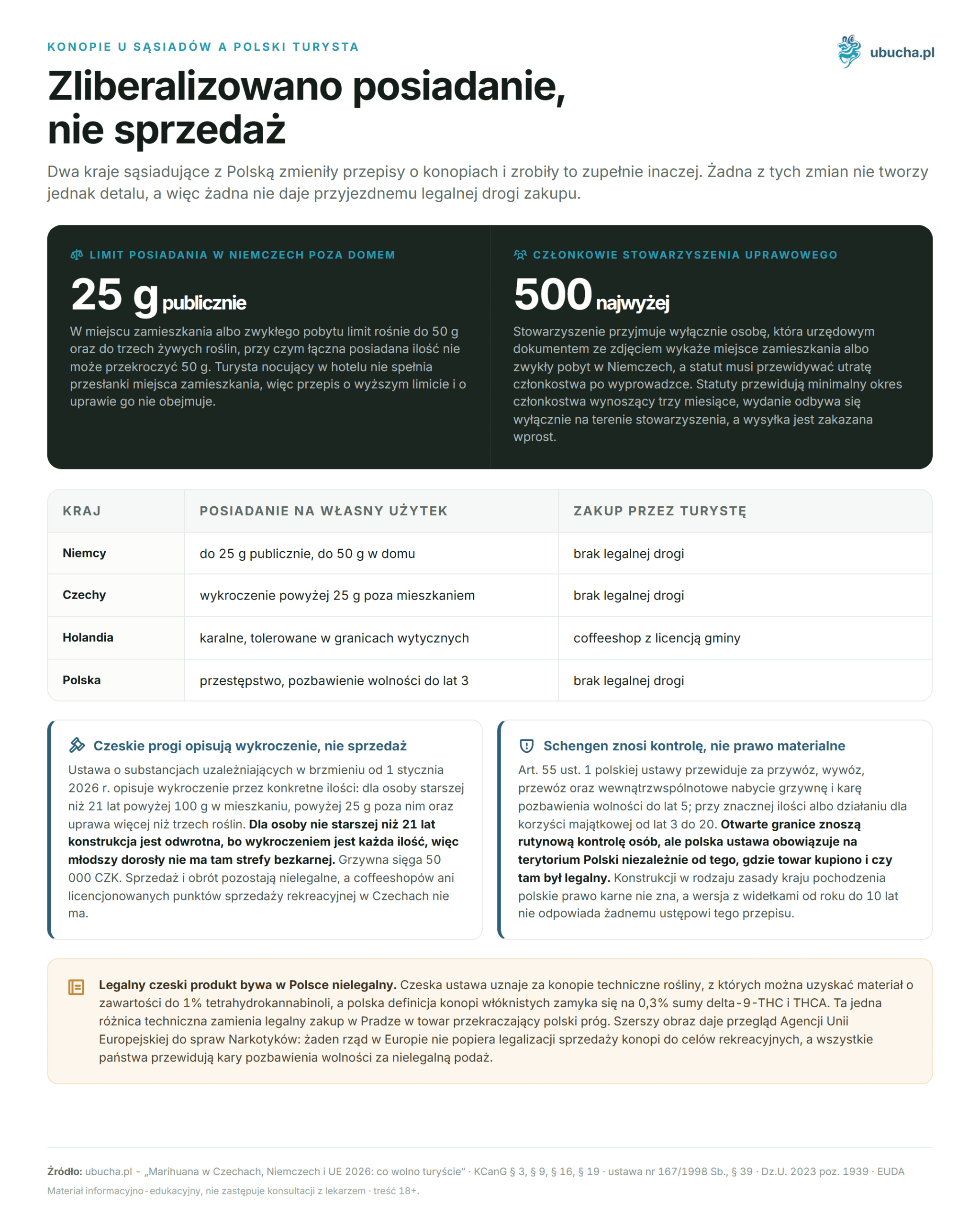
Two countries neighboring Poland have liberalized cannabis regulations, and they did so quite differently. Germany did it with a law from 2024, which introduces possession limits and a club distribution model. The Czech Republic took a different path and, starting January 1, 2026, included specific quantities and the number of plants in the addictive substances law, above which an offense begins. None of these changes operate on the Polish side of the border, and none grant tourists the right to purchase. Below you will find the wording of both laws read from official legal collections, the Polish penalty for transport, and one technical difference that can turn a legal Czech purchase into an illegal Polish product.
KEY INFORMATION
• In Germany, an adult can possess up to 25 g of cannabis in public and up to 50 g in their place of residence (KCanG, § 3).
• German cultivation clubs accept only individuals with a place of residence or usual stay in Germany, so a tourist cannot legally buy anything there.
• The Czech law from January 1, 2026, describes an offense only above 25 g outside of a residence and above 3 plants, and only for individuals over 21 years old.
• Czech industrial hemp can have up to 1% THC, while the Polish threshold is 0.3%, so a legal Czech product may be illegal in Poland.
• For transport across the border, Polish law provides for fines and imprisonment of up to 5 years.
How much marijuana can one possess in Germany in 2026?
The Konsumcannabisgesetz allows a person over 18 years old to possess up to 25 g of cannabis for personal consumption, counting the weight after drying (§ 3, section 1). In their place of residence or usual stay, the limit increases to 50 g and up to three live plants, with the total amount possessed not exceeding 50 g (§ 3, section 2).
Private cultivation has its own regulation. Paragraph 9 allows no more than three plants simultaneously and only in the place of residence or usual stay, and cannabis from such cultivation cannot be transferred to third parties. A tourist staying in a hotel does not meet the requirement of a place of residence and is therefore not covered by this regulation.
A separate layer consists of consumption bans, not possession, and here descriptions in the Polish network often diverge. Paragraph 5 prohibits smoking in schools and within their sight, in playgrounds, in facilities for children and youth, in publicly accessible sports facilities, on the premises of cultivation associations, and in pedestrian zones from 7 AM to 8 PM. The sight distance is capped at 100 meters from the entrance to the facility. There is no general prohibition in city centers nor a ban on possession itself in this regulation. We wrote more broadly about the reform itself in the post about legalizacji marihuany w Niemczech.
Can a tourist buy cannabis in a German cultivation club?
No. The cultivation association only accepts individuals who can prove their place of residence or usual stay in Germany with an official photo ID and are over 18 years old (§ 16, section 4 KCanG). The statute must additionally provide for the loss of membership when a member ceases to reside in Germany.
The rest of the structure is equally tight. The association has a maximum of 500 members, and one person can belong to only one (§ 16, section 2). The statutes of registered associations provide for a minimum membership period of three months, so the model is not suitable for a weekend trip even for a resident. The distribution of cannabis occurs only on the premises of the association, from member to member, in the simultaneous presence of both individuals (§ 19, section 2).
Distribution limits are sometimes quoted inversely to how they actually are. A member over 21 years old can receive a maximum of 25 g per day and a maximum of 50 g per calendar month. A person aged 18 to 20 has the same daily limit but only 30 g monthly, and the distributed cannabis cannot exceed 10% THC (§ 19, section 3). Shipping and delivery are expressly prohibited (§ 19, section 4), and advertising and sponsorship of cannabis and associations are prohibited by a separate regulation (§ 6). The German model thus fundamentally differs from the Spanish one, which we described in the post about cannabis social clubs w Hiszpanii.
What changed in the Czech Republic on January 1, 2026?
The Czech law on addictive substances, effective from January 1, 2026, describes an offense using specific quantities. For a person older than 21 years, an offense is storing for personal use more than 100 g in their residence and more than 25 g outside of it, as well as cultivating more than three plants (§ 39, section 2). The change was introduced by Law No. 270/2025 Sb.
For a person not older than 21 years, the structure is reversed: an offense is possessing any amount up to 200 g in their residence and up to 50 g outside of it, as well as cultivating up to five plants. A younger adult thus does not have a zone of impunity in Czech law. For an offense under this section, a fine of up to 50,000 CZK is imposed (§ 39, section 7), and the case is handled by the municipal office with extended powers.
Two things remain unchanged, and they determine the situation for tourists. Sales and trade are still illegal; there are no coffeeshops or licensed points of recreational sale in the Czech Republic, so there is simply no legal purchasing channel. The thresholds in the law pertain to material containing more than 1% substances from the group of tetrahydrocannabinols, meaning they do not cover CBD products from industrial hemp. We broke down the difference between such a model and full legalization in the post about dekryminalizacji i legalizacji marihuany.
What are the consequences of transporting marijuana across the border into Poland?
Transport is a separate crime, more severe than mere possession. Article 55, paragraph 1 of the Polish Act on Counteracting Drug Addiction provides for a fine and a prison sentence of up to 5 years for the import, export, transport, intra-community acquisition, or intra-community supply of narcotic substances. The consolidated text of the law is Dz.U. 2023 poz. 1939.
The law provides for two exceptions to this penalty. In the case of lesser severity, the offender is subject to a fine, a restriction of liberty, or imprisonment for up to one year (paragraph 2). If the act involves a significant quantity or if the act was committed for the purpose of obtaining financial or personal benefits, the penalty ranges from 3 to 20 years (paragraph 3). The version circulating in guides, stating a range from one to 10 years, does not correspond to any of these paragraphs.
We have noticed that the most common misunderstanding concerns not the sanctions, but the principle itself. Open borders in the Schengen area eliminate routine checks of individuals, but do not change substantive law: the Polish law applies on the territory of Poland regardless of where the goods were purchased and whether they were legal there. Polish criminal law does not recognize constructions like 'country of origin principle', and random checks on roads, at train stations, and airports are still conducted.
What does the map of regulations look like in other EU countries?
No government in Europe supports the legalization of cannabis sales for recreational purposes, and all countries provide for prison sentences for illegal supply. This is how the situation is described in a review by the European Monitoring Centre for Drugs and Drug Addiction (EUDA, Cannabis policy). Neither the German club model nor the Czech quantity thresholds create retail trade, so they fall within this description.
The Netherlands is an exception, but different from what popular belief suggests. Sales and possession remain punishable by imprisonment; coffeeshops operate on a tolerance basis, have a municipal license, and must meet the criteria outlined in the prosecutor's guidelines. About two-thirds of municipalities do not allow them at all, and the production supplying these establishments is not tolerated at all, which the Dutch refer to as the backdoor problem. We have detailed the entry rules in our post about how a coffeeshop operates in the Netherlands. how a coffeeshop works in the Netherlands.
| Country | Possession for personal use | Purchase by a tourist | Basis read at the source |
|---|---|---|---|
| Germany | Up to 25 g publicly, up to 50 g and 3 plants at the place of residence | Brak legalnej drogi | KCanG, § 3, § 9, § 16, § 19 |
| Czech Republic | Offense above 25 g outside the residence and above 3 plants, for individuals older than 21 years | Brak legalnej drogi | Ustawa nr 167/1998 Sb., § 39 |
| Netherlands | Karalne, w praktyce tolerowane w granicach wytycznych prokuratury | Coffeeshop with a municipal license | EUDA, Cannabis policy |
| Poland | Crime, prison sentence of up to 3 years | Brak legalnej drogi | Dz.U. 2023 poz. 1939, art. 62 |
Frequently Asked Questions
How much marijuana is allowed to possess in Germany?
A person over 18 years old can possess up to 25 g of cannabis in public and up to 50 g in their place of residence or usual stay, where they are also allowed to keep three live plants. The total amount possessed cannot exceed 50 g. The basis is § 3 of the Konsumcannabisgesetz.
Can a tourist register with a German cultivation club?
No. Paragraph 16, section 4 of the KCanG law requires proof of residence or usual stay in Germany with an official photo ID. The association's statute must also provide for the loss of membership upon moving out of the country, and the distribution of cannabis occurs only on the association's premises.
Is marijuana legal in the Czech Republic in 2026?
Sales remain illegal, and there are no coffeeshops there. Law No. 167/1998 Sb. as of January 1, 2026, describes an offense only above 100 g in a residence, above 25 g outside of it, and above three plants, and only for individuals over 21 years old. The fine can reach 50,000 CZK.
Is it possible to transport marijuana from the Czech Republic or Germany to Poland?
No. Article 55, section 1 of the Anti-Narcotics Act provides for fines and imprisonment of up to 5 years for transport and intra-community acquisition. For significant amounts or actions for financial gain, the penalty ranges from 3 to 20 years. The legality of purchase abroad does not matter here.
Is a CBD product purchased in the Czech Republic legal in Poland?
Not always. The Czech law recognizes as industrial hemp plants from which material with up to 1% tetrahydrocannabinols can be obtained, while the Polish definition of fiber hemp is capped at 0.3% of the total delta-9-THC and THCA. Therefore, a product legal in Prague may exceed the Polish threshold.
Do the open Schengen borders change anything in this matter?
Not in terms of law. Schengen abolishes routine border checks for individuals, but Polish law applies on the territory of Poland without exceptions and does not recognize the legality of the country of purchase. Random checks on roads, at stations, and airports are still conducted.
Hemp products that fall within the Polish threshold, with a laboratory test included, can be found in the category dried hemp.
The article is for informational and educational purposes and does not constitute legal advice. The legal status described in the article is valid as of the publication date: regulations regarding hemp may change. Before making a decision, consult a lawyer or current legal acts.
Author: Michał Waluk · Opublikowano: 2026-07-08 · Aktualizacja: 2026-08-11