
Mucuna pruriens: what studies say and why it is banned in supplements
Mucuna pruriens contains levodopa and as of April 4, 2024, it is prohibited for use in dietary supplements in Poland. What studies have shown and what the real interactions are.
Mucuna pruriens, or velvet bean, is a legume whose seeds contain levodopa, the active substance in medications used for Parkinson's disease. This is not just an ordinary adaptogen, and this is not a matter of opinion: as of April 4, 2024, mucuna is listed in Poland among plant raw materials that cannot be used in the production of dietary supplements. There is a layer of claims surrounding this plant that do not withstand scrutiny: dosing schemes without basis, cyclic protocols that have not been studied, and numbers attributed to studies that do not exist. This text explains the origin of the Polish ban and where we read it, what two studies involving patients really showed, how drug interactions work, and under what symptoms one should stop using it and contact a doctor.
KEY INFORMATION
• Mucuna pruriens (velvet bean) is listed in the register of substances and plant raw materials prohibited for use in dietary supplements, maintained by the Chief Sanitary Inspectorate.
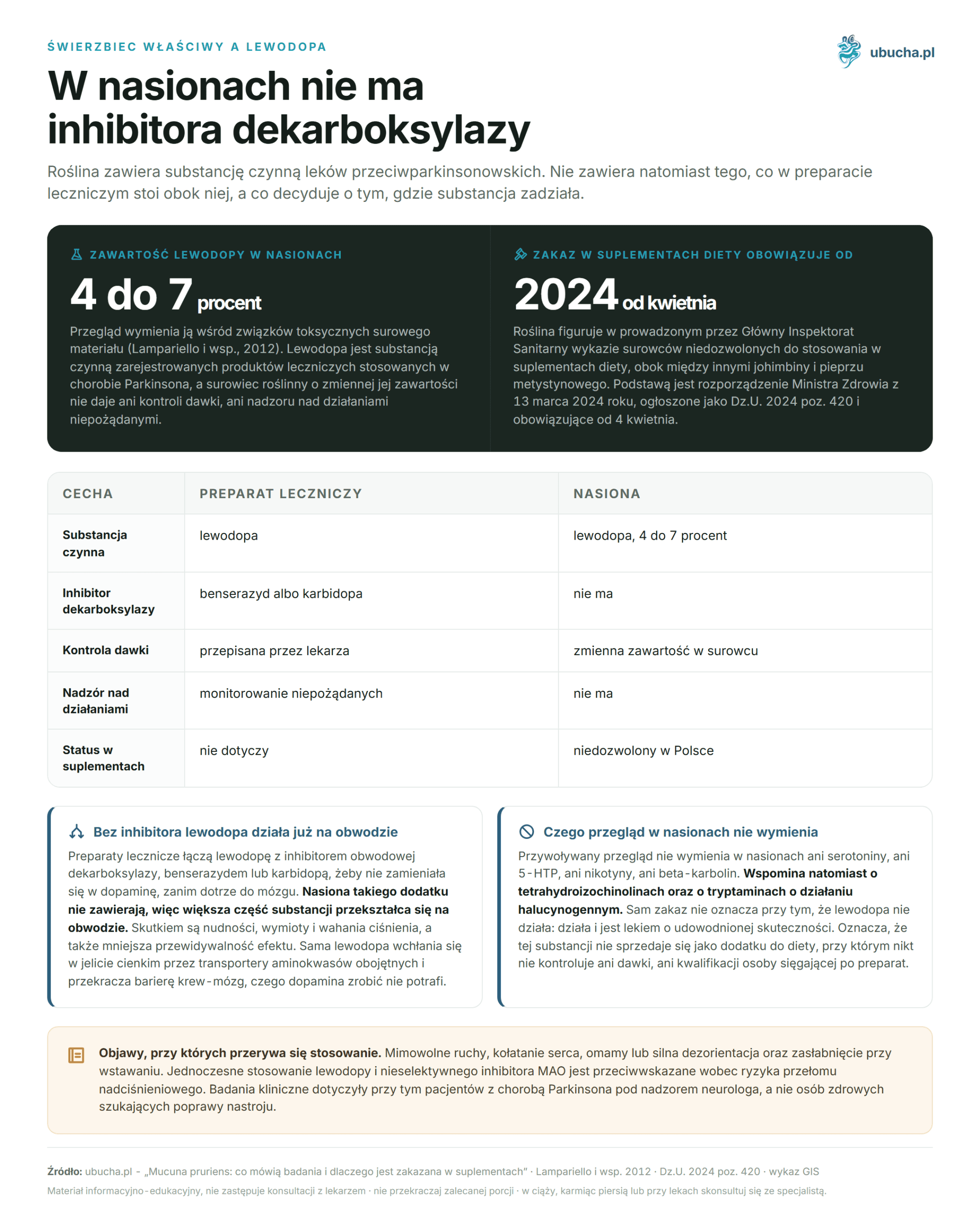
• Basis: Regulation of the Minister of Health of March 13, 2024, regarding enriching substances added to food (Journal of Laws 2024, item 420), effective from April 4, 2024.
• The seeds contain 4 to 7 percent levodopa, which is the active substance of the medicinal product, and not a compound with solely nutritional effects.
• The simultaneous use of levodopa and a non-selective MAO inhibitor is contraindicated due to the risk of hypertensive crisis.
• Alarm symptoms: involuntary movements, palpitations, hallucinations or severe disorientation, fainting upon standing. Stop using and contact a doctor.
• Clinical studies involved patients with Parkinson's disease under the supervision of a neurologist, not healthy individuals seeking mood improvement.
Is mucuna allowed to be used in dietary supplements in Poland?
No, it is not allowed. Velvet bean (Mucuna pruriens) is listed in the register maintained by the Chief Sanitary Inspectorate of substances and plant raw materials prohibited for use in dietary supplements, alongside, among others, yohimbine, methysticin, and pancreatin. The basis is the Regulation of the Minister of Health of March 13, 2024, regarding enriching substances added to food, published on March 20, 2024, as Journal of Laws 2024, item 420, and effective from April 4, 2024. We verified the status of the act as applicable in the register of the Electronic Journal of Laws.
The reason for this decision stems directly from the chemistry of the seeds. Levodopa is the active substance of registered medicinal products used in Parkinson's disease and is subject to medical supervision, dosage control, and monitoring of adverse effects. A plant raw material with variable content of this substance does not provide any of these guarantees. In a review published in Journal of Traditional and Complementary Medicine the authors report the levodopa content in the seeds at 4 to 7 percent and list it among the toxic compounds of the raw material (Lampariello i wsp., J Tradit Complement Med 2012, PMC3942911).
It is worth noting what this ban does not mean. It is not a statement that levodopa does not work, because it does, and it is a drug with proven efficacy. It is a statement that this substance is not sold as a dietary supplement, where no one controls either the dosage or the qualifications of the person reaching for the product.
How does mucuna pruriens affect dopamine?
Levopoda from the seeds is absorbed in the small intestine by neutral amino acid transporters and crosses the blood-brain barrier, which dopamine itself cannot do. In the brain, aromatic amino acid decarboxylase converts it into dopamine. This is the same mechanism on which anti-Parkinson's drugs are based, and that is why mucuna does not behave like a calming or toning herb.
A significant difference concerns what is not present in the seeds. Medicinal preparations combine levodopa with a peripheral decarboxylase inhibitor, benserazide or carbidopa, so that levodopa does not convert into dopamine before reaching the brain. The seeds do not contain such an additive, so a larger portion of the substance converts peripherally. The result is nausea, vomiting, and fluctuations in blood pressure, as well as less predictability of the effect.
There are many claims surrounding the composition of the seeds that are not supported by the cited literature. The aforementioned review does not mention serotonin, 5-HTP, nicotine, or beta-carbolines in the seeds. However, it does mention tetrahydroisoquinolines and tryptamines with hallucinogenic effects such as Mucuna. Similarly, it does not mention any effect on growth hormone or Leydig cells, which are sometimes cited to explain the alleged effect on testosterone.
What did studies on patients with Parkinson's disease show?
Two randomized, double-blind, crossover studies examined mucuna in individuals with Parkinson's disease. Both involved patients under the care of a neurologist and both studied single doses, not long-term supplementation. The results are favorable for mucuna in terms of speed of action and tolerance, but say nothing about healthy individuals.
| Study | Kto i ilu | Co podano | Outcome |
|---|---|---|---|
| Katzenschlager i wsp., J Neurol Neurosurg Psychiatry 2004 | 8 patients with Parkinson's disease and a short response to levodopa | Single doses: levodopa with carbidopa or 15 g or 30 g of the seed preparation, at weekly intervals | With 30 g, the onset of action was after 34.6 instead of 68.5 minutes; the time in the ON state was longer by 21.9 percent, or 37 minutes. No significant differences in dyskinesias and tolerance |
| Cilia i wsp., Neurology 2017 (NCT02680977) | 18 patients with advanced Parkinson's disease | Six single doses in random order, including roasted seed powder 12.5 and 17.5 mg/kg and placebo | The higher dose provided greater motor improvement after 90 and 180 minutes, longer ON state, fewer dyskinesias, and fewer adverse events than the reference drug. No differences in circulatory response |
| Shukla i wsp., Fertility and Sterility 2009 | 75 healthy fertile men as a control group and 75 men diagnosed with infertility | Treatment with the seed preparation; measurement of hormones by radioimmunoassay, catecholamines by HPLC | Increase in testosterone, LH, dopamine, adrenaline, and noradrenaline; decrease in FSH and prolactin; improvement in sperm count and motility |
Two things in this table are often misrepresented. In a 2004 study, the comparative time to onset was 68.5 minutes, not 55, and the authors stated directly that they did not find significant differences in the severity of dyskinesias. (Katzenschlager i wsp. 2004, PMC1738871). A lower severity of dyskinesias was only shown in a 2017 study with a single dose (Cilia i wsp., Neurology 2017, PMC5539737). Attributing this result to the 2004 study is a mistake.
What is known about the effect of mucuna on male fertility?
A study published in Fertility and Sterility included 75 healthy fertile men as a reference group and 75 men diagnosed with infertility. In infertile men, a reduced sperm count and motility, as well as lower levels of testosterone, luteinizing hormone, dopamine, adrenaline, and noradrenaline were observed. After treatment with the seed preparation, these values increased, while FSH and prolactin levels decreased (Shukla i wsp., Fertility and Sterility 2009, PMID 18973898).
This work is often cited under Ahmad's name and from the year 2008, with figures indicating a 37 percent increase in sperm motility and a 28 percent decrease in cortisol in men with stress-related infertility. None of these values are included in the summary of the work, nor does it contain measurements of cortisol or specify the duration of therapy. They could not be confirmed in the available summary, so presenting them as results of this study is unfounded.
It should also be noted whom the study concerned. The participants were men diagnosed with infertility, not healthy men wishing to boost testosterone. Results obtained in a group with a disorder do not automatically transfer to individuals without that disorder.
Who should avoid mucuna and when should one seek help?
Stop using it and contact a doctor if involuntary body movements, rapid or irregular heartbeat, hallucinations, or severe disorientation occur, as well as fainting or dizziness upon standing, which indicate a drop in blood pressure. Nausea and vomiting, especially on an empty stomach, are the most common symptoms of peripheral conversion of levodopa to dopamine.
The interaction with the most serious consequences concerns monoamine oxidase inhibitors, but requires differentiation. The characteristics of the medicinal product containing levodopa with benserazide indicate treatment with nieselektywnymi MAO inhibitors as a contraindication due to the risk of hypertensive crisis, and require a break of at least two weeks after such treatment. Selective MAO-B inhibitors, such as selegiline and rasagiline, and the selective MAO-A inhibitor moclobemide are not contraindicated separately, but their simultaneous use corresponds to non-selective inhibition and is unacceptable.
Two groups need to be mentioned separately. Individuals treated for Parkinson's disease should not add levodopa from another source without the neurologist's knowledge, as it adds up to the medication dose. Individuals diagnosed with psychosis or bipolar affective disorder, as well as those with such a diagnosis in their family history, should discuss the matter with a psychiatrist, as the intensity of dopaminergic transmission may worsen symptoms. This text does not provide any doses or usage schemes, as mucuna is not an allowed ingredient in dietary supplements in Poland, and levodopa as a medicinal substance requires medical supervision.
Frequently Asked Questions
Is mucuna pruriens allowed in dietary supplements in Poland?
No. Mucuna pruriens is listed in the register of substances and plant raw materials prohibited for use in dietary supplements, maintained by the Chief Sanitary Inspectorate. The basis is the regulation of the Minister of Health from March 13, 2024, Journal of Laws 2024 item 420, effective from April 4, 2024.
Does mucuna really increase dopamine levels?
The levodopa contained in the seeds crosses the blood-brain barrier and is converted into dopamine there by aromatic amino acid decarboxylase. This is a pharmacological mechanism, the same one on which Parkinson's disease medications are based. However, clinical studies assessed motor response in patients, not mood in healthy individuals.
Does mucuna work better than Parkinson's disease medication?
In two studies with a single dose in patients, mucuna acted faster and longer than the reference preparation. Neither assessed long-term use or compared effectiveness in chronic therapy. The authors of the 2004 study directly indicated that long-term evaluation is still needed.
What symptoms indicate that use should be discontinued?
Involuntary body movements, accelerated or irregular heartbeat, hallucinations or severe disorientation, and fainting upon standing. Persistent nausea and vomiting also require consultation. Each of these symptoms is an indication to stop use and contact a doctor, not to change the timing of intake.
What medications does mucuna interact with and in which direction?
With non-selective MAO inhibitors, there is a risk of hypertensive crisis, and this is a contraindication. With antipsychotic medications, it acts oppositely, so both sides lose effectiveness. In individuals treated with levodopa, it adds to the dose of the medication. Blood pressure-lowering medications may intensify drops in blood pressure.
Can mucuna be combined with ashwagandha?
We did not find any studies that would verify this combination in humans, so the answer is: it is unknown. The absence of a documented interaction is not evidence of its non-existence, but rather a lack of data. Since mucuna is not an allowed ingredient in dietary supplements in Poland, the question of combining it with anything loses its practical significance.
If you are looking for plant ingredients studied for mood and transmission, we have described separately 5-HTP jako prekursor serotoniny and ashwagandha in the context of male fertility., where the data comes from randomized studies.
The article is informational and educational in nature and does not replace consultation with a doctor. If you are pregnant, breastfeeding, taking medications, or have chronic conditions, consult the use of supplements or herbs with a specialist.
Author: Michał Waluk · Opublikowano: 2026-07-08 · Aktualizacja: 2026-08-16