
CBD for acne - effective use 2026
CBD for acne: what the Olah 2014 study really showed, which cannabinoids help, how to use hemp cosmetics, and when a dermatologist is needed.
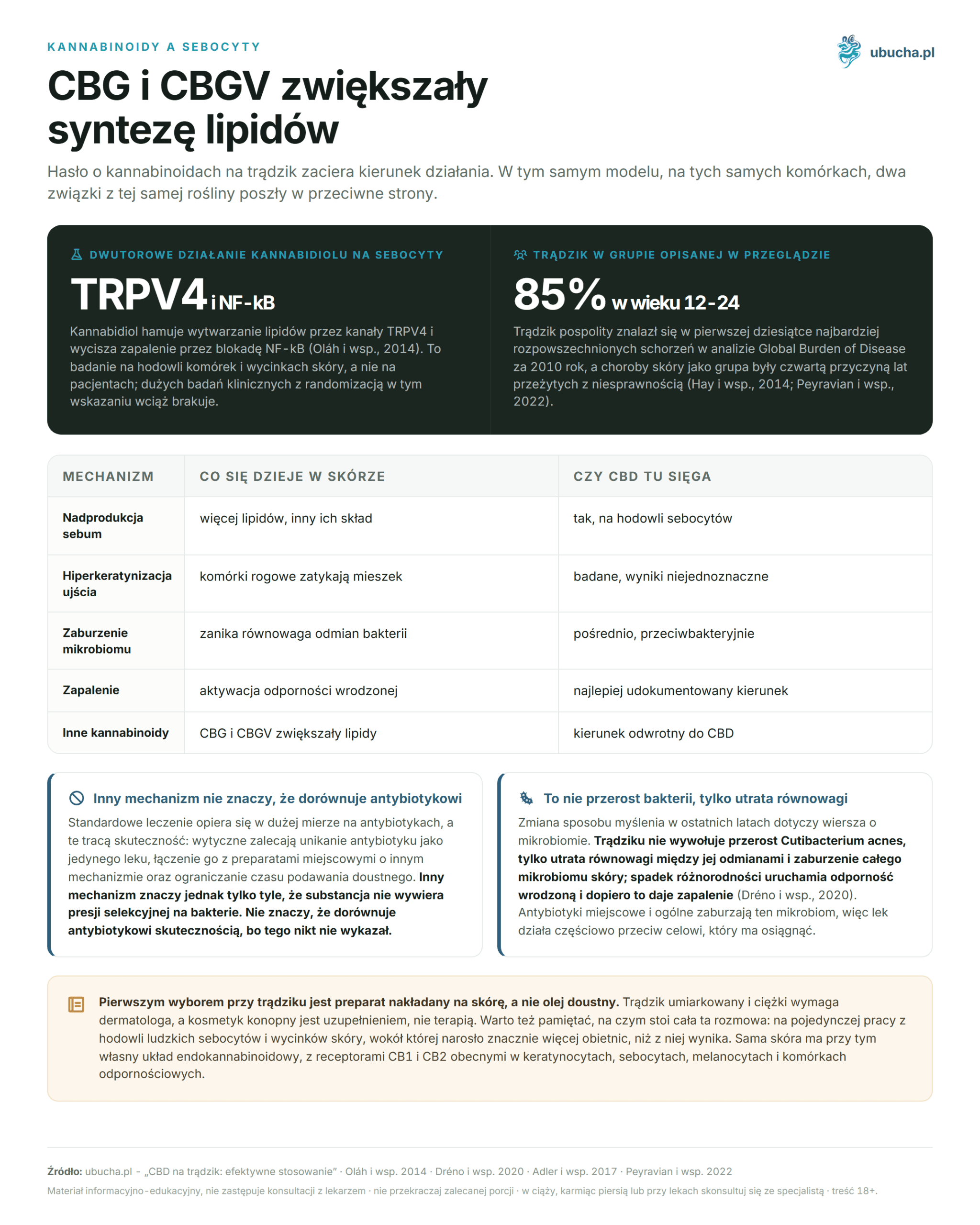
Common acne is one of the most prevalent skin diseases in the world. In the Global Burden of Disease analysis for 2010, it ranked among the top ten most widespread conditions, and skin diseases as a group were the fourth leading cause of years lived with disability (Hay i wsp., 2014). A review from 2022 states that acne affects about 85% of individuals aged 12-24 (Peyravian i wsp., 2022). Cannabidiol entered this conversation in 2014 when Oláh's team demonstrated on human sebocytes that it inhibits lipid production and reduces inflammation. A lot of promises have since emerged around this single result, which research does not confirm. This text separates one from the other: what has been specifically demonstrated, in what model, and what this means in the context of cosmetic shelves.
KEY INFORMATION
• CBD acts on sebocytes in two ways: it inhibits lipid production through TRPV4 channels and reduces inflammation by blocking NF-kB (Oláh i wsp., 2014).
• This study was conducted on cell cultures and skin samples, not on patients. There is still a lack of large randomized clinical trials.
• Not every cannabinoid works the same: CBG and CBGV in the same model increased lipid synthesis.
• The first choice for acne is a topical preparation, not an oral oil.
• Moderate and severe acne requires a dermatologist. A hemp cosmetic is a complement, not a therapy.
What is acne and why does the skin react with inflammation?
Common acne is a chronic inflammatory disease of the pilosebaceous unit, which is a combination of the hair follicle and sebaceous gland. It develops when excess sebum meets disrupted keratinization of the follicle opening, changes in the composition of skin bacteria, and an inflammatory response. These processes drive each other, which is why effective care rarely targets just one of them.
The review by Moradi Tuchayi et al. (2015) lists a broader set of mechanisms than the popular "clogged pores": disrupted sebaceous gland function along with changes in the composition of sebum fatty acids, hormonal environment dysregulation, neuropeptide interactions, hyperkeratinization of the follicle, and disturbances in both innate and acquired immunity.
| Mechanism | What happens in the skin | Does CBD reach here |
|---|---|---|
| Nadprodukcja sebum | The gland produces more lipids, their composition changes | Yes, demonstrated on sebocyte cultures |
| Hyperkeratinization of the opening | Keratinocytes clog the follicle opening, leading to the formation of a comedo | Badane, ale wyniki niejednoznaczne |
| Zaburzenie mikrobiomu | The balance between strains disappears C. acnes | Indirectly, through antibacterial action |
| Inflammation | Activation of innate immunity, papules and pustules | Tak, najlepiej udokumentowany kierunek |
The third row of this table has changed the most in recent years. Dréno et al. (2020) describe a shift in thinking: it is not the overgrowth of bacteria Cutibacterium acnes that causes acne, but the loss of balance between its strains and the disruption of the entire skin microbiome. A decrease in diversity triggers innate immunity, and only then does inflammation occur.
Why are alternatives to antibiotics being sought at all?
Because standard acne treatment largely relies on antibiotics, which are losing their effectiveness. Adler et al. (2017) summarize that the use of topical and oral antibiotics in acne is associated with the development of resistance in follicle bacteria and other bacteria, and that this has clinical consequences.
The conclusions from this review are specific. Guidelines recommend avoiding antibiotics as the sole treatment, combining them with topical preparations that have a different mechanism, and limiting the duration of oral antibiotic administration. In other words, antibiotics alone are no longer a solution that can be used for months.
The second reason was described by Dréno et al. (2020). Topical and systemic antibiotics disrupt the skin microbiome, and since it is the loss of microbiome balance that contributes to acne, the treatment partially works against the goal it aims to achieve. The authors propose a reverse direction: therapies targeting pathogenic strains while preserving commensal bacteria.
This opens up space for ingredients with a different mechanism, including cannabinoids. However, it should be immediately noted that "different mechanism" only means that the substance does not exert selective pressure on bacteria. It does not mean that it matches the effectiveness of antibiotics, as no one has demonstrated that.
How does the endocannabinoid system regulate skin function?
The skin has its own endocannabinoid system. CB1 and CB2 receptors and enzymes responsible for the breakdown of endocannabinoids are present in keratinocytes, sebocytes, melanocytes, and immune cells. This system is involved in maintaining skin balance, building the epidermal barrier, and its regeneration.
The review by Tóth et al. (2019) compiles two decades of work on this issue. The authors link the dysregulation of cannabinoid signaling in the skin with a whole list of common conditions: atopic dermatitis, psoriasis, scleroderma, acne, hair growth and pigmentation disorders, keratin diseases, and itching. This provides a biological rationale for why cannabinoids from the plant have made their way into dermatology.
It is worth separating two things, as they usually blend together in guides. The presence of a receptor in a cell only indicates that there is a place for action. It does not indicate the direction. The same receptor can enhance lipid production at low stimulation and inhibit it at high stimulation, and this has been precisely observed for anandamide in sebocytes.
Therefore, with every claim about cannabinoids on the skin, one must ask three questions: which molecule, at what concentration, and in what model. The answer "cannabis acts on the skin" is true but useless. A similar problem was described in another inflammatory skin disease in the text about CBD oil for atopic dermatitis, where the discrepancy between mechanism and clinical evidence looks almost the same.
How does CBD affect sebocytes in the Olah 2014 study?
The work of Oláh et al. from 2014 is the foundation of the entire discussion about CBD in acne. The team provided cannabidiol to cultured human sebocytes and human skin samples and described three effects at once: inhibition of lipid production, reduction of gland cell proliferation, and suppression of the inflammatory response (Oláh i wsp., 2014).
The authors examined two stimuli that enhance lipid production. The first was arachidonic acid. The second was a combination of linoleic acid with testosterone, which is closer to what happens in the skin under the influence of androgens. CBD inhibited both.
| Effect | Described mechanism of action |
|---|---|
| Less lipids | Activation of TRPV4 channels, disruption of the ERK1/2 MAPK pathway, and reduction of NRIP1 protein |
| Fewer sebocyte divisions | Also through TRPV4 |
| Weaker inflammation | Receptor adenozynowy A2a, wzrost TRIB3 i zablokowanie NF-kB |
It must be stated clearly what this work does not contain. There are no patients, no counting of lesions or acne severity scales, and there is no percentage "reduction of sebum by so much" that circulates in cosmetic descriptions. The authors conclude cautiously: the combination of three effects makes CBD a promising candidate for acne treatment. A candidate, not a drug.
What else have studies shown about cannabinoids in the skin?
After 2014, the same team checked other cannabinoids, and the results turned out to be less convenient for marketing. Not all behave like CBD, and two act in a way that is contrary to what is suggested by product descriptions "for oily skin".
W pracy Oláha i wsp. (2016) the basic synthesis of lipids in sebocytes was inhibited by CBC and THCV, while CBDV had minimal influence on it, whereas CBG and CBGV increased it.. Arachidonic acid-induced lipogenesis was reduced by CBC, CBDV, and THCV. THCV additionally inhibited cell proliferation. The authors' conclusion is clear: they see CBG and CBGV as candidates for dry skin, while indicating CBC, CBDV, and especially THCV as anti-acne agents.
Druga praca dotyczy rogowacenia. Pucci i wsp. (2013) demonstrated on keratinocytes that CBD and CBG reduce the expression of epidermal differentiation genes, including keratin 10, by enhancing DNA methylation. Both behave as transcriptional repressors. This is an interesting mechanism, but it is not evidence that CBD unclogs the follicle, and it should not be interpreted as such.
The third thread is bacteria. Appendino et al. (2008) demonstrated that five main cannabinoids, including CBD and CBG, have a strong effect on methicillin-resistant Staphylococcus aureus strains. The study did not investigate C. acnes, so transferring this result to acne remains a hypothesis.
Topical product or oral oil for acne?
For acne, the first choice is a topical preparation: cream, serum, or gel. The reason is simple. The therapy's target lies in the skin, and studies on the effects of cannabinoids on sebocytes were conducted on skin cell cultures and skin samples, not after oral administration.
Oral oil serves a different role and does not replace topical application. It may make sense where acne is clearly associated with mental stress or poor sleep, but then it works on the accompanying factor, not on the sebaceous gland. This difference is easy to overlook, as both products are referred to by the same name.
| Feature | Topical preparation | Olej doustny |
|---|---|---|
| Purpose of the action | Sebaceous gland and epidermis | The whole body |
| Evidence base for acne | Studies on sebocytes and skin samples | Lack of studies targeting acne |
| Ryzyko interakcji z lekami | Niewielkie | Realne, wymaga rozmowy z lekarzem |
| When to consider | Zawsze jako pierwszy krok | Gdy dochodzi silny komponent stresowy |
The practical order looks like this: first, a few weeks with one well-chosen topical preparation, then an assessment, and only at the end, a possible extension to an oral form. The reverse order costs time and complicates the evaluation of what actually worked.
How to use creams and serums with CBD?
The cannabis preparation fits into the routine between cleansing and moisturizing cream. Apply it to dry, washed skin in a thin layer over all affected areas, not just spot-treating individual pimples. In the morning, the routine ends with sunscreen.
Consistency yields more than intensity. The epidermis renews in a cycle measured in weeks, so an assessment after seven days lacks biological basis. A reasonable horizon is eight weeks for the first assessment and twelve for the decision to continue.
- In the morning: gentle cleansing, cannabis preparation, moisturizing cream, sunscreen.
- In the evening: makeup removal, cleansing, cannabis preparation, or an active ingredient prescribed by a doctor.
- Use retinoids, salicylic acid, and benzoyl peroxide at a different time of day than the cannabis preparation or alternately on consecutive evenings.
- Do not apply the product to wet skin, as it makes it harder to achieve a consistent dose.
- Do not introduce more than one new active ingredient at a time.
The last point can be the most challenging, as it is tempting to speed up the effect. Moradi Tuchayi et al. (2015) point out that complex schemes combining several products reduce adherence to the regimen, and it is precisely the lack of consistency that most often determines the failure of acne therapy. A simpler plan that you stick to for three months wins over an ambitious plan abandoned after three weeks.
How to choose a cannabis product for acne-prone skin?
Three things are decisive: what exactly is in the composition, at what concentration, and what else the manufacturer has added. The name "cannabis" on the packaging does not indicate any of these, as it encompasses products with completely different effects.
The first distinction concerns the raw material. Hemp seed oil does not contain cannabinoids; however, it is a good, light carrier. Extract from flower buds contains cannabinoids, and it is this that the studies on sebocytes concern. A label with just the name Cannabis sativa seed oil opisuje ten pierwszy przypadek.
The second distinction concerns concentration. A manufacturer that does not provide the extract content in percentages or milligrams per gram does not give you a basis for comparing anything. The third concerns the rest of the composition: alcohol high on the list and highly concentrated essential oils can undermine the anti-inflammatory effect you are seeking.
Badanie Ali i Akhtar (2015) tested a cream with a 3% hemp seed extract on healthy volunteers for twelve weeks. The side of the face treated with the cream had a significantly lower level of sebum and less redness after this time than the side treated with just the base. This study involved a small group of people without acne, so treat it as an indication, not as proof of effectiveness. You can find more about the differences between forms in the text about whether cannabis cosmetics really work on the skin.
What won't CBD do for acne?
A hemp-based cosmetic is not a medicine and does not replace treatment. It will not cure nodular or cystic acne, will not remove atrophic scars, will not replace isotretinoin in resistant forms, and will not solve the hormonal problem behind the relapses.
Nickles and Lio's review (2020) presents the state of knowledge fairly: available data suggest a possible benefit for acne, chronic itching, and atopic dermatitis, but existing studies are small and poorly designed, and proper randomized studies are needed to assess efficacy. The authors recommend that dermatologists be familiar with this data and discuss it with patients, rather than promoting cannabinoids as a therapy.
A realistic range of expectations is narrower than product descriptions suggest, and looks something like this: less redness around inflammatory lesions, calmer skin when used alongside irritating preparations, and a more stable feeling of moisturization. Changes are subtle and spread over weeks.
If after twelve weeks of consistent use you see none of these changes, it is not a signal to increase the dose or to purchase a second hemp product. It is a signal that the problem lies elsewhere and you need a diagnosis, not another cosmetic.
Does CBD irritate the skin and when should you stop using it?
The safety profile of cannabidiol is good. The review by Iffland and Grotenhermen (2017) confirms a favorable profile in humans, with the most commonly reported side effects being fatigue, diarrhea, and changes in appetite and body weight. All of these come from studies on oral administration, mainly in epilepsy and mental disorders.
When used on the skin, the picture is different, as absorption into the bloodstream is minimal. Peyravian et al. (2022) report that the tested preparations with hemp extracts under conditions similar to acne were safe and well tolerated. Reactions that occur more often concern the other ingredients of the formulation rather than the cannabinoid itself.
Before the first use of a new cosmetic with an active ingredient, perform a patch test on a small area, such as the inside of your elbow, and wait a day. The absence of a reaction does not rule out problems later, so for the first two weeks on your face, observe more closely than usual.
- Stop using the product if redness, itching, or burning persists for more than a week.
- Stop immediately if there is swelling or changes on the eyelids and lips.
- Consult a doctor if lesions appear that are clearly different from your usual acne.
- During pregnancy and breastfeeding, discuss any new active ingredient with your healthcare provider.
How do diet, sleep, and stress affect acne?
They do have an effect, but not as straightforwardly as the popular narrative suggests. The relationship with diet is the best documented. A cohort study by Penso et al. (2020) included 24,452 adult French individuals and showed that the consumption of fatty and sugary products was associated with a 54% higher chance of active acne.
In the same cohort, sugary drinks increased the chance by 18%, and milk by 12%. This is a cross-sectional study, so it shows correlation rather than causation. However, the magnitude is clear enough that changing dietary habits makes sense as part of a plan.
The situation with stress is more interesting, as the popular explanation turned out to be incorrect. Yosipovitch et al. (2007) studied 94 students during the pre-exam period and during the holidays. The severity of papulopustular acne correlated with stress levels, but the amount of sebum did not differ between periods of high and low stress.The authors conclude that stress worsens acne through a mechanism other than increased sebum production.
This changes the practical conclusion. Reducing tension makes sense, but not because it will "lower sebum". The same goes for mineral ingredients, which we discuss in the text about zinc for immunity and acne..
What mistakes most often ruin the treatment?
Most unsuccessful treatments do not fail due to the choice of product, but due to how it is used. Four patterns recur most often, and all can be eliminated without spending an extra penny.
| Error | Dlaczego szkodzi | What to do instead |
|---|---|---|
| Ocena po tygodniu | The epidermis has not had time to renew itself. | Set the evaluation date for the eighth week. |
| Several active ingredients at once | Irritation and lack of knowledge about what worked | Separate them into different times of day or days |
| Skipping sunscreen | Increased redness and post-inflammatory hyperpigmentation | Use sunscreen daily, even in winter |
| Kosmetyk zamiast diagnozy | Leczysz objaw przy nierozpoznanej przyczynie | Consult a dermatologist for deep changes or scars |
To this list, there is one purely informational error: transferring results from cell culture directly to your own face. The statement "studies have shown that CBD reduces sebum" is true only in relation to sebocytes in a culture dish. Between this and the predictable effect on a specific person lies a whole stage of research that no one has yet conducted.
The fifth mistake appears only after a few weeks and is the most deceptive. Skin with acne improves and worsens in waves, regardless of care. If you evaluate a product after a single good or bad week, you are measuring noise, not the effect of the cosmetic. Therefore, the evaluation period is set in advance, before you start the treatment, and it is adhered to regardless of how the skin looks along the way.
When to see a dermatologist?
Always when the changes are deep, painful, or leave marks. A hemp cosmetic has no application here as therapy, and delaying in such a situation costs scars, which are harder and more expensive to remove than treating acne itself.
Moradi Tuchayi i wsp. (2015) remind us of two things that are easy to forget when looking at the cosmetics shelf: acne often leaves scars and significantly lowers the quality of life for those affected. None of these consequences can be reversed with a cream.
- Guzki, torbiele albo zmiany bolesne przy ucisku.
- Emerging scars, depressions, or discolorations lasting for months.
- No improvement after twelve weeks of proper care.
- Sudden exacerbation in an adult after a period of stabilization.
- Suspected hormonal background, for example, with irregular periods.
- A clear impact of skin changes on well-being and functioning.
For your visit, bring a list of everything you apply to your skin and take orally, along with supplements. Photos from several moments and notes on what worsens the skin condition will also be helpful. You can usually use a hemp cosmetic alongside treatment, but inform your doctor about it, especially before exfoliating procedures.
Summary: how to safely incorporate CBD into your skincare
CBD has a reasonable biological basis in acne and a weak clinical basis. The work of Oláh et al. from 2014 showed three effects at once on human sebocytes, and the review by Nickles and Lio from 2020 adds that there is still a lack of large studies on patients. Both statements are true simultaneously and together describe the state of knowledge.
This leads to a cautious approach. A topical product as the first choice, one new ingredient at a time, evaluation after eight weeks, and decision after twelve. Oral oil only when you see a clear connection between flare-ups and mental stress.
Also remember that not every cannabinoid pulls in the same direction. CBG and CBGV in a 2016 study increased lipid synthesis in sebocytes, so a product description promising CBG for oily skin contradicts the study it usually references. Reading the composition makes very practical sense here.
And the most important thing: the cosmetic is an addition to the plan, not the plan itself. Moderate and severe acne should be addressed by a dermatologist, and the sooner a person with deep changes gets there, the fewer traces will remain.
Frequently Asked Questions
Does CBD really help with acne, or is it just marketing?
The biological basis is real. Oláh et al. (2014) demonstrated on human sebocytes that CBD inhibits lipid production, limits cell proliferation, and calms inflammation. However, this is a study on cell cultures and skin samples, not on patients, so we treat it as an indication, not as evidence of clinical efficacy.
How long do you have to wait for the effects of a CBD cosmetic?
Realistically, from eight to twelve weeks of regular use twice a day. The epidermis renews in a cycle measured in weeks, so an assessment after seven days measures nothing. The eighth week is a good time for the first evaluation, and the twelfth for a decision on continuation.
Is CBG better than CBD for oily skin?
No, available studies indicate the opposite. In the work of Oláh et al. (2016), CBG and CBGV increased baseline lipid synthesis in human sebocytes, and the authors see them as candidates for dry skin. As an anti-acne direction, they indicated CBC, CBDV, and especially THCV. Therefore, the product description promising CBG for oily skin contradicts this work.
Is hemp seed oil the same as CBD extract?
No. Hemp seed oil does not contain cannabinoids and serves as a light carrier and emollient. Extract from flower buds contains CBD, and it is this that the studies on sebocytes refer to. A label with just the name Cannabis sativa seed oil describes the first case.
Can I combine a CBD cosmetic with a retinoid or acids?
Yes, provided you space them out in time. Use retinoid, salicylic acid, or benzoyl peroxide as directed by your doctor, and the hemp preparation at a different time of day or on alternate evenings. Do not introduce two new active ingredients in the same week, as in case of irritation, you won't be able to distinguish which one caused it.
Does stress really increase sebum production?
Yosipovitch et al. (2007) did not confirm this in a study of 94 students. The severity of papular-pustular changes correlated with stress levels, but the amount of sebum did not differ between periods of high and low tension. Stress exacerbates acne through a different mechanism than increased sebum production.
Is a CBD cosmetic safe for sensitive skin?
Usually yes. Peyravian et al. (2022) report good tolerance of products with hemp extracts tested under conditions similar to acne. Reactions are more often triggered by other ingredients in the formulation, such as alcohol or highly concentrated essential oils. Before the first use, perform a 24-hour patch test on the inner elbow and monitor your skin for the first two weeks.
Can CBD replace a visit to the dermatologist?
No. Acne with nodules, cysts, or scars requires treatment that no cosmetic can provide. Moradi Tuchayi et al. (2015) remind us that acne often leaves scars and significantly reduces the quality of life for those affected. A hemp product can accompany therapy conducted by a doctor, but it does not replace it and should not delay a visit.
If you want to see what recipes with hemp extract look like, browse the available hemp cosmetics and compare the compositions according to the principles described above.
This article is for informational and educational purposes only and does not constitute medical advice. Before starting to use hemp or CBD for therapeutic purposes, consult your doctor, especially if you are taking other medications, are pregnant, or breastfeeding.
Author: Michał Waluk · Opublikowano: 2026-05-11 · Aktualizacja: 2026-08-10