
CBD tea: how to brew it, what concentration to choose, and what it helps with
CBD herb for tea – how to brew, what concentration to choose, and what it helps with? CBD dosage in a cup, duration of action, effective concentrations 5–15%. Guide 2026.
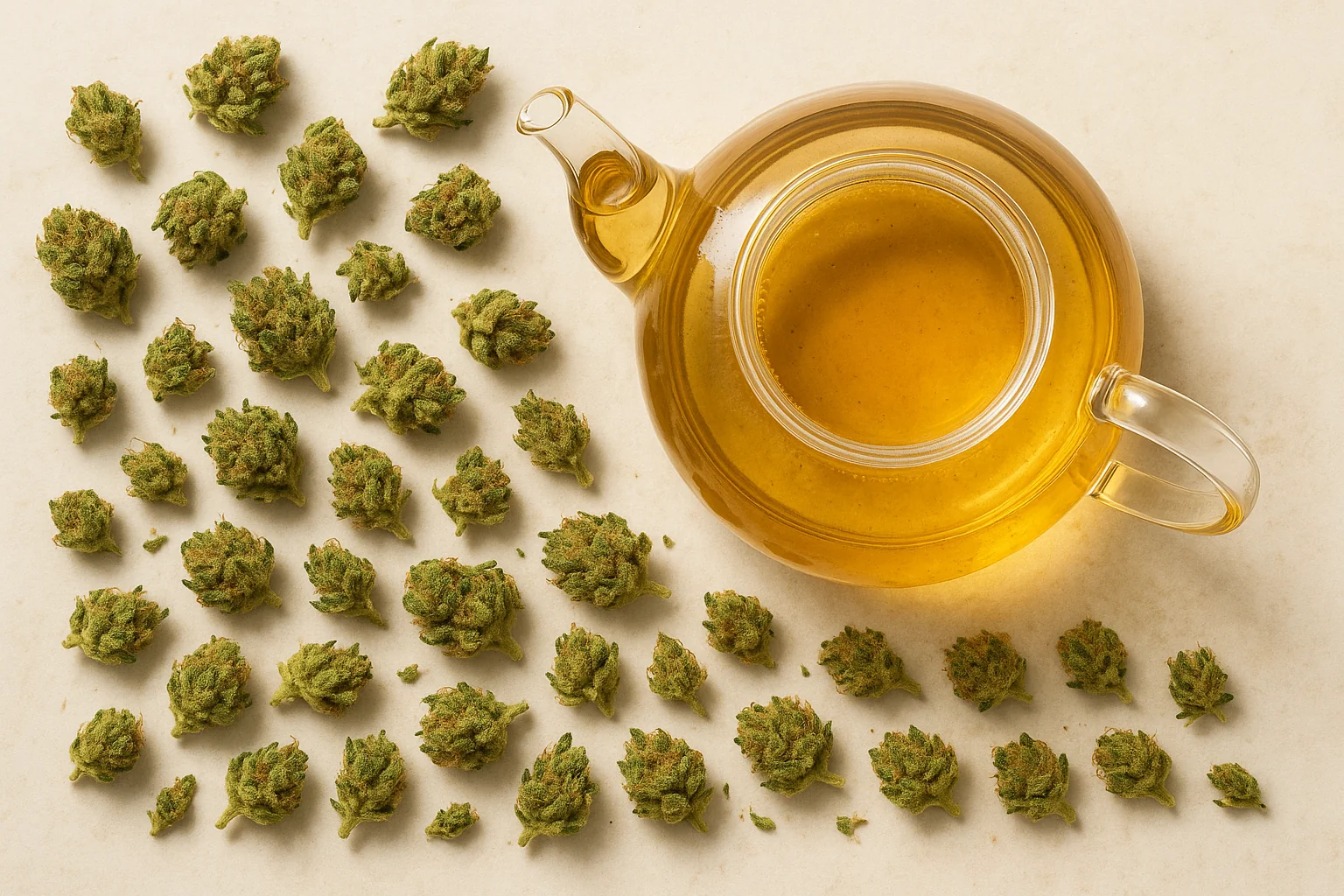
More and more Poles are reaching for CBD flower as an ingredient in their evening tea. This is not just a trend — there is logic behind this practice: a hemp infusion provides CBD along with a full spectrum of terpenes that enhance its relaxing effects. However, the effectiveness of hemp tea depends on several variables: the concentration of CBD in the flower, the amount of material used, the brewing temperature, and — most importantly — the presence of fat in the cup. This article will guide you through each of these factors and help you choose the flower that truly works.
KEY INFORMATION
• Leson et al. (Journal of Analytical Toxicology, 2001) confirmed that the extraction of CBD from an infusion without fat is only 1–3% — with fat, it increases to 10–18%.
• Effective CBD concentration in tea: 5–15 mg CBD per cup with 1–2 g of flower containing fat; onset 30–60 min, peak 90–120 min.
• For tea, flower with 5–10% CBD is sufficient at a dose of 1–2 g; concentrations of 12–18% allow for using less material.
• Shannon et al. (2019) demonstrated improved sleep in 66.7% of patients with regular CBD intake ranging from 25–175 mg/day.
How much CBD does hemp flower tea provide?
To understand how much CBD ends up in your cup, you need to grasp two stages: the extraction of CBD from the flower into the infusion and the bioavailability of CBD absorbed from the intestine. Both stages have significant losses — but proper brewing technique radically improves the outcome.
CBD extraction into the infusion: CBD is lipophilic — it dissolves poorly in water. Without fat in the cup, only 1–3% of the CBD contained in the dried material passes into the infusion. By adding a teaspoon of fat (oil, milk, butter), the extraction increases to 10–18%. Leson et al. (Journal of Analytical Toxicology, 2001) measured these values directly for cannabinoids in hemp infusions. A longer brewing time (12–15 vs. 5 min) and a higher percentage of fat in the addition (cream vs. skim milk) further improve extraction.
Intestinal bioavailability of CBD: CBD absorbed from the infusion into the bloodstream is another 6–15% of what was in the infusion. Millar et al. (Molecules, 2019) collected data from studies on CBD bioavailability and showed that oral CBD (capsules, drinks) has a bioavailability of 6–15% — clearly lower than sublingual oil (20–30%) and vaporization (30–60%). Higher oral bioavailability was achieved when administered with fat and with preparations containing CBD in nano-emulsion form.
Practical example: 1 g of CBD flower with 10% CBD contains 100 mg of CBD. Proper brewing with fat will extract about 12–15 mg of CBD into the infusion. From the infusion, approximately 1.5–3 mg of CBD will be absorbed into the bloodstream. This is a modest but sufficient dose for a relaxing effect — especially with regular daily use, as CBD accumulates in fatty tissue.
What concentration of CBD flower should you choose for tea?
The market offers CBD flowers with CBD content ranging from 3% to over 20%. Which concentration makes sense for tea and how can this be converted into practical amounts?
3–5% CBD flower: Economical, but requires larger amounts (2–3 g) to achieve 10–15 mg of CBD in the infusion. There may be an excess of plant material — a bitter taste and the need to use a large infuser. Good for someone just starting out who wants to test effects at low doses (stop brewing after 5 min for a smaller dose).
8–12% CBD flower: Optimal for tea. With 1–2 g, you provide 10–25 mg of CBD to the infusion, which with 13% extraction and 10% bioavailability translates to 1.5–4 mg of CBD in the blood — sufficient for a relaxing effect with daily use. Most reputable CBD flowers fall within this range. The price/quality ratio is usually the best.
15–20% CBD flower: It allows you to use smaller amounts (0.5–1g) for the same dose of CBD in your infusion. It's often recommended when you want a less intense hemp flavor in your tea or when you're combining CBD with other herbs and don't want the aroma to dominate. A higher concentration doesn't, in and of itself, produce a "stronger" effect—the effect depends on the total amount of CBD in the infusion, not the percentage.
Our observations: People who buy the most expensive 20% CBD "because it's stronger" and brew only 0.5g are often disappointed with the results—they deliver the same amount of CBD per infusion as 1g of 10%, but pay twice as much per gram. A better calculation: buy 8–12% and use slightly more material—the effect is identical, the cost is lower.
How to brew CBD flower for tea – a precise guide
Proper brewing maximizes the extraction of CBD and terpenes. These are a few simple rules, but each has a biochemical justification.
Water temperature: 85–90°C. No boiling water. At 100°C, linalool and myrcene — key relaxing terpenes — evaporate quickly. CBD is thermostable at higher temperatures, but terpenes are not. 88°C is a good compromise: hot enough for CBD extraction into a fat infusion, cool enough to preserve terpenes. A kitchen thermometer or temperature-controlled kettle makes precision easier.
Amount of flower: 1–2 g per 200–250 ml. Start with 1 g. If the relaxing effects are weak after a few attempts with the correct technique (temperature + fat) — increase to 1.5–2 g. Do not brew more than 3 g at once — the taste becomes overwhelmingly bitter and you do not gain proportionally more CBD.
Brewing time: 12–15 minutes covered. Covering reduces terpene loss through evaporation. A longer brewing time (over 20 min) does not significantly increase CBD extraction but concentrates the bitterness. 12 minutes is the optimum for flavor-extraction.
Fat: mandatory. A teaspoon of hemp oil, coconut oil, butter, or whole milk (2–3 tablespoons). Add the fat directly to the cup before pouring to act as an emulsifier during brewing. Cold-pressed hemp oil is the best choice — it provides its own omega acids and has a neutral flavor that does not overpower the aroma of CBD flower.
Infuser: Metal strainer-infuser or steel ball — not a paper filter. Paper absorbs fats, which reduces CBD extraction. Metal does not react with cannabinoids.
Timing and duration of effects of CBD flower tea
The effects of CBD hemp tea differ from those of oil and vaporization. Understanding the pharmacokinetic profile helps plan when to drink it.
Onset (first effects): 30–60 minutes after drinking. CBD is absorbed from the small intestine — a slower process than sublingual absorption. The first effects are usually mild relaxation, reduced tension in the shoulders, and a slight calming of thoughts.
Peak (peak effect): 90–120 minutes. This is the moment of the highest concentration of CBD in the blood. For evening tea before sleep: drink 60–90 minutes before planned sleep, so that the peak occurs when you lie down.
Duration of effects: 3–5 hours. Tea lasts longer than vaporization (1–2 h) and similar to oil (4–6 h). Evening tea should maintain effects throughout the night — or at least during the crucial first hours of sleep.
Regularity matters. Drinking CBD hemp tea at the same time every day builds both pharmacological (CBD accumulation in fat tissue) and behavioral (ritual) foundations for better sleep and lower evening tension. A comparison with other methods of using CBD can be found in the article CBD hemp tea effects how to brew.
What does CBD flower tea help with?
CBD flower tea is used in several wellness areas where CBD shows documented biological activity.
Anxiety and stress: CBD acts anxiolytically through 5-HT1A (serotonin) receptors and modulation of the HPA axis. Blessing et al. (Neurotherapeutics, 2015) analyzed 49 studies — CBD in doses of 25–75 mg reduced anxiety in experimental and clinical settings. The dose from tea (2–4 mg of effectively absorbed CBD) is at the lower end, but regular use builds a cumulative level.
Sleep: As described in the article on CBD hemp tea before sleep — regular use of CBD improved subjective sleep quality in 66.7% of participants in the study by Shannon et al. (2019). Hemp tea as an evening ritual is the optimal application for this method of delivery.
Gastrointestinal inflammation: CBD exhibits anti-inflammatory effects on intestinal epithelial cells through CB2 and TRPV1 receptors in the intestinal wall. Warm hemp tea — like any warm liquid — relaxes intestinal spasms, and CBD may further reduce local inflammation. The most described application is for irritable bowel syndrome (IBS) with a pain component. Details about CBD flower and its properties can be found in the article CBD flower what it is how to use.
CBD flower tea vs. other CBD supplements – what to choose?
CBD flower tea is one of many methods for daily CBD supplementation. How does it compare to capsules, gummies, and oil? The choice depends on the priority: speed of action, dosing precision, convenience, or sensory experience.
Hemp tea performs best in terms of ritual experience and the complexity of phytochemicals (entourage effect with terpenes). Its limitations: lowest bioavailability, variable dosage between batches, requires time and equipment. CBD capsules and gummies have consistent dosing and convenience, but lack terpenes and have similar bioavailability. Sublingual oil has higher bioavailability and faster onset.
For an evening ritual and those who want "something warm and calming before bed," CBD hemp tea is hard to replace. For morning supplementation with precise dosing, oil or capsules are a better choice. Many people combine both methods—evening tea and morning oil—and this approach yields the best daily CBD profile.
CBD flower for tea – what to pay attention to when buying?
The CBD flower market in Poland is largely unregulated, and the quality of products varies greatly. Before spending money, check a few key things.
COA (Certificate of Analysis): Every reliable supplier should have analysis results from an independent laboratory confirming the declared CBD and THC content. <0.3%, pesticide-free, and free of heavy metals. This is the bare minimum. The lack of a COA or "manufacturer" (not independent) certification is a red flag.
Strain and origin: Flower from certified European strains (Fedora, Futura, Kompolti) or Italian/Swiss crops has controlled levels of THC and CBD. A product without information about the strain or origin is questionable.
Appearance and smell: Fresh, good CBD flower has an intense herbal and floral aroma with citrus or forest notes (depending on the strain), is flexible, and does not crumble in your fingers. Flower with a hay smell and brittle texture is old or poorly stored material with degraded terpenes — resulting in weaker effects.
CBD content per gram: Convert the total mg of CBD by the package weight. 10g of herb with "15% CBD" should contain 1500 mg of CBD. If the manufacturer only provides percentages without total mg on the package, ask for a COA.
No synthetic flavors: CBD flower flavored with synthetic fragrance substances loses value as a natural product. Artificial flavors can mask the low quality of the base material. Good flower has a beautiful natural aroma — additional flavors are unnecessary.
Frequently Asked Questions
How much CBD does one cup of tea from flower provide?
With 1 g of CBD flower with 10% CBD brewed for 12 min at 88°C with a teaspoon of fat: the infusion contains about 10–18 mg of CBD. The intestinal bioavailability of CBD is 6–15%, so effectively absorbed CBD: 1.5–4 mg. Leson et al. (2001) confirmed that fat is essential for extracting CBD from the infusion. Peak concentration after 90–120 minutes, effects lasting 3–5 hours.
What concentration of CBD flower should you choose for tea?
For tea, flower with 5–10% CBD is sufficient at a dose of 1–2 g. Concentrations of 12–18% allow using less material (0.5–1 g) for the same dose of CBD — more economical for daily use, but more expensive per gram. The best price-to-effect ratio: 8–10% CBD flower with a COA from an independent laboratory.
How long does it take for CBD tea to take effect?
Onset: 30–60 minutes. Peak: 90–120 minutes. Duration: 3–5 hours. Slower onset than vaporization (a few minutes) and sublingual oil (15–30 min), but a longer and smoother effect. For sleep, drink 60–90 minutes before bedtime for optimal timing.
What does CBD flower tea help with?
Used for mild anxiety and evening stress, difficulties falling asleep, muscle tension, and inflammatory conditions of the gastrointestinal tract. Shannon et al. (2019) showed that CBD improved sleep in 66.7% and reduced anxiety in 79.2% of patients at doses of 25–175 mg/day. An infusion made from 2 g of good quality herb with fat provides a dose in the lower range studied.
Can you add CBD herb to regular tea?
Yes — the best combinations are CBD herb + lemon balm (GABAergic effect), CBD + linden (traditional calming agent), CBD + chamomile (anti-inflammatory and antispasmodic effects). Avoid combining with green tea or stimulating herbs — they negate the relaxing effects of CBD.
How to store CBD herb for tea?
In an airtight glass jar, in a dark, cool place (15–20°C). UV light and heat degrade CBD and terpenes — especially linalool, which evaporates easily. Properly stored herb retains its properties for 12–18 months. Do not store in ziplock bags — they do not protect against light or moisture. When removing from the fridge, wait a few minutes — cold herb absorbs moisture from warm air and may mold with prolonged storage.
This article is for informational and educational purposes and does not replace consultation with a doctor. If you are pregnant, breastfeeding, taking medications, or have chronic conditions, consult the use of supplements or herbs with a specialist.
Author: Michał Waluk · Published: 2026-05-04 · Updated: 2026-05-04