
CBD a ciąża i karmienie piersią: co mówi nauka i kiedy zachować ostrożność
Czy CBD jest bezpieczne w ciąży i podczas karmienia piersią? Stanowisko EFSA 2026, perfuzja ludzkiego łożyska, pomiary w mleku matki i zalecenia ACOG.
Nudności, ból pleców, bezsenność i lęk to dolegliwości, na które CBD bywa polecane w internecie, i jednocześnie dolegliwości, których w ciąży doświadcza większość kobiet. Pytanie o olejek konopny zadaje więc sobie coraz więcej ciężarnych i karmiących. Odpowiedź, którą znaleźliśmy w źródłach, nie brzmi „szkodzi” ani „jest bezpieczne”, tylko coś trzeciego i mniej wygodnego: bezpieczeństwa CBD dla tej grupy po prostu nie da się dziś ustalić, i tak brzmi stanowisko europejskiego urzędu odpowiedzialnego za żywność. Poniżej opisujemy, co dokładnie zmierzono w ludzkim łożysku i w mleku matki, czego badania nie zmierzyły wcale oraz jakie postępowanie proponują towarzystwa położnicze. Osobno odpowiadamy na pytanie o nasiona konopi, które są żywnością, a nie preparatem kannabinoidowym, i podlegają zupełnie innym przepisom.
KLUCZOWE INFORMACJE
• EFSA 2026: bezpieczeństwa CBD nie da się ustalić u kobiet w ciąży i karmiących, u osób poniżej 25 roku życia oraz u przyjmujących leki.
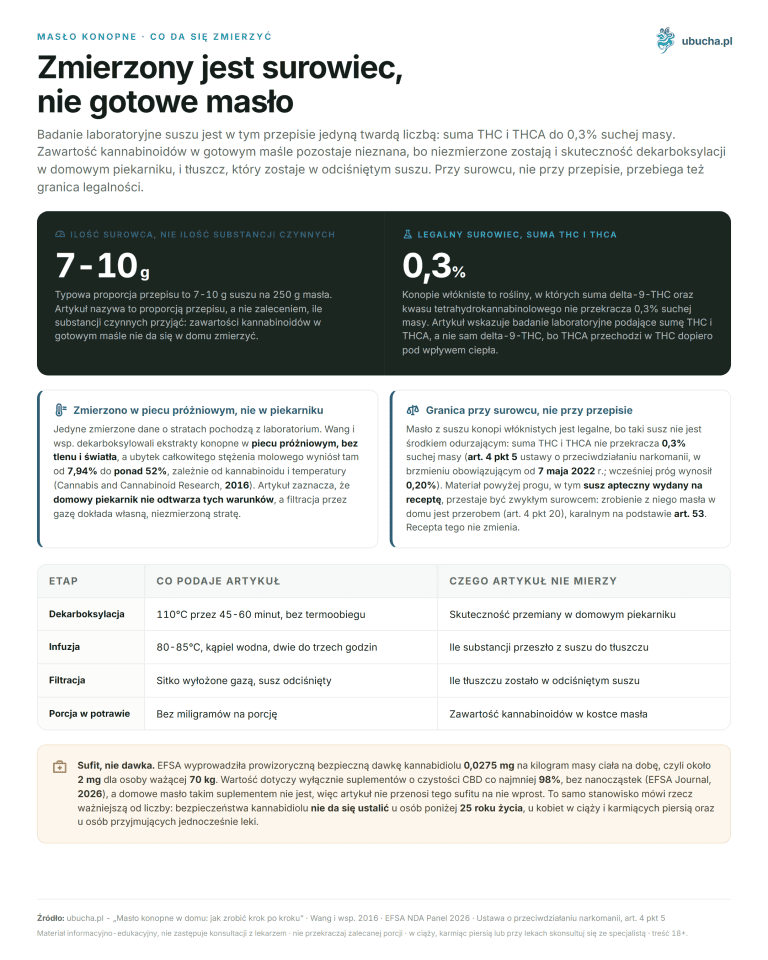
• Prowizoryczna dawka bezpieczna dla dorosłego to 0,0275 mg/kg masy ciała na dobę, czyli około 2 mg dla osoby ważącej 70 kg.
• W perfuzji ludzkiego łożyska stężenie CBD po stronie płodowej wyniosło jedną piątą matczynego (Berman i wsp., Epilepsia 2023).
• ACOG odradza konopie i ich pochodne w ciąży oraz w laktacji (Committee Opinion nr 722, 2017).
Dlaczego CBD w ciąży budzi obawy?
Powodem nie jest udowodniona szkodliwość, tylko rozmiar luki w danych. Nie ma badań klinicznych z udziałem ciężarnych, które oceniałyby CBD, bo takich badań się nie prowadzi, a zebrane dane zwierzęce i mechanistyczne wystarczają, żeby nie uznawać sprawy za zamkniętą.
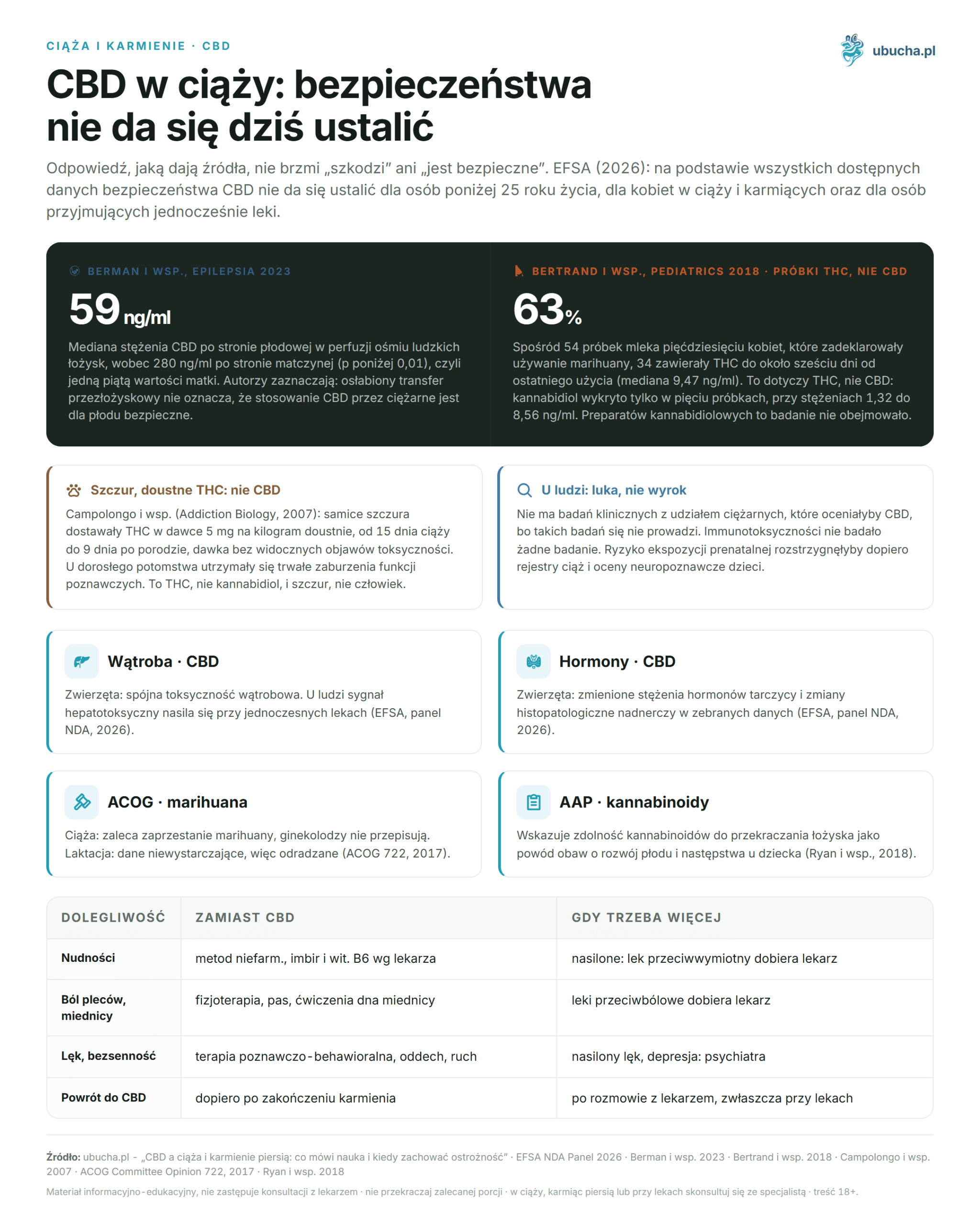
Aktualizacja stanowiska Europejskiego Urzędu do spraw Bezpieczeństwa Żywności (EFSA, panel NDA, 2026) wylicza, czego wciąż nie wiadomo. Luki wskazane w 2022 roku nie zostały zamknięte, bo nowe prace mają ograniczenia metodologiczne: protokoły niestandaryzowane, krótki czas obserwacji i jednoczesne leczenie innymi środkami. Badania na zwierzętach pokazują spójną toksyczność wątrobową, a u ludzi potencjał hepatotoksyczny ujawnia się zwłaszcza przy łączeniu CBD z lekami. Panel odnotowuje też zaburzenia hormonalne, czyli zmienione stężenia hormonów tarczycy oraz zmiany histopatologiczne nadnerczy.
Dwa zdania z tego dokumentu dotyczą wprost ciąży. Zdolność CBD do przenikania przez łożysko i kumulowania się w organizmie budzi dodatkowe obawy o bezpieczeństwo. Po ekspozycji prenatalnej obserwowano efekty neurorozwojowe, długotrwałe i zależne od płci. Osobno panel zaznacza, że immunotoksyczności nie badało żadne badanie.
Wniosek EFSA jest sformułowany wprost: na podstawie wszystkich dostępnych danych bezpieczeństwa CBD nie da się ustalić dla osób poniżej 25 roku życia, dla kobiet w ciąży i karmiących oraz dla osób przyjmujących jednocześnie leki. Prowizoryczna dawka bezpieczna, którą panel wyprowadził metodą benchmark dose ze współczynnikiem niepewności 400, wynosi 0,0275 mg na kilogram masy ciała na dobę, czyli około 2 mg dziennie dla osoby ważącej 70 kg, i dotyczy wyłącznie suplementów o czystości CBD co najmniej 98%.
Czy CBD przechodzi przez łożysko?
Tak, i zmierzono to w ludzkiej tkance. Łożysko nie jest nieprzepuszczalnym murem, tylko barierą wybiórczą, a CBD jest cząsteczką małą i silnie lipofilną, czyli dokładnie taką, jaka przez nią przechodzi.
Badanie Berman i wsp. (Epilepsia, 2023) wykorzystało perfuzję łożysk pobranych od zdrowych kobiet po cięciu cesarskim. Osiem wycinków perfundowano przez 180 minut pożywką ze stężeniem CBD odpowiadającym niskiemu stężeniu terapeutycznemu. Wynik: CBD gromadziło się w tkance łożyska w ilościach bardzo zróżnicowanych między próbkami, a stężenie po stronie płodowej wyniosło jedną piątą stężenia po stronie matczynej (mediana 59 wobec 280 ng/ml, p poniżej 0,01). Ekspresja genów łożyska nie zmieniła się istotnie.
Autorzy opisują to zjawisko obrazowo: łożysko zachowuje się jak magazyn, który spowalnia przechodzenie CBD do płodu, co w organizmie żywym może dawać stężenia płodowe niższe, ale utrzymujące się dłużej. I dodają zdanie, którego żaden sprzedawca nie zacytuje: osłabiony transfer przezłożyskowy nie oznacza, że stosowanie CBD przez ciężarne jest dla płodu bezpieczne. Ryzyko ekspozycji prenatalnej rozstrzygnęłyby dopiero rejestry ciąż i oceny neuropoznawcze dzieci.
Wcześniejsza wersja tego artykułu przypisywała opisaną wyżej perfuzję ludzkiego łożyska pracy „Bertrand i wsp. 2018”, a podany przy niej identyfikator prowadził do artykułu z chemii organicznej. Bertrand i wsp. rzeczywiście istnieją, tylko zbadali coś innego, o czym niżej.
Co mówią EFSA, ACOG i AAP o CBD w ciąży?
Trzy dokumenty odpowiadają na trzy różne pytania i warto ich nie mylić, bo dotyczą różnych substancji. EFSA ocenia sam kannabidiol jako składnik żywności. Towarzystwa położnicze i pediatryczne wypowiadają się o konopiach jako używce, w tym o wyrobach zawierających THC.
Stanowisko amerykańskiego towarzystwa położników i ginekologów (ACOG, Committee Opinion No. 722, Obstetrics and Gynecology 2017) formułuje trzy zalecenia. Kobiety w ciąży lub planujące ciążę należy zachęcać do zaprzestania używania marihuany. Ginekolodzy nie powinni przepisywać ani sugerować stosowania marihuany w celach medycznych przed poczęciem, w ciąży i w okresie laktacji. Dla okresu karmienia dane są niewystarczające, a przy braku danych stosowanie jest odradzane.
Raport kliniczny Amerykańskiej Akademii Pediatrii (Ryan i wsp., Pediatrics 2018) idzie tym samym torem, wskazując zdolność kannabinoidów do przekraczania łożyska jako powód obaw o rozwój płodu i o odległe następstwa u dziecka. Autorzy odnotowują przy tym, że media społecznościowe promują konopie na ciężkie nudności ciążowe.
Z tego zestawienia usunęliśmy dwa twierdzenia, które stały tu wcześniej. Pierwsze mówiło, że WHO uznało CBD za bezpieczne dla dorosłych przy typowych dawkach: raport WHO nie jest oceną bezpieczeństwa suplementu i został w tej roli zastąpiony przez stanowisko EFSA z 2026 roku. Drugie przypisywało polskiemu towarzystwu ginekologicznemu konkretną rekomendację o kannabinoidach, której nie udało się potwierdzić w żadnym dostępnym dokumencie.
Czy CBD przenika do mleka matki?
Pomiar istnieje, ale mówi mniej, niż powtarza się w internecie. Zbadano mleko kobiet używających marihuany, a nie kobiet przyjmujących preparaty z kannabidiolem, więc wynik odnosi się do innej sytuacji niż codzienne branie olejku.
W pracy Bertrand i wsp. (Pediatrics, 2018) pięćdziesiąt karmiących kobiet deklarujących używanie marihuany przekazało 54 próbki mleka. THC wykryto w 34 próbkach, czyli w 63%, do około sześciu dni od ostatniego zadeklarowanego użycia, przy medianie stężenia 9,47 ng/ml. Kannabidiol albo 11-hydroksy-THC wykryto natomiast tylko w pięciu próbkach, przy stężeniach CBD od 1,32 do 8,56 ng/ml. Kannabinolu nie znaleziono w żadnej próbce.
Ta różnica ma znaczenie dla czytania nagłówków. Zdanie „CBD wykrywano w mleku przez co najmniej sześć dni” jest przekręceniem: sześć dni dotyczy THC, a CBD pojawiło się w niespełna dziesiątej części próbek. Nie jest to jednak dowód bezpieczeństwa, tylko brak pomiaru w interesującym nas scenariuszu. EFSA obejmuje kobiety karmiące tym samym zdaniem co ciężarne: bezpieczeństwa dla tej grupy nie da się ustalić. Osobno o samym okresie połogu piszemy w tekście CBD a depresja poporodowa i baby blues.
Czego uczą badania na zwierzętach o kannabinoidach w ciąży?
Uczą tego, czego u ludzi zbadać się nie da, i trzeba je czytać z ostrożnością właściwą modelom zwierzęcym. Najczęściej przywoływane badanie dotyczy przy tym THC, a nie kannabidiolu, co bywa gubione po drodze.
Campolongo i wsp. (Addiction Biology, 2007) podawali samicom szczura THC w dawce 5 mg na kilogram doustnie, od 15 dnia ciąży do 9 dnia po porodzie, czyli w dawce bez widocznych objawów toksyczności. Parametry rozrodu się nie zmieniły. U dorosłego potomstwa utrzymywały się natomiast zmiany ekspresji genów kory mózgowej związanych z układem glutaminianergicznym i noradrenergicznym, obniżone zewnątrzkomórkowe stężenia obu neuroprzekaźników oraz trwałe zaburzenia funkcji poznawczych.
Poprzednia wersja tego artykułu przypisywała tej pracy zmiany gęstości receptorów CB1 w hipokampie i zaburzenie dojrzewania układu endokannabinoidowego, a jako źródło podawała Journal of Neuroscience. Praca ukazała się w Addiction Biology i takich wyników nie zawiera. Poprawiliśmy zarówno opis, jak i identyfikator.
Dla samego CBD sygnał zwierzęcy podsumowuje stanowisko EFSA: badania nad toksycznością rozrodczą wzmacniają obawy w tym punkcie, a po ekspozycji prenatalnej obserwowano efekty neurorozwojowe długotrwałe i zależne od płci. Dawki w modelach zwierzęcych bywają wyższe niż typowe dawki suplementacyjne u człowieka, więc przeniesienie wyniku wprost nie jest uprawnione. Wobec braku badań klinicznych to jednak jedyny dostępny sygnał.
Co zamiast CBD przy dolegliwościach ciążowych?
Dla każdej z dolegliwości, przy których pada pytanie o CBD, istnieje postępowanie z lepiej opisanym profilem bezpieczeństwa w ciąży. Wybór i dawkowanie należą do lekarza prowadzącego, bo ciąża zmienia farmakokinetykę i część leków dostępnych bez recepty jest w niej przeciwwskazana.
Przy nudnościach i wymiotach ciążowych postępowanie zaczyna się zwykle od metod niefarmakologicznych, a przy nasilonych objawach lekarz dobiera lek przeciwwymiotny o ustalonym profilu bezpieczeństwa. Imbir i witamina B6 bywają zalecane jako uzupełnienie, ale ich zasadność oraz dawkę ustala osoba prowadząca ciążę, nie artykuł. Więcej o samym mechanizmie przeciwwymiotnym kannabinoidów napisaliśmy w tekście Czy CBD pomaga na nudności, z zastrzeżeniem, że w ciąży ta ścieżka odpada.
Przy bólu pleców i miednicy pierwszą linią jest fizjoterapia okołoporodowa, uzupełniona pasem podtrzymującym i ćwiczeniami dna miednicy. Leki przeciwbólowe dobiera lekarz, bo dopuszczalność poszczególnych substancji zmienia się wraz z trymestrem.
Przy lęku i bezsenności skuteczna i wolna od wpływu na płód jest terapia poznawczo-behawioralna, wsparta technikami oddechowymi i ruchem dostosowanym do ciąży. Przy nasilonym lęku albo depresji prenatalnej właściwym adresem jest psychiatra, który dobierze leczenie z udokumentowanym profilem bezpieczeństwa. Zestawienie ogólnych zastrzeżeń wobec samego kannabidiolu znajdziesz w tekście Czy CBD jest bezpieczne.
Czy nasiona konopi są bezpieczne w ciąży?
Nasiona konopi to żywność, nie preparat kannabinoidowy, i pod tym względem stoją zupełnie gdzie indziej niż olejek CBD. Nie są jednak, wbrew częstemu zapewnieniu, całkowicie wolne od kannabinoidów, a wcześniejsza wersja tego tekstu twierdziła inaczej.
Rozstrzyga to prawo żywnościowe. Załącznik I sekcja 2.6 rozporządzenia Komisji (UE) 2023/915, stosowanego od 25 maja 2023 roku, ustala najwyższe dopuszczalne poziomy THC w żywności z nasion konopi: 3,0 mg/kg dla nasion oraz dla nasion zmielonych i innych produktów z nich przetworzonych, a także 7,5 mg/kg dla oleju z nasion konopi. Poziom odnosi się do sumy delta-9-THC i delta-9-THCA wyrażonej jako delta-9-THC, ze współczynnikiem 0,877 dla THCA. Takich limitów nie ustala się dla składnika, którego w produkcie nie ma.
Praktyczny wniosek jest spokojny, ale wymaga precyzji. Nasiona wprowadzane legalnie do obrotu muszą mieścić się w tych limitach i pozostają wartościowym pokarmem, bogatym w białko oraz w kwas alfa-linolenowy. Zapewnienie „zero kannabinoidów” jest natomiast hasłem marketingowym, a nie opisem produktu, i nie należy budować na nim poczucia bezpieczeństwa. Każdą większą zmianę diety w ciąży warto omówić z osobą prowadzącą ciążę.
Kiedy po ciąży można wrócić do CBD?
Po zakończeniu karmienia piersią i po rozmowie z lekarzem. Zakończenie laktacji usuwa jedyną drogę ekspozycji dziecka, ale nie usuwa pytań o samą matkę, zwłaszcza jeśli po porodzie przyjmuje leki.
Powód jest konkretny i wynika ze stanowiska EFSA: potencjał hepatotoksyczny CBD u ludzi ujawnia się przede wszystkim przy jednoczesnym stosowaniu innych leków, a jednym z trzech wykluczonych z oceny bezpieczeństwa są właśnie osoby przyjmujące leki. Po porodzie dotyczy to wielu kobiet, od leczenia przeciwdepresyjnego po preparaty tarczycowe. Rozmowa z lekarzem nie jest tu formalnością, tylko sposobem na uniknięcie interakcji.
Znaczenie ma też postać preparatu. Prowizoryczna dawka bezpieczna EFSA dotyczy wyłącznie suplementów o czystości kannabidiolu co najmniej 98%, bez nanocząstek i o bezpiecznym procesie produkcji. Dla wyrobów pełnospektralnych, kosmetyków i żywności z dodatkiem konopi ta ocena nie obowiązuje, bo panel jej nie prowadził. Etykieta z napisem „pełne spektrum” nie mieści się więc w liczbie, którą urząd podał.
Nie podajemy natomiast czasu, po jakim CBD „znika” z organizmu ani schematu odczekania przed powrotem do karmienia. Liczby, które stały tu wcześniej, nie miały źródła, a odstęp odmierzany z artykułu w sprawie dotyczącej niemowlęcia jest dokładnie tym, czego chcemy uniknąć. Jeśli szukasz szerszego kontekstu hormonalnego, znajdziesz go w tekście Układ endokannabinoidowy w cyklu miesiączkowym.
Najczęściej zadawane pytania
Czy CBD jest bezpieczne w ciąży?
Tego nie da się dziś ustalić i tak brzmi wniosek EFSA z 2026 roku, obejmujący kobiety w ciąży, karmiące, osoby poniżej 25 roku życia i przyjmujące leki. Badań klinicznych z udziałem ciężarnych nie ma. ACOG odradza konopie oraz ich pochodne w ciąży i w laktacji.
Czy CBD przechodzi przez łożysko?
Tak. W perfuzji ośmiu ludzkich łożysk kannabidiol gromadził się w tkance łożyskowej, a jego stężenie po stronie płodowej wyniosło jedną piątą matczynego (Berman i wsp., Epilepsia 2023). Autorzy podkreślają, że osłabiony transfer nie oznacza bezpieczeństwa dla płodu.
Czy CBD przenika do mleka matki?
W badaniu mleka pięćdziesięciu kobiet używających marihuany kannabidiol wykryto w pięciu z 54 próbek, przy stężeniach od 1,32 do 8,56 ng/ml (Bertrand i wsp., Pediatrics 2018). Sześciodniowe utrzymywanie się dotyczyło THC, nie CBD. Preparatów kannabidiolowych to badanie nie obejmowało.
Czy CBD na nudności w ciąży jest bezpieczne?
Nie ma danych, które by to potwierdzały, a przy nudnościach ciążowych istnieje postępowanie o lepiej opisanym profilu bezpieczeństwa. Zaczyna się ono od metod niefarmakologicznych, a przy nasilonych objawach lekarz dobiera lek przeciwwymiotny. EFSA nie potrafi ustalić bezpieczeństwa CBD dla ciężarnych.
Czy nasiona konopi zawierają kannabinoidy?
Tak, w ilościach śladowych, i właśnie dlatego prawo unijne wyznacza dla nich limity: 3,0 mg/kg dla nasion i produktów z nich przetworzonych oraz 7,5 mg/kg dla oleju z nasion konopi, jako suma delta-9-THC i THCA. Podstawa to rozporządzenie (UE) 2023/915.
Kiedy po ciąży i karmieniu można wrócić do CBD?
Po zakończeniu karmienia i po konsultacji lekarskiej, zwłaszcza przy jednoczesnym przyjmowaniu leków. EFSA wskazuje, że potencjał hepatotoksyczny kannabidiolu u ludzi ujawnia się przede wszystkim w połączeniu z lekami, a osób przyjmujących leki ocena bezpieczeństwa nie obejmuje.
Artykuł ma charakter informacyjno-edukacyjny i nie stanowi porady medycznej. Przed rozpoczęciem stosowania konopi lub CBD w celach terapeutycznych skonsultuj się z lekarzem, zwłaszcza jeśli przyjmujesz inne leki, jesteś w ciąży lub karmisz piersią.
Autor: Michał Waluk · Opublikowano: 2026-06-15 · Aktualizacja: 2026-08-15