
Plantago lanceolata - for cough and throat (FAQ)
Babka lancetowata: odpowiedzi na najczestsze pytania i co mowia badania. u Bucha.
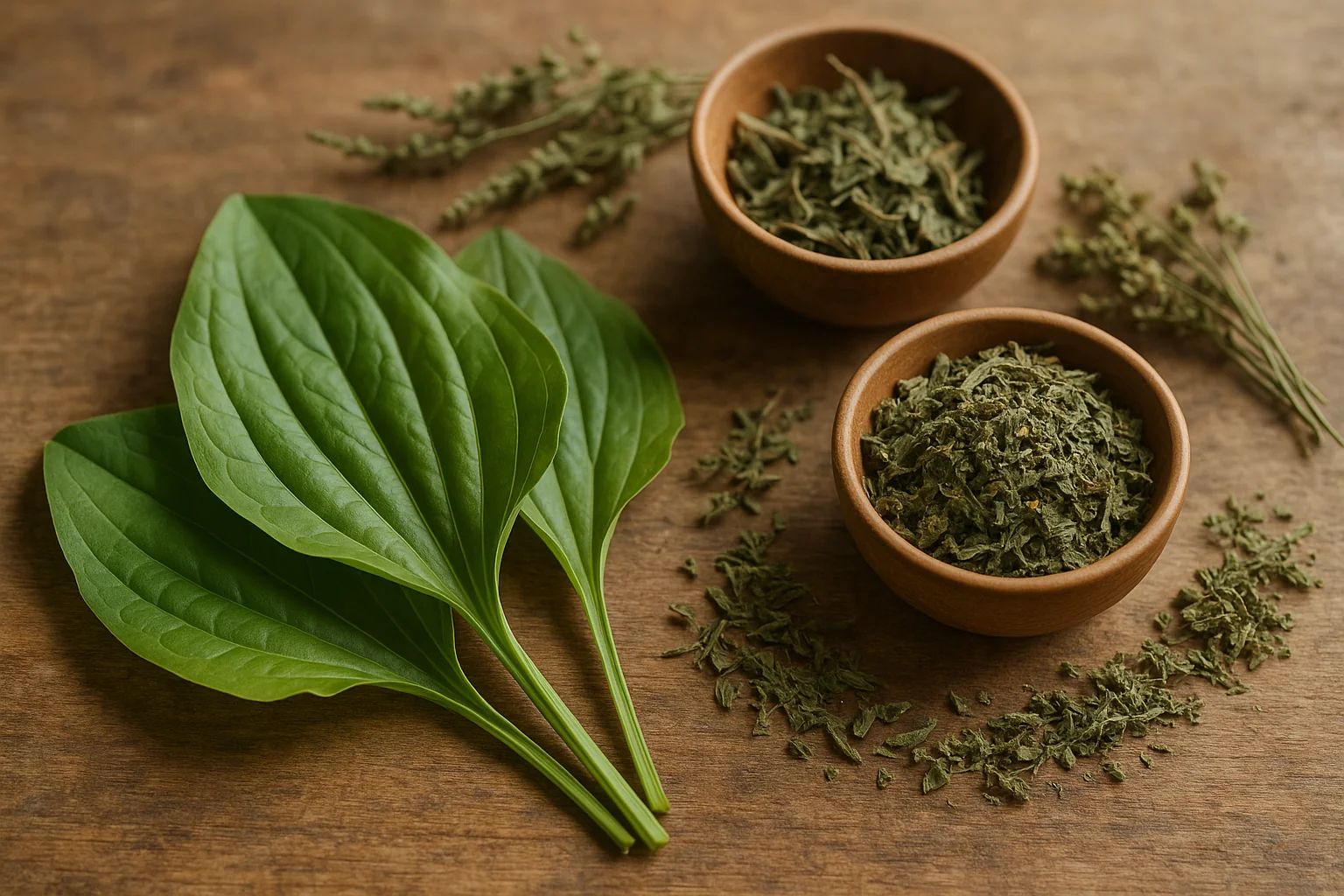
Plantago lanceolata (Plantago lanceolata L.) grows in every Polish meadow, and its leaves have been used in folk medicine for millennia. The European Medicines Agency has granted Plantago lanceolata the status of "traditional use" for cough, throat irritation, and mild inflammation of the oral mucosa (EMA, Plantaginis lanceolatae folium). Key ingredients - aucubin, mucilaginous polysaccharides, and flavonoids - work synergistically: coating, soothing, and reducing inflammation. This article answers the most common questions about Plantago lanceolata.
KEY INFORMATION
• Plantago lanceolata has an EMA monograph as an herb for cough and throat irritation - one of the few herbs with official confirmation of traditional pediatric use (children over 1 year).
• Aucubin (iridoid) and mucilage polysaccharides create a protective layer on the throat mucosa and suppress the cough reflex in dry, irritating coughs (EMA).
• Excellent for combining with thyme (complementary mechanisms: thyme - expectorant and bactericidal; Plantago - coating and soothing).
• May cause allergic reactions in individuals allergic to Plantago pollen as an inhalant allergen - check tolerance.
• Cough lasting more than 3 weeks: always a doctor's visit, regardless of the herbs used.
Plantago lanceolata - what works in it and why?
The herb of Plantago lanceolata contains four main groups of active compounds. The first is iridoid glycosides - mainly aucubin (0.3-2.5%) and catalpol. Aucubin, after hydrolysis by intestinal microflora, yields aucubinogenin, which exhibits anti-inflammatory effects by inhibiting the enzyme phospholipase A2 and reducing the production of inflammatory prostaglandins. This same mechanism reduces irritation of the mucous membranes of the throat and bronchi.
The second group is mucilaginous polysaccharides (mucilago) - from 2 to 6.5% of the dry mass of the herb. They form a gel-like layer on the irritated surface, physically protecting it from further irritation. The third group is flavonoids (apigenin, luteolin, plantaginoside) with anti-inflammatory and antioxidant effects. The fourth is rosmarinic acid with in vitro antiviral activity - the same compound responsible for some of the medicinal properties of thyme and lemon balm (PMC, 2019). Rosmarinic acid acts anti-inflammatorily by inhibiting cyclooxygenase and reducing the synthesis of prostaglandin E2 (PGE2) - a mediator of pain and swelling of the mucosa - which has been well documented for both Melissa officinalis, as well as Thymus vulgaris (PMC, 2021). As a strong antioxidant, rosmarinic acid neutralizes free radicals generated during inflammation of the respiratory tract, limiting secondary damage to the epithelium - this effect is particularly significant in recurrent viral infections.
An aspect rarely described in articles about Plantago lanceolata: the content of aucubin in the leaves varies significantly depending on the time of harvest. Leaves harvested in spring (May-June) contain up to 2.5% aucubin, while in autumn - even three times less. High-quality dried herb should be labeled as "standardized Plantago lanceolata leaf" or "spring harvest" - this is a clinically significant difference, although rarely communicated on supplement labels.
Babka lancetowata na kaszel suchy - dlaczego to najlepsze dopasowanie?
Dry, irritating cough without phlegm - often residual after an infection or caused by irritation - is an indication where Plantago lanceolata performs best among all "herbs for cough". The mechanism is simple: mucilaginous polysaccharides create a layer on the irritated mucosa of the back wall of the throat and larynx, reducing the stimulus that triggers the cough reflex. The effect is quick - it appears after the first or second dose of the infusion, stabilizing with regular consumption over several days.
In the case of a wet cough, plantago acts more slowly and less spectacularly. Aucubin and flavonoids reduce inflammation of the mucosa, but do not have as strong a mucokinetic effect as the saponins in thyme. Therefore, for a wet cough with thick secretion, thyme or a combination of thyme + plantago is a better choice: thymol thins the secretion, while plantago protects the regenerating mucosa.
It is worth comparing Plantago lanceolata with marshmallow root (Althaea officinalis), as both plants are often used for dry cough and seem similar. Both contain mucilaginous polysaccharides that form a protective layer on the mucous membrane; however, marshmallow - especially the root - has a significantly higher concentration of mucilago, reaching 35%, which provides a stronger physical protective effect (PMC, 2014). Plantago lanceolata, on the other hand, contains aucubin and flavonoids with documented anti-inflammatory effects, which marshmallow practically lacks. The practical rule is this: for a dry cough with predominant mucosal inflammation - for example, after a viral infection or due to allergic irritation - Plantago is better; when the cough results from very intense mechanical or chemical irritation (reflux, irritation after a procedure), marshmallow may provide quicker relief due to its higher concentration of protective mucus.
Plantago in syrup or infusion - what to choose?
Syrup made from Plantago lanceolata has one practical advantage over the infusion: it acts directly on the irritated mucous membrane of the throat, especially when a teaspoon is held in the mouth for a moment before swallowing. Sugar or glycerin in the syrup additionally coats the throat, enhancing the effect of mucilage. Standardized syrups have a consistent content of aucubin and are particularly convenient for children.
An infusion from dried leaves is cheaper, allows for mixing with other herbs (thyme, mullein, marshmallow), and ensures the quality of the raw material. When preparing the infusion: always brew covered (aucubin is thermally stable, but mucilaginous polysaccharides partially expand), do not filter through a coarse sieve - mucilago remains in the infusion as a slight cloudiness, which is desirable.
| Form | Adult dose | Dzieci 1-12 lat | Best for |
|---|---|---|---|
| Infusion from leaves | 1,5-2 g / 200 ml, 3-4× dz. | 1 g / 150 ml, 2-3× dz. | Dry cough, sore throat |
| Syrup from Plantago | 1 teaspoon 3-4 times a day. | 0.5 teaspoon 3× daily. | Night cough, children |
| Mixed infusion of plantago + thyme | 1 g of plantago + 1 g of thyme / 200 ml, 3× daily. | 0.5 g + 0.5 g / 150 ml, 2× daily. | Wet cough + irritation |
Data updated: May 4, 2026
When Plantago lanceolata is not enough - important warning signals.
Plantago lanceolata is a symptomatic herb, not a causal one. It alleviates cough and sore throat but does not treat bacterial infections (strep throat, pneumonia), does not reduce fever, and does not combat viruses. When is a doctor's visit required instead of an infusion of plantago? First: cough with a fever above 38.5°C lasting more than 3 days. Second: sore throat with white spots on the tonsils (which could be strep throat, requiring antibiotic therapy). Third: cough with blood or sputum that is green, yellow with traces of blood.
Fourth: a cough lasting more than 3 weeks without a clear cause - may be a symptom of asthma, COPD, gastroesophageal reflux, or, less commonly, respiratory tract cancer. No herb, including Plantago lanceolata, should be used as a substitute for diagnostics in chronic cough. You can use it concurrently as a symptom-relieving agent, but not replacing a visit to the doctor.
From practical observations: syrups made from Plantago lanceolata used regularly throughout the cold season (October-March) reduce the intensity of residual cough after infections and shorten its duration. The key is regularity - single doses provide temporary relief, but the true anti-inflammatory effect of aucubin requires several days of use.
Frequently Asked Questions
How to use Plantago lanceolata for cough?
Infusion: pour 1.5-2 g of dried leaves with 200 ml of boiling water, cover, and brew for 10 minutes. Drink 3-4 times a day between meals. Syrup: 1 teaspoon 3-4 times a day. Children over 1 year: 0.5 teaspoon of syrup 3 times a day. For dry, irritating cough, the coating effect appears after the first dose - aucubin and mucilaginous polysaccharides protect the throat mucosa (EMA).
What is the difference between Plantago lanceolata and Plantago major?
Plantago lanceolata (Plantago lanceolata) contains more aucubin and mucilaginous polysaccharides than Plantago major (Plantago major). Both have an EMA monograph, but lanceolata is preferred in pharmaceutical preparations and supplements due to its higher concentration of active ingredients. The action of both is similar - alleviating cough and throat irritation.
Does Plantago lanceolata help with allergic cough?
It may alleviate symptoms of allergic cough due to the anti-inflammatory action of aucubin and flavonoids, but it does not act as an antihistamine and does not treat hypersensitivity. For seasonal allergic cough, Plantago reduces local mucosal inflammation, providing relief. However, the cause of the allergy requires allergological diagnostics and appropriate causal treatment.
What are the contraindications for using Plantago lanceolata?
Main contraindication: allergy to plants from the Plantaginaceae family - cross-reactive allergic reactions are possible in individuals allergic to plantain pollen. Others: pregnancy (infusions in standard doses are considered safe, but there are no RCT studies). No significant drug interactions when using infusions from leaves in typical doses.
Can Plantago lanceolata be used together with thyme?
Yes - it's an optimal combination. Thyme acts as an expectorant and bactericidal (thymol thins secretions and inhibits bacteria), while Plantago coats and soothes mucosal irritation (aucubin, mucilago). Together, they cover both main mechanisms of coughing. Mixed infusion: 1 g of each herb in 200 ml of boiling water, brew for 10 minutes covered, 3 times a day.
Can Plantago lanceolata be used long-term?
The EMA monograph for Plantaginis lanceolatae folium classifies Plantago lanceolata as a safe herb for traditional use, without setting a strict time limit for treatment (EMA, Plantaginis lanceolatae folium). However, the EMA recommends that a cough lasting longer than 3 weeks should be absolutely consulted with a doctor - regardless of whether herbs are used or not, as chronic cough can signal conditions requiring diagnostics. In the case of recurrent seasonal cough - for example, in the course of chronic bronchitis or residual cough after successive infections - Plantago lanceolata can be used as a symptom-relieving agent alongside medical care; infusions from leaves in standard doses do not show known adverse effects with prolonged use or organ toxicity. Practical advice: if the cough returns regularly every winter, Plantago is a good supplement, but the cause of recurrent infections should be addressed separately - assessing immunity and the hydration of mucous membranes.
This article is for informational and educational purposes and does not replace consultation with a doctor. If you are pregnant, breastfeeding, taking medications, or have chronic conditions, consult the use of supplements or herbs with a specialist.
Author: Michał Waluk · Published: 2026-05-04 · Updated: 2026-05-04