
Marshmallow root - for throat, cough, and stomach (FAQ)
Marshmallow root: answers to frequently asked questions and what studies say. u Bucha.
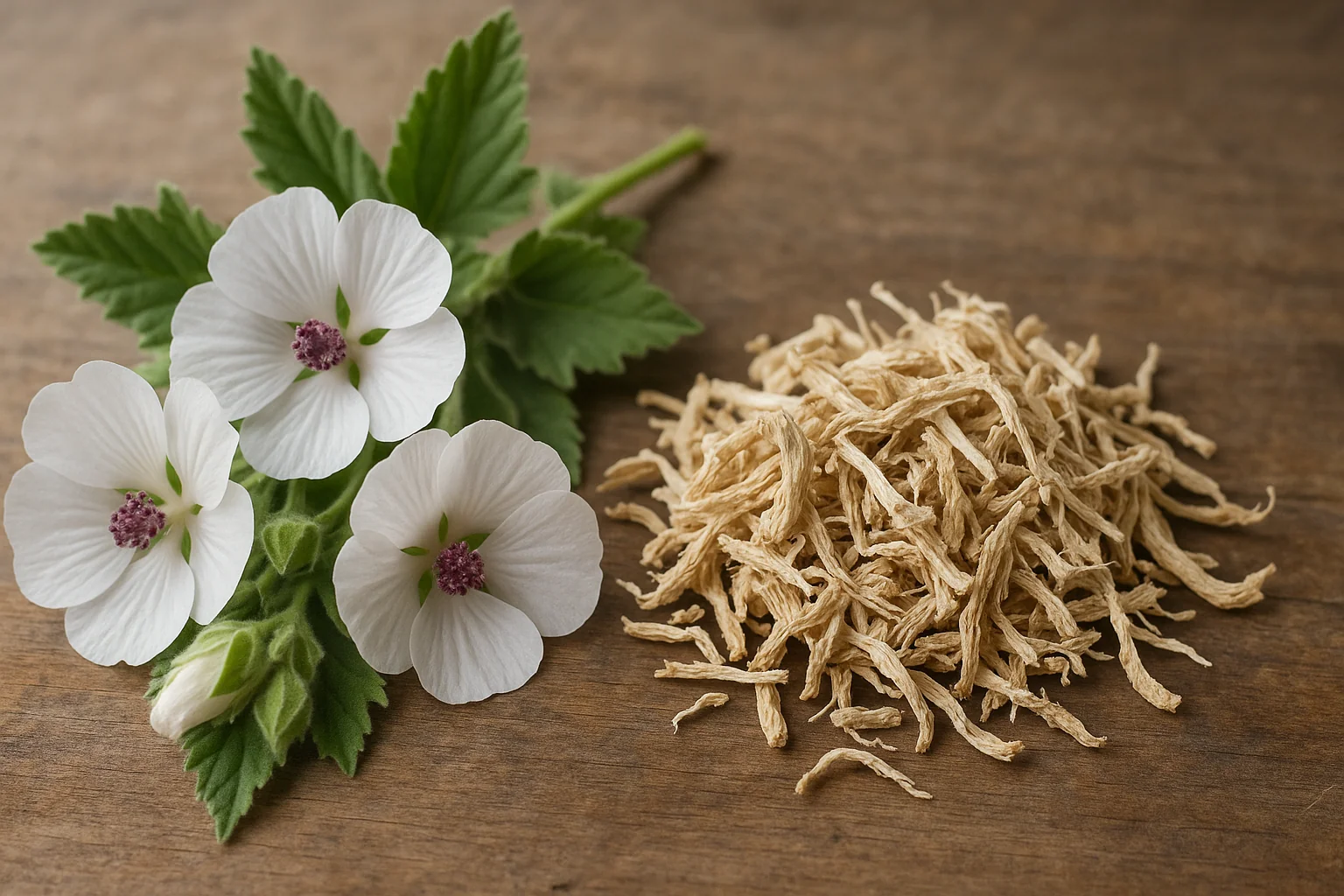
Marshmallow root (Althaea officinalis) is one of the few herbs that act physically, not just biochemically. Its root contains up to 35% mucilaginous polysaccharides - arabinogalactans and rhamnogalacturonans - which, upon contact with the mucous membrane, form a protective coating layer. The European Medicines Agency (EMA) has granted marshmallow root the status of "traditional use" for cough, throat irritation, and mild stomach ailments (EMA, Althaeae radix). This article answers the most common questions about marshmallow - how to prepare it, use it, and when it may not be sufficient.
KEY INFORMATION
• Marshmallow root contains up to 35% mucilaginous polysaccharides that create a mechanical protective layer on the mucous membrane - this unique action among herbs for cough and throat (EMA).
• Key: soak in cold water (macerate), not boiling water - hot water destroys active mucilaginous polysaccharides.
• EMA allows use in children over 3 years old - one of the few herbs with such pediatric indications.
• Maintain a 2-hour break between marshmallow macerate and taking oral medications - the mucilage delays absorption.
• For chronic stomach ailments lasting more than 4 weeks without improvement: medical diagnosis is necessary.
What is marshmallow root and how does it work?
Marshmallow root is a perennial plant from the mallow family (Malvaceae), growing wild in Central Europe and Western Asia. In medicine, the root (Althaeae radix) and herb (Althaeae folium/flos) are used, but the root has a higher concentration of polysaccharides and is a pharmacopoeial raw material. The word "marshmallow" (in English means marshmallow) comes from this herb - historically, the root was boiled with sugar to create a sweet paste that coated the throat during coughing.
Marshmallow root has been listed in the European Pharmacopoeia (Ph. Eur.) as an official pharmaceutical raw material for decades. The Ph. Eur. monograph requires a minimum content of 2% mucilage polysaccharides determined by the swelling index method. The European Medicines Agency issued a full community monograph for Althaeae radix in 2016, confirming both the status of "traditional use" and detailed quality requirements for the raw material (EMA, Althaeae radix). This means that manufacturers of herbal supplements and medicines across the European Union must adhere to the same standards of purity and active ingredient content.
The mechanism of action is simpler than for most herbs: mucilaginous polysaccharides absorb water and form a gel that physically covers the irritated surface of the mucous membrane. This layer protects tissues from further irritation, soothes, and gives the mucous membrane time to regenerate. Unlike antibiotics or anti-inflammatory drugs, marshmallow does not attack the cause of the infection - it only alleviates symptoms. This is an important clinical distinction.
A rarely mentioned fact: marshmallow acts mukokinetically (thins secretions) not through enzymes but through dilution. The mucous layer on the epithelium of the respiratory tract "hydrates" the dried mucus, facilitating its transport by cilia. This explains why marshmallow is effective for dry, irritating coughs - the problem is not infectious but mechanical.
How to properly prepare marshmallow - cold macerate vs infusion
The method of preparation determines the effectiveness of marshmallow more than for most herbs. Active polysaccharides extract excellently in cold water but degrade at temperatures above 60-70°C. Boiling or steeping in boiling water destroys the mucilage structure - you get a sweet infusion with weaker coating effects, although still containing flavonoids with anti-inflammatory properties.
Cold macerate: soak 2-3 g of crushed marshmallow root in 150 ml of cold water (preferably boiled and cooled). Stir every 10-15 minutes for 30-90 minutes. Strain through a fine sieve or gauze - the decoction will be slightly thick and mucilaginous. Drink 3-5 times a day, 100-150 ml, preferably between meals or directly before eating for stomach issues. You can store the macerate in the refrigerator for up to 24 hours.
Ready syrup (pharmacy or store-bought): standardized extract of marshmallow in syrup has the advantage of being prepared using cold extraction methods in industrial conditions and has a repeatable content of polysaccharides. Dosage: 1 teaspoon (5 ml) 3-4 times a day for adults, 0.5 teaspoon 2-3 times a day for children over 3 years old. Syrups based on glycerin instead of alcohol are safe for the whole family.
Dosage table for marshmallow according to form and age group
| Form | Adults | Dzieci 3-12 lat | Duration of use |
|---|---|---|---|
| Cold macerate | 2-3 g / 150 ml, 3-5 × dz. | 1-2 g / 100 ml, 2-3 × dz. | Do 4 tygodni |
| Marshmallow syrup | 1 teaspoon 3-4 times a day. | 0.5 teaspoon 2-3 times a day. | Up to 2 weeks |
| Capsules with extract | 300-600 mg 2 × dz. | Not recommended for under 12 years | Do 4 tygodni |
| Lozenges | 1 pastylka co 2-3 godz. | 1 lozenge every 4 hours (over 3 years) | Up to 7 days |
Data updated: May 4, 2026
Marshmallow and reflux - does it work the way you think?
Marshmallow acts symptomatically in reflux and hyperacidity - it does not reduce the secretion of hydrochloric acid, nor does it treat infections. Helicobacter pylori and does not heal ulcers. Its role is mechanical protection: the polysaccharide layer on the mucosa of the esophagus and stomach soothes burning and discomfort, but does not eliminate the cause. Therefore, in cases of chronic reflux or recurring stomach ailments, marshmallow is a supportive, not a medicinal remedy.
Clinical studies on marshmallow for reflux are limited - most data comes from in vitro studies and short case series. The EMA granted it the status of "traditional use" (not "established use"), meaning that clinical evidence is insufficient for a full monograph on efficacy, but the safety profile is well described. Practically: marshmallow is safe to try for reflux, but if it does not provide relief after 2-3 weeks, a doctor's visit and diagnostics are necessary.
Practical observation: marshmallow works best in combination with other measures - dietary changes (reducing fatty foods, coffee, alcohol), elevating the head of the bed, and using macerates regularly rather than as needed. As monotherapy for severe reflux, it usually is not sufficient, but as part of a broader approach, it provides significant relief for many people.
Marshmallow root also contains phenolic compounds, including caffeic acid, chlorogenic acid, and scopoletin, which in in vitro studies show anti-inflammatory activity by inhibiting COX-2 enzymes and reducing the secretion of pro-inflammatory cytokines (IL-6, TNF-alpha). A study published in Journal of Ethnopharmacology confirmed that phenolic fractions of marshmallow root extract inhibit the proliferation of inflammatory epithelial cells in an in vitro model (Recio et al., 2004, PubMed). This action complements the mucilaginous effect: polysaccharides provide mechanical protection, while phenolic compounds may alleviate the inflammatory substrate of the gastric mucosa with regular use.
Frequently Asked Questions
How to use marshmallow for throat and cough?
The root of marshmallow is best prepared as a cold macerate: soak 2-3 g of root in 150 ml of cold water for 30-90 minutes, stirring. Drink 100-150 ml 3-5 times a day between meals. Use marshmallow syrup at 1 teaspoon 3-4 times a day. The coating effect appears almost immediately upon contact with the mucous membrane (EMA).
Why is marshmallow soaked in cold water instead of boiling water?
Mucilaginous polysaccharides from marshmallow extract best at temperatures of 20-25°C. Hot water (above 60°C) destroys their structure and degrades the mucus into simple sugars, which do not have a coating effect. A cold macerate (30-90 minutes) yields a thick liquid rich in active mucus - this is what protects the irritated mucosa of the throat and stomach.
Does marshmallow help with reflux and hyperacidity?
Yes, symptomatically. Polysaccharides create a protective layer on the mucosa of the esophagus and stomach, alleviating burning caused by acid. The action is mechanical - it does not reduce acid production. The effect is quick (minutes), but short-lived, requiring use several times a day. In chronic reflux, if there is no improvement after 4 weeks: medical diagnostics and examination are necessary. H. pylori.
Can marshmallow be used in children?
Yes - the EMA approves the traditional use of marshmallow root in children over 3 years old for cough and throat irritation. Pediatric doses: 1-2 g of root for cold macerate twice a day or syrup at a dose of 0.5 teaspoon 3 times a day. Below 3 years of age, pediatric consultation is recommended before use.
Does marshmallow interact with medications?
Marshmallow may delay the absorption of oral medications due to the mucous layer covering the intestinal wall. Maintain a 2-hour interval between marshmallow macerate and taking any oral medication. No serious pharmacodynamic interactions have been reported, but caution is advised with metformin and other drugs with a narrow absorption window.
How long can marshmallow be used?
The EMA recommends use for no longer than 2-4 weeks for acute ailments. In chronic reflux, longer use may be possible, but after 4 weeks without improvement, a medical consultation and diagnostics are necessary - chronic gastric ailments require exclusion of infection. H. pylori, structural reflux, or peptic ulcer disease (EMA).
Can marshmallow be combined with other herbs?
Yes, marshmallow works well with other herbs, provided you understand the differences in their mechanisms of action. For cough and throat irritation, combining with thyme (Thymus vulgaris) is justified: marshmallow coats the mucous membrane, and thyme acts as an expectorant and antimicrobial. Together they create a complementary profile - protection + active assistance in expelling mucus. For gastric issues, a combination with lemon balm (Melissa officinalis) alleviates both smooth muscle tension and mucosal irritation.
An important principle when combining marshmallow with other herbs in the context of medications: the 2-hour interval rule applies not only to a single marshmallow macerate but to any herbal blend containing mucilaginous herbs. The mucus from marshmallow acts as a coating regardless of whether it is taken alone or in a blend with thyme or lemon balm. If you drink a blend containing marshmallow and take oral medications, maintain the same 2-hour break as with pure marshmallow macerate (EMA).
This article is for informational and educational purposes and does not replace consultation with a doctor. If you are pregnant, breastfeeding, taking medications, or have chronic conditions, consult the use of supplements or herbs with a specialist.
Author: Michał Waluk · Published: 2026-05-04 · Updated: 2026-05-04