
Ashwagandha and libido: what exactly do scientific studies show
Five placebo studies measured the effect of ashwagandha on sexual functions. How many people, for how long, what results were found in women and men, and who funded it.
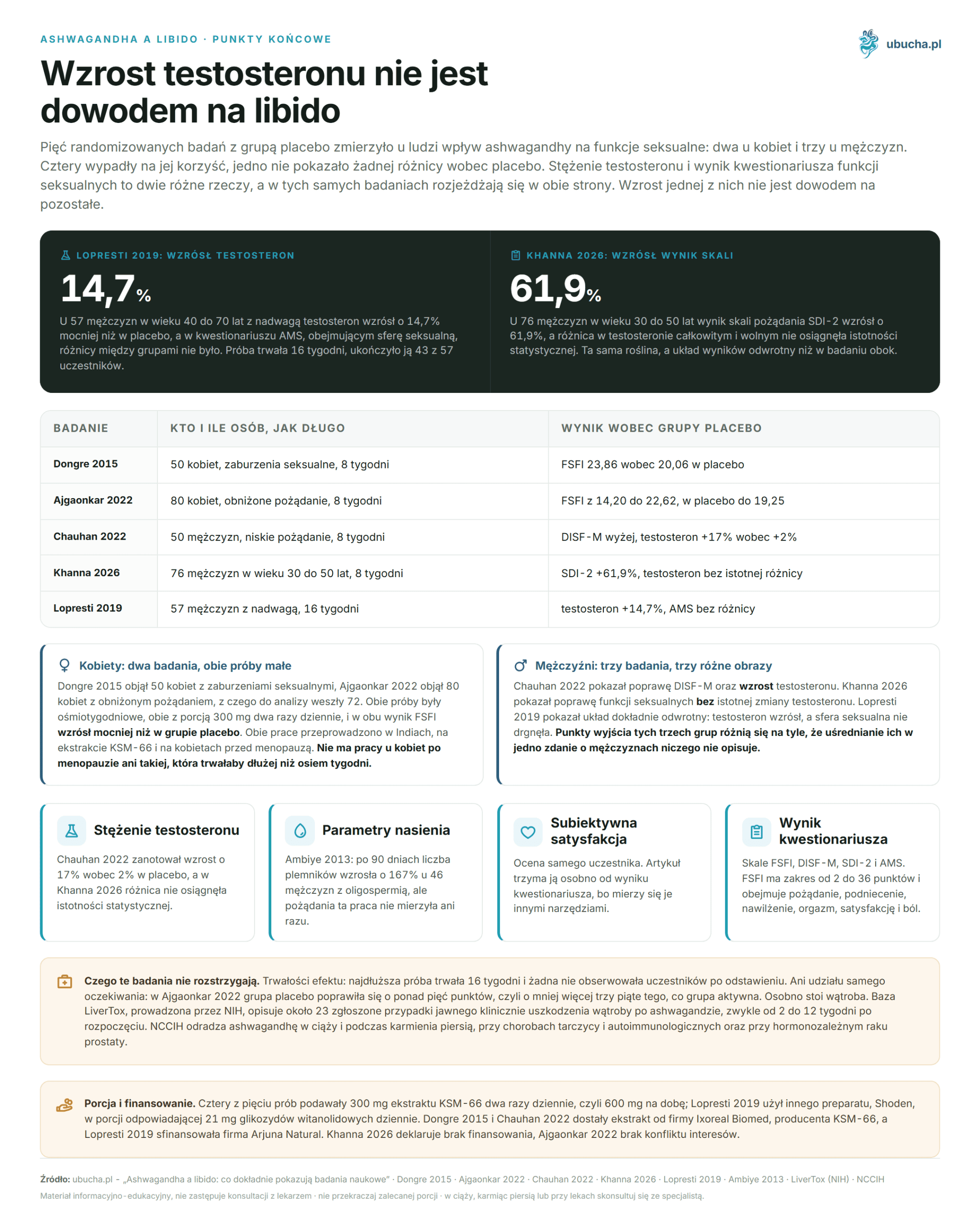
Five randomized studies with a placebo group measured the impact of ashwagandha on sexual functions in humans: two in women and three in men. Four showed positive results, while one showed no difference compared to placebo. The trials included between 50 to 80 participants, and the longest lasted 16 weeks. This is too few to speak of a certain effect, and too many to dismiss the question as myth. Below, we break down each of these studies: who participated, how many people, how long, what dose, what exactly was measured, and who funded the research. We keep the genders separate, as the results differ between them. The endpoints are also different, as testosterone concentration and the score on the sexual function questionnaire are two distinct things, yet the advertising treats them as one.
KEY INFORMATION
• Dongre 2015: 50 women, 8 weeks, FSFI score 23.86 compared to 20.06 in the placebo group
• Ajgaonkar 2022: 80 women, 8 weeks, FSFI from 14.20 to 22.62, in placebo from 14.17 to 19.25
• Chauhan 2022: 50 men with low desire, 8 weeks, improvement in DISF-M questionnaire, testosterone +17% compared to +2%
• Khanna 2026: 76 men, 8 weeks, SDI-2 score higher by 61.9%, testosterone with no significant difference
• Lopresti 2019: 57 men, 16 weeks, testosterone +14.7%, and the sexual sphere showed no difference compared to placebo
• LiverTox (NIH): about 23 reported cases of liver damage after ashwagandha, usually 2 to 12 weeks after starting
How many studies are there on ashwagandha and libido?
Five randomized trials with a placebo group measured the endpoint related to sexuality in humans: two in women and three in men. The smallest included 50 participants, the largest 80, and the longest lasted 16 weeks. A sixth study, Ambiye 2013, is often cited here, although it did not measure desire even once.
All five were compared to placebo, all lasted from 8 to 16 weeks, and none checked what happens after discontinuation. Four used the same branded extract KSM-66, which facilitates the comparison of results, while also narrowing it down to one preparation. Differences between standardizations are described in a separate text about KSM-66 and Sensoril extracts.
| Study | Who and how many participants | Time | Dose | What was measured | Outcome | Who paid |
|---|---|---|---|---|---|---|
| Dongre 2015 | 50 women with sexual disorders | 8 weeks | 300 mg twice daily, KSM-66 | FSFI, FSDS | FSFI 23.86 compared to 20.06 in placebo | Ixoreal Biomed: extract and part of the costs |
| Ajgaonkar 2022 | 80 women with reduced desire | 8 weeks | 300 mg twice daily, KSM-66 | FSFI, FSDS, GHQ-28 | FSFI from 14.20 to 22.62, in placebo up to 19.25 | KSM-66 extract, authors with no conflicts of interest |
| Chauhan 2022 | 50 men with low desire | 8 weeks | 300 mg twice daily, KSM-66 | DISF-M, testosterone, prolactin | DISF-M higher than placebo, testosterone +17% compared to +2% | Ixoreal Biomed: extract and placebo capsules |
| Khanna 2026 | 76 men aged 30 to 50 | 8 weeks | 300 mg twice daily, KSM-66 | SDI-2, IIEF, testosterone, semen | SDI-2 +61.9%, testosterone with no significant difference | authors declare no funding |
| Lopresti 2019 | 57 men aged 40 to 70 with overweight, 43 completed | 16 weeks | 21 mg of withanolides, Shoden | testosterone, DHEA-S, AMS questionnaire | testosterone +14.7%, sexual sphere with no difference | Arjuna Natural, producer of the extract |
| Ambiye 2013 | 46 men with oligospermia | 90 days | 675 mg daily | semen, testosterone, LH | sperm count +167%, desire not measured | authors with no conflicts of interest |
What did studies show in women?
Two studies, both small trials, both eight weeks long and both with a dose of 300 mg twice daily. Dongre 2015 included 50 women with diagnosed sexual disorders, Ajgaonkar 2022 included 80 women with reduced desire, of which 72 were analyzed. In both, the FSFI questionnaire score increased more than in the placebo group.
FSFI is a scale from 2 to 36 points, covering desire, arousal, lubrication, orgasm, satisfaction, and pain. In the Dongre 2015 study The group taking ashwagandha finished with a score of 23.86 points, while the placebo group scored 20.06. In the study by Ajgaonkar 2022 the active group improved from 14.20 to 22.62, while the placebo group went from 14.17 to 19.25.
The second number in this pair is more interesting than the first. The placebo group alone improved by over five points, which is about three-fifths of what the active group achieved. At this endpoint, the placebo effect is significant, and none of these studies eliminate it; they only measure it alongside the rest. Both studies were conducted in India, both used KSM-66 extract, and both involved premenopausal women. Dongre 2015 directly thanks Ixoreal Biomed, the producer of KSM-66, for providing the extract and covering part of the study costs. There is no study on postmenopausal women or one that lasted longer than eight weeks.
What did the studies show in men?
Three studies and three different outcomes. Chauhan 2022, involving 50 men with low libido, showed improvement in the DISF-M questionnaire and an increase in testosterone. Khanna 2026, with 76 healthy men, demonstrated improvement in sexual function without a significant change in testosterone levels. Lopresti 2019 showed exactly the opposite result.
W in the study by Chauhan 2022 testosterone increased by 17% compared to 2% in the placebo group after eight weeks, and the extract and placebo capsules were provided by Ixoreal Biomed. Khanna 2026 lasted the same amount of time, the SDI-2 desire scale score increased by 61.9%, and the difference in total and free testosterone did not reach statistical significance; the authors state that they did not receive funding for this work.
Lopresti 2019 was an alternating trial lasting 16 weeks, completed by 43 out of 57 participants, who were men aged 40 to 70 with overweight. Testosterone increased there by 14.7% more than in the placebo group, while in the AMS questionnaire, which covers the sexual sphere, there was no difference between the groups. The sponsor was Arjuna Natural, the producer of the Shoden extract used. The starting points of these three groups differ enough that averaging them into one statement about men describes nothing.
Does higher testosterone and better sperm mean higher libido?
No. In the same studies, both measures diverge in both directions: in Lopresti 2019 testosterone increased, but the sexual sphere did not budge; in Khanna 2026 sexual functions improved, but testosterone did not change significantly. These are separate endpoints and separate questions.
The farthest goes here Ambiye 2013. After 90 days on a dose of 675 mg daily, among 46 men with oligospermia, the sperm count increased by 167%, semen volume by 53%, motility by 57%, and testosterone by 17%. This study did not measure sexual desire at all, so it is not evidence in this matter, although it often appears in advertisements alongside the word libido. Separately, we describe what RCTs say about sperm parameters and male fertility.
Four things are often bundled together in sales: testosterone concentration, sperm parameters, subjective satisfaction, and the score of the sexual function questionnaire. They are measured with different tools, and in ashwagandha studies, they moved independently of each other. An increase in one of them is not evidence for the others.
What do these studies not resolve, and who does ashwagandha harm?
They do not resolve the durability of the effect, as the longest trial lasted 16 weeks and none observed participants after discontinuation. They also do not determine how much of the result was due to the plant itself and how much was due to expectation, as the placebo groups clearly improved in them. A separate issue is the liver.
LiverTox, a database maintained by the NIH, describes about 23 reported cases of clinically evident liver damage after ashwagandha. Symptoms usually appeared from 2 to 12 weeks after starting, most often with jaundice and itching, and the degree of probability of a connection was rated as B, meaning a probable cause. Individual cases ending in liver transplantation or death have been described, mainly in individuals with pre-existing liver disease.
NCCIH states that safety data extend at most to three months of use, and advises against ashwagandha during pregnancy and breastfeeding, in cases of thyroid and autoimmune diseases, as well as in hormone-dependent prostate cancer. Those looking for a raw material with a different evidence base will find it in the text about the properties of maca, and a comparison of several plants at once is in the summary "Adaptogens for libido: which support and which do not". We have gathered products from this group in the category adaptogens.
Frequently Asked Questions
Does ashwagandha increase libido in women?
In two eight-week placebo-controlled studies, Dongre 2015 on 50 women and Ajgaonkar 2022 on 80 women, the FSFI questionnaire score increased more than in the placebo group. Both trials were small, both from India, and both used KSM-66 extract.
Does ashwagandha affect libido in men?
Two out of three studies showed improvement: Chauhan 2022 on 50 men with low libido and Khanna 2026 on 76 men. The third, Lopresti 2019 on 57 overweight men, did not show a difference in the sexual sphere compared to placebo.
How long does it take to see an effect in these studies?
All trials with a sexual endpoint measured outcomes after eight weeks, while Lopresti 2019 measured after sixteen. There are no shorter measurements, so studies simply do not answer the question about effects after one or two weeks.
What dose was used in studies on libido?
Four out of five trials administered 300 mg of KSM-66 extract twice daily, totaling 600 mg per day. Lopresti 2019 used a different preparation, Shoden, at a dose corresponding to 21 mg of withanolide glycosides per day.
Does ashwagandha raise testosterone?
In some studies, yes: Chauhan 2022 noted a 17% increase compared to 2% in placebo, and Lopresti 2019 reported a 14.7% increase over placebo. In Khanna 2026, the difference did not reach statistical significance, although sexual functions improved noticeably.
Is the improvement in semen parameters the same as libido?
No. Ambiye 2013 showed a 167% increase in sperm count in 46 men with oligospermia, but sexual desire was not measured at all in that study. These are two different endpoints, assessed with different tools.
Did the producers of the raw material fund these studies?
Partially yes. Dongre 2015 and Chauhan 2022 received extract from Ixoreal Biomed, the producer of KSM-66, while Lopresti 2019 was funded by Arjuna Natural. Khanna 2026 declares no funding, and Ajgaonkar 2022 reports no conflict of interest.
Who should not use ashwagandha?
NCCIH advises against it during pregnancy and breastfeeding, in cases of thyroid and autoimmune diseases, and in hormone-dependent prostate cancer. The LiverTox database describes about 23 cases of liver damage, so it is also better to avoid it in case of liver disease.
The article is informational and educational in nature and does not replace consultation with a doctor. If you are pregnant, breastfeeding, taking medications, or have chronic conditions, consult the use of supplements or herbs with a specialist.
Author: Michał Waluk · Published: 2026-08-24 · Updated: 2026-08-24