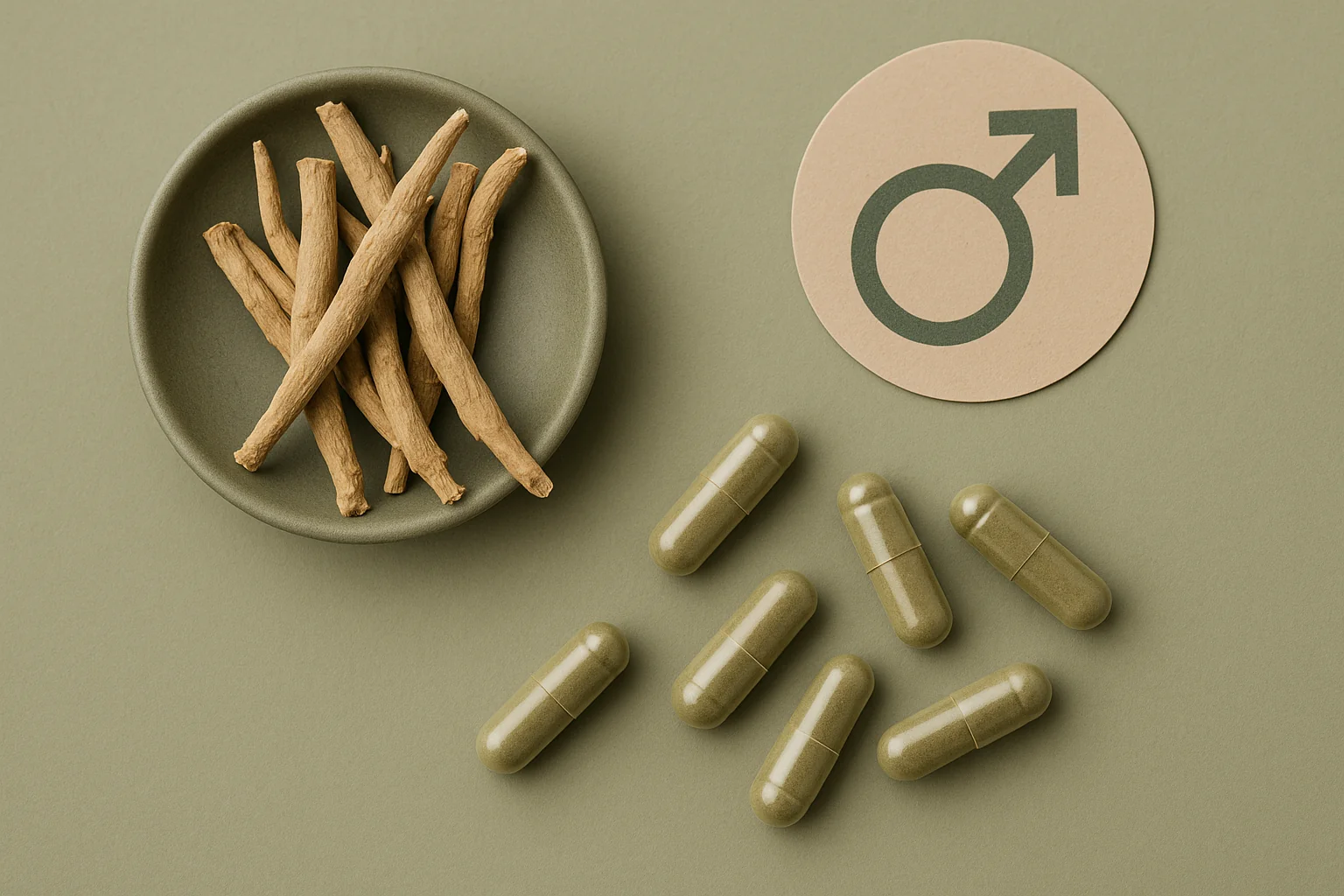

Ashwagandha for male fertility and semen parameters - what RCTs show
Ashwagandha for male fertility and semen parameters: a reliable response based on research. u Bucha.
Male infertility accounts for half of all cases of difficulties in conceiving a child. Often the first thing checked after unsuccessful attempts is the spermogram. If the results are below WHO norms, men increasingly seek natural ways to improve - before resorting to assisted reproduction options. Ashwagandha regularly appears in these searches, as there are several randomized clinical studies that directly tested its impact on semen parameters. What exactly did these studies show and how to interpret them reliably? This article is dedicated to that.
KEY INFORMATION
• A meta-analysis of 5 RCTs (Durg et al., Andrologia, 2018) showed a 167% increase in sperm concentration and a 57% increase in motility after ashwagandha supplementation in men with reduced semen parameters.
• The effect on testosterone is moderate: +15% after 8 weeks of 600 mg KSM-66 in the study by Wankhede et al. (JISSN, 2015).
• Improvement in semen parameters is not synonymous with a higher pregnancy rate - no large RCT has measured pregnancy as an endpoint.
• Standardowo stosowane dawki w badaniach: 300-675 mg ekstraktu dziennie przez 90-120 dni.
What semen parameters does ashwagandha improve according to RCT studies?
The best overview of available data is the meta-analysis by Durga and colleagues published in Andrologia in 2018, covering 5 randomized clinical trials (Durg et al., Andrologia, 2018). The meta-analysis included a total of 185 men with idiopathic infertility or reduced semen parameters. The results were statistically clear: sperm concentration increased by 167% compared to baseline values, progressive motility by 57%, and ejaculate volume by 53%.
Important disclaimer: percentage increases are calculated relative to baseline low values, not relative to the control group. This makes absolute numbers look impressive, but clinical interpretation is more challenging. A man with a baseline concentration of 5 million/ml (severe oligospermia) may reach 13 million/ml after 90 days - which is an improvement, but still below the WHO norm threshold of 16 million/ml.
| Semen parameter | Change (ashwagandha) | Change (placebo) | Source |
|---|---|---|---|
| Sperm concentration | +167% (vs. baseline) | +8% (vs. baseline) | Durg et al., 2018 |
| Progressive motility | +57% | +9% | Durg et al., 2018 |
| Ejaculate volume | +53% | no aggregate data | Durg et al., 2018 |
| Serum testosterone | +15-17% | +2-4% | Wankhede et al., 2015 |
We have noticed that most media cite the results of Durg's meta-analysis as evidence of "167% improvement in fertility," which is a misinterpretation. The percentage change from baseline measured in the same group is a different metric than the difference between the ashwagandha group and placebo - the latter is clinically more informative and usually less spectacular.
How does ashwagandha affect testosterone levels?
The impact of ashwagandha on testosterone is one of the better-studied aspects of this supplement. A randomized, double-blind study by Wankhede and colleagues involving 57 healthy men engaged in strength training showed a 15.4% increase in testosterone (96 ng/dL, p=0.004) after 8 weeks of taking 600 mg of KSM-66 extract daily, compared to a 4% increase in the placebo group (Wankhede et al., JISSN, 2015).
The mechanism of action on testosterone is likely multifaceted. The main pathway runs through cortisol: ashwagandha consistently lowers cortisol by 25-30% (Chandrasekhar et al., Indian Journal of Psychological Medicine, 2012), and cortisol acts antagonistically to LH and inhibits Leydig cells in the testes that produce testosterone. Lowering cortisol may "unblock" physiological androgen production.
Another proposed mechanism is the direct effect of withanolides on Leydig cells and the HPG axis. In vitro studies suggest that withanolide A may stimulate the activity of 3β-hydroxysteroid dehydrogenase, an enzyme crucial for the synthesis of sex steroids. This is promising, but mechanistic studies in humans are still limited.
Improvement in semen vs. pregnancy - a key distinction
This distinction rarely appears in popular science discussions of ashwagandha, yet it is fundamental for a reliable assessment of its clinical utility. Semen parameters (concentration, motility, morphology) are surrogate indicators - they correlate with fertility but are not synonymous with it. A spermogram with good results does not guarantee pregnancy, and low parameters do not preclude conception.
The only study involving ashwagandha that mentioned pregnancies as an outcome was a small study by Mahendra and colleagues from 2009 (Mahendra et al., ECAM, 2009). Of the 46 participants, 3 men in the ashwagandha group achieved pregnancy - compared to none in the control group. This is a promising signal, but the sample was too small, the observation period too short, and the design insufficient to draw conclusions about the actual impact on pregnancy rates.
From our editorial experience: men with idiopathic infertility - where there is no clear organic cause - most often inquire about ashwagandha as an option "before we go to the infertility treatment clinic." This is a sensible approach: 12-16 weeks of supplementation at a reasonable dose has an acceptable safety profile and may yield measurable improvements in parameters. However, it should not replace diagnostics - first rule out organic causes (varicocele, infections, hormonal disorders).
Practical supplementation protocol for ashwagandha with reduced semen parameters
Before starting supplementation, it is worth undergoing complete diagnostics: spermogram (WHO 2021), hormone profile (FSH, LH, total and free testosterone, prolactin, TSH), zinc and vitamin D levels. Micronutrient deficiencies - especially zinc and selenium - are a common, easily remedied cause of reduced semen quality and should be supplemented alongside ashwagandha, not instead of it.
Protocol used in clinical studies: 300-600 mg of standardized extract (KSM-66 or Sensoril, min. 5% withanolides) daily, divided into two doses. Duration: minimum 90 days - corresponding to one full cycle of spermatogenesis (74 days). Evaluate the effects with a spermogram after 3 months, comparing it to the baseline result. Without this comparison, it is difficult to assess whether the supplement made any difference.
What else is worth doing in parallel? Oxidative stress is one of the main factors damaging sperm DNA - enhancing the diet with antioxidants (vitamin C, E, coenzyme Q10, lycopene) has confirmed clinical evidence in oligospermia (Agarwal et al., Reproductive Biology and Endocrinology, 2014). The temperature of the scrotum is a sensitive parameter - a laptop on the lap, tight synthetic underwear, and long hot baths harm spermatogenesis more than many men realize. Ashwagandha may work better when these factors are eliminated.
When, despite supplementation, there is no improvement after 3-4 months? It's time for urological diagnostics: exclusion of varicocele (varicocele - in about 40% of men with infertility), obstruction of the vas deferens, and infections of the urinary and reproductive systems. These are organic causes that no supplement can correct. Ashwagandha has a place in the complementary protocol - not as a substitute for diagnostics.
Frequently Asked Questions
Does ashwagandha improve semen parameters?
Yes - a meta-analysis of 5 RCTs (Durg et al., Andrologia, 2018) showed an increase in sperm concentration by 167% and motility by 57% compared to baseline values in men with reduced parameters (Durg et al., Andrologia, 2018). The absolute difference vs. placebo is smaller - the results are encouraging but not clinically groundbreaking for every patient.
Does ashwagandha increase testosterone?
Yes, but the effect is moderate. The study by Wankhede et al. showed a 15% increase in testosterone (96 ng/dL) after 8 weeks of 600 mg KSM-66 vs. 4% in the placebo group (Wankhede et al., JISSN, 2015). Ashwagandha is not a steroid - do not expect anabolic effects comparable to hormonal interventions.
What dose of ashwagandha is effective for fertility?
In fertility studies, 300-675 mg of standardized extract was most commonly used daily for 90-120 days. Popular extracts KSM-66 and Sensoril are standardized to a minimum of 5% withanolides. A duration of less than 8 weeks is likely too short to see the full effect - the spermatogenesis cycle lasts about 74 days.
Does ashwagandha improve chances of pregnancy, not just semen parameters?
There are no large RCTs measuring pregnancy as an endpoint. The only small study (n=46, Mahendra et al., 2009) reported a 14% pregnancy rate in the ashwagandha group vs. 0% in the control - but the sample was too small for reliable conclusions. Improvement in sperm analysis is a promising surrogate marker, not evidence of a higher pregnancy rate.
How does ashwagandha affect fertility through cortisol?
Cortisol inhibits the HPG axis and directly suppresses Leydig cells. Ashwagandha consistently lowers cortisol by 25-30% (Chandrasekhar et al., IJPM, 2012), which may indirectly increase testosterone production and the quality of spermatogenesis. This mechanism is particularly relevant for men with high levels of chronic stress.
Is ashwagandha safe when planning a pregnancy?
For men - clinical data up to 16 weeks do not show significant adverse effects. For women - ashwagandha is discouraged during pregnancy due to potential abortifacient effects. Couples planning a pregnancy: the woman should stop taking ashwagandha before attempting to conceive or after obtaining a positive test. Always consult the use of supplements when planning conception with a gynecologist or urologist.
This article is for informational and educational purposes and does not replace consultation with a doctor. If you are pregnant, breastfeeding, taking medications, or have chronic conditions, consult the use of supplements or herbs with a specialist.
Author: Michał Waluk · Published: 2026-05-04 · Updated: 2026-05-04