
Anandamide - the endocannabinoid responsible for the feeling of bliss
Anandamid — co to, jak dziala i na co. Przewodnik u Bucha.
Your brain produces its own version of cannabis. It is called anandamide and is the first endocannabinoid discovered by science - in 1992, Israeli chemist Raphael Mechoulam and his colleagues identified this molecule, naming it after the Sanskrit word "ananda" meaning bliss (Devane et al., Science, 1992). Anandamide binds to the same receptors as THC - but you produce it yourself, every day. This article explains what this molecule is, how it works, what influences it, and why CBD may have more in common with it than you think.
KEY INFORMATION
• Anandamide (AEA) is an endogenous cannabinoid discovered in 1992 - it binds to CB1 and CB2 receptors, affecting mood, pain, and motivation (Devane et al., Science, 1992).
• Moderate-intensity physical activity significantly raises AEA levels in the blood - this is one of the mechanisms of the "runner's high".
• CBD may prolong the action of anandamide by inhibiting the FAAH enzyme that breaks it down.
• Anandamide is rapidly degraded in the body - its half-life is only a few minutes.
What is anandamide and how was it discovered?
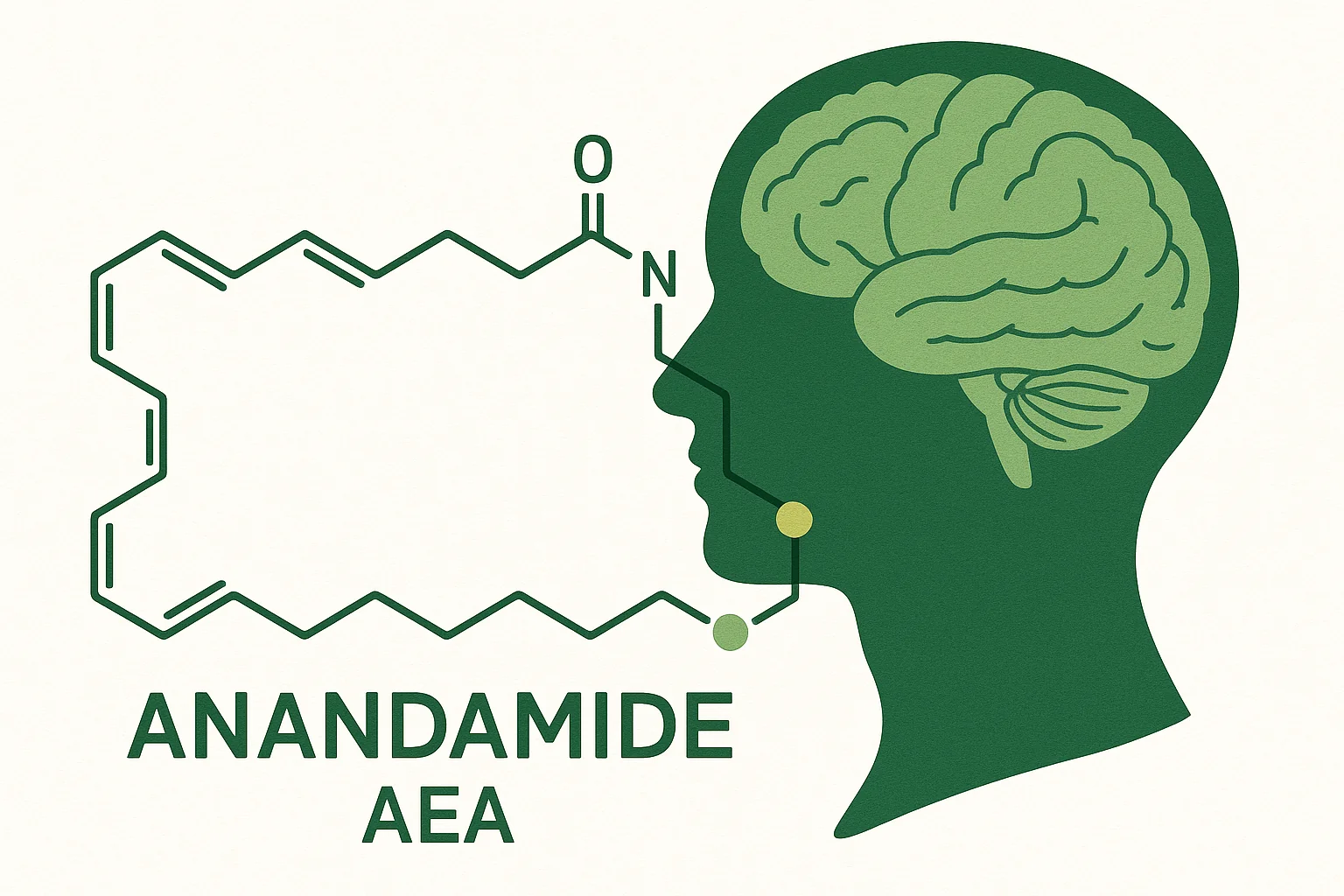
Anandamide (arachidonoylethanolamide, AEA) is an amide of arachidonic acid and ethanolamine. It is synthesized directly from the cell membranes of neurons on demand - unlike classical neurotransmitters, it is not stored in vesicles but produced momentarily when the brain needs it. Its discovery in 1992 by Devane, Hanus, and Mechoulam in Jerusalem was groundbreaking: for the first time, an endogenous ligand of cannabinoid receptors was identified (Devane et al., Science, 1992).
The CB1 receptor, to which anandamide binds, was described a few years earlier, in 1988. Scientists then knew that THC from the cannabis plant must "land" somewhere in the brain - they were searching for the receptor. When they found it, the next question arose: since the brain has a receptor for substances from cannabis, it must produce something similar itself. Anandamide was the answer. Its discovery initiated an entire field of research on the endocannabinoid system.
The name is not accidental. Mechoulam, who knew Sanskrit, consciously chose the word "ananda" - he wanted to convey the character of this molecule. Subsequent studies confirmed that anandamide indeed relates to pleasurable experiences: rewards, exploration, euphoria after physical exertion. However, it is not a simple "happiness drug" - its role in the brain is much more complicated.
How does anandamide work in the nervous system?
Anandamide primarily acts as a retrograde neurotransmitter. In a typical synapse, information flows from the presynaptic neuron to the postsynaptic neuron. Anandamide goes against the flow: it is released by the postsynaptic cell and travels backward to bind to CB1 receptors on the sending neuron. The effect? Inhibition of excessive release of excitatory neurotransmitters, primarily glutamate, which stabilizes the activity of neural networks (Piomelli, Nature Reviews Neuroscience, 2003).
CB1 receptors, with which anandamide binds, are among the most densely distributed receptors in the human brain. There are particularly many of them in the hippocampus (memory, learning), amygdala (emotions, anxiety), basal ganglia (movement, reward), and prefrontal cortex (decisions, planning). This distribution explains why anandamide - and substances acting on its receptors - simultaneously affect memory, mood, movement, and motivation.
Besides CB1, anandamide also binds to the CB2 receptor, although more weakly. CB2 is primarily found in immune tissues: the spleen, lymph nodes, and microglial cells in the brain. Through CB2, anandamide can modulate the inflammatory response and immune system activity. The role of CB2 in the neurobiology of anandamide is actively being researched, particularly in the context of neuroinflammatory diseases.
| Receptor | Location | Effect of activation by AEA |
|---|---|---|
| CB1 | Brain (hippocampus, amygdala, cortex), spinal cord | Mood modulation, pain inhibition, memory regulation, euphoria |
| CB2 | Immune system, microglia, intestines | Anti-inflammatory action, immune modulation |
| TRPV1 | Nociceptors (pain neurons), heart | Pain perception, temperature regulation |
| PPAR-γ | Cell nucleus | Regulation of lipid metabolism, anti-inflammatory response |
Anandamide exhibits a particular feature: it acts as a "partial agonist" of the CB1 receptor, meaning it binds to it strongly but does not activate it with maximum power. THC, with a similar structure, is a full agonist - hence the stronger and longer-lasting effects after external administration of cannabis compared to endogenous anandamide.
Why is anandamide so short-lived?
The half-life of anandamide in the brain is only a few minutes - this is one of its most important features that distinguishes it from THC, which can circulate in the body for hours and days. The breakdown of anandamide is mainly due to the FAAH enzyme (fatty acid amide hydrolase). FAAH quickly cleaves AEA into arachidonic acid and ethanolamine, terminating its action.
This mechanism makes profound biological sense. Signaling through anandamide is meant to be precise and momentary - it modulates the activity of specific synapses exactly when needed. Prolonged maintenance of high AEA levels would disrupt the fine-tuning of the neural network. The brain needs the ability to quickly turn cannabinoid signals on and off.
It is precisely the short-lived nature of anandamide that makes the "runner's high" - a state of euphoria that occurs after 30-40 minutes of aerobic exercise - last only a moment. A 2021 study showed that a 30-minute run at 70-80% of maximum heart rate significantly raises AEA levels in the blood, with the effect quickly disappearing after the activity ends (Raichlen et al., Psychoneuroendocrinology, 2021). THC works differently: it is lipophilic, stores in fat tissue, and is released gradually over days or weeks.
Anandamide and CBD - why is this important connection?
Cannabidiol (CBD) interacts with anandamide indirectly by inhibiting the FAAH enzyme. When CBD blocks FAAH, anandamide degrades more slowly and remains in the synapses longer. Leweke and colleagues demonstrated in 2012 that patients with schizophrenia treated with CBD had significantly higher levels of anandamide in cerebrospinal fluid compared to untreated patients, and this increase correlated with improvement in psychotic symptoms (Leweke et al., Translational Psychiatry, 2012).
This discovery has changed the understanding of the CBD mechanism. For years, it was assumed that CBD primarily works by directly binding to receptors - now we know that a significant part of its effects may result from maintaining the natural level of anandamide. CBD is not a substance that "disrupts balance from the outside" - rather, it is a modulator of the body's own system.
It is worth noting, however, that the inhibitory effect of CBD on FAAH is studied in laboratory and clinical conditions. The doses of CBD used in supplementation (10-50 mg daily) may have different implications than the pharmacological doses from clinical studies (150-600 mg daily). Science is still clarifying what dose of CBD realistically affects the level of anandamide in healthy individuals.
What naturally raises anandamide levels?
Since AEA is produced endogenously, behaviors and substances that increase its levels or inhibit its breakdown can naturally influence mood and well-being. Research indicates several strategies.
Physical exercise
Moderate-intensity aerobic exercise is the best-documented natural stimulant of anandamide. For decades, "runner's high" was attributed solely to endorphins. Raichlen's research from 2021 showed that AEA may be equally important - and perhaps more important in the context of euphoria, because endorphins poorly penetrate the blood-brain barrier, which anandamide does not need.Raichlen et al., Psychoneuroendocrinology, 2021).
Dieta - kwas arachidonowy i czekolada
Anandamide is synthesized from arachidonoylethanolamine. Arachidonic acid - the substrate for AEA production - comes from food: meat, eggs, vegetable oils. Additionally, dark chocolate contains substances (N-acylethanolamines) structurally similar to AEA and FAAH inhibitors, which may prolong the action of anandamide.di Tomaso et al., Nature, 1996). This is a scientifically confirmed, albeit modest effect - it does not justify eating chocolate in excess.
Positive social stimuli and relaxation
Pleasurable experiences - laughter, social contact, exposure to music - are associated with the activation of the endocannabinoid system. Direct measurement of AEA in such conditions is methodologically difficult, but studies on animal models confirm the link between behavioral reward and endocannabinoid signaling. The ECS regulates not only pain and mood but also reward and motivation processes.
Anandamide and emotions, pain, and memory
The CB1 receptor, to which anandamide preferentially binds, is particularly densely located in the amygdala - a brain structure crucial for processing emotions and fear. Modulating CB1 activity by AEA has direct implications for regulating anxiety responses. Studies on mice with genetically disabled FAAH enzyme (and thus with chronically elevated anandamide) showed significantly reduced reactions to anxiety stimuli - without the sedative effects typical of benzodiazepines.Cravatt et al., Proceedings of the National Academy of Sciences, 2003).
In the area of pain, anandamide acts bidirectionally. Through CB1 in the spinal cord and brain, it inhibits the transmission of pain signals. Through TRPV1 receptors (vanilloid channel) - the same ones that respond to capsaicin from chili - it may paradoxically intensify the perception of pain at higher concentrations. This dualism is biologically purposeful: AEA modulates pain contextually, it does not block it unconditionally.
In the questions that reach the editorial office of ubucha.pl, one theme recurs: users of CBD oils notice that after a few weeks of use, "something changes" in their perception of daily tension - and they ask whether this is the effect of CBD directly or perhaps something else. The mechanism of FAAH inhibition by CBD, which we described above, provides a reasonable answer: some effects may indeed result from maintaining a higher level of one's own anandamide, rather than just from the direct action of cannabidiol.
When it comes to memory, the matter is more subtle. Anandamide through CB1 in the hippocampus participates in memory consolidation - but also in selective forgetting. The process called "forgetting through ECS" is an active, purposeful mechanism: the brain silences unnecessary or painful memories through cannabinoid signaling. This is fascinating from the perspective of PTSD research, where excessive consolidation of traumatic memories is a central problem.
Frequently Asked Questions
What is anandamide and why is it called the bliss molecule?
Anandamide (AEA, arachidonoylethanolamide) is an endogenous cannabinoid produced by the human brain. Its name comes from the Sanskrit word "ananda" meaning bliss or joy. It binds to CB1 and CB2 receptors in the endocannabinoid system and modulates mood, pain perception, and motivation. Discovered in 1992 by Devane and Mechoulam (Science, 1992).
How does anandamide work in the brain?
Anandamide acts as a retrograde neurotransmitter - released by the postsynaptic cell, it travels backward and binds to CB1 receptors on the presynaptic neuron. It inhibits excessive release of glutamate and modulates dopaminergic activity. The result is reduced anxiety, a feeling of calm, and an impact on motivation.Piomelli, Nature Reviews Neuroscience, 2003).
How to naturally increase anandamide levels?
Anandamide levels can be increased through moderate-intensity aerobic exercise. A 2021 study showed that a 30-minute run significantly raises AEA levels in the blood (Raichlen et al., Psychoneuroendocrinology, 2021). Additionally, dark chocolate contains FAAH inhibitors, and CBD enzymatically inhibits this enzyme, prolonging the action of endogenous anandamide.
What is the relationship between CBD and anandamide?
CBD inhibits the activity of the FAAH enzyme, which breaks down anandamide. When FAAH is less active, AEA degrades more slowly and acts longer in the synapses. This is one of the mechanisms through which CBD affects mood and anxiety - not directly through CB1, but by maintaining the natural level of anandamide.Leweke et al., Translational Psychiatry, 2012).
Can anandamide be supplemented?
Direct supplementation with anandamide is not possible - the AEA molecule is too unstable to survive oral administration and reach the brain in an active form. Indirect strategies include: inhibiting FAAH through CBD or polyphenols, aerobic exercise, and exposure to positive social stimuli. Science is just beginning to understand the full picture of these mechanisms.
This article is for informational and educational purposes and does not replace consultation with a doctor. If you are pregnant, breastfeeding, taking medications, or have chronic conditions, consult the use of supplements or herbs with a specialist.
Author: Michał Waluk · Published: 2026-05-04 · Updated: 2026-05-04