
Wormwood (absinthe): digestive properties, parasites, and controversies
Wormwood is a bitter digestive herb, and thujone has raised concerns for a hundred years. We check the measured thujone content, EU limits, trials in Crohn's disease, and the risks.
Wormwood has a reputation as a dangerous herb, built on absinthe and the seizures of 19th-century bohemia. However, when one turns to measurements instead of anecdotes, the picture shifts in several places at once. The thujone content in historical absinthe turned out to be several times lower than previously reported for a century. Toxicologists recalculated the seizure threshold using newer methods, arriving at a different number than the one circulating on the internet. Crohn's disease, often mentioned as a contraindication, was studied with wormwood in a double-blind trial with placebo, and the results were favorable. This article gathers what has actually been measured: the composition of the herb, evidence for digestive effects, toxicological data on thujone, applicable EU limits, and contraindications that are supported by sources. For each claim, we provide a study or document that can be consulted independently.
KEY INFORMATION
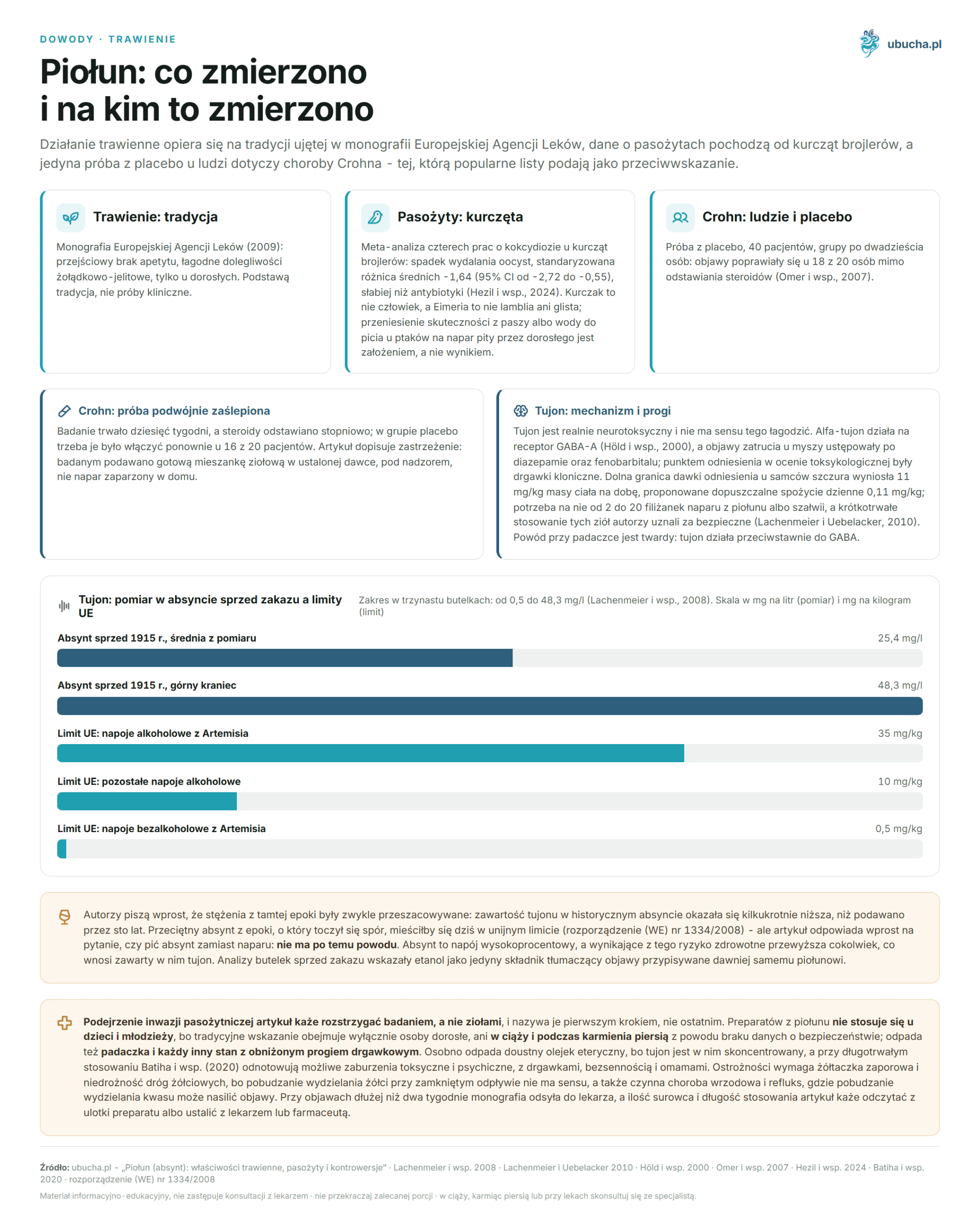
• Lachenmeier et al. (Journal of Agricultural and Food Chemistry, 2008) examined thirteen bottles of absinthe from before 1915: the total thujone content ranged from 0.5 to 48.3 mg/l, averaging 25.4 mg/l. The authors state directly that concentrations from that era were usually overestimated, and nothing explains the syndrome of absinthism other than ethanol.
• Lachenmeier and Uebelacker (Regulatory Toxicology and Pharmacology, 2010) calculated the lower limit of the reference dose (BMDL10) for clonic seizures in male rats at 11 mg/kg body weight per day and proposed an acceptable daily intake of 0.11 mg/kg. According to them, achieving this requires between 2 to 20 cups of wormwood or sage infusion.
• Regulation (EC) No 1334/2008 allows thujone up to 35 mg/kg in alcoholic beverages made from Artemisia species, up to 10 mg/kg in other alcoholic beverages, and up to 0.5 mg/kg in non-alcoholic beverages with Artemisia.
• Omer et al. (Phytomedicine, 2007) studied a mixture with wormwood in 40 patients with Crohn's disease in a double-blind placebo-controlled trial and achieved a steroid-sparing effect.
Wormwood preparations are not used in children, during pregnancy, and in cases of epilepsy.
What is wormwood and what accounts for its bitterness?
Wormwood, or common wormwood (Artemisia absinthium), is a perennial herb from the Asteraceae family that grows wild in Europe, western Asia, and North America. The herbal raw material is the herb, described in pharmacopoeias as Absinthii herba, and the essential oil. The bitterness comes from sesquiterpene lactones, not from thujone.
Review by Szopa et al. (Plants, 2020) lists groups of compounds responsible for the herb's effects: essential oil, bitter sesquiterpene lactones, flavonoids, azulenes, phenolic acids, tannins, and lignans. This distinction is practically significant because in popular descriptions, bitterness and toxicity are often conflated into one substance. Lactones are responsible for the taste, while thujone from the oil is the source of controversy, and these are different molecules with different fates in the body.
The same review reminds us that wormwood was described in medieval Europe as the most important remedy for exhaustion, and in both Asian and European traditions, it was used for gastrointestinal ailments, worm infestations, anemia, insomnia, bladder diseases, slow-healing wounds, and fever. Today, the plant is also returning as a cosmetic raw material and as an additive in the alcohol industry, where it contributes to the character of absinthe and vermouth-type wines.
How do the bitters of wormwood affect digestion?
The bitter taste triggers a reflexive response from the digestive system before the raw material can be absorbed. Bitter receptors in the mouth and throat stimulate an increase in saliva, gastric juice, and bile secretion. This is the basis for the entire European tradition of bitter aperitifs consumed before meals, not after.
Review by Batiha et al. (Antibiotics, 2020) compiles traditional indications for wormwood, showing that most of them pertain to the digestive tract: indigestion, dyspepsia, bloating, stomach pain, lack of appetite, gastritis, as well as jaundice and liver enlargement. The same review lists actions confirmed in laboratory studies and on animals, including anti-ulcer, hepatoprotective, and anti-parasitic effects.
The formal status in the EU is narrower than the list of traditional uses. The Committee on Herbal Medicinal Products of the European Medicines Agency included wormwood in its monograph as a traditional herbal medicinal product. for the first time in 2009. The indication covers transient loss of appetite and mild gastrointestinal discomfort, exclusively in adults, and in cases of symptoms persisting longer than two weeks, the monograph refers to a doctor. The basis is long-standing traditional use, not clinical trials. Other bitter and enzymatic raw materials have a similar profile of action, for example,What did the only large placebo trial in humans show? krwawnik pospolity.
The strongest clinical evidence for wormwood does not concern indigestion but inflammatory bowel disease.
conducted a double-blind study in five centers in Germany, where 40 patients with Crohn's disease received a mixture containing wormwood or a placebo for ten weeks. Omer i wsp. (Phytomedicine, 2007) All participants were on a stable dose of steroids at the start, which was gradually tapered off from the second week, so that by the tenth week, no one was taking them anymore. In the wormwood group, symptoms improved despite tapering off steroids in 18 out of 20 individuals, and after eight weeks, 13 people from this group had nearly complete remission of symptoms, which was not observed in anyone on placebo. In the placebo group, the condition worsened after stopping steroids, and 16 out of 20 patients had to be restarted on them.
This result has direct implications for the lists of contraindications circulating on Polish internet, where Crohn's disease stands alongside epilepsy and pregnancy. The placebo study shows something contrary. However, two caveats must be added: the groups consisted of twenty individuals each, and the subjects were given a ready herbal mixture at a set dose, under supervision, not an infusion brewed at home.
Thujone is indeed neurotoxic, and there is no point in downplaying that.
Is thujone in wormwood dangerous?
they demonstrated that alpha-thujone acts on the GABA-A receptor: the symptoms of poisoning in mice resembled those after picrotoxin and were alleviated by diazepam and phenobarbital. Höld i wsp. (Proceedings of the National Academy of Sciences, 2000) However, the same study shows the other half of the mechanism, which popular descriptions usually overlook. Alpha-thujone is very quickly metabolized by liver cytochromes to 7-hydroxy-alpha-thujone, and this metabolite reaches significantly higher concentrations in the mouse brain than thujone itself and is less toxic than it. The other studied metabolites also turned out to be detoxification products. Thus, thujone is a compound that acts quickly but is also quickly broken down.
they recalculated toxicological data using the reference dose method, adding results from a long-term study of the American toxicological program. The lower limit of the reference dose for clonic seizures in male rats was found to be 11 mg per kilogram of body weight per day, and the proposed acceptable daily intake is 0.11 mg/kg. The authors estimate that achieving this requires between 2 to 20 cups of wormwood or sage infusion, and consider short-term use of these herbs to be safe.
Lachenmeier i Uebelacker (Regulatory Toxicology and Pharmacology, 2010) How much thujone was actually in historical absinthe?
How much thujone was really in historical absinthe?
This question was resolved by measurement, not by dispute. Lachenmeier i wsp. (Journal of Agricultural and Food Chemistry, 2008) They analyzed thirteen bottles of authentic absinthe from before the ban, that is, from before 1915. The total content of thujone ranged from 0.5 to 48.3 mg/l, with an average of 25.4 mg/l.
The authors draw a direct conclusion: the concentration of thujone in absinthe before the ban was usually overestimated in the past. Moreover, the analysis of absinthes from 1915-1988 and contemporary ones produced according to historical recipes showed similar ranges, which disproves the assumption of a fundamental difference between the old and today's drink. Methanol and higher alcohols were also examined, as well as copper and antimony in a separate measurement. None of these parameters deviated from the norm, so there is nothing to replace thujone as the culprit.
What are the thujone limits in the European Union?
The limits are recorded in Annex III to Regulation (EC) No 1334/2008 on flavoring substances. For thujone, the combined alpha and beta limits are 35 mg/kg in alcoholic beverages made from Artemisia species, 10 mg/kg in other alcoholic beverages, and 0.5 mg/kg in non-alcoholic beverages made from Artemisia.
The distinction is therefore made by raw material, not by the strength of the drink, which is a common misunderstanding. Absinthe and vermouth are made from Artemisia species, so they fall under the higher limit of 35 mg/kg. Comparing this number with the measurement of bottles from before the ban leads to a conclusion that sounds paradoxical, but is not: the average absinthe from that era, which was the subject of dispute, would today fall within the EU limit.
It is worth separating two regimes. The regulations on flavoring substances govern food and beverages, while for herbal medicinal products, limits are set by the European Medicines Agency, which introduced them in 2009. The conclusions of toxicologists from 2010 were that the existing limits do not require tightening, as they sufficiently protect consumers, including those who consume many products containing thujone.
Does wormwood act on parasites?
The tradition of using wormwood for worms is old and not unfounded, but the evidence comes from laboratories and animals. Reviews by Batiha and Szopa mention documented anti-parasitic and anti-protozoal activity of the herb, based on in vitro studies and animal models.
The most specific data comes from veterinary medicine and is worth stating precisely, as it shows the scale of the phenomenon. Hezil i wsp. (Avian Pathology, 2024) They conducted a systematic review with a meta-analysis of the effect of Artemisia absinthium on coccidiosis in broiler chickens. From the four studies included in the meta-analysis, a significant reduction in oocyst excretion was found, with a standardized mean difference of -1.64 (95% CI from -2.72 to -0.55). The authors also note that the extract was less effective than antibiotics.
For humans, the conclusions are limited by two thresholds at once. First, chicken is not human, and Eimeria is not Giardia or roundworm. Second, transferring effectiveness from feed or drinking water in birds to a brew consumed by an adult is an assumption, not a result. Suspecting a parasitic invasion is resolved by testing, not herbs, and that testing is the first step, not the last. For digestive issues without confirmed invasion, other raw materials may be more sensible, for example, bromelaina.
Who should not use wormwood?
Three restrictions arise directly from the mechanism and from the monograph. Preparations containing wormwood are not used in children and adolescents, as the traditional indication covers only adults. They are also not used during pregnancy or breastfeeding due to a lack of safety data. Epilepsy and any other condition with a lowered seizure threshold are also excluded.
The reason for excluding epilepsy is firm and stems from the works cited above. Thujone acts oppositely to GABA, and the reference point in toxicological assessment was precisely clonic seizures. Separately, the essential oil of wormwood taken orally is excluded, as this is the form in which thujone is concentrated, not diluted in a brew. Batiha et al. note that prolonged use of essential oil may cause toxic and psychological disorders in humans, including seizures, insomnia, and hallucinations.
Caution is also required with obstructive jaundice and bile duct obstruction, as stimulating bile secretion with closed drainage makes no sense, as well as active peptic ulcer disease and reflux, where stimulating acid secretion may exacerbate symptoms. The amount of raw material and duration of use should be read from the leaflet of the specific preparation or determined with a doctor or pharmacist; this article describes studies, not recommendations for the reader.
Frequently Asked Questions
Is thujone in wormwood dangerous?
Thujone is neurotoxic but is quickly broken down into less toxic metabolites. Toxicologists calculated the lower reference dose for seizures in rats at 11 mg/kg body weight per day and proposed an acceptable intake of 0.11 mg/kg. Short-term use of wormwood infusion was considered safe.
How much thujone did absinthe contain before the ban?
Analysis of thirteen authentic bottles from before 1915 showed thujone content ranging from 0.5 to 48.3 mg per liter, averaging 25.4 mg/l. The authors concluded that historical concentrations were overestimated, and the symptoms attributed to absinthe can be explained by nothing in these samples other than ethanol.
What are the thujone limits in the European Union?
Regulation (EC) No. 1334/2008 allows 35 mg/kg of thujone in alcoholic beverages made from species of Artemisia, such as absinthe and vermouth, 10 mg/kg in other alcoholic beverages, and 0.5 mg/kg in non-alcoholic beverages with Artemisia. The criterion is the raw material, not the strength of the drink.
Does wormwood help with digestion?
The European Medicines Agency has included wormwood in the monograph of traditional herbal medicinal products for temporary loss of appetite and mild gastrointestinal discomfort, exclusively for adults. The basis is long-term use, not clinical trials, and for symptoms lasting more than two weeks, the monograph refers to a doctor.
Does wormwood kill parasites?
Antiparasitic activity is documented in laboratory studies and in animals. A meta-analysis from 2024 showed a significant reduction in oocyst excretion in broiler chickens with wormwood extract, but it was weaker than with antibiotics. The transfer of these results to humans has not been confirmed, and suspicion of an invasion is resolved by testing.
Is wormwood contraindicated in Crohn's disease?
This is not confirmed by the only placebo trial. In a 2007 study, 40 patients with Crohn's disease received a mixture with wormwood or a placebo while tapering off steroids; in the herbal group, symptoms improved, while in the placebo group, 16 out of 20 individuals had to resume steroids.
Can you drink absinthe instead of wormwood infusion?
There is no reason for that. Absinthe is a high-proof beverage, and the health risks associated with it outweigh anything that the thujone it contains might offer. Analyses of bottles sold before the ban indicated ethanol as the only component explaining the symptoms previously attributed to wormwood itself.
Dried herbs and plant extracts can be found in the herbs category.
This article is for informational and educational purposes and does not constitute medical advice. Before starting supplementation, consult your doctor, especially if you are taking medications regularly, are pregnant or breastfeeding, or have a chronic illness.
Author: Michał Waluk · Opublikowano: 2026-05-20 · Aktualizacja: 2026-08-15