
Delta-8 and Delta-10 THC: what are they and are they legal in Poland 2026
As of July 28, 2026, the Polish list of controlled substances names delta-8 and delta-10 THC. We check the regulation, the origin of these products, and FDA data.
Delta-8 THC is sold online as a "legal equivalent" of cannabis intoxication, and delta-10 has joined this offer as its milder version. In Poland, this narrative has no basis in regulations, and as of July 28, 2026, it has even lost any semblance of ambiguity: the regulation of the Minister of Health names both isomers in the list of controlled substances by name, not just by chemical formula. Below you will find the position in the list under which they stand, as well as the signature of the regulation that gave it its current wording. You will also find an explanation of where these isomers come from in commercial products, and numbers from American monitoring of adverse events, as this is the only dataset on the health effects of these products that can currently be verified at the source.
KEY INFORMATION
• Delta-8-THC and delta-10-THC are listed under item 96 of the list of psychotropic substances group I-P (Dz.U. 2026 poz. 934, effective from July 28, 2026).
• Possession of a psychotropic substance contrary to the provisions of the law is punishable by imprisonment for up to 3 years.
• Delta-8 in commercial products is produced from cannabidiol through a chemical reaction, not from plant extraction.
• American poison control centers reported 2362 cases of exposure to delta-8 products from January 2021 to February 2022.
• The list does not mention cannabidiol, cannabigerol, or cannabinol by name.
What are delta-8 and delta-10 THC?
They are isomers of tetrahydrocannabinol, meaning they have the same molecular formula as delta-9-THC, differing in the position of the double bond in the ring. Delta-8 has it at position 8, delta-10 at position 10. The Polish list of controlled substances describes them by both their abbreviated name and full chemical designation.
Delta-8 is not a neutral substance. The American Food and Drug Administration describes it as a psychoactive and intoxicating substance, with effects similar to delta-9-THC, and adds that commercial products expose consumers to significantly higher concentrations than those naturally occurring in raw cannabis extracts (FDA, 5 Things to Know about Delta-8 THC). Historical experience with cannabis does not allow for conclusions about the safety of these preparations.
Much less is known about delta-10. There are no clinical studies in humans that would allow for a comparison of its potency with delta-8 or delta-9, and the descriptions circulating in online stores are based on user reports, not measurements. Any potency percentages provided in such descriptions are estimates without sources, so treat them as marketing material. The legal status of both isomers is identical and does not depend on how potent they are. We wrote more broadly about acid forms and derivatives of THC in przewodniku po THCA.
Are delta-8 and delta-10 THC legal in Poland in 2026?
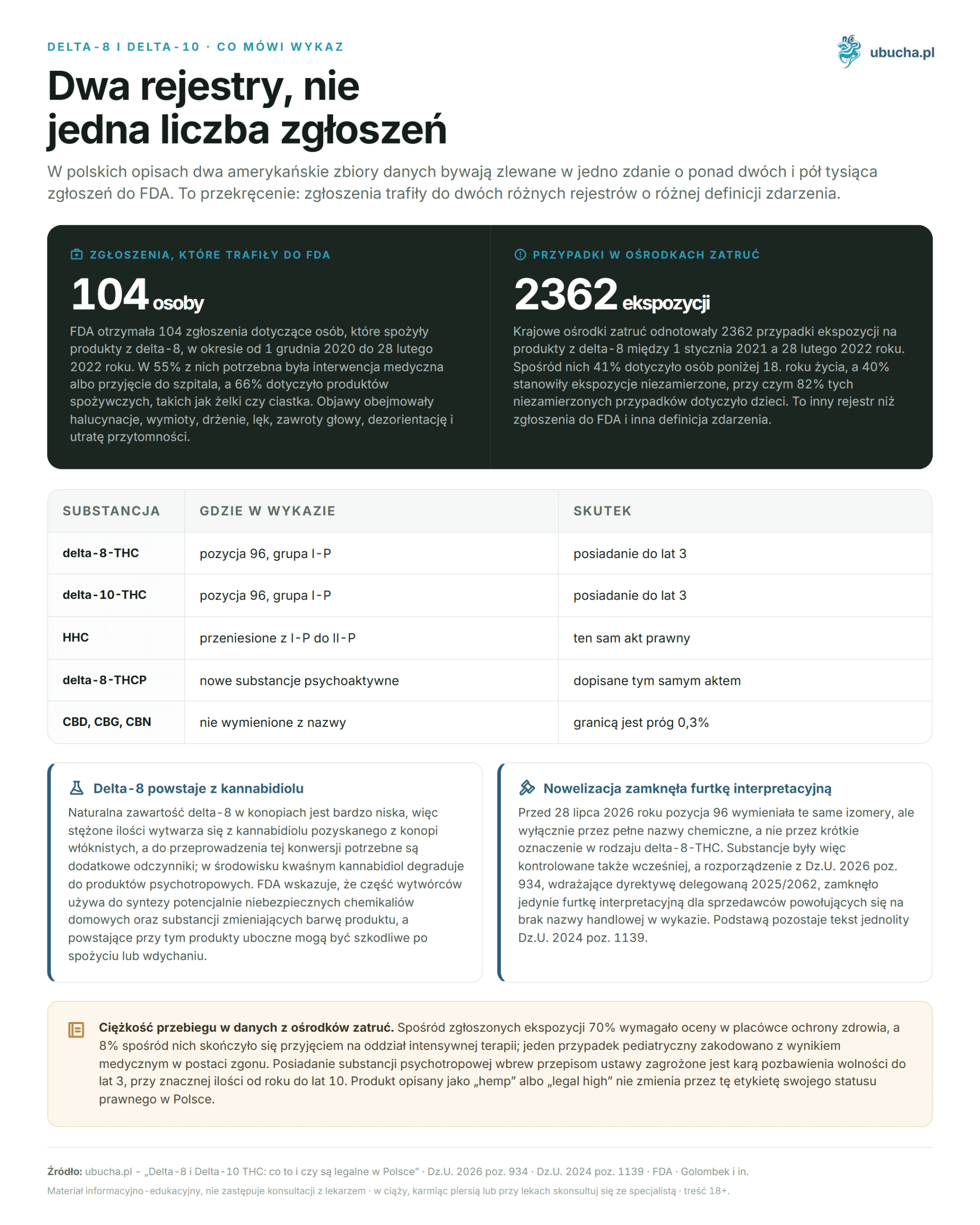
No. Both isomers are listed in the list of psychotropic substances group I-P, under item 96, titled "Tetrahydrocannabinols, the following isomers and their stereochemical variants." The item names delta-6a,10a-THC, delta-6a,7-THC, delta-7-THC, delta-8-THC, delta-10-THC, and delta-9,11-THC, each along with their chemical designation.
The basis is the regulation of the Minister of Health of August 17, 2018, regarding the list of psychotropic substances, narcotic drugs, and new psychoactive substances, consolidated text. Dz.U. 2024 poz. 1139The wording of item 96 was given by the regulation of July 7, 2026, Dz.U. 2026 poz. 934, effective from July 28, 2026, and implementing the delegated directive of the Commission (EU) 2025/2062.
It is important to understand what this change did and what it did not. Before July 28, 2026, item 96 listed the same isomers, but exclusively by their full chemical names, for example, "(6aR,10aR)-6a,7,10,10a-tetrahydro-6,6,9-trimethyl-3-pentyl-6H-dibenzo[b,d]pyran-1-ol" instead of the short "delta-8-THC." Thus, the substances were already controlled earlier, and the amendment merely closed an interpretative loophole for sellers citing the lack of a trade name in the list. In the same regulation, HHC was moved from group I-P to II-P and delta-8-THCP and delta-9-THCP-O were added to the list of new psychoactive substances.
The criminal consequence is Article 62 of the Act on Counteracting Drug Addiction, consolidated text. Dz.U. 2023 poz. 1939Possession of a psychotropic substance contrary to the provisions of the law is punishable by imprisonment for up to 3 years, with a significant quantity resulting in a penalty from one year to 10 years, and in the case of lesser weight, a fine, restriction of liberty, or imprisonment for up to one year.
Where do delta-8 and delta-10 in commercial products come from?
From a chemical reaction, not from the plant. The natural content of delta-8 in cannabis is very low, so concentrated amounts are produced from cannabidiol obtained from industrial hemp, and additional reagents are needed to carry out this conversion. This process is described by the FDA, and the same is confirmed by the chemistry described in the literature.
A review published in the journal Toxics summarizes knowledge about the degradation of cannabidiol and states directly that in an acidic environment, CBD degrades into psychotropic products (Golombek et al., PMC7357058). This reaction is behind the delta-8 market: cheap raw material, acid, solvent, and a product with intoxicating effects.
The problem is not just the molecule itself. The FDA indicates that some manufacturers use potentially dangerous household chemicals for synthesis, as well as substances that change the color of the final product; the resulting by-products can be harmful when ingested or inhaled. Additionally, there is the production in uncontrolled or unhygienic conditions. The agency also points out the labels: products are sometimes simply described as "hemp products," which misleads consumers associating cannabis with a lack of psychoactive effects.
What is known about the health risks of delta-8 THC?
The hardest available data comes from American monitoring of adverse events. The FDA received 104 reports concerning individuals who consumed delta-8 products from December 1, 2020, to February 28, 2022. In 55% of these cases, medical intervention or hospitalization was required, and 66% involved food products such as gummies or cookies.
Symptoms described in these reports include hallucinations, vomiting, tremors, anxiety, dizziness, disorientation, and loss of consciousness. Concurrently, national poison centers recorded 2362 cases of exposure to delta-8 products between January 1, 2021, and February 28, 2022. Of these, 41% involved individuals under 18 years of age, and 40% were unintentional exposures, with 82% of these unintentional cases involving children.
Further numbers from the same dataset show the severity of the cases: 70% required evaluation at a healthcare facility, and 8% of them ended with admission to the intensive care unit. One pediatric case was coded with a medical outcome of death. We noticed that in Polish descriptions, these two sets are sometimes conflated into one number "over 2500 reports to the FDA," which is a misrepresentation: 104 reports went to the FDA, and 2362 cases to poison centers, and these are different registries with different definitions of events.
Which cannabinoids are legal in Poland and how do they differ?
The list of controlled substances does not specifically mention cannabidiol, cannabigerol, or cannabinol. Legal trade concerns products from industrial hemp, meaning those in which the sum of delta-9-THC and tetrahydrocannabinolic acid in the tops does not exceed 0.3% dry mass (Article 4 point 5 of the Act on Counteracting Drug Addiction). This definition, rather than the name of the compound itself, sets the boundary for a legal product.
The difference is evident in the action on the CB1 receptor. Delta-8 induces intoxication, which the FDA describes as a psychoactive effect, similar to delta-9; little is known about the mechanism of delta-10 to describe it with similar certainty. Cannabidiol behaves differently: in a study published in the British Journal of Pharmacology, it acted as a non-competitive negative allosteric modulator of the CB1 receptor, meaning it reduced the efficacy and potency of agonists instead of activating it itself (Laprairie et al., PMC4621983). The study concerned cell lines, not humans, so it describes the mechanism, not the clinical effect.
The practical conclusion for the buyer is simple. A product described as „hemp” or „legal high” and containing delta-8 or delta-10 does not change its legal status in Poland due to this label, and importing it from abroad adds regulations regarding importation to the matter. We have shown how much this status varies between countries in the map of marijuana legality worldwide, and we described the history of the 0.3% threshold in our post about it, where the 0.3% THC limit came from.
Frequently Asked Questions
Is delta-8 THC legal in Poland?
No. Delta-8-THC is listed under item 96 of the list of psychotropic substances group I-P, as amended by the regulation of the Minister of Health of July 7, 2026 (Journal of Laws 2026, item 934), effective from July 28, 2026. Possession of a psychotropic substance contrary to the provisions of the law is punishable by imprisonment for up to 3 years.
Does delta-10 THC have a different legal status than delta-8?
No. Delta-10-THC is in the same position 96 of the same list, next to delta-8-THC, delta-7-THC, delta-6a,7-THC, delta-6a,10a-THC, and delta-9,11-THC. The legal status does not depend on the potency of the isomer or how it is described on the product label.
How does delta-8 differ chemically from delta-9 THC?
Both compounds have the same molecular formula and differ in the position of the double bond in the ring: delta-8 has it at position 8, delta-9 at position 9. The FDA describes delta-8 as a psychoactive and intoxicating substance, with effects similar to delta-9, and not as a neutral compound.
Where does delta-8 THC in products sold online come from?
From the chemical conversion of cannabidiol, not from plant extraction. The natural content of delta-8 in hemp is very low, so concentrated amounts are produced from CBD using additional reagents. A review in the journal Toxics confirms that in an acidic environment, cannabidiol degrades into psychotropic products.
How many reports of side effects from delta-8 have been recorded in the USA?
The FDA received 104 reports of adverse events from December 1, 2020, to February 28, 2022, of which 55% required medical intervention or hospitalization. Poison control centers recorded 2362 cases of exposure during a similar period, with 41% of them involving individuals under 18 years of age.
Are CBD and CBG controlled substances in Poland?
The list of psychotropic substances, narcotics, and new psychoactive substances does not name cannabidiol, cannabigerol, or cannabinol. Legal trade concerns products made from industrial hemp, meaning those in which the sum of delta-9-THC and THCA does not exceed 0.3% dry weight.
You can find products made from industrial hemp that fall within this threshold in the category hemp oils.
The article is for informational and educational purposes and does not constitute legal advice. The legal status described in the article is valid as of the publication date: regulations regarding hemp may change. Before making a decision, consult a lawyer or current legal acts.
Author: Michał Waluk · Opublikowano: 2026-07-08 · Aktualizacja: 2026-08-11